Solution:
Key idea: The first law of thermodynamics is written ΔU=q+w in this chapter: q is the heat absorbed by the system and w is the work done ON the system, so work done BY an expanding gas is negative. For a reversible isothermal change of an ideal gas w=−2.303nRTlogP2P1, and against a constant external pressure w=−PextΔV. In an adiabatic change no heat is exchanged.
Step 1 — Find the reversible isothermal work, part (i).
The temperature is 300 K (27 + 273). For an isothermal ideal gas V1V2=P2P1, so we can use the pressure ratio 10 : 1 directly, with R = 8.314 J K⁻¹ mol⁻¹.
wrev=−2.303nRTlogP2P1
wrev=−2.303×3×8.314×300×log10
wrev≈−17232 J
wrev≈−17.23 kJ
Step 2 — Find the starting and final volumes.
For the expansion against a constant pressure we need the change in volume. We use the ideal gas equation PV = nRT, with R = 0.0821 L atm K⁻¹ mol⁻¹, since the pressures are in atm.
V1=P1nRT
V1=103×0.0821×300
V1≈7.389 L
In the same way, at the final pressure of 1 atm:
V2=13×0.0821×300
V2≈73.89 L
Step 3 — Find the work against a constant 1 atm.
The gas pushes back a constant external pressure of 1 atm while its volume grows from V₁ to V₂.
w=−Pext(V2−V1)
w=−1×(73.89−7.389)
w≈−66.50 L atm
The question gives 1 atm = 1.013 × 10⁵ N m⁻², and 1 L is 10⁻³ m³, so 1 L atm is 101.3 J.
w≈−66.50×101.3 J
w≈−6737 J
w≈−6.74 kJ
Working fully in SI units with R = 8.314 J K⁻¹ mol⁻¹ gives about −6734 J (−6.73 kJ); the small difference comes only from the rounded value of R in L atm.
Step 4 — Compare the two works on a P–V diagram.
The work done by a gas is the area under the line of the opposing pressure on a P–V diagram. In the reversible expansion the opposing pressure always nearly equals the gas pressure, so the area is the whole region under the isotherm; against a constant 1 atm it is only the thin strip under P = 1 atm.
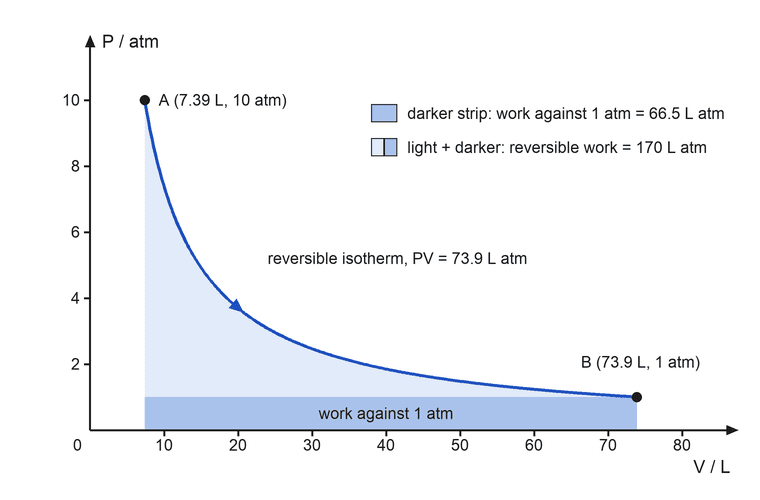
This is why the reversible expansion gives the maximum work (about 17.23 kJ done by the gas), while the expansion against 1 atm gives only about 6.74 kJ.
Step 5 — Decide what happens to the internal energy, part (ii).
In an adiabatic change no heat enters or leaves the gas, so q is zero and the first law becomes:
ΔU=w
When the gas expands against a pressure it does work, so w is negative and ΔU is negative. For an ideal gas with a constant heat capacity ΔU=nCVΔT, so the temperature falls as well.
Step 6 — Decide what happens to the entropy.
In a reversible adiabatic expansion no heat is exchanged at any stage, so qrev is zero and the entropy does not change (such a change is called isentropic). In an irreversible adiabatic expansion, for example a sudden expansion against a low constant pressure, entropy is created inside the gas, so ΔS is positive. In no adiabatic change does the entropy of the gas decrease.
Watch out: If the gas expands into a vacuum (free expansion), it does no work, so its internal energy and temperature stay the same, although its entropy still increases.
Therefore, (i) the reversible isothermal work is about −17.23 kJ (17232 J done by the gas) and the work against a constant 1 atm is about −6.74 kJ; (ii) in an adiabatic expansion the internal energy decreases, while the entropy stays the same if the expansion is reversible and increases if it is irreversible.
