
Opening your dashboard
Class 11 Chemistry Chapter 6 Chemical Thermodynamics: Competency-Based Questions (CBQ)
40 questions on Chapter 6, each worked through on its own page with the AI tutor. Class 11 Chemistry, ICSE 2026-27.
40 questions
1–5 marks · Mixed difficulty
- 11 mark
Question 1
Competency: Analysis & Evaluation
A civil engineer in Mumbai explains why the iron water pipes of an old building need regular painting. The standard Gibbs energy change for the rusting of iron is large and negative, yet some unpainted pipes rust badly within a few years while others last for decades.
Assertion (A): Thermodynamics can tell us that iron pipes in moist air can rust on their own, but it cannot tell us how fast the rusting will happen.
Reason (R): The rusting of iron in moist air is an exothermic process.
- 21 mark
Question 2
Competency: Application
A teacher fixes a vertical glass syringe of air in a water bath kept at 25 °C. A pile of fine sand rests on its frictionless piston, and the weight of the sand keeps the air compressed. Which way of letting the air expand to the same final volume comes closest to a reversible process?
- 31 mark
Question 3
Competency: Analysis & Evaluation
An electric kettle has its heating coil immersed in the water it heats. While the kettle is switched on, energy from the mains supply raises the temperature of the water. A student describes this energy transfer for two different choices of system: system X is the water together with the coil, and system Y is the water alone. Which description is correct?
- 43 marks
Question 4
Competency: Application
A baker leaves a ball of bread dough to rise in a warm kitchen at 30 °C. (Hypothetical data.) Yeast in the dough ferments some of its glucose:
The carbon dioxide forms bubbles that push the dough outwards against the atmosphere. The volume of the dough grows by 0.50 L, all of it due to the new carbon dioxide, while the pressure stays at 1.00 bar. Treat the carbon dioxide as an ideal gas that all stays in the dough, and take R = 0.08314 L bar K⁻¹ mol⁻¹ and 1 L bar = 100 J (C = 12, H = 1, O = 16).
(a) Calculate the work done on the carbon dioxide, , with its sign.
(b) Calculate the amount of carbon dioxide formed and the mass of glucose that must be fermented to form it.
(c) If the same mass of glucose fermented in a sealed, rigid steel jar instead, what would be? Use this to explain why work is not a state function.
- 53 marks
Question 5
Competency: Application
A courier packs a box of laboratory samples with 1.00 kg of dry ice (solid carbon dioxide) to keep them cold. (Hypothetical data.) The box has a small vent, so the dry ice sublimes at 195 K under a steady pressure of 1.00 bar:
The enthalpy of sublimation of carbon dioxide at 195 K is 25.2 kJ mol⁻¹. Treat the gas as ideal, neglect the volume of the solid, and take R = 8.314 J K⁻¹ mol⁻¹ (C = 12, O = 16). For the sublimation of all the dry ice:
(a) calculate the work done on the carbon dioxide, ;
(b) calculate the heat absorbed by the carbon dioxide from the samples and the box;
(c) calculate for the carbon dioxide and explain why it is smaller than .
- 61 mark
Question 6
Competency: Analysis & Evaluation
In a diesel engine, air is compressed by the piston so quickly that there is almost no time for heat to pass through the cylinder walls. Diesel fuel sprayed into this compressed air then catches fire without any spark.
Assertion (A): When air is compressed quickly in the cylinder of a diesel engine, its temperature stays the same, because no heat has time to enter or leave it.
Reason (R): For an adiabatic process , so the first law gives .
- 71 mark
Question 7
Competency: Application
Two groups of students take identical samples of argon gas in cylinders fitted with pistons. (Hypothetical data.) Both samples start from the same initial state and end in the same final state, but by different routes. In group 1 the gas absorbs 500 J of heat while doing 200 J of work on its surroundings. In group 2 the gas does 350 J of work on its surroundings. Taking and as positive when energy enters the gas, how much heat does the gas of group 2 absorb?
- 84 marks
Question 8
Competency: Application
A student heats 2.00 mol of a pure solid X in a vessel fitted with an electric heater, at a constant pressure of 1 atm, with negligible heat loss. (Hypothetical data.) The graph shows the temperature of X against the total heat supplied. The heater was switched off as soon as the last of the liquid had boiled away.

(a) Find the molar enthalpy of fusion of X.
(b) Find the molar heat capacity of liquid X, and explain why the temperature stays constant along the two flat parts of the graph.
(c) Find the molar enthalpy of vaporisation and the molar entropy of vaporisation of X. Trouton's rule states that, for most liquids whose molecules are not hydrogen bonded, the molar entropy of vaporisation at the normal boiling point is about 85–88 J K⁻¹ mol⁻¹. Does X follow this rule?
- 91 mark
Question 9
Competency: Application
Contact-lens cleaning kits use a 3% solution of hydrogen peroxide. A small platinum-coated disc in the lens case makes the peroxide decompose into water and oxygen, so that the lenses can be worn safely the next morning:
Treating oxygen as an ideal gas, neglecting the volumes of the liquids and taking R = 8.314 J K⁻¹ mol⁻¹, what is at 25 °C for the decomposition of 1 mol of hydrogen peroxide?
- 104 marks
Question 10
Competency: Application
An ocean thermal energy conversion (OTEC) plant is a heat engine that uses warm surface sea water as its heat source and cold water pumped up from a depth of about 1000 m as its heat sink. Near the Lakshadweep islands the surface water is at about 28 °C and the deep water at about 8 °C. A small plant there is designed to deliver 65 kW of useful power. (Hypothetical data.) Take T/K = t/°C + 273.
(a) Calculate the maximum (Carnot) efficiency of a heat engine working between these two temperatures.
(b) The plant actually turns only 2.5% of the heat it takes in into useful work. How much heat must it take from the warm water each second? What mass of warm water must flow through it each second if this water cools by 2.0 K? (Specific heat capacity of sea water = 4.0 J g⁻¹ K⁻¹.)
(c) During the south-west monsoon the surface water cools to about 27 °C, while the deep water stays at 8 °C. How does this change the maximum efficiency?
- 111 mark
Question 11
Competency: Analysis & Evaluation
A cylinder in a kitchen contains LPG, a mixture of propane (molar mass 44 g mol⁻¹) and butane (molar mass 58 g mol⁻¹); the average molar mass of air is about 29 g mol⁻¹. If the cylinder valve is left open, the gas that escapes mixes with the air of the room, which is why a leak is so dangerous.
Assertion (A): Gas that escapes from an open LPG cylinder valve mixes with the kitchen air, and the escaped gas does not gather back into the cylinder by itself.
Reason (R): LPG is denser than air, so a leak first collects near the floor.
- 123 marks
Question 12
Competency: Application
Petrol sold as E20 contains 20% ethanol by volume. To compare fuels, treat petrol as pure octane and use the data below. The enthalpies of combustion are standard values at 298 K, with liquid water as a product (C = 12, H = 1, O = 16).
Ethanol, (l): kJ mol⁻¹, density 0.789 g mL⁻¹.
Octane, (l): kJ mol⁻¹, density 0.703 g mL⁻¹.
(a) Calculate the heat released when 1.00 L of ethanol burns completely.
(b) Calculate the heat released when 1.00 L of octane burns completely.
(c) Assuming the volumes simply add, estimate the heat released by 1.00 L of E20 and the percentage by which it is lower than for pure petrol. Suggest why ethanol releases less energy per gram than octane.
- 131 mark
Question 13
Competency: Application
During a one-hour practice match on a hot afternoon, a 60 kg cricketer loses 0.50 kg of sweat, and all of it evaporates from the skin. (Hypothetical data.) The enthalpy of vaporisation of water at body temperature (37 °C) is 2.41 kJ g⁻¹, and the average specific heat capacity of the human body is 3.5 J g⁻¹ K⁻¹. If the heat carried away by this evaporation had instead stayed in the body, by about how much would the cricketer's body temperature have risen?
- 144 marks
Question 14
Competency: Application
In the upper part of a blast furnace, iron(III) oxide in the ore is reduced by carbon monoxide:
The enthalpy change of this step is not easy to measure directly, but it can be found from the enthalpy cycle below. All values are standard enthalpy changes at 298 K.
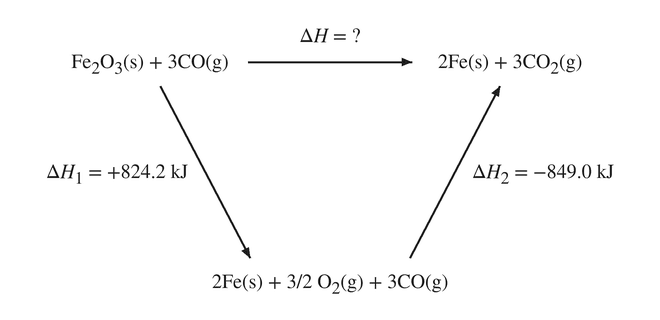
(a) What changes do and stand for? Use them to write the standard enthalpy of formation of iron(III) oxide and the standard enthalpy of combustion of carbon monoxide.
(b) Use Hess's law to find for the reduction, and the heat released by this step when 1.00 tonne of iron is produced (Fe = 56).
(c) Lower in the furnace, some of the oxide is reduced directly by coke:
Given (CO, g) = −110.5 kJ mol⁻¹, find for this reaction and say what it shows about this step.
- 151 mark
Question 15
Competency: Analysis & Evaluation
White phosphorus burns in a limited supply of air to form tetraphosphorus hexoxide, which burns further in excess air to form tetraphosphorus decoxide. In excess air, white phosphorus can also burn directly to the decoxide:
Assertion (A): More heat is released in total when white phosphorus burns in two stages, first to and then to , than when the same amount burns directly to .
Reason (R): The enthalpy change of a reaction is the same whether it takes place in one step or in several steps.
- 163 marks
Question 16
Competency: Application
Dimethyl ether, , has been tested in India as a clean fuel that can be blended with LPG. It is an isomer of ethanol, : both have the molecular formula . Average bond enthalpies (kJ mol⁻¹): C–C 348, C–H 414, C–O 360, O–H 463.
(a) Compare the bonds in the two molecules, and name the bonds that must be broken and formed when gaseous ethanol is converted into gaseous dimethyl ether.
(b) Estimate for the change below from the bond enthalpies.
(c) The standard enthalpies of formation are −234.8 kJ mol⁻¹ for ethanol(g) and −184.1 kJ mol⁻¹ for dimethyl ether(g). Calculate for the change from these values. Which isomer has the lower enthalpy, and does the bond-enthalpy estimate agree with this order?
- 171 mark
Question 17
Competency: Analysis & Evaluation
CFC-12, , was once widely used in refrigerators and is now banned. Molecules released in the past drift slowly up to the stratosphere, where ultraviolet light from the Sun splits them, and the chlorine atoms set free destroy ozone.
Assertion (A): In the stratosphere, ultraviolet light splits molecules by breaking a C–Cl bond rather than a C–F bond.
Reason (R): The C–Cl bond enthalpy (about 330 kJ mol⁻¹) is much lower than the C–F bond enthalpy (about 485 kJ mol⁻¹).
- 183 marks
Question 18
Competency: Application
Green leaves make glucose from carbon dioxide and water using the energy of sunlight:
For this reaction = +2803 kJ mol⁻¹ at 298 K. Standard molar entropies at 298 K (J K⁻¹ mol⁻¹): (g) 213.7, (l) 69.9, (s) 212.1, (g) 205.1.
(a) Calculate for the reaction and explain its sign.
(b) Calculate at 298 K and say whether the reaction can take place on its own.
(c) The least amount of useful (non-expansion) energy that must be supplied to drive a non-spontaneous reaction equals its . What is the least energy that sunlight must supply to make 1 mol of glucose under standard conditions, and why is it more than ?
- 191 mark
Question 19
Competency: Analysis & Evaluation
When a doctor sets a broken arm, a bandage soaked in plaster of Paris, , is wrapped round it. The plaster takes up water and sets into a hard cast of gypsum, , warming slightly as it does so. In the equation below, plaster of Paris is written as , so the equation is for 2 mol of :
Assertion (A): Plaster of Paris sets spontaneously into gypsum even though the entropy of the reacting substances decreases.
Reason (R): In every spontaneous process, the entropy of the system must increase.
- 204 marks
Question 20
Competency: Application
Baking soda (sodium hydrogencarbonate) makes cakes rise because, on heating, it gives off carbon dioxide and steam:
Standard data at 298 K:
(s): kJ mol⁻¹, J K⁻¹ mol⁻¹
(s): kJ mol⁻¹, J K⁻¹ mol⁻¹
(g): kJ mol⁻¹, J K⁻¹ mol⁻¹
(g): kJ mol⁻¹, J K⁻¹ mol⁻¹
Assume that and do not change with temperature, and take T/K = t/°C + 273.
(a) Calculate and for the reaction.
(b) Above what temperature does the decomposition become spontaneous under standard conditions?
(c) A cake is baked in an oven at 180 °C. Calculate for the reaction at this temperature and say what it shows.
- 211 mark
Question 21
Competency: Analysis & Evaluation
In the Haber process, ammonia is made from nitrogen and hydrogen:
For this reaction = −92.2 kJ and = −198.8 J K⁻¹; assume both stay constant with temperature. Industrial plants run the reaction at about 700 K over an iron catalyst.
Assertion (A): The Haber process is run at about 700 K, although for the formation of ammonia is positive above about 464 K.
Reason (R): Raising the temperature increases the equilibrium yield of ammonia.
- 221 mark
Question 22
Competency: Application
In a laboratory study of one step of copper extraction, copper(I) sulphide is heated in oxygen at 1200 K:
For this reaction = −217.3 kJ and = −11.4 J K⁻¹; assume both stay constant with temperature. What is for the reaction at 1200 K?
- 233 marks
Question 23
Competency: Application
Wet clothes hung indoors in Mumbai during the monsoon take much longer to dry than on a dry day. At 298 K the standard Gibbs energies of formation are −237.1 kJ mol⁻¹ for (l) and −228.6 kJ mol⁻¹ for (g). For the equilibrium
the equilibrium constant equals the partial pressure of water vapour, in bar, at equilibrium. Use R = 8.314 J K⁻¹ mol⁻¹, and 1 bar = 100 kPa.
(a) Calculate for the vaporisation of water at 298 K.
(b) Calculate , and hence the vapour pressure of water at 298 K in kPa.
(c) On a monsoon day the air indoors at 298 K holds water vapour at a partial pressure of 2.9 kPa; on a dry day at the same temperature it holds 0.80 kPa. For each day, compare the reaction quotient (the partial pressure of water vapour in bar) with to decide whether water can evaporate from the clothes, and explain why the clothes dry much more slowly on the monsoon day.
- 241 mark
Question 24
Competency: Analysis & Evaluation
Even the purest water prepared in a laboratory conducts electricity very slightly, because a few of its molecules ionise:
At 298 K, for this ionisation is +79.9 kJ mol⁻¹. Take R = 8.314 J K⁻¹ mol⁻¹ and .
Assertion (A): Pure water at 298 K contains hydrogen ions and hydroxide ions, about mol L⁻¹ of each, although for its ionisation is positive.
Reason (R): A positive means that the equilibrium constant is less than 1, not that it is zero.
- 251 mark
Question 25
Competency: Application
In glycolysis, the enzyme triose phosphate isomerase interconverts two three-carbon sugar phosphates, dihydroxyacetone phosphate (DHAP) and glyceraldehyde 3-phosphate (GAP). In a test tube at 298 K, the equilibrium mixture has [GAP]/[DHAP] = 0.0475. Using with R = 8.314 J K⁻¹ mol⁻¹, for the change DHAP → GAP is
- 264 marks
Question 26
One mole of an ideal gas at 300 K and 6.0 bar expands isothermally until its pressure is 1.0 bar. (Hypothetical data.) Take L bar K⁻¹ mol⁻¹ J K⁻¹ mol⁻¹ and 1 L bar = 100 J. Calculate the work done on the gas, , when the expansion is carried out:
(a) in two steps, first against a constant 3.0 bar and then against a constant 1.0 bar;
(b) in three steps, against constant pressures of 4.0 bar, 2.0 bar and then 1.0 bar;
(c) reversibly.
In (a) and (b), each step continues until the gas pressure has fallen to the external pressure of that step.
(d) What do the three answers show about work?
- 271 mark
Question 27
Competency: Application
A trekker in Sikkim carries a hand warmer: a sealed pouch of iron powder mixed with a little salt, water and charcoal. When the pouch is opened, air enters and the iron slowly oxidises, giving out heat:
The pouch holds 14.0 g of iron, all of which reacts, and it warms the hands at an average rate of 8.0 W (8.0 J s⁻¹). Take the standard enthalpy of formation of (s) as −824 kJ mol⁻¹, treat the product as (s), and take Fe = 56. (Hypothetical data.) For about how long does the hand warmer give out heat?
- 281 mark
Question 28
Competency: Analysis & Evaluation
A student designing the cooling loop of a small generator must choose between water and ethylene glycol, , as the liquid that carries heat away from the engine. Molar heat capacities at constant pressure (J K⁻¹ mol⁻¹): water 75.3, ethylene glycol 149.5. Molar masses (g mol⁻¹): water 18.0, ethylene glycol 62.0. The student claims: "Ethylene glycol has about twice the molar heat capacity of water, so 5.0 kg of it will take up about twice as much heat as 5.0 kg of water for the same 10 K rise in temperature." Which judgement of the claim is correct?
- 291 mark
Question 29
Competency: Analysis & Evaluation
During an energy-saving drive in a hostel, a student suggests cooling a small, closed, well-insulated store room on a hot day by switching on a refrigerator kept in it and leaving the refrigerator door open.
Assertion (A): With its door left open, a working refrigerator in a closed, well-insulated room will slowly cool the room.
Reason (R): In each cycle a refrigerator gives out more heat at its back than it takes in from its inside, and the difference equals the electrical work it uses.
- 301 mark
Question 30
Competency: Understanding
In a pilot plant for sulphuric acid, the reaction below has reached equilibrium in a closed vessel at 700 K. A catalyst speeds up a reaction by giving it a path of lower activation energy. An engineer now adds more vanadium(V) oxide catalyst, keeping the temperature and the volume of the vessel the same.
Assertion (A): Adding more catalyst does not change the amount of sulphur trioxide in the equilibrium mixture.
Reason (R): A catalyst makes of the reaction more negative, and at a given temperature the equilibrium constant depends only on .
- 311 mark
Question 31
Competency: Analysis
Four groups of students each start with the same sample of nitrogen in a cylinder fitted with a piston, and each group carries out one process. Their notebooks record the following. (Hypothetical data.)
Process What happened to the gas P It absorbed 400 J of heat from a burner and pushed the piston out, doing 150 J of work. Q The piston was pushed in, doing 300 J of work on it, while 100 J of heat leaked out to a water bath. R It absorbed 200 J of heat while the piston was pushed in, doing 120 J of work on it. S In an insulated cylinder it pushed the piston out, doing 500 J of work. Which process raised the internal energy of the gas the most?
- 321 mark
Question 32
Competency: Analysis
On a winter night in Ladakh, water left in a steel pot outdoors freezes while the air around it stays at −5 °C (268 K). For the freezing of water at 268 K, kJ mol⁻¹ and J K⁻¹ mol⁻¹. The heat given out passes to the surrounding air, which is so large that its temperature does not change. What is the total entropy change of the water and its surroundings when 1 mol of water freezes, and what does it show?
- 332 marks
Question 33
Competency: Application
Magnesium burns in air with a dazzling white flame, so the heat given out is hard to measure by burning it in a calorimeter. In a school laboratory, students instead measure two reactions in an insulated cup. (Hypothetical data.)
kJ mol⁻¹
kJ mol⁻¹
They also use the standard enthalpy of formation of liquid water, −285.8 kJ mol⁻¹.
(a) Show how these three changes combine to give the formation of magnesium oxide, , and calculate its enthalpy of formation.
(b) Give two reasons why burning magnesium in air would give a poor value for this enthalpy change.
- 342 marks
Question 34
Competency: Application
High in the stratosphere, ultraviolet light from the Sun splits some oxygen molecules into atoms; the atoms then join other molecules to form ozone. The bond enthalpy of O=O is 498 kJ mol⁻¹ and that of N≡N is 946 kJ mol⁻¹. The energy of one photon of wavelength is , with J s, m s⁻¹ and mol⁻¹. Assume that one photon with enough energy can break one bond.
(a) Calculate the longest wavelength of light that can split an oxygen molecule into atoms.
(b) Calculate the same for a nitrogen molecule, and use the two answers to suggest why sunlight splits many molecules in the stratosphere but hardly any molecules.
- 352 marks
Question 35
Competency: Evaluation
A 30 g packet of roasted peanuts states that it supplies 710 kJ of energy. To check this, a student burns a 1.00 g peanut on a pin under a steel can holding 100 g of water. The peanut burns away completely, a black layer of soot collects on the bottom of the can, and the water temperature rises by 14.0 °C. (Hypothetical data.) Take the specific heat capacity of water as 4.18 J g⁻¹ K⁻¹ and ignore the heat taken up by the can.
(a) Calculate the energy per gram found by the student, and express it as a percentage of the value per gram stated on the packet.
(b) Suggest two reasons why the student's value is so low, and one change of apparatus that would give a value much closer to the packet's.
- 363 marks
Question 36
Competency: Analysis
At a diving centre in the Andaman Islands, steel scuba cylinders are filled with air by a compressor. (Hypothetical data.) If a cylinder is filled quickly, the air inside reaches 200 bar and 330 K, and the cylinder feels hot. The valve is then closed and the cylinder slowly cools to the room temperature of 300 K. If instead a cylinder is filled slowly while it stands in a tank of water at 300 K, the air stays close to 300 K throughout. Treat the air as an ideal gas (only roughly true at such high pressures) and the cylinder as rigid.
(a) For the air that ends up in the cylinder, name the type of process that each method of filling comes close to, and give a reason for each.
(b) Name the type of process while the closed, quickly filled cylinder cools, and calculate the pressure of the air when it has cooled to 300 K.
(c) For the air during this cooling, state the signs of , and . Explain why the diving centre prefers the slow method of filling.
- 373 marks
Question 37
Competency: Analysis
Titanium metal is made from the ore rutile, , by first turning the oxide into titanium(IV) chloride. Chlorine alone does not do this, but chlorine together with coke does. Standard Gibbs energies of formation at 298 K (kJ mol⁻¹): (s) −889.4, (g) −726.7, (g) −394.4. Take as a gas, as it is at the plant temperature. For the two possible reactions of carbon with 1 mol of oxygen, assume that and stay constant with temperature:
Reaction (kJ) (J K⁻¹) −393.5 +2.9 −221.0 +178.9 (a) Calculate at 298 K for , and say what it shows.
(b) Calculate at 298 K for , and explain how the carbon makes the chlorination possible.
(c) The plant runs at about 1200 K, and the carbon leaves mainly as carbon monoxide. Calculate at 1200 K for each reaction in the table, and use to explain why carbon monoxide is favoured at high temperature.
- 383 marks
Question 38
Competency: Analysis
A water-testing laboratory detects chloride and iodide ions by adding silver nitrate solution, which forms a precipitate of the silver halide. For the dissolving of a silver halide, for example
the equilibrium constant is , with concentrations in mol L⁻¹, and in pure water the solubility of the salt is mol L⁻¹. At 298 K, for AgCl is . Standard Gibbs energies of formation at 298 K (kJ mol⁻¹): (aq) +77.1, (aq) −131.2, (aq) −51.6, AgI(s) −66.2. Use with J K⁻¹ mol⁻¹.
(a) Calculate for the dissolving of silver chloride at 298 K.
(b) Work backwards from your answer to find the standard Gibbs energy of formation of AgCl(s).
(c) Calculate for the dissolving of silver iodide. Compare the solubilities of the two salts, and explain which of the two ions the laboratory can detect at a far lower concentration with the same silver nitrate solution.
- 394 marks
Question 39
Competency: Creativity
Case study: A school in Rajasthan wants to store heat from rooftop solar collectors during the day and use it to warm a hostel room at night. Two materials are compared for the store. Water is cheap and stores heat only as its temperature rises. Glauber's salt, , melts at 32 °C, so it also stores heat as its enthalpy of fusion; on cooling it freezes again and gives that heat back at a nearly constant temperature. Each day the store is warmed from 25 °C to 45 °C at constant pressure. (Hypothetical data.)
Material Specific heat capacity (J g⁻¹ K⁻¹) Melting point (°C) Enthalpy of fusion (J g⁻¹) Water 4.18 — — Glauber's salt, solid 1.9 32 250 Glauber's salt, liquid 2.8 — — (a) Calculate the heat stored by 100 kg of water warmed from 25 °C to 45 °C.
(b) Calculate the heat stored by 100 kg of Glauber's salt over the same range, and compare it with your answer to (a).
(c) The room needs 50 MJ of heat each night. Propose which material the school should use for a compact store: find the mass of each material that would be needed, and give one further advantage and one practical precaution for your choice.
- 405 marks
Question 40
Competency: Analysis & Evaluation
Case study: Under India's National Green Hydrogen Mission, hydrogen is to be made by splitting water with electricity from solar and wind power. For a reaction that is not spontaneous, the least electrical (non-expansion) work that must be supplied at constant temperature and pressure equals its ; the rest of the energy needed, up to , can enter as heat from the surroundings. A start-up compares three electrolysers working at 298 K and 1 bar, and lists the electricity each uses for every kilogram of hydrogen produced. (Hypothetical data.)
Data at 298 K: of (l) = −285.8 kJ mol⁻¹; standard molar entropies (J K⁻¹ mol⁻¹): (l) 69.9, (g) 130.7, (g) 205.1. Take H = 1.008 and 1 kWh = 3.6 MJ.
Electrolyser Electricity used per kg of hydrogen (kWh) A 52 B 45 C (maker's claim, with no heat supplied) 30 (a) Calculate and at 298 K for splitting 1 mol of liquid water.
(b) Find the least electrical energy, in kWh, needed to make 1 kg of hydrogen at 298 K, and the heat, in kWh, that must then enter from the surroundings.
(c) Judge each electrolyser in the table. For A, find what percentage of the electricity it uses ends up as of the hydrogen and oxygen made, and comment on the claim for C.