
Question 144 marksMedium
Competency: Application
In the upper part of a blast furnace, iron(III) oxide in the ore is reduced by carbon monoxide:
The enthalpy change of this step is not easy to measure directly, but it can be found from the enthalpy cycle below. All values are standard enthalpy changes at 298 K.
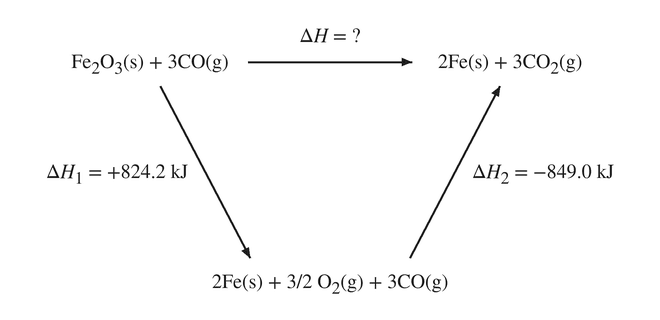
(a) What changes do and stand for? Use them to write the standard enthalpy of formation of iron(III) oxide and the standard enthalpy of combustion of carbon monoxide.
(b) Use Hess's law to find for the reduction, and the heat released by this step when 1.00 tonne of iron is produced (Fe = 56).
(c) Lower in the furnace, some of the oxide is reduced directly by coke:
Given (CO, g) = −110.5 kJ mol⁻¹, find for this reaction and say what it shows about this step.