
Opening your dashboard
Class 10 Biology Chapter 16: Pollution – A Rising Environmental Problem Solutions
40 textbook questions with step-by-step answers, free to read, for ICSE 2026-27.
Get talked through Ch 16, not just shown the answer
Reading a finished solution is not the same as being able to do it. The AI tutor takes one question at a time and works it with you, in your own words, until you can.
- Ask it out loud, in your own words
- It gives you the next step, not the answer
- Stuck on part (ii)? Start there
40 questions with solutions
1–14 marks · Mixed difficulty
- 15 marks
Question 1
Mention whether the following statements are True (T) or False (F).
(i) Pollution and pollutant are one and the same thing. (T/F)
(ii) Rubber tyres of motor vehicles contribute to particulate pollution. (T/F)
(iii) The chief gaseous air pollutants are and . (T/F)
(iv) Kitchen garbage and leftovers in food dishes can be used for making manure (compost). (T/F)
(v) Brick kilns give out both gaseous and particulate pollutants. (T/F)
Solve with AIWritten solution
Solution:
Concept: Pollution is the fall in the quality of the environment; a pollutant is the substance that causes it. Air pollutants are of two kinds: harmful gases and fine solid particles (particulate pollutants).
Step 1 — Statement (i): pollution and pollutant.
False. Pollution is the effect (the environment becomes worse); a pollutant is its cause (for example, smoke). One causes the other, so they are not the same thing.
Step 2 — Statement (ii): rubber tyres.
True. As tyres wear, they release tiny rubber particles, and speeding vehicles also raise road dust. Both are particulate pollutants.
Step 3 — Statement (iii): chief gaseous pollutants.
True. and are chief gaseous pollutants, along with carbon monoxide (CO) and oxides of nitrogen. They come out in the exhaust of vehicles and from industries.
Step 4 — Statement (iv): kitchen garbage.
True. Peelings of vegetables and fruits and leftovers in food dishes are biodegradable. Microorganisms break them down into manure (compost) for use in agriculture.
Step 5 — Statement (v): brick kilns.
True. Brick kilns give out gases (gaseous pollutants) as well as smoke and large quantities of ash (particulate pollutants).

Watch out: 'pollution' is the change; 'pollutant' is the thing that causes it.
Therefore, (i) F, (ii) T, (iii) T, (iv) T, (v) T.
- 21 mark
Question 2
Name any four ways to control vehicular air pollution.
Solve with AIWritten solution
Solution:
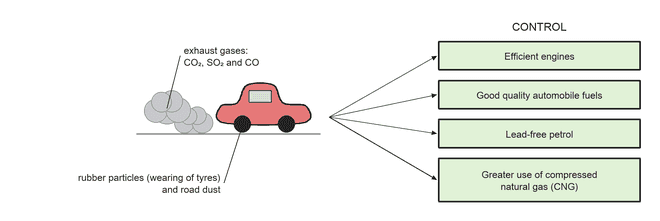
Concept: A vehicle pollutes the air through its exhaust gases (, and CO) and particles. Control means burning less fuel, and burning cleaner fuel more efficiently.
Step 1 — Way 1: efficient engines.
An efficient engine burns the fuel more completely, so less exhaust is given out.
Step 2 — Way 2: good quality, lead-free petrol.
Good quality fuel and lead-free (unleaded) petrol add no lead particles to the air.
Step 3 — Way 3: CNG.
Greater use of CNG (compressed natural gas), which is a cleaner fuel than petrol and diesel.
Step 4 — Way 4: switching off engines.
Switching off the engine at red lights and when the vehicle is not in use, because a running engine gives out exhaust for no use.
Step 5 — One more way.
Following the Bharat Stage (BS) emission norms, which fix how much pollutant a motor vehicle may give out.
Therefore, four ways are efficient engines, good quality / lead-free petrol, greater use of CNG and switching off engines when not needed.
- 31 mark
Question 3
Name any two small scale industries that can be the source of particulate air pollution.
Solve with AIWritten solution
Solution:
Concept: Particulate pollutants are tiny solid particles, such as smoke, ash and dust, that stay suspended in the air. Small units that burn fuel or break stone throw such particles into the air.
Step 1 — First industry: brick kilns.
A brick kiln burns fuel such as coal or firewood for days. It gives out a lot of smoke and leaves large quantities of ash.
Step 2 — Second industry: stone drilling / crushing.
Stone drilling and stone crushing units produce fine particles of stone, which are a serious health hazard to the labourers.
Therefore, two such small scale industries are brick kilns and stone drilling / stone crushing units.
- 41 mark
Question 4
Give two examples of gaseous air pollutants.
Solve with AIWritten solution
Solution:
Concept: Gaseous air pollutants are harmful gases released into the air, mainly in the exhaust of vehicles and from factories.
Step 1 — Name two gaseous pollutants.
Sulphur dioxide () and carbon monoxide (CO). Carbon dioxide () and oxides of nitrogen are also gaseous pollutants.
Step 2 — Say where they come from.
The exhaust of vehicles running on petrol and diesel contains , and CO. Industries give out the same gases and also oxides of nitrogen.
Step 3 — Say why they are harmful.
damages the air passages of the lungs (bronchitis) and dissolves in rain drops to form acid rain. CO joins the haemoglobin of the blood, so less oxygen reaches the body.
Therefore, two gaseous air pollutants are sulphur dioxide () and carbon monoxide (CO).
- 55 marks
Question 5
Mention whether the following statements are True (T) or False (F).
(i) Liquid kitchen waste alone constitutes the sewage. (T/F)
(ii) Household detergents are safe and non-contributors to water pollution. (T/F)
(iii) Industrial wastes mainly consist of chemical pollutants. (T/F)
(iv) Thermal power plants give out a lot of hot waste water. (T/F)
(v) Hot water discharged into water bodies hardly affects the fish and other aquatic life. (T/F)
Solve with AIWritten solution
Solution:
Concept: Water is polluted by five main sources: household detergents, sewage, industrial wastes, oil spills and hot water (thermal pollution).
Step 1 — Statement (i): what sewage is.
False. Sewage is the liquid waste from all domestic activities: kitchen wastes, toilet wastes and other household waste water. Kitchen waste is only one part of it.
Step 2 — Statement (ii): detergents.
False. Household detergents are a major source of water pollution. Every home uses them to wash clothes, crockery and utensils, and the dirty water flows down the drains into rivers and lakes.
Step 3 — Statement (iii): industrial wastes.
True. Factory effluents (liquid wastes) carry various chemical pollutants, and they are commonly discharged into the rivers.
Step 4 — Statement (iv): thermal power plants.
True. These plants use water for cooling and release it 8–10 °C warmer into nearby streams, rivers or the sea.
Step 5 — Statement (v): effect of hot water.
False. Warm water holds less dissolved oxygen, so the heating harms and even kills fish and affects aquatic plants. This is thermal pollution.

Therefore, (i) F, (ii) F, (iii) T, (iv) T, (v) F.
- 67 marks
Question 6
Mention whether the following statements are True (T) or False (F).
(i) Soil pollution is largely localised. (T/F)
(ii) Flyash and metallic ash are examples of urban domestic waste. (T/F)
(iii) Chemical fertilisers may reach the rivers but do not harm the fish. (T/F)
(iv) Biomedical waste may consist of both biodegradable and non-biodegradable waste. (T/F)
(v) X-rays are a potential source of radiation pollution. (T/F)
(vi) Unwanted disturbing sound, even if it is music next door, is noise. (T/F)
(vii) People routinely working in noisy places are not much affected by noise. (T/F)
Solve with AIWritten solution
Solution:
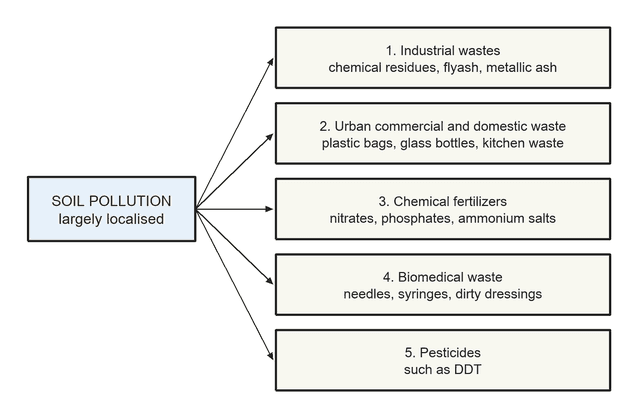
Concept: Soil is polluted by industrial wastes, urban commercial and domestic waste, chemical fertilisers, biomedical waste and pesticides. Radiation and noise are two other kinds of pollution.
Step 1 — Statement (i): soil pollution is localised.
True. Unlike polluted air and water, polluted soil does not spread over long distances; it stays largely where the waste is dumped.
Step 2 — Statement (ii): flyash and metallic ash.
False. These are industrial solid wastes. Urban domestic waste is plastic bags, glass bottles, kitchen waste and the like.
Step 3 — Statement (iii): fertilisers and fish.
False. Rain water slowly washes the fertilisers into lakes and ponds.
→ The extra nutrients make algae and bacteria grow very fast.
→ The bacteria use up much of the oxygen in the water.
→ Fish and other water animals die for want of oxygen.
Step 4 — Statement (iv): biomedical waste.
True. It contains biodegradable waste such as dirty dressings and non-biodegradable waste such as needles and syringes.
Step 5 — Statement (v): X-rays.
True. X-rays carry a great deal of energy. Too frequent exposure damages body cells and may cause damaged chromosomes, genetic variations and bone cancer.
Step 6 — Statement (vi): music next door.
True. Noise is any unpleasant, undesired sound. If it disturbs one's hearing and concentration, even music is noise.
Step 7 — Statement (vii): people in noisy places.
False. Prolonged noise can damage the ear and even lead to deafness; it also causes irritability and lowers the efficiency of work.
Therefore, (i) T, (ii) F, (iii) F, (iv) T, (v) T, (vi) T, (vii) F.
- 74 marks
Question 7
Mention whether the following statements are True (T) or False (F).
(i) Diseases like cholera and jaundice are the results of soil pollution. (T/F)
(ii) and methane are directly contributing to global warming. (T/F)
(iii) Erosion of ancient monuments and statues is caused by acid rain which itself is the result of gaseous pollution. (T/F)
(iv) Use of unleaded petrol and compressed Natural Gas (CNG) in automobiles is one of the methods of abatement of gaseous and particulate air pollution. (T/F)
Solve with AIWritten solution
Solution:
Concept: Link each pollutant to the effect it causes: dirty water spreads disease, greenhouse gases warm the air, acid-forming gases cause acid rain.
Step 1 — Statement (i): cholera and jaundice.
False. Cholera, jaundice and typhoid result from water pollution, when people use water contaminated with sewage. Soil pollution affects human health only indirectly.
Step 2 — Statement (ii): and methane.
True. These greenhouse gases accumulate in the atmosphere and prevent the escape of heat, so the air warms up (global warming).
Step 3 — Statement (iii): acid rain and monuments.
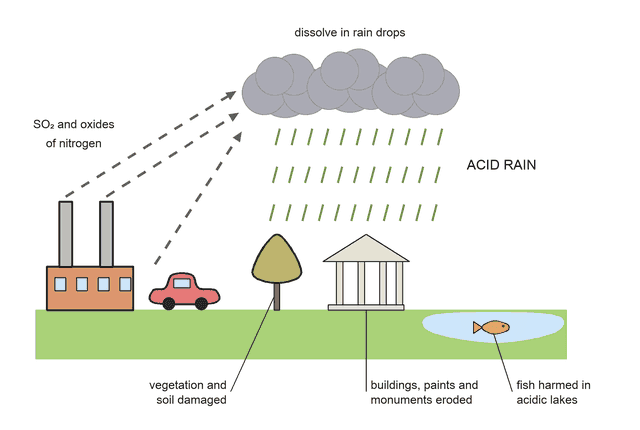
True. Sulphur dioxide and oxides of nitrogen from chimneys and vehicles dissolve in rain drops to form acid rain. The acid reacts with the calcium carbonate of marble and limestone, so monuments and statues erode.
Step 4 — Statement (iv): unleaded petrol and CNG.
True. Unleaded petrol adds no lead particles to the air, and CNG is a cleaner fuel. Their use in automobiles is one of the steps taken to reduce air pollution.
Therefore, (i) F, (ii) T, (iii) T, (iv) T.
- 81 mark
Question 8
Which of the following is an example of a green-house gas ?
Solve with AIAnswer
(A) Sulphur dioxide
- Correct
(B) Methane
(C) Oxygen
(D) Nitrogen
Answer: (B) Methane
Concept: Greenhouse gases, such as carbon dioxide and methane (), let sunlight in but absorb the heat given back by the earth, so they keep the air warm.
Step 1 — Follow the heat.
The earth's surface absorbs the sun's energy, warms up and radiates heat back as long waves.
Step 2 — See which gas traps it.
Carbon dioxide and methane in the atmosphere absorb a part of this heat and do not let it escape, so the air warms up. Of the options, only methane is such a gas.

Why the other options are wrong:
- (A) Sulphur dioxide: sulphur dioxide is mainly known for causing acid rain, not for trapping heat.
- (C) Oxygen: oxygen is the gas we breathe in; it does not trap the earth's heat.
- (D) Nitrogen: nitrogen makes up most of the air; it does not trap the earth's heat.
Therefore, methane is a greenhouse gas, option (B).
- 91 mark
Question 9
The prime source of chlorofluorocarbons is :
Solve with AIAnswer
(A) Domestic sewage
- Correct
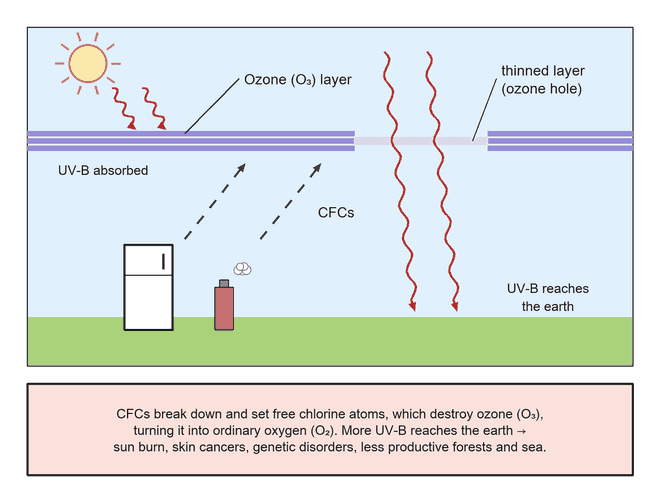
(B) Refrigeration equipment
(C) Industrial effluents
(D) Vehicular emissions
Answer: (B) Refrigeration equipment
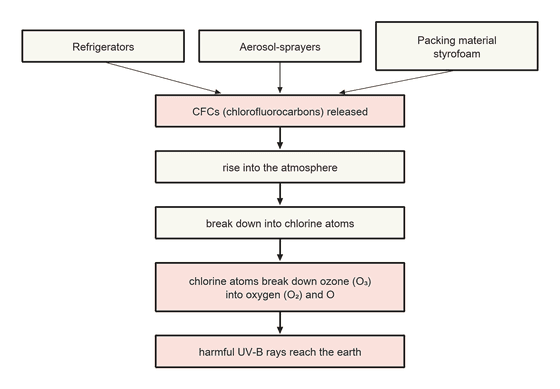
Concept: CFCs (chlorofluorocarbons) are released from refrigerators and air conditioners, aerosol sprayers and the packing material styrofoam.
Step 1 — Find the source among the options.
Of the four options, only refrigeration equipment uses CFCs; the gas leaks out of it into the air.
Step 2 — See why it matters.
The CFCs rise into the atmosphere and break down into chlorine atoms, which break down ozone. This thins the ozone layer.
Why the other options are wrong:
- (A) Domestic sewage: domestic sewage is liquid waste from homes; it pollutes water but releases no CFCs.
- (C) Industrial effluents: industrial effluents are liquid chemical wastes that pollute rivers; they are not the source of CFCs.
- (D) Vehicular emissions: vehicle exhaust gives out , , CO and particles, not CFCs.
Therefore, the prime source of chlorofluorocarbons is refrigeration equipment, option (B).
- 101 mark
Question 10
Which of the following gas can cause acid rain ?
Solve with AIAnswer
- Correct
(A) Sulphur dioxide
(B) Ammonia
(C) Hydrogen
(D) Nitrogen
Answer: (A) Sulphur dioxide
Concept: Acid rain forms when acid-forming gases, mainly sulphur dioxide and oxides of nitrogen, dissolve in rain drops and make the rain much more acidic than normal.
Step 1 — Know what normal rain is like.
Clean rain is only slightly acidic (pH about 5.6), because a little from the air dissolves in it.
Step 2 — See what the pollutant gas does.
Industries and vehicles now give out a lot of sulphur dioxide () and oxides of nitrogen. These dissolve in the rain drops and form acids, so the rain becomes far more acidic. This is acid rain.
Watch out: Nitrogen () is not an acid-rain gas; only its oxides are.
Why the other options are wrong:
- (B) Ammonia: ammonia is basic, not acidic, so it cannot make the rain acidic.
- (C) Hydrogen: hydrogen does not dissolve in rain water to form an acid.
- (D) Nitrogen: nitrogen gas itself is unreactive; it is the oxides of nitrogen that cause acid rain.
Therefore, sulphur dioxide can cause acid rain, option (A).
- 111 mark
Question 11
Which of the following is responsible for causing the ozone hole ?
Solve with AIAnswer
(A) Methane
(B) Carbon dioxide
- Correct
(C) Aerosols
(D) Sulphur dioxide
Answer: (C) Aerosols
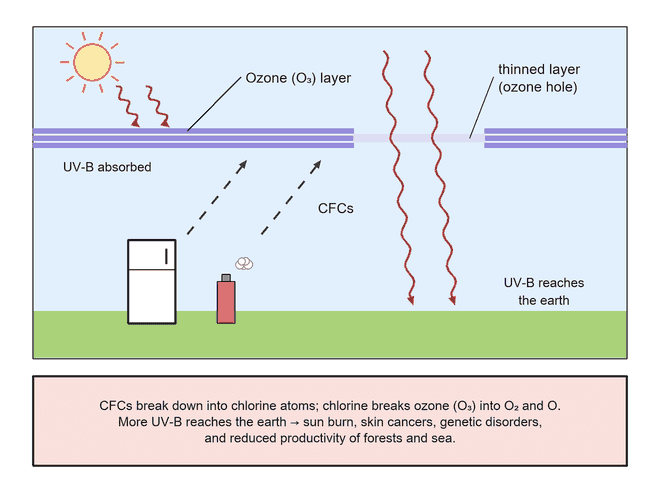
Concept: The ozone () layer high up in the atmosphere stops the sun's harmful UV-B rays. CFCs from aerosol sprayers break down into chlorine atoms that destroy ozone, making the layer thin (an ozone hole).
Step 1 — Know what ozone does.
Ozone forms a kind of sunscreen high up in the atmosphere, stopping the harmful UV-B rays of the sun.
Step 2 — Follow the CFCs.
CFCs from aerosol sprayers, refrigerators and styrofoam rise into the atmosphere and break down into chlorine atoms.
Step 3 — See how the hole forms.
The chlorine atoms break ozone () into oxygen () and O. The layer becomes thin at places, and such a region is called an ozone hole.
Why the other options are wrong:
- (A) Methane: methane is a greenhouse gas; it adds to global warming, not to the ozone hole.
- (B) Carbon dioxide: carbon dioxide causes the greenhouse effect, not ozone depletion.
- (D) Sulphur dioxide: sulphur dioxide causes acid rain, not the ozone hole.
Therefore, aerosols (which release CFCs) are responsible for the ozone hole, option (C).
- 121 mark
Question 12
Which of the following is non-biodegradable ?
Solve with AIAnswer
(A) Tea leaves
(B) Wood
(C) Animal bones
- Correct
(D) Nylon
Answer: (D) Nylon
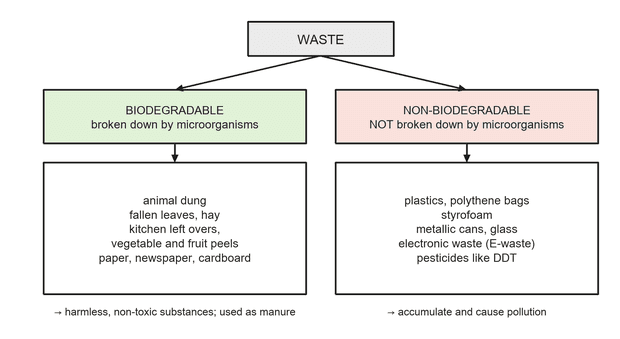
Concept: Non-biodegradable wastes cannot be broken down by microorganisms, so they stay in the environment for a very long time. Synthetic (man-made) materials such as plastics and nylon are of this kind.
Step 1 — Sort natural and man-made materials.
Tea leaves, wood and bones come from living things, so microorganisms can break them down.
Step 2 — Pick the synthetic one.
Nylon is man-made, like plastics. Microorganisms cannot break it down, so it is non-biodegradable.
Watch out: Slow to decay (bones) is not the same as never decaying (nylon).
Why the other options are wrong:
- (A) Tea leaves: tea leaves are plant matter and decompose quickly, so they are biodegradable.
- (B) Wood: wood is broken down by fungi and bacteria, so it is biodegradable.
- (C) Animal bones: animal bones are organic and are broken down, though slowly, so they are biodegradable.
Therefore, nylon is non-biodegradable, option (D).
- 131 mark
Question 13
One of the best solutions to get rid of non-biodegradable wastes is :
Solve with AIAnswer
(A) Dumping
(B) Incinerating
- Correct
(C) Recycling
(D) Composting
Answer: (C) Recycling
Concept: Non-biodegradable wastes are not broken down by microorganisms. In recycling, used plastic, metal and glass are made into new articles, so the waste does not pile up.
Step 1 — See the problem.
Left to themselves, non-biodegradable wastes keep collecting and cause pollution.
Step 2 — Choose the best way.
Recycling turns the used material into new articles, so the same material is used again. The chapter's control measure is recycling of plastic, metal and glass, with incineration only for non-recyclable waste.

Why the other options are wrong:
- (A) Dumping: dumping only shifts the waste; it lies there for hundreds of years and pollutes soil and water.
- (B) Incinerating: incineration is kept for waste that cannot be recycled, and burning gives out polluting gases.
- (D) Composting: composting works only for biodegradable waste, which microorganisms can break down.
Therefore, one of the best solutions for non-biodegradable wastes is recycling, option (C).
- 141 mark
Question 14
An undesirable change in the environment is called as :
Solve with AIAnswer
(A) Pollutant
(B) Population
- Correct
(C) Pollution
(D) None of these
Answer: (C) Pollution
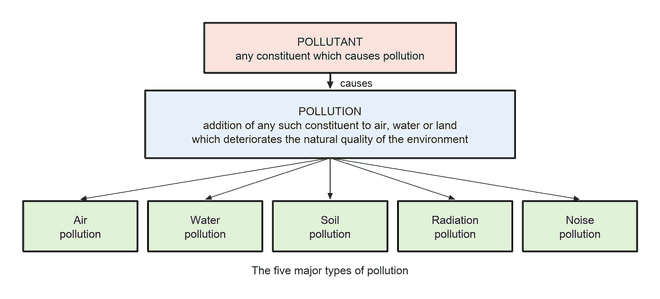
Concept: Pollution is the addition of any constituent to air, water or land which spoils the natural quality of the environment. The constituent itself is called a pollutant.
Step 1 — Name the change.
An undesirable change means the natural quality of the environment has become worse. This change itself is pollution.
Step 2 — Separate the cause.
The substance causing the change is the pollutant. For example, smoke is a pollutant; the fall in air quality it causes is air pollution.
Why the other options are wrong:
- (A) Pollutant: a pollutant is the substance that causes pollution, not the change itself.
- (B) Population: population is the number of individuals living in an area.
- (D) None of these: 'none of these' cannot be right, because pollution, option (C), fits exactly.
Therefore, an undesirable change in the environment is called pollution, option (C).
- 151 mark
Question 15
The greenhouse effect leads to :
Solve with AIAnswer
(A) Thermal pollution
(B) Oil spills
(C) Droughts
- Correct
(D) Global warming
Answer: (D) Global warming
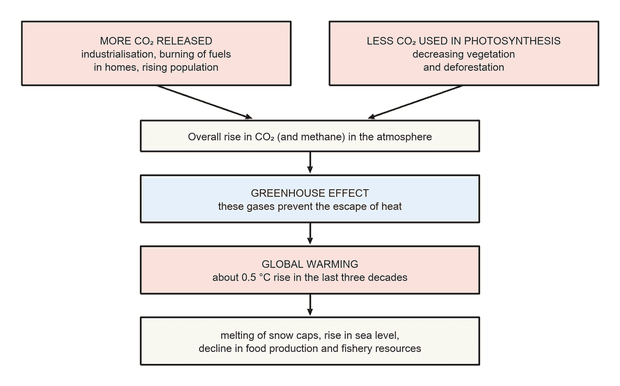
Concept: Greenhouse gases trap heat in the atmosphere. When more of them collect, more heat is held and the earth's average temperature rises: this is global warming.
Step 1 — See why is rising.
More is being released (industries, burning of fuels in homes, a rising population) and less is being used in photosynthesis (decreasing vegetation and deforestation).
Step 2 — Follow the effect.
The overall rise in keeps more of the sun's heat in the atmosphere, so the air warms up. This is global warming.
Step 3 — Know its results.
The chapter states that the earth's temperature has risen by about 0.5 °C in the last three decades, causing melting of snow caps, a rise in sea level, and a decline in food production and fishery resources.
Why the other options are wrong:
- (A) Thermal pollution: thermal pollution is the warming of water bodies by hot waste water from power plants.
- (B) Oil spills: oil spills are accidental discharges of petroleum into the sea.
- (C) Droughts: droughts may follow climate change, but the direct result of the greenhouse effect is global warming.
Therefore, the greenhouse effect leads to global warming, option (D).
- 161 mark
Question 16
The energy content of X-rays is usually measured in :
Solve with AIAnswer
(A) Proton
(B) Protium
- Correct
(C) Photon
(D) None of these
Answer: (C) Photon
Concept: X-rays are a radiation that carries energy in tiny packets called photons. The more energetic the photons, the more harm the X-rays can do to body cells.
Step 1 — Match the word to the radiation.
Of the four options, only a photon is a packet of radiation energy. A proton is a particle of the atom's nucleus, and protium is a kind of hydrogen atom.
Step 2 — See why the energy matters.
Because X-ray photons carry so much energy, too frequent exposure may cause damaged chromosomes, genetic variations and bone cancer.
Watch out: Strictly, the energy of one photon is measured in electronvolts (eV); 'photon' names the packet of energy. The book's answer is photon.
Why the other options are wrong:
- (A) Proton: a proton is a positively charged particle in the nucleus of an atom; it is not a unit of radiation energy.
- (B) Protium: protium is the commonest isotope of hydrogen, not a measure of energy.
- (D) None of these: 'none of these' is not the book's answer, because the photon, option (C), is the packet in which X-ray energy comes.
Therefore, the book's answer is photon, option (C).
- 171 mark
Question 17
Which of the following is a radioactive pollutant ?
Solve with AIAnswer
- Correct
(A) Iodine-131
(B) Iodine-113
(C) Iodine-313
(D) Cobalt-16
Answer: (A) Iodine-131
Concept: A radioactive pollutant gives out harmful nuclear radiation. Two named in the chapter are Iodine-131 (released in the Fukushima nuclear plant accident, Japan, 2011) and Cobalt-60 (the waste that harmed people at Mayapuri, Delhi, 2010).
Step 1 — Know how such pollution happens.
Nuclear power plants can leak radiation through careless disposal of wastes or through an accidental explosion.
Step 2 — Pick the named pollutant.
In the Fukushima Daiichi accident, Iodine-131 was a chief radiation pollutant. It collects in the thyroid gland and raises the risk of thyroid cancer.

Why the other options are wrong:
- (B) Iodine-113: Iodine-113 is not the radioactive pollutant named; it swaps the digits of 131.
- (C) Iodine-313: Iodine-313 does not exist; no iodine atom is that heavy.
- (D) Cobalt-16: Cobalt-16 does not exist; the radioactive cobalt pollutant is Cobalt-60.
Therefore, Iodine-131 is a radioactive pollutant, option (A).
- 181 mark
Question 18
The following questions are Assertion-Reason based questions. Choose the answer based on the codes given below.
(1) A is True and R is False
(2) A is False and R is True
(3) Both A and R are True
(4) Both A and R are False
Assertion (A): Pesticides are the chemical substances used in agriculture to destroy pests.
Reason (R): DDT is an example of a pesticide which was once widely used all over India. Pests are the enemies of crop.
Solve with AIAnswer
(A) (1) A is True and R is False
(B) (2) A is False and R is True
- Correct
(C) (3) Both A and R are True
(D) (4) Both A and R are False
Answer: (C) (3) Both A and R are True
Concept: Pesticides such as DDT are chemicals used to kill pests in farms, godowns and homes. Judge the Assertion, then the Reason, then pick the code.
Step 1 — Judge the Assertion.
True. Pesticides are chemical substances used in agriculture to destroy pests.
Step 2 — Judge the Reason.
True. DDT (Dichloro Diphenyl Trichloroethane) was once widely used in farms, godowns and homes, and pests are indeed enemies of crops.
Step 3 — Choose the code.
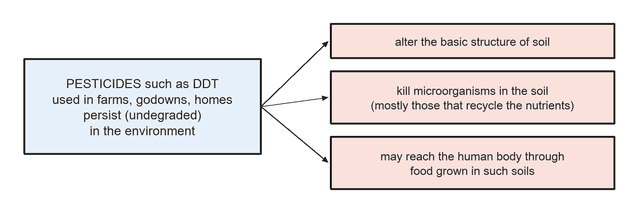
Both statements are true, which is code (3). Remember that DDT is also a pollutant: it persists in the environment, alters the structure of soil, kills soil microorganisms and may reach the human body through food.
Why the other options are wrong:
- (A) (1) A is True and R is False: code (1) says R is false, but R is true.
- (B) (2) A is False and R is True: code (2) says A is false, but A is true.
- (D) (4) Both A and R are False: code (4) says both are false, but both statements are true.
Therefore, both A and R are true, option (C).
- 191 mark
Question 19
The following questions are Assertion-Reason based questions. Choose the answer based on the codes given below.
(1) A is True and R is False
(2) A is False and R is True
(3) Both A and R are True
(4) Both A and R are False
Assertion (A): Ozone layer is a sort of sunscreen present high up in the atmosphere which prevents the harmful ultra-violet rays of the sun from harming us.
Reason (R): Ozone is an allotropic form of carbon which is formed in the atmosphere due to the release of chloroflurocarbons .
Solve with AIAnswer
- Correct
(A) (1) A is True and R is False
(B) (2) A is False and R is True
(C) (3) Both A and R are True
(D) (4) Both A and R are False
Answer: (A) (1) A is True and R is False
Concept: Ozone () is an allotropic form of oxygen. The ozone layer stops harmful UV rays; CFCs destroy ozone, they do not form it.
Step 1 — Judge the Assertion.
True. The ozone layer forms a sort of sunscreen high up in the atmosphere and stops harmful UV-B rays, which cause sun burn, genetic disorders and skin cancers.
Step 2 — Judge the Reason.
False, on two counts. Ozone is an allotrope of oxygen, not carbon. And CFCs break down into chlorine atoms that break ozone () into oxygen () and O, so they destroy ozone rather than form it.
Step 3 — Choose the code.
A is true and R is false, which is code (1).
Watch out: '' contains only oxygen atoms, so ozone cannot be a form of carbon.
Why the other options are wrong:
- (B) (2) A is False and R is True: code (2) says A is false, but A is true.
- (C) (3) Both A and R are True: code (3) says R is true, but R is false on both counts.
- (D) (4) Both A and R are False: code (4) says A is false, but A is true.
Therefore, A is true and R is false, option (A).
- 201 mark
Question 20
The following questions are Assertion-Reason based questions. Choose the answer based on the codes given below.
(1) A is True and R is False
(2) A is False and R is True
(3) Both A and R are True
(4) Both A and R are False
Assertion (A): The greenhouse effect is exacerbated by the presence of nitrogen oxides and sulphur oxides in the atmosphere, intensifying the absorption of heat and contributing to global warming.
Reason (R): Oxides of nitrogen and sulphur, primarily released through industrial activities and combustion processes, amplify the greenhouse effect by enhancing the heat-trapping capacities of the atmosphere, leading to an increase in the average global temperatures.
Solve with AIAnswer
(A) (1) A is True and R is False
(B) (2) A is False and R is True
- Correct
(C) (3) Both A and R are True
(D) (4) Both A and R are False
Answer: (C) (3) Both A and R are True
Concept: Gases released by industries and the burning of fuels add to the heat-trapping gases of the atmosphere, and the more heat is trapped, the warmer the earth becomes. Judge the Assertion, then the Reason, then pick the code.
Step 1 — Judge the Assertion.
True, as the book intends. Oxides of nitrogen released by industries add to the greenhouse effect along with and methane, so they contribute to global warming.
Step 2 — Judge the Reason.
True, as the book intends. These oxides come mainly from industries and combustion, and the extra heat trapped raises the average global temperature.
Step 3 — Choose the code.
Both statements are taken as true, which is code (3).
Watch out: Strictly, nitrous oxide () is the oxide of nitrogen that is a strong greenhouse gas, while sulphur dioxide is better known for causing acid rain. At this level the book treats both statements as true, so the key stays (3).
Why the other options are wrong:
- (A) (1) A is True and R is False: code (1) needs R to be false, but R is taken as true.
- (B) (2) A is False and R is True: code (2) needs A to be false, but A is taken as true.
- (D) (4) Both A and R are False: code (4) needs both to be false, but both are taken as true.
Therefore, both A and R are true, option (C).
- 212 marks
Question 21
Name the following pollutants :
(i) A pollutant which is mainly responsible for causing acid rain
(ii) Any two chemicals leading to the formation of ozone holes.
Solve with AIWritten solution
Solution:
Concept: Acid-forming gases cause acid rain; chlorine- and bromine-containing gases destroy ozone.
Step 1 — Part (i): the chief acid-rain pollutant.
Sulphur dioxide (). Given out by industries and vehicles, it dissolves in the rain drops and makes the rain acidic. Oxides of nitrogen add to it.
Step 2 — Part (ii): two chemicals that cause ozone holes.
Chlorofluorocarbons (CFCs) and halons (bromine-containing compounds). Carbon tetrachloride also depletes ozone.
Step 3 — See how the ozone hole forms.
CFCs from refrigerators, aerosol sprayers and styrofoam rise into the atmosphere and break down into chlorine atoms.
→ The chlorine atoms break ozone () into oxygen () and O.
→ Through the thinned layer (ozone hole), harmful UV-B rays reach the earth.
Therefore, (i) sulphur dioxide (); (ii) chlorofluorocarbons (CFCs) and halons.
- 226 marks
Question 22
Match the items in column I with the closely related ones in column II.
Column I Column II (i) Chlorofluocarbons (CFCs) (a) Global warming (ii) Fly ash (b) Biodegradable (iii) Cow dung (c) Nuclear radiation pollutant (iv) and methane (d) Acid rain (v) Sulphur dioxide (e) Industrial waste (vi) Iodine – 131 (f) Ozone depletion Solve with AIWritten solution
Solution:
Concept: Link each pollutant to the problem it causes or to the category it belongs to.
Step 1 — Match the gases.
CFCs break down into chlorine atoms that destroy ozone, so (i) → (f) ozone depletion. and methane prevent the escape of heat, so (iv) → (a) global warming. Sulphur dioxide dissolves in rain to make it acidic, so (v) → (d) acid rain.
Step 2 — Match the wastes.
Fly ash is one of the solid wastes given out by industries, so (ii) → (e) industrial waste. Cow dung is broken down by microorganisms into harmless substances, so (iii) → (b) biodegradable.
Step 3 — Match the radioactive substance.
Iodine-131 was a chief radiation pollutant of the Fukushima nuclear plant accident, so (vi) → (c) nuclear radiation pollutant.
Step 4 — Write the matched table.
Column I Column II (i) Chlorofluocarbons (CFCs) (f) Ozone depletion (ii) Fly ash (e) Industrial waste (iii) Cow dung (b) Biodegradable (iv) and methane (a) Global warming (v) Sulphur dioxide (d) Acid rain (vi) Iodine – 131 (c) Nuclear radiation pollutant Therefore, (i)–(f), (ii)–(e), (iii)–(b), (iv)–(a), (v)–(d), (vi)–(c).
- 234 marks
Question 23
Fill in the blanks :
(i) Rubber particles and dust raised by running motor vehicles are examples of .......... pollutants.
(ii) Too frequent exposure to .......... in a medical diagnostic technique may damage chromosomes.
(iii) Thermal power plants give out a lot of .......... waste water.
(iv) Sewage is a liquid waste from ..........
Solve with AIWritten solution
Solution:
Concept: Recall the sources of air, radiation and water pollution named in the chapter.
Step 1 — Blank (i).
Rubber particles and road dust are tiny solid particles in the air, not gases, so they are particulate pollutants.
Step 2 — Blank (ii).
X-rays are used in medical diagnosis. They carry a great deal of energy, so too frequent exposure may damage chromosomes.
Step 3 — Blank (iii).
Thermal power plants use water to cool their machinery and give it out 8–10 °C warmer, so they release a lot of hot waste water.
Step 4 — Blank (iv).
Sewage consists of kitchen wastes, toilet wastes and other household waste water, so it is the liquid waste from domestic activities (households).
Therefore, the blanks are (i) particulate, (ii) X-rays, (iii) hot, (iv) domestic activities.
- 245 marks
Question 24
Write the full forms of each :
(a) DDT
(b) ODF
(c) CFCs
(d) CNG
(e) LPG
Solve with AIWritten solution
Solution:
Concept: These abbreviations come from pesticides, the Swachh Bharat Abhiyan, ozone depletion and fuels.
Step 1 — DDT.
Dichloro Diphenyl Trichloroethane: a pesticide once much used in farms, godowns and homes. It persists in the environment as a pollutant.
Step 2 — ODF.
Open Defecation Free: a goal of the Swachh Bharat Abhiyan, reached by building toilets, specially in rural India.
Step 3 — CFCs.
Chlorofluorocarbons: gases released from refrigerators, aerosol sprayers and styrofoam that destroy the ozone layer.
Step 4 — CNG.
Compressed Natural Gas: a cleaner fuel for automobiles, whose greater use helps to control vehicular air pollution.
Step 5 — LPG.
Liquefied Petroleum Gas: the cooking gas supplied in cylinders.
Therefore, DDT: Dichloro Diphenyl Trichloroethane; ODF: Open Defecation Free; CFCs: Chlorofluorocarbons; CNG: Compressed Natural Gas; LPG: Liquefied Petroleum Gas.
- 255 marks
Question 25
Give two examples of :
(a) Biodegradable wastes
(b) Non-biodegradable wastes
(c) Particulate pollutants
(d) Greenhouse gases
(e) Radioactive pollutants
Solve with AIWritten solution
Solution:
Concept: Pick examples named in the lesson, and know what each term means.
Step 1 — Biodegradable wastes.
Vegetable peels and paper (also dung and fallen leaves). Microorganisms can break these down into harmless, non-toxic substances.
Step 2 — Non-biodegradable wastes.
Plastics and glass (also styrofoam and metallic cans). Microorganisms cannot break these down, so they accumulate.

Step 3 — Particulate pollutants.
Dust and smoke (soot) (also rubber particles and fly ash). These are fine solid particles in the air, not gases.
Step 4 — Greenhouse gases.
Carbon dioxide () and methane (). These gases collect in the atmosphere and prevent the escape of heat.
Step 5 — Radioactive pollutants.
Iodine-131 and Cobalt-60. Iodine-131 was released in the Fukushima nuclear plant accident; Cobalt-60 was the radioactive waste that harmed people at Mayapuri, Delhi.
Therefore, (a) vegetable peels, paper; (b) plastics, glass; (c) dust, smoke; (d) carbon dioxide, methane; (e) Iodine-131, Cobalt-60.
- 264 marks
Question 26
List one major harmful effect of each of the following:
(i) Rivers contaminated with sewage.
(ii) Too much gaseous exhausts containing and .
(iii) Pesticides such as DDT used in agriculture.
(iv) Prolonged noise such as the one produced by crackers.
Solve with AIWritten solution
Solution:
Concept: For each pollutant, follow what it does once it reaches people or the environment, and name one clear harm.
Step 1 — Rivers contaminated with sewage.
Sewage carries toilet wastes and household waste water.
→ People who use the contaminated river water swallow germs.
→ They suffer from water-borne diseases like cholera, jaundice and typhoid.
Step 2 — Too much exhaust with and .
The dissolves in the rain drops and causes acid rain. The traps heat (global warming), and also damages the air passages of the lungs (bronchitis).
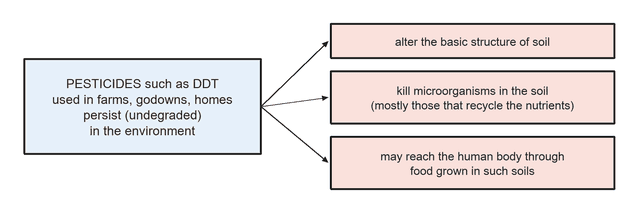
Step 3 — Pesticides such as DDT.
They kill the soil microorganisms that recycle nutrients and may reach the human body through food grown in such soil. Because DDT persists in the environment, its harm goes on for a long time.
Step 4 — Prolonged noise such as crackers.
A loud sound can damage the ear drum, and prolonged noise can lead to deafness. It also disturbs sleep and causes irritability.
Therefore, (i) water-borne diseases, (ii) acid rain, (iii) soil microorganisms killed / poison in food, (iv) damage to the ear and deafness.
- 271 mark
Question 27
List the three major constituents of sewage.
Solve with AIWritten solution
Solution:
Concept: Sewage is the liquid waste from domestic activities.
Step 1 — List the three constituents.
- Kitchen wastes
- Toilet wastes
- Other household waste water (for example, water with detergents from washing)
Step 2 — Say what is done with it.
Most cities have sewage treatment plants. They remove the dirty part and release the cleaned water into nearby water bodies or rivers. Where sewage is released untreated, it pollutes the river or lake.

Therefore, the three major constituents of sewage are kitchen wastes, toilet wastes and other household waste water.
- 283 marks
Question 28
What are the common sources of oil spills ? How do they affect sea life ?
Solve with AIWritten solution
Solution:
Concept: Oil spills are accidental discharges of petroleum into the sea or estuaries. The oil floats and spreads as a thin film over the water.
Step 1 — Name the common sources.
Oil spills come from overturned oil tankers, offshore oil mining and oil refineries.
Step 2 — Effect on sea birds.
Oil coats the feathers of birds.
→ The feathers stick together.
→ The birds cannot fly or keep warm, and many die.
Step 3 — Effect on fish and other sea life.
The oil film cuts off air and light from the water below, and the oil is poisonous.
→ Fish and other marine animals are poisoned or suffocated.
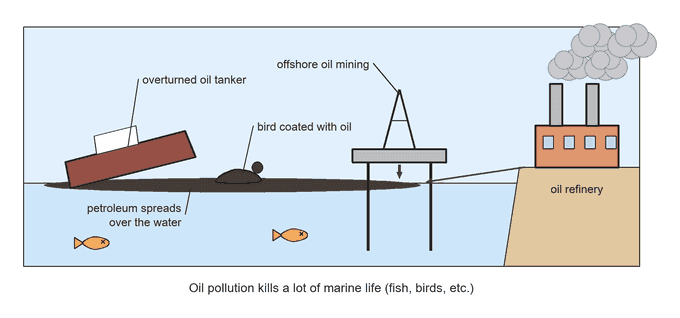
Therefore, oil spills come from overturned tankers, offshore oil mining and refineries, and they kill a lot of marine life (fish, birds, etc.).
- 292 marks
Question 29
Mention any two measures to minimise noise pollution.
Solve with AIWritten solution
Solution:
Concept: Noise can be reduced where it is made (at the source), or stopped on its way to our ears.
Step 1 — Measure 1: cut noise at the source.
Prohibit the blowing of horns and restrict loudspeakers, specially at night. This reduces the noise where it is produced.
Step 2 — Measure 2: block noise on its way.
Plant trees by the road side and keep the doors of houses closed. The trees and closed doors stop part of the noise before it reaches our ears.

Step 3 — One more measure.
Do not burn fire crackers.
Therefore, two measures are prohibiting the blowing of horns (and loudspeakers at night) and planting trees by the road side.
- 303 marks
Question 30
Briefly mention about 'Swachh Bharat Abhiyan'. When was it launched and what are its objectives?
Solve with AIWritten solution
Solution:
Concept: Swachh Bharat Abhiyan (Clean India Movement) is a national cleanliness campaign of the Government of India, with the dream of a clean and hygienic India.
Step 1 — Say what it is.
It asks every citizen neither to litter nor to let others litter. Millions of people from all sections of society joined this mass movement for cleanliness.
Step 2 — Say when it was launched.
It was officially launched on 2nd October 2014.
Step 3 — List its objectives.
- to clean the streets, roads and infrastructure of cities and towns;
- to eliminate open defecation by building individual, cluster and community toilets (an Open Defecation Free India);
- to set up an accountable mechanism of monitoring latrine use;
- to achieve efficient solid and liquid waste management.
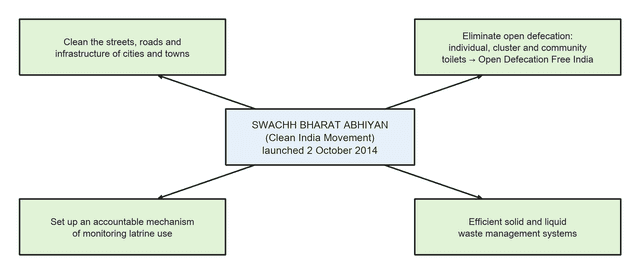
Therefore, Swachh Bharat Abhiyan was launched on 2nd October 2014; it aims at clean streets, an open defecation free India, monitored latrine use and efficient waste management.
- 3114 marks
Question 31
Define the following terms :
(a) Pollution
(b) Waste
(c) Air pollution
(d) Oil spills
(e) Pesticides
(f) Sanitary landfills
(g) Noise
Solve with AIWritten solution
Solution:
Concept: Give the exact meaning of each term, then one line that makes it clear.
Step 1 — Pollution.
Pollution is the addition of any constituent to air, water or land which spoils the natural quality of the environment. The constituent that causes it is a pollutant.
Step 2 — Waste.
Waste is any unwanted or undesired material resulting from industrial, commercial, mining and agricultural operations and from community activities. It is either biodegradable or non-biodegradable.
Step 3 — Air pollution.
Air pollution is the degradation of the air quality which harmfully affects living organisms as well as certain objects. It is of two types: gaseous and particulate.
Step 4 — Oil spills.
Oil spills are accidental discharges of petroleum into the sea or estuaries, from overturned tankers, offshore oil mining and refineries.
Step 5 — Pesticides.
Pesticides are chemical substances, such as DDT, used in agriculture, godowns and homes to kill pests.
Step 6 — Sanitary landfills.
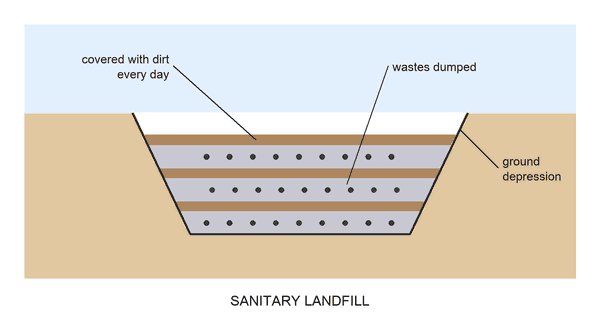
Sanitary landfills are places where wastes are dumped in a ground depression and covered with dirt every day.
Step 7 — Noise.
Noise is any unpleasant, loud or undesired sound that interferes with one's hearing and concentration. The pollution it causes is noise pollution.
Therefore, the seven terms are defined above.
- 326 marks
Question 32
Distinguish between the following pairs :
(a) Sewage and effluents.
(b) Biodegradable and Non-biodegradable waste.
(c) Smoke and smog.
Solve with AIWritten solution
Solution:
Concept: To distinguish two terms, give matching points of difference side by side, with examples.
Step 1 — Sewage and effluents.
Both are liquid wastes; they differ in where they come from.
Sewage Effluents Liquid waste from domestic activities Liquid waste discharged by factories (industries) Kitchen, toilet and household waste water Water carrying various chemical pollutants Cleaned in sewage treatment plants before release Must be treated before discharge into water bodies Step 2 — Biodegradable and non-biodegradable waste.
They differ in whether microorganisms can break them down.
Biodegradable waste Non-biodegradable waste Can be broken down by microorganisms into harmless substances Cannot be broken down by microorganisms e.g. dung, fallen leaves, kitchen leftovers, paper e.g. plastics, styrofoam, glass, metallic cans Can be made into manure (compost) Accumulate and cause pollution; plastic, metal and glass can be recycled Step 3 — Smoke and smog.
Smog is smoke mixed with fog, so it is the worse of the two.
Smoke Smog Gases and fine particles given out by burning (chimneys, vehicles, garbage) Smoke mixed with dust particles and small drops of fog (smoke + fog) Adds to particulate air pollution Harms plants; causes asthma, allergies and poor visibility 
Therefore, the pairs differ as shown in the tables: (a) domestic / industrial liquid waste, (b) broken down / not broken down by microorganisms, (c) smoke alone / smoke mixed with fog.
- 332 marks
Question 33
A lot of fish are dying near a sea shore. Describe any two possible causes.
Solve with AIWritten solution
Solution:
Concept: Fish die when the sea water is poisoned or loses its dissolved oxygen.
Step 1 — Cause 1: an oil spill.
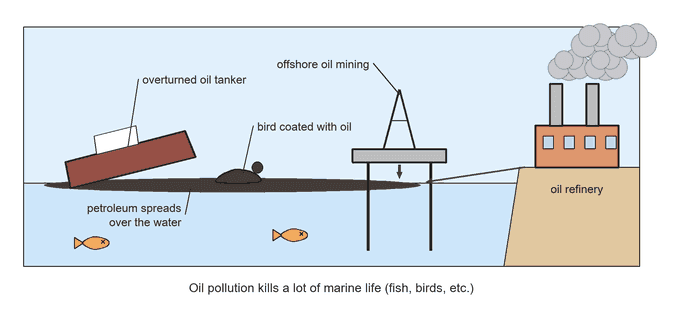
Oil from an overturned tanker, offshore oil mining or a refinery spreads as a film over the sea.
→ It cuts off air from the water and is poisonous.
→ Fish and other marine life die.
Step 2 — Cause 2: industrial wastes.
Factories near the coast, such as fish-processing units, discharge toxic effluents into the sea, which poison the fish.
Step 3 — Other possible causes.
Hot waste water from power plants warms the sea water, which then holds less oxygen. Fertilisers washed into the sea make algae and bacteria grow fast, and the bacteria use up the oxygen.
Step 4 — See why the shore is affected first.
Oil tankers, refineries, fish-processing industries and power plants are all found along the coast, so their wastes enter the sea there first.
Therefore, two possible causes are an oil spill and toxic industrial wastes discharged into the sea.
- 344 marks
Question 34
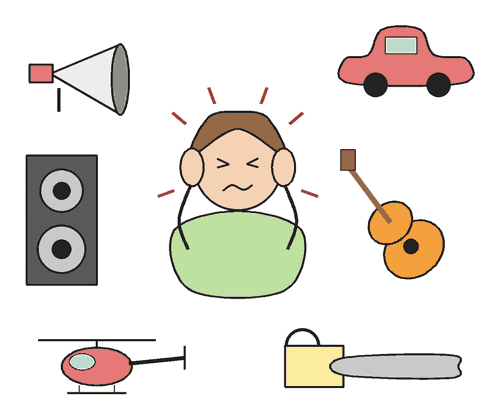
Look at a cartoonist's presentation of a kind of pollution given below.
(i) Name the kind of pollution.
(ii) List the sources of pollution.
(iii) Mention any two harmful effects of this pollution.
Solve with AIWritten solution
Solution:
Concept: The person in the cartoon is covering the ears against loud sounds coming from all around, so the picture shows noise pollution.
Step 1 — Part (i): name the pollution.
Noise pollution. Noise is any unpleasant, loud or undesired sound that interferes with one's hearing and concentration.
Step 2 — Part (ii): list the sources.
Loudspeakers and megaphones, automobiles (car horns), musical instruments (guitar), helicopters and aircraft, and machines such as the chain saw.

Step 3 — Part (iii): two harmful effects.
- It interrupts concentration, disturbs peace of mind and disturbs sleep, leading to irritability.
- A sudden loud sound can damage the ear drum, and prolonged noise can lead to deafness.
Therefore, (i) noise pollution; (ii) loudspeakers, vehicles, musical instruments, aircraft and machines; (iii) it disturbs concentration and sleep and can damage the ear, causing deafness.
- 355 marks
Question 35
The following picture depicts a certain phenomenon.

(i) Name the phenomenon and explain it.
(ii) Enlist the sources that are responsible for the above mentioned phenomenon.
(iii) List out the effects of the above phenomenon on humans.
Solve with AIWritten solution
Solution:
Concept: The left panel shows an intact ozone layer stopping the sun's harmful rays; the right panel shows the layer thinned by gases from factories and sprays, so the rays reach the earth.
Step 1 — Part (i): name the phenomenon.
The phenomenon is ozone layer depletion.
Step 2 — Part (i): explain it.
Ozone () high up in the atmosphere acts as a sunscreen that stops harmful UV-B rays.
→ Gases such as CFCs rise into the atmosphere and break down into chlorine atoms.
→ The chlorine atoms break ozone into oxygen () and O.
→ The thinned layer (ozone hole) can no longer stop the UV-B rays from reaching the earth.
Step 3 — Part (ii): the sources.
Chlorofluorocarbons (CFCs) released from refrigerators (and air conditioners), aerosol sprayers and styrofoam packing material.
Step 4 — Part (iii): effects on humans.
UV-B rays reaching the earth cause sun burn, skin cancers and genetic disorders. They also reduce the productivity of forests and the sea.
Therefore, (i) ozone layer depletion by chlorine from CFCs; (ii) CFCs from refrigerators, aerosol sprayers and styrofoam; (iii) sun burn, skin cancers and genetic disorders.
- 363 marks
Question 36
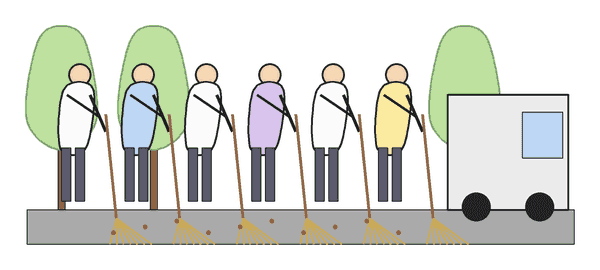
The picture below shows a campaign recently started by the Indian Government.
(i) When was this campaign launched ?
(ii) Mention the chief objectives of this campaign.
Solve with AIWritten solution
Solution:
Concept: The picture shows people sweeping the streets: the Swachh Bharat Abhiyan (Clean India Movement).
Step 1 — Part (i): when it was launched.
It was launched on 2nd October 2014, as a cleanliness campaign of the Government of India with the dream of a clean and hygienic India.
Step 2 — Part (ii): its chief objectives.
- to clean the streets, roads and infrastructure of cities and towns;
- to eliminate open defecation by building individual, cluster and community toilets (Open Defecation Free India);
- to set up an accountable mechanism of monitoring latrine use;
- to achieve efficient solid and liquid waste management.

Therefore, (i) the campaign was launched on 2nd October 2014; (ii) its objectives are clean streets, an open defecation free India, monitored latrine use and efficient waste management.
- 377 marks
Question 37
The figure given below shows a kind of pollution. Study the figure and answer the following questions.
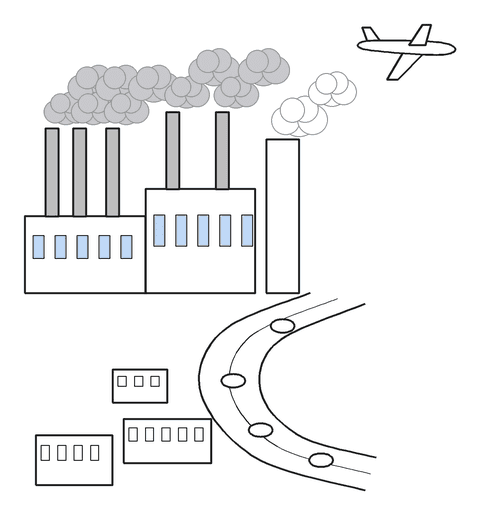
(i) Define the kind of pollution shown here.
(ii) Name two types of the kind of pollution shown here.
(iii) Write two main sources of above mentioned pollution with one example each.
(iv) Write two points to control the given pollution.
Solve with AIWritten solution
Solution:
Concept: Smoking factory chimneys, an aeroplane and vehicles on the road all release harmful gases and particles, so the figure shows air pollution.
Step 1 — Part (i): define the pollution.
Air pollution is the degradation of the air quality which harmfully affects living organisms as well as certain objects.
Step 2 — Part (ii): its two types.
Gaseous pollution is caused by harmful gases from a variety of sources. Particulate pollution is caused by particles such as dust and smoke.
Step 3 — Part (iii): two main sources.
- Natural sources, for example ash from erupting volcanoes (also dust storms and forest fires).
- Man-made sources, for example vehicle exhaust (also industries, burning garbage and brick kilns).

Step 4 — Part (iv): two ways to control it.
- Use unleaded petrol and CNG in automobiles.
- Fit factories with tall chimneys with filters and electrostatic precipitators, which remove the particles from the smoke.
Switching off engines at red lights also helps.
Therefore, (i) air pollution is the degradation of air quality; (ii) gaseous and particulate; (iii) natural (volcanic ash) and man-made (vehicle exhaust); (iv) unleaded petrol / CNG and chimneys with filters and precipitators.
- 385 marks
Question 38
Study the figure shown here and answer the following questions.
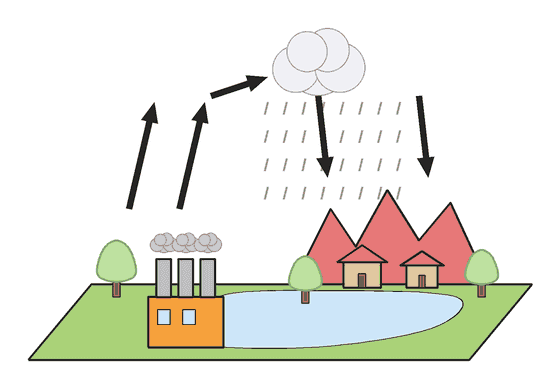
(i) Identify the kind of pollution and define it.
(ii) Mention four main sources of the pollution.
(iii) Write two harmful effects the above-mentioned pollution for the living organisms.
Solve with AIWritten solution
Solution:
Concept: Gases from factory chimneys rise, dissolve in the clouds and come down as rain on the land, houses and water. This is acid rain.
Step 1 — Part (i): identify and define it.
The pollution is acid rain. Gases such as sulphur dioxide () and oxides of nitrogen released into the air dissolve in the rain drops, so the rain falling on earth is far more acidic than clean rain (pH about 5.6).
Step 2 — Part (ii): four main sources.
The acid-forming gases come mainly from these four sources:
- Industries and factories
- Thermal power plants burning coal
- Automobiles (vehicle exhaust)
- Burning of fuels in homes and burning of garbage
All four burn fuel, and so they give out the acid-forming gases.
Step 3 — Part (iii): two harmful effects.
Acid rain harms living organisms in two main ways:
- Lakes and rivers become more acidic, so fish and other aquatic animals are harmed.
- Vegetation is damaged: leaves are injured and the soil is polluted.
Therefore, (i) acid rain; (ii) industries, thermal power plants, automobiles and burning of fuels; (iii) aquatic life harmed and vegetation damaged.
- 393 marks
Question 39
Study the pictures given below of the two main categories of wastes and answer the questions :
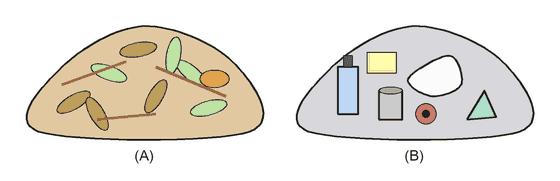
(i) Identify the categories of wastes in (A) and (B).
(ii) Which of the above category of wastes can be used to prepare compost ?
(iii) Mention one control measure to manage the waste of category (B).
Solve with AIWritten solution
Solution:
Concept: Biodegradable waste can be broken down by microorganisms; non-biodegradable waste cannot.
Step 1 — Part (i): identify the categories.
Heap (A) has leaves, twigs and peels, which microorganisms can break down: it is biodegradable waste. Heap (B) has bottles, cans, polythene and glass, which microorganisms cannot break down: it is non-biodegradable waste.
Step 2 — Part (ii): which can be composted.
Compost is made when microorganisms break waste down into manure. Only biodegradable waste can be broken down this way, so category (A) is used.
Step 3 — Part (iii): managing category (B).
Recycling of plastic, metal and glass into new articles, with incineration of the part that cannot be recycled. Reducing and reusing such articles also helps.

Therefore, (i) (A) biodegradable, (B) non-biodegradable; (ii) category (A); (iii) recycling.
- 404 marks
Question 40
Pollution is on the rise due to a rapid increase in the number of automobiles and buildings. All of these release a large amount of harmful gases and particulate pollutants in the atmosphere which react with atmospheric moisture and produce various kinds of acidic gases.
(i) Mention two main gases which are emitted from the industries into the atmosphere.
(ii) What are the two main acids produced in the atmosphere when poisonous gases combine with the atmospheric moisture ?
(iii) Write two harmful effects of acid rain.
Solve with AIWritten solution
Solution:
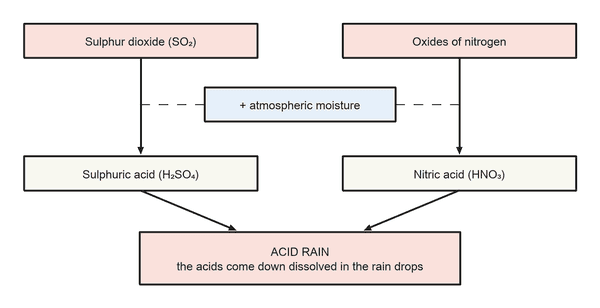
Concept: Sulphur dioxide and oxides of nitrogen combine with the moisture in the air to form acids, which come down with the rain as acid rain.
Step 1 — Part (i): two gases from industries.
Sulphur dioxide () and oxides of nitrogen (such as ).
Step 2 — Part (ii): the two acids formed.
Sulphur dioxide forms sulphuric acid (), and the oxides of nitrogen form nitric acid (). These acids come down dissolved in the rain drops.
Step 3 — Part (iii): two harmful effects of acid rain.
- The acid reacts with the calcium carbonate of marble and limestone, so ancient monuments, statues and buildings erode; building material and paints decay.
- Vegetation and aquatic life are harmed: the soil is polluted and lakes become too acidic for fish.
Therefore, (i) and oxides of nitrogen; (ii) sulphuric acid and nitric acid; (iii) monuments erode and plants and aquatic life are harmed.
What Class 10 Biology Ch 16 covers
The sections of the chapter, in the order the book takes them. Every question above comes from one of these.
- 01What Is Waste
- 02Pollution
- 03Air Pollution
- 04Water Pollution
- 05Soil Pollution
- 06Radiation
More ways to study this chapter
The same chapter asked three other ways. Practise it, revise it, and see what the board has set on Ch 16 before.
- Competency-Based Questions (CBQ)Case study questions: a situation, and the part of the chapter that answers it.40questionsOpen
- Previous Year QuestionsQuestions that have actually appeared in board papers, each tagged with its year.46questionsOpen
- Practice QuestionsExtra questions per chapter, for when one attempt at a method is not enough.45questionsOpen
Ch 16 in past ICSE papers
The same chapter as the board has actually asked it. These are worded differently from the textbook exercise, which is the point of reading them.
- 11 mark
Board paper question 1
Name the following:
The pollutants that cannot be broken down to simple and harmless products.
Solve with AIWritten solution
Solution:
Concept: Wastes are of two kinds. Biodegradable wastes (dung, fallen leaves, kitchen left-overs, paper, crop residue) are broken down by microorganisms such as bacteria and fungi into harmless substances. Non-biodegradable wastes (plastics, styrofoam, metal cans, glass, E-waste and persistent pesticides like DDT) are not broken down by microorganisms, or only extremely slowly, so they pile up and cause pollution.
Step 1 — Read what is asked.
The question wants the name of the pollutants that microorganisms cannot break down into simple, harmless products.
Step 2 — Match it to the two kinds of waste.
Pollutants that bacteria and fungi break down are biodegradable; those they cannot break down are non-biodegradable. Plastics, styrofoam, metal cans, glass, E-waste and DDT stay in the environment for a very long time, and their build-up causes pollution.

Watch out: 'Biodegradable' is the opposite group; the prefix 'non-' is the whole answer.
Therefore, they are called non-biodegradable pollutants (non-biodegradable wastes).
- 21 mark
Board paper question 2
In each set of terms given below, there is an odd one and cannot be grouped in the same category to which the other three belong. Identify the odd term in each set and name the category to which the remaining three belong.
Example: Ovary, Fallopian tube, Ureter, Uterus. Odd term: Ureter Category: Parts of female reproductive system.
Sewage, Newspaper, Styrofoam, Hay.
Solve with AIWritten solution
Solution:
Concept: In an odd-one-out item, first find the property that three of the terms share, then name the term that lacks it and the category of the other three. Wastes are of two kinds. Biodegradable wastes (dung, fallen leaves, kitchen left-overs, paper, crop residue) are broken down by microorganisms such as bacteria and fungi into harmless substances. Non-biodegradable wastes (plastics, styrofoam, metal cans, glass, E-waste and persistent pesticides like DDT) are not broken down by microorganisms, or only extremely slowly, so they pile up and cause pollution.
Step 1 — Test each term.
Sewage (kitchen and toilet waste), newspaper (paper, made of plant fibre) and hay (dry grass) are all made of plant or animal matter, so bacteria and fungi break them down.
Step 2 — Find the odd term.
Styrofoam is a plastic foam used for packing. Microorganisms cannot break it down, so it is non-biodegradable and does not belong with the other three.
Watch out: Newspaper is not the odd term; paper is biodegradable even though it is a manufactured item.
Therefore, the odd term is styrofoam, and the other three are biodegradable wastes.
- 31 mark
Board paper question 3
Give the Biological / technical term for the following:
The process causing an undesirable change in the environment.
Solve with AIWritten solution
Solution:
Concept: Pollution is the addition of any constituent to air, water or land that spoils the natural quality of the environment. The constituent that causes it, a substance or a form of energy such as noise, heat or radiation, is called a pollutant.
Step 1 — Read what is asked.
The term must name the process, the undesirable change itself, and not the substance that causes it.
Step 2 — Name the process.
An undesirable change in the air, water or land, such as smoke in the air, sewage in a river or pesticides in the soil, is called pollution.
Watch out: 'Pollutant' is the agent that causes the change; the process is 'pollution'.
Therefore, the term is pollution.
- 41 mark
Board paper question 4
Choose the correct answer from the four options given below:
The prime source of chlorofluorocarbons is:
Solve with AIAnswer
(A) Vehicular emissions
(B) Industrial effluents
(C) Domestic sewage
- Correct
(D) Refrigeration equipments
Answer: (D) Refrigeration equipments
Concept: The ozone layer high in the atmosphere absorbs most of the sun's harmful ultraviolet (UV-B) rays. Chlorofluorocarbons (CFCs), once used in refrigerators, air conditioners, aerosol sprays and foam packing, rise to this layer, where UV light splits them and sets free chlorine atoms; each chlorine atom can destroy many thousands of ozone molecules, turning them into ordinary oxygen (O₂).
Step 1 — Recall where CFCs were used.
CFCs are man-made gases that were used as coolants in refrigerators and air conditioners, as propellants in aerosol spray cans and in making foam packing. Cooling equipment was their main source.
Step 2 — See why it matters.
CFCs that leak out rise to the ozone layer and set free chlorine, which destroys ozone. The thinner layer lets more harmful UV-B rays reach the earth. For this reason CFCs have been phased out worldwide under the Montreal Protocol (1987), and newer refrigerators use other coolants.
Watch out: Vehicle exhaust is the main source of many air pollutants, but not of CFCs.
Why the other options are wrong:
- (A) Vehicular emissions: vehicle exhaust gives out carbon dioxide, carbon monoxide, oxides of nitrogen, unburnt fuel and particles, not CFCs.
- (B) Industrial effluents: industrial effluents are liquid wastes discharged into rivers; they pollute water, not the ozone layer.
- (C) Domestic sewage: domestic sewage is liquid waste from kitchens and toilets; it pollutes water bodies and contains no CFCs.
Therefore, the prime source of chlorofluorocarbons is refrigeration equipment, option (D).
- 51 mark
Board paper question 5
Match the item given in Column A with the most appropriate one in Column B.
Column A Column B Euro norms dynamic body balance Hyperglycemia Hypoglycemia Natality static body balance vehicular standards nucleosome Solve with AIWritten solution
Solution:
Concept: Euro norms are emission standards first set in Europe. They fix the largest amount of each harmful gas and particle that a motor vehicle's exhaust may contain.
Step 1 — Read the item in Column A.
Euro norms are rules about how much pollution a vehicle may give out, so they must be matched with the item about vehicles.
Step 2 — Choose from Column B.
The only item about vehicles is vehicular standards. Body balance, blood sugar levels, natality and the nucleosome belong to other chapters.
Step 3 — Link it to India.
India follows the same idea through the Bharat Stage (BS) norms, based on the Euro norms. They limit carbon monoxide, unburnt hydrocarbons, oxides of nitrogen and particulate matter in the exhaust. India moved from BS IV straight to BS VI on 1 April 2020, skipping BS V.
Watch out: Do not match Euro norms with 'static' or 'dynamic body balance'; the word 'norms' means standards, here for vehicles.
Therefore, Euro norms are matched with vehicular standards.
- 65 marks
Board paper question 6
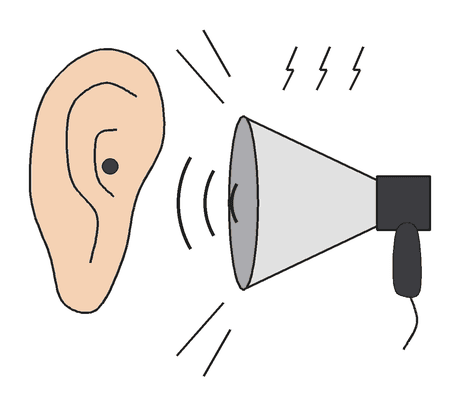
Given below is a representation of a kind of pollution. Study the same and answer the questions that follow:
(i) Name the kind of pollution.
(ii) List any three common sources of this pollution.
(iii) Mention three harmful effects of this pollution on human health.
(iv) Explain the term 'Pollutant'.
(v) Name two soil pollutants.
Solve with AIWritten solution
Solution:
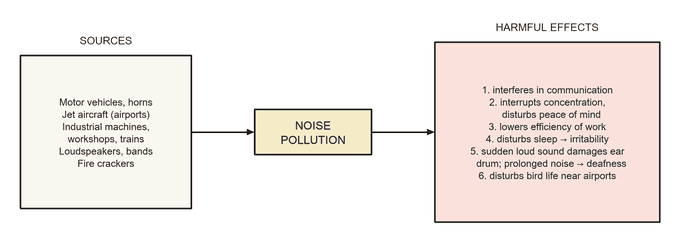
Concept: The picture shows a loudspeaker (megaphone) blaring sound straight into a human ear. Noise is unpleasant, loud, undesired sound. Its main sources are motor vehicles and their horns, jet aircraft, industrial machines, trains, loudspeakers, bands and fire crackers. It affects both the ear and the mind. Pollution is the addition of any constituent to air, water or land that spoils the natural quality of the environment. The constituent that causes it, a substance or a form of energy such as noise, heat or radiation, is called a pollutant.
Step 1 — (i) Name the kind of pollution.
Loud, unpleasant, undesired sound poured into the ear is noise pollution.
Step 2 — (ii) List three common sources.
Three common sources are: (1) motor vehicles and their horns; (2) loudspeakers and musical bands in public places; (3) industrial machines and workshops. Jet aircraft at airports, trains and fire crackers are other sources.
Step 3 — (iii) Give three harmful effects on health.
Noise harms us in three main ways: (1) it disturbs sleep and causes nervous irritability; (2) it interrupts concentration and disturbs peace of mind, which lowers the efficiency of work; (3) a sudden very loud sound can damage the ear drum, and prolonged noise can cause deafness.
Step 4 — (iv) Explain the term 'pollutant'.
A pollutant is any substance or form of energy (such as noise, heat or radiation) which, when added to air, water or land, spoils the natural quality of the environment. Pollution is the change; the pollutant is what causes it, for example smoke in air, sewage in water or pesticides in soil.
Step 5 — (v) Name two soil pollutants.
Two soil pollutants are pesticides such as DDT and chemical fertilizers used in excess. Industrial wastes such as fly ash, and biomedical waste, also pollute the soil.
Watch out: Part (v) asks for SOIL pollutants, not sources of noise; read every part on its own.
Therefore, (i) noise pollution; (ii) vehicles, loudspeakers, industrial machines; (iii) disturbed sleep and irritability, loss of concentration, damage to the ear drum and deafness; (iv) a pollutant is anything added to the environment that spoils its natural quality; (v) pesticides and chemical fertilizers.
All 46 board paper questions for this chapter, solved the same way.
Class 10 Biology Ch 16 questions students ask
How many questions are there in Class 10 Biology Ch 16?
40 questions. Every one is solved step by step on this page.
Are these Class 10 Biology solutions free?
Yes. Every question and its full working is free to read, with no account needed.
Can I download the Class 10 Biology Ch 16 solutions as a PDF?
There is no PDF to download. Every solution is on this page instead, which means it is searchable, always the current syllabus, and readable on a phone. Use your browser's print option if you want it on paper.