
Opening your dashboard
Class 10 Biology Chapter 16 Pollution – A Rising Environmental Problem: Competency-Based Questions (CBQ)
40 questions on Chapter 16, each worked through on its own page with the AI tutor. Class 10 Biology, ICSE 2026-27.
40 questions
1–5 marks · Mixed difficulty
- 11 mark
Question 1
Cognitive domain: Application
A stone-crushing unit starts working at the edge of a village. Within a few weeks the villagers complain of two things: a fine dust that settles on everything and makes them cough, and the roar of the machines that does not let them sleep. Which two types of pollution are the villagers facing ?
- 21 mark
Question 2
Cognitive domain: Analysis
A pollution control team analysed the air at four sites and listed the main pollutants found at each.
Site Gaseous pollutants Particulate pollutants P , , Rubber particles and road dust Q , , , oxides of nitrogen Particles in smoke from tall chimneys R Hot gases Smoke, large quantities of ash and broken brick bits S None in excess Ash and dust carried by the wind from far away Which site is most likely to be beside a busy highway ?
- 31 mark
Question 3
Cognitive domain: Application
After an accidental explosion at a nuclear power plant on the sea coast, health officials in a town km away begin two kinds of checks: they examine the thyroid gland of the residents, and they test the fish brought in by the local fishermen. Which facts from your chapter best explain both checks ?
- 41 mark
Question 4
Cognitive domain: Analysis
Scientists report that the ozone layer above a region has become much thinner. A student lists four changes and wonders which of them could be a direct result of this thinning.
- P: more cases of sun burn
- Q: more cases of skin cancer
- R: a rise in the sea level
- S: faster decay of building material and paints
Which of these should the student select ?
- 51 mark
Question 5
Cognitive domain: Understanding
Assertion (A): Planting trees along the roadside helps to control more than one kind of pollution.
Reason (R): Roadside trees reduce the noise reaching our ears and also reduce the amount of in the atmosphere.
- 61 mark
Question 6
Cognitive domain: Understanding
Assertion (A): The chemical fertilisers a farmer adds to his field can harm only the soil of that field.
Reason (R): Chemical fertilisers are slowly washed away by rain water and reach lakes and ponds.
- 71 mark
Question 7
Cognitive domain: Application
On his way to the office, Mr. Nair's car has to wait at red lights, for about seconds at each. He decides to follow one of the measures given in your chapter and switches off the engine at every red light.
On this journey his car now gives out no exhaust for ______ minutes, so less of the three main gaseous pollutants of vehicles, , and ______, is added to the air.
- 81 mark
Question 8
Cognitive domain: Understanding
Rohan enjoys playing film songs loudly on his speaker in the evening. His neighbour Sana, who is preparing for an examination at that time, cannot study because of it.
For Sana the same music is ______, because it is an undesired sound that interferes with her hearing and ______.
- 91 mark
Question 9
Cognitive domain: Application
A science club measured the pH of rain water at two places. In a hill village far from any town it was about . In an industrial town with heavy traffic it was .
The rain of the town is called ______ rain; its lower pH is due to the excess of carbon dioxide, sulphur dioxide and oxides of ______ that dissolve in the rain drops.
- 102 marks
Question 10
Cognitive domain: Application
A new colony of houses is built beside a lake from which a nearby village takes its drinking water. The builder plans to let all the waste water from the kitchens and toilets flow straight into the lake.
Predict two harmful results of this plan, and suggest two facilities that the builder should provide instead.
- 112 marks
Question 11
Cognitive domain: Evaluation
During a debate, a speaker says: "All air pollution is made by man. If people stopped polluting, the air would have no pollutants at all."
Do you agree with the speaker ? Justify your answer with two points.
- 122 marks
Question 12
Cognitive domain: Analysis
A factory has two workshops, each with workers doing the same job. In workshop A, noisy machines run all day. Workshop B is quiet. The manager collected these figures.
Observation Workshop A Workshop B Average number of mistakes made by a worker in a week 14 5 Workers who complain of disturbed sleep and irritability 12 3 Workers with partial loss of hearing 4 0 Which three harmful effects of noise do these figures point to ? Why was it necessary to collect the same figures for workshop B ?
- 135 marks
Question 13
Cognitive domain: Analysis
Case: To model what happens in the earth's atmosphere, a teacher took two identical glass jars, P and Q, each fitted with a thermometer. Jar P contained ordinary air. Jar Q contained air to which the teacher had added extra carbon dioxide. Both jars were closed tightly and kept side by side in the sunlight. The class recorded the temperature inside each jar.

Time (minutes) Jar P () Jar Q () 0 28 28 10 31 33 20 33 36 30 34 38 (a) Calculate the rise in temperature in each jar in minutes. Why was jar P included in the experiment ?
(b) The air in both jars became warm. Explain why, and explain why jar Q became warmer than jar P.
(c) Name the effect in the atmosphere that jar Q models, and name one other gas that acts in the same way. Give two reasons why the amount of carbon dioxide in the atmosphere is rising.
(d) State two consequences for the earth if this warming continues.
- 144 marks
Question 14
Cognitive domain: Evaluation
Case: The council of a small town has received four proposals for making the town cleaner.
Proposal What it says 1 Collect all the garbage of the town and burn it on the open ground every evening. 2 Lay a long pipe to carry the town's sewage to the river, at a point beyond the last house. 3 Plant trees along the roads and on the waste land around the town. 4 Put up boards at traffic signals asking drivers to switch off their engines at red lights. (a) Which two proposals should the council reject ? Give one reason for rejecting each.
(b) Suggest a better measure from your chapter in place of each rejected proposal.
(c) A council member says, "Once the good proposals are carried out, our town will be completely free of pollution." Judge this statement.
- 155 marks
Question 15
Cognitive domain: Creativity
Case: The eco-club of a school wants to find out for itself which kinds of household waste break down in the soil and which do not. It has six flower pots, garden soil, a watering can, gloves, labels, and these clean, dry items: a vegetable peel, a fallen leaf, a piece of newspaper, a piece of a polythene bag, a piece of a styrofoam cup and the lid of a metallic can.
(a) Write the question the club is trying to answer, and state the result you expect for each item.
(b) Design the investigation. Describe how the pots should be set up and looked after so that the comparison is fair.
(c) Draw up a table in which the club can record its observations, and state how often it should observe.
(d) State how the club should use its findings to advise the school on handling its waste, and mention one safety precaution the members must take.
- 161 mark
Question 16
CISCE Competency-Focused Practice Questions (2024) · Cognitive domain: Analysis
Rita suffers from constant headaches and high blood pressure. Her residence is close to an airport. What could be the most likely cause of her condition?
- 172 marks
Question 17
CISCE Competency-Focused Practice Questions (2024) · Cognitive domain: Analysis
The number of asthma patients increases during winters in metropolitan cities like Delhi. Why is it so? How can it be reduced?
- 181 mark
Question 18
Cognitive domain: Analysis
A thermal power plant uses river water to cool its machinery and releases the used water back into the river. A science club caught fish with the same net for minutes at five points on the same morning: above the plant, and at four distances below its outlet. No other waste enters this stretch of the river. (Hypothetical data.)
Point Above the plant m m m m Water temperature Fish caught What is the farthest of these points below the outlet at which the warm water is clearly harming the fish ?
- 191 mark
Question 19
Cognitive domain: Understanding
A factory sends out three kinds of waste from its site: P, black smoke from its tall chimney; Q, liquid waste that flows out into a nearby stream; and R, flyash and metallic ash that are dumped on the bare ground beside the factory wall. After a few days, which of these will most likely be harming only the land close to the factory, and why ?
- 201 mark
Question 20
Cognitive domain: Application
The eco-club of a school sorts its waste into three heaps: P, vegetable peels from the canteen and fallen leaves from the garden; Q, empty glass bottles and metal cans; R, torn plastic wrappers that no local scrap dealer will take for recycling. Which option gives the method from the chapter that suits each heap best ?
- 211 mark
Question 21
Cognitive domain: Understanding
Assertion (A): An old mobile phone can be disposed of by putting it into a compost pit along with vegetable peels.
Reason (R): Electronic waste cannot be broken down by microorganisms.
- 221 mark
Question 22
Cognitive domain: Analysis
Assertion (A): Global warming is melting the snow caps of the earth.
Reason (R): The depletion of the ozone layer lets more UV-B rays reach the earth.
- 231 mark
Question 23
Cognitive domain: Analysis
The eco-club of a school cleaned a m stretch of a beach and counted the single-use plastic items it collected. The bar chart shows the numbers. (Hypothetical data.)
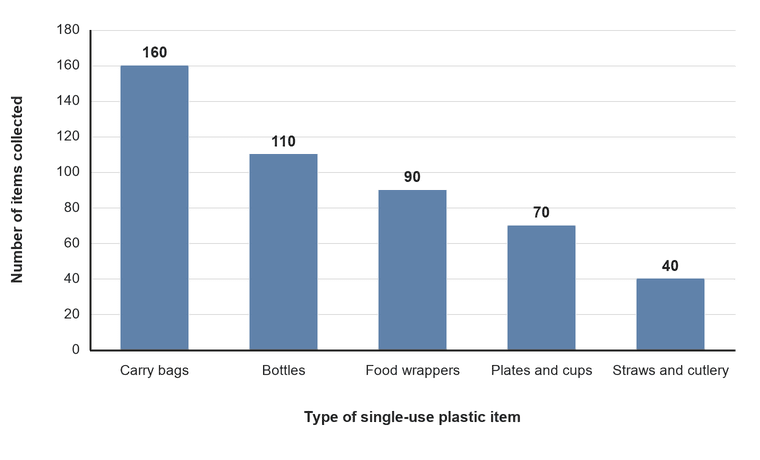
The club can ask people to follow some habits that help to lessen the plastic menace:
- Habit 1: carry a reusable fabric bag and do not ask for plastic carry bags
- Habit 2: carry a refillable water bottle
- Habit 3: avoid disposable cutlery and straws
- Habit 4: avoid disposable plates and cups
Suppose each habit completely removes the items it targets. Which pair of habits would have prevented the largest number of the collected items ?
- 241 mark
Question 24
Cognitive domain: Application
A health camp in a big city records three patients.
- Patient 1: a traffic constable who stands at a crowded junction every day and has serious damage to the air passages of his lungs (bronchitis).
- Patient 2: a child who gets asthma attacks on foggy winter mornings, when it is hard to see across the road.
- Patient 3: a worker in a place where the air carries fine lead particles, who has a shortage of blood cells.
Which option matches each patient with the air pollutant that, according to the chapter, causes the problem ?
- 251 mark
Question 25
Cognitive domain: Evaluation
Aarav sowed green gram seeds in each of three trays of the same soil and kept the trays in the same place. He watered tray P every day with tap water, tray Q with tap water in which g of washing detergent was dissolved in mL, and tray R with a solution of g of the same detergent in mL. After six days he counted the seeds that had germinated. (Hypothetical data.)
Tray Water used Seeds germinated (out of ) P Tap water Q g detergent in mL R g detergent in mL Which conclusion is best supported by these results ?
- 262 marks
Question 26
Cognitive domain: Understanding
A hospital puts up this notice outside its X-ray room: "X-ray tests only on the doctor's advice. Please do not ask for repeat X-rays." A patient had an X-ray of his chest taken at another clinic last week but has lost the report, and he asks for a fresh X-ray. The doctor first asks him to get a copy of the old report from that clinic.
(a) Name two serious health hazards that too frequent and too many X-ray exposures may cause.
(b) Using your answer to part (a), explain why the doctor does not simply take a fresh X-ray.
- 272 marks
Question 27
Cognitive domain: Application
The Euro/Bharat (BS) norms fix the most that a vehicle may release of the oxides of nitrogen and sulphur. The table gives the limit for the oxides of nitrogen for a car of each BS standard, in grams per kilometre. (Hypothetical data.)
Standard BS II BS III BS IV Limit for oxides of nitrogen (g per km) A taxi company replaces BS II taxis by BS IV taxis. Each taxi runs km a day for days in a year.
(a) By what percentage is the limit per kilometre lower for a BS IV car than for a BS II car ?
(b) By how many tonnes a year does the company lower the quantity of oxides of nitrogen that its taxis are allowed to release ? ( tonne g)
- 282 marks
Question 28
Cognitive domain: Evaluation
At a village meeting, a visitor says: "Pollution is a problem of big cities with factories and heavy traffic. A village with its fields and ponds has no pollution."
Do you agree with the visitor ? Support your answer with two points from your chapter.
- 292 marks
Question 29
Cognitive domain: Application
A tanker lorry full of petrol overturns on a bridge over a river and catches fire. The explosion is heard two kilometres away. Thick black smoke rises over the town, and some of the petrol flows over the edge of the bridge and spreads over the surface of the river.
Name three types of pollution that this one accident causes, and give one pollutant for each.
- 302 marks
Question 30
Cognitive domain: Analysis
Some years ago, a farmer sprayed his field every season for ten years with a long-lasting pesticide. A soil scientist compared a sample from this field with a sample from a neighbouring field of the same kind of soil that has never been sprayed. In each field, identical pieces of dead leaf were buried for days. (Hypothetical data.)
Sample Microorganisms (millions per gram of soil) Leaf pieces not yet broken down after days (out of ) Sprayed field Field never sprayed (a) By what percentage are the microorganisms fewer in the sprayed field than in the field that was never sprayed ?
(b) Use your chapter to explain why more leaf pieces are left in the sprayed soil, and why this matters for the crops.
- 312 marks
Question 31
Cognitive domain: Creativity
The residents' association of a colony wants a quiet and clean festival. Write a short notice of about words for the notice board, asking residents not to burst fire crackers. Your notice must name one harm that the noise does to people, one harm to the air, and suggest one other way of celebrating.
- 323 marks
Question 32
Cognitive domain: Analysis
The air-quality report of a town gives the share of each source in the particles found in the town's air in one year. (Hypothetical data.)
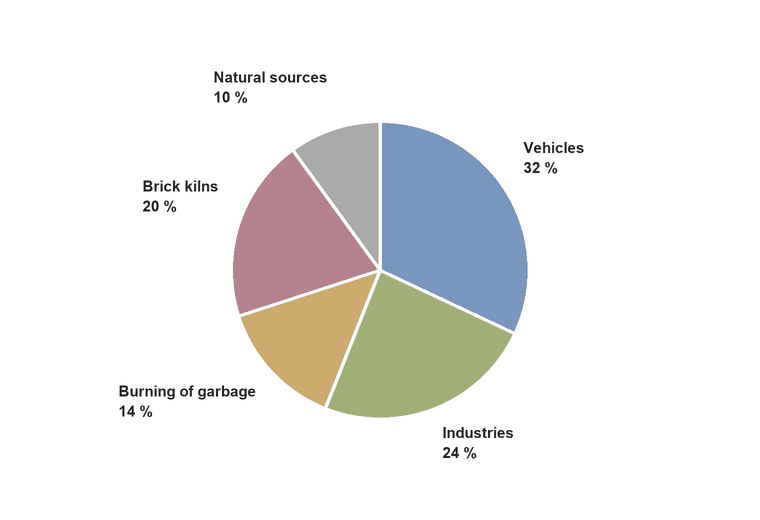
(a) What percentage of the particles comes from sources that people can control ?
(b) The town stops the burning of garbage completely and halves the amount of particles given out by vehicles. Nothing else changes. By what percentage does the amount of particles in the air fall ?
(c) Name two measures from the chapter that would help to lower the share of the source that gives the most particles.
- 333 marks
Question 33
Cognitive domain: Application
A small village clinic dumps used needles and syringes, dirty dressings and out-of-date tablets, together with its kitchen waste, in an open pit behind the building. The pit is next to a field, and the monsoon rain fills it every year.
(a) Name this kind of waste that the clinic produces.
(b) State two ways in which this waste can cause harm.
(c) How should the clinic handle this waste instead ?
- 343 marks
Question 34
Cognitive domain: Application
A town plans to widen a road and to cut down trees that grow along it. Suppose that each tree takes in about kg of carbon dioxide in a year. (Hypothetical value.)
(a) Find the quantity of carbon dioxide, in tonnes, that these trees no longer take in each year. ( tonne kg)
(b) The town promises to plant saplings, each of which takes in about kg of carbon dioxide in a year. How many saplings are needed to make up for the loss ?
(c) State one benefit of planting trees, other than taking in carbon dioxide, that is given in the chapter.
- 353 marks
Question 35
Cognitive domain: Evaluation
A fish-processing unit on a sea coast releases its toxic liquid waste into the sea. The owner says: "The sea is so huge that the waste gets lost in it and cannot harm anyone."
(a) Do you agree with the owner ? Give a reason.
(b) How can the harm reach people who live far from the unit ?
(c) What should the unit do before it releases its liquid waste ?
- 363 marks
Question 36
Cognitive domain: Understanding
In Ward A of a town, a sweeper sweeps a dry, dusty main road with a broom at a.m. every day. A tea-stall owner beside this road coughs a lot, and the sweeper often has a sore throat. In Ward B, the road is first sprinkled lightly with water and then swept.
(a) Name the type of air pollution that the dry sweeping causes, and state whether its source is natural or man-made.
(b) Using your chapter, state how this pollution harms the sweeper and the tea-stall owner.
(c) Explain why sprinkling water before sweeping, as in Ward B, reduces this pollution, and suggest one way in which the sweeper in Ward A can protect himself.
- 375 marks
Question 37
Cognitive domain: Analysis
Case: In January 2020 the municipal ward of Ramnagar had open garbage heaps along its streets. Residents complained of flies, rats and a foul smell, and after every monsoon shower dirty water from the heaps flowed into the drains and the nearby pond. The ward then joined the Swachh Bharat Abhiyan. It began door-to-door collection of waste, placed separate bins for wet and dry waste, set up a compost unit for the kitchen waste and asked people not to litter. The ward office counted the open heaps and the complaints about flies and rats in the first week of every January. (Hypothetical data.)
Year Open garbage heaps Complaints about flies and rats in the week 2020 2021 2022 2023 (a) Find the percentage fall in the number of open garbage heaps from 2020 to 2023.
(b) Find the number of complaints per heap in each year, and say what the answers show.
(c) Explain, with reasons from your chapter, why open heaps of garbage are a danger to health and to the environment.
(d) Name two objectives of the Swachh Bharat Abhiyan that the ward's actions served, and state one thing that the residents themselves must do.
- 384 marks
Question 38
Cognitive domain: Evaluation
Case: A school climate club collected rounded values of the carbon dioxide in the air and of the average temperature of the earth's atmosphere for four years. (Hypothetical data.)
Year Carbon dioxide in the air (parts per million) Rise in average temperature since () 1990 2000 2010 2020 (a) Find the rise in carbon dioxide from to , in parts per million and as a percentage of the value, to the nearest whole number.
(b) Rohit says: "The table proves that more carbon dioxide makes the earth warmer." Evaluate his statement.
(c) Seema says: "A rise of only is too small to worry about." Evaluate her statement using your chapter.
- 395 marks
Question 39
Cognitive domain: Analysis
Case: The pollution control cell of a city recorded the complaints that it received in one month from three localities. The table gives the number of complaints per households. (Hypothetical data.)
Locality X lies beside a highway and a cement factory. Locality Y is an old part of the town beside a lake and has no sewage treatment plant. Locality Z is a village on the edge of the city, with farms and a brick kiln.
Complaint Locality X Locality Y Locality Z Dust, smoke or trouble in breathing Foul or foamy water, dead fish Loud noise and loss of sleep Dumped waste and damaged soil (a) Name the type of pollution that tops the complaints in each locality.
(b) Give a likely source for the top complaint of locality X, and one for its high noise complaints.
(c) For the top complaint of locality Y, name two likely sources and two control measures.
(d) Find which locality has the largest total number of complaints, and what percentage of the complaints of that locality are about the air, to the nearest whole number.
- 405 marks
Question 40
Cognitive domain: Creativity
Case: Students of a school near a busy road want to find out which of three places in their locality has the most particulate pollution in the air: the footpath beside the busy road, the school garden, and a corner of the colony where garbage is often burnt. They have white cards ( cm cm), petroleum jelly, sticky tape, a magnifying glass, labels and a ruler.
(a) Write the question that the group is trying to answer, and the result you expect at each place, with a reason.
(b) Describe how the group should use the cards so that the comparison is fair.
(c) Draw a table in which the group can record its observations, and state how long the cards should be left out.
(d) Say how the group should use its findings, and state one safety precaution.