
Question 101 markMCQEasy
Which of the following gas can cause acid rain ?
Confirming your payment
Sign up now and get 250 free tokens.
Pollution – A Rising Environmental Problem · Question 10 of 40
Which of the following gas can cause acid rain ?
(A) Sulphur dioxide
(B) Ammonia
(C) Hydrogen
(D) Nitrogen
Answer: (A) Sulphur dioxide
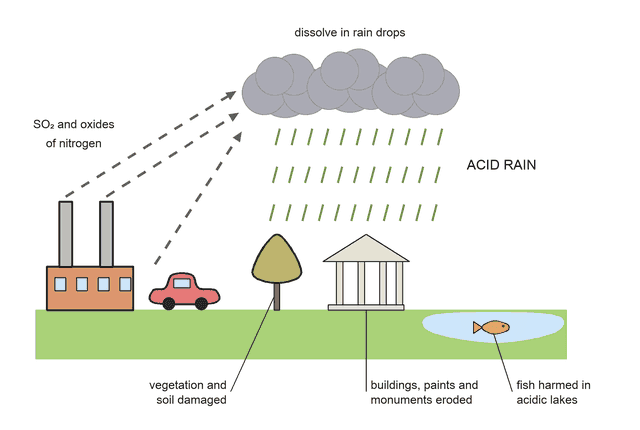
Concept: Acid rain forms when acid-forming gases, mainly sulphur dioxide and oxides of nitrogen, dissolve in rain drops and make the rain much more acidic than normal.
Step 1 — Know what normal rain is like.
Clean rain is only slightly acidic (pH about 5.6), because a little from the air dissolves in it.
Step 2 — See what the pollutant gas does.
Industries and vehicles now give out a lot of sulphur dioxide () and oxides of nitrogen. These dissolve in the rain drops and form acids, so the rain becomes far more acidic. This is acid rain.
Watch out: Nitrogen () is not an acid-rain gas; only its oxides are.
Why the other options are wrong:
Therefore, sulphur dioxide can cause acid rain, option (A).