Solution:
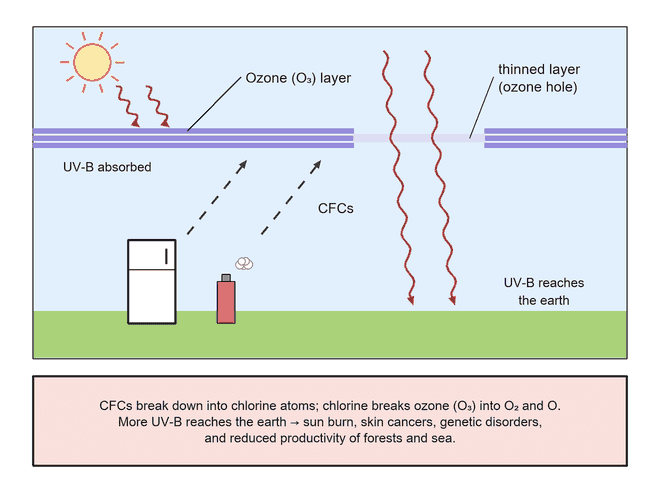
Concept: The left panel shows an intact ozone layer stopping the sun's harmful rays; the right panel shows the layer thinned by gases from factories and sprays, so the rays reach the earth.
Step 1 — Part (i): name the phenomenon.
The phenomenon is ozone layer depletion.
Step 2 — Part (i): explain it.
Ozone (O3) high up in the atmosphere acts as a sunscreen that stops harmful UV-B rays.
→ Gases such as CFCs rise into the atmosphere and break down into chlorine atoms.
→ The chlorine atoms break ozone into oxygen (O2) and O.
→ The thinned layer (ozone hole) can no longer stop the UV-B rays from reaching the earth.
Step 3 — Part (ii): the sources.
Chlorofluorocarbons (CFCs) released from refrigerators (and air conditioners), aerosol sprayers and styrofoam packing material.
Step 4 — Part (iii): effects on humans.
UV-B rays reaching the earth cause sun burn, skin cancers and genetic disorders. They also reduce the productivity of forests and the sea.
Therefore, (i) ozone layer depletion by chlorine from CFCs; (ii) CFCs from refrigerators, aerosol sprayers and styrofoam; (iii) sun burn, skin cancers and genetic disorders.

