
Opening your dashboard
Class 10 Biology Chapter 16 Pollution – A Rising Environmental Problem: Practice Questions
45 questions on Chapter 16, each worked through on its own page with the AI tutor. Class 10 Biology, ICSE 2026-27.
45 questions
1–5 marks · Mixed difficulty
- 11 mark
Question 1
Bloom's level: Remember
In 2010, several people in Mayapuri, Delhi, suffered serious radiation burns and one of them died after handling carelessly discarded radioactive waste from a research centre. The radioactive material was :
- 21 mark
Question 2
Bloom's level: Remember
Which of the following is not one of the five major types of pollution described in the chapter ?
- 31 mark
Question 3
Bloom's level: Remember
The Euro / Bharat Stage (BS) emission norms for automobiles mainly aim to cut down the amount of :
- 41 mark
Question 4
Bloom's level: Remember
Some air pollutants come from natural sources that are beyond human control and will continue to occur. One such source is :
- 51 mark
Question 5
Bloom's level: Understand
Open heaps of untreated garbage are a danger to human health mainly because they :
- 61 mark
Question 6
Bloom's level: Understand
Pollution is described as a serious problem of modern times mainly because :
- 71 mark
Question 7
Bloom's level: Understand
When chemical fertilisers from fields are washed into a pond, the fish in the pond may die because :
- 81 mark
Question 8
Bloom's level: Apply
Meera cannot solve a difficult sum because two people are talking softly in her room. Later, she reads a comic in a noisy running train without being disturbed. This shows that :
- 91 mark
Question 9
Bloom's level: Apply
In an old city with many factories and heavy traffic, the marble statues in a public garden have become pitted and rough over the years. The most likely cause is :
- 101 mark
Question 10
Bloom's level: Analyse
Assertion (A): DDT can enter the body of a person who has never handled it.
Reason (R): DDT persists undegraded in the soil and can reach humans through food grown in such soil.
- 111 mark
Question 11
Bloom's level: Analyse
Assertion (A): Burning garbage adds to air pollution.
Reason (R): Garbage consists mainly of items such as vegetable peels, shells of dry fruits and leftover food.
- 121 mark
Question 12
Bloom's level: Evaluate
Assertion (A): Operators of X-ray machines have to take very special care to avoid exposure.
Reason (R): X-rays are harmless to body cells because they are used in hospitals for medical purposes.
- 132 marks
Question 13
Bloom's level: Understand
Explain why pollution is said to threaten not only human health but almost all kinds of our surroundings. Give two examples.
- 142 marks
Question 14
Bloom's level: Understand
is naturally present in clean air, yet it is listed as a pollutant. Explain why.
- 152 marks
Question 15
Bloom's level: Understand
Explain two ways in which radiation can escape from nuclear power plants, and how radiation from the Fukushima plant reached people living far from it.
- 162 marks
Question 16
Bloom's level: Understand
Explain how chlorofluorocarbons (CFCs) released at ground level end up harming people through the ozone layer.
- 172 marks
Question 17
Bloom's level: Apply
A power plant takes in river water at to cool its machinery and discharges it back into the river – warmer. Between what temperatures will the discharged water be ? Name this kind of pollution and state its effect on the river.
- 182 marks
Question 18
Bloom's level: Apply
A family produces about 2 kg of waste a day, of which 60% is biodegradable (peels, leftovers, dry leaves) and the rest is non-biodegradable (plastic, glass, metal cans).
(a) How much waste could the family turn into compost in a week ?
(b) How much non-biodegradable waste does it produce in a week, and what should be done with it ?
- 192 marks
Question 19
Bloom's level: Apply
Suggest one suitable control measure for each of the following, with a reason :
(a) Thick smoke from the chimney of a cement factory.
(b) A city's fleet of old diesel buses.
- 202 marks
Question 20
Bloom's level: Apply
A village panchayat builds a toilet in every house and a community toilet near the market, and appoints volunteers to check that the toilets are being used. Which objectives of the Swachh Bharat Abhiyan is the village working towards ? What would the village then be called ?
- 212 marks
Question 21
Bloom's level: Analyse
The temperature of the earth's atmosphere has risen by about in the last three decades. Analyse how a rising population and deforestation together lead to this warming, and name two results of the warming.
- 222 marks
Question 22
Bloom's level: Evaluate
A shopkeeper says : "Thin plastic carry bags are no problem — we just burn them at the end of the day." Evaluate this claim, and suggest two better habits.
- 234 marks
Question 23
Bloom's level: Apply
Case: A farmer sprays large amounts of DDT on his crops and adds much more chemical fertiliser than needed. His field slopes down to a village pond. After the monsoon rains, many fish in the pond are found dead, and over the years his soil has become less fertile.
(a) How do the fertilisers from the field reach the pond, and how do they kill the fish ?
(b) Explain why the soil has become less fertile.
(c) Suggest two changes in his farming practice.
- 243 marks
Question 24
Bloom's level: Apply
Case: A school stands next to a busy highway and a wedding hall that plays loud music late into the night. A building is also being constructed opposite the school. During the examination season, students complain of headaches and of being unable to concentrate.
(a) Name the three sources of noise in this situation.
(b) State three harmful effects this noise may have on the students and teachers.
(c) Suggest three measures to reduce the noise reaching the school.
- 254 marks
Question 25
Bloom's level: Apply
A brick kiln has been set up at the edge of a village.
(a) Briefly describe how bricks are baked in such a kiln.
(b) Name the gaseous and particulate pollutants the kiln is likely to add to the air.
(c) Explain what harm these pollutants could cause to the villagers' health, and name the solid wastes the kiln leaves behind.
- 264 marks
Question 26
Bloom's level: Analyse
In an experiment, two similar spinach plants were sprayed regularly for some weeks — plant P with water of pH 5.6 (mildly acidic) and plant Q with water of pH 3 (much more acidic). The leaves of P stayed almost normal, but the leaves of Q developed many pale, dead spots.
(a) Which plant represents the effect of acid rain more strongly ? Explain using the pH values.
(b) Clean rain is itself slightly acidic (pH about 6). Why ?
(c) Analyse how acid rain can harm (i) the fish in a lake and (ii) the plants of a forest.
- 274 marks
Question 27
Bloom's level: Analyse
A science club tested a river at two points — upstream of a town and downstream, where the town's drains and a factory outlet join the river. Their report on the downstream sample says :
- White foam floating on the surface.
- Foul smell and floating kitchen wastes.
- Coloured water with chemicals; many dead fish.
- Water warmer than upstream, near a power plant outlet.
(a) For each observation, name the most likely source of water pollution.
(b) Which two human diseases might spread among people who use this water ?
(c) Suggest two measures the town should take.
- 285 marks
Question 28
Bloom's level: Evaluate
Case: A growing city suffers from smog every winter. Two plans are proposed :
- Plan X : Make all factory chimneys taller so that the smoke goes higher up. Nothing else is changed.
- Plan Y : Fit factory chimneys with filters and electrostatic precipitators, run public buses on CNG, enforce Bharat Stage norms for vehicles, ask drivers to switch off engines at red lights, and plant trees along roads.
(a) What is smog, and how does it affect people ?
(b) Evaluate Plan X. Is it enough on its own ?
(c) Which plan would you recommend ? Justify, by linking each part of the plan to the pollutant or source it tackles.
- 295 marks
Question 29
Bloom's level: Create
Construct a revision table for the five major types of pollution, with the columns : Type of pollution, Two sources, One harmful effect and One control measure.
- 305 marks
Question 30
Bloom's level: Create
Plan a "Clean and Green School" waste-management programme for your school, in the spirit of the Swachh Bharat Abhiyan.
(a) How will waste be collected and separated ?
(b) What will be done with each kind of waste ?
(c) Suggest two rules that will reduce plastic waste, and one way of checking that the programme is working.
- 311 mark
Question 31
A moving motor car adds several pollutants to the air. Which one of the following is added by the car, but does not come out of its exhaust pipe ?
- 321 mark
Question 32
Iodine-131 was the chief radiation pollutant released when a nuclear power plant in Japan exploded in 2011. This pollutant raises the risk of cancer of the :
- 331 mark
Question 33
Assertion (A): Rain water is slightly acidic even at a place where the air is clean.
Reason (R): Sulphur dioxide and oxides of nitrogen given out by industries dissolve in the rain drops.
- 342 marks
Question 34
A roadside stall serves snacks on two kinds of plates — plates made of dried leaves and plates made of Styrofoam. The used plates of both kinds are thrown on an open heap behind the stall.
(i) Which of the two kinds of plates forms a non-biodegradable waste ? Give a reason for your answer.
(ii) State two ways in which this open heap of garbage can harm the people living near it.
- 352 marks
Question 35
Give a reason for each of the following.
(i) The sewage of a city is passed through a sewage treatment plant before it is let into a river.
(ii) Many sea birds are found dead along the coast after an oil tanker overturns at sea.
- 362 marks
Question 36
The figure shows a section through a place outside a city where the solid waste collected by the municipal workers is finally disposed of. A depression in the ground is being filled up, day after day, with the layers numbered 1 and 2.
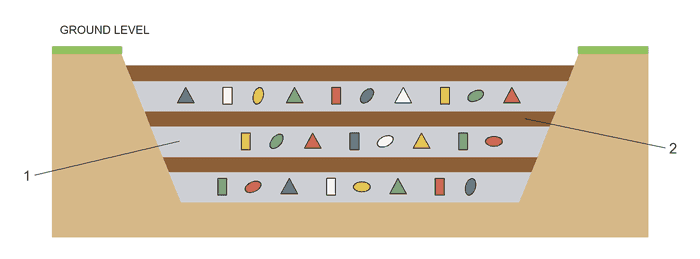
(i) Name this kind of place and state what the layers 1 and 2 are made of.
(ii) A part of the solid waste collected from the city need not be brought to this place at all. Which part is it, and what is done with it ?
- 372 marks
Question 37
(i) How does the harm done to the ear by a sudden loud sound differ from the harm done by prolonged noise ?
(ii) The houses of a colony stand along a busy road. Suggest two measures which will reduce the noise reaching the people inside these houses.
- 384 marks
Question 38
The figure shows what happens to the energy that the Earth receives from the sun. The rays numbered 1 come from the sun, the rays numbered 2 are given out by the warm surface of the Earth, and 3 is a part of the atmosphere.
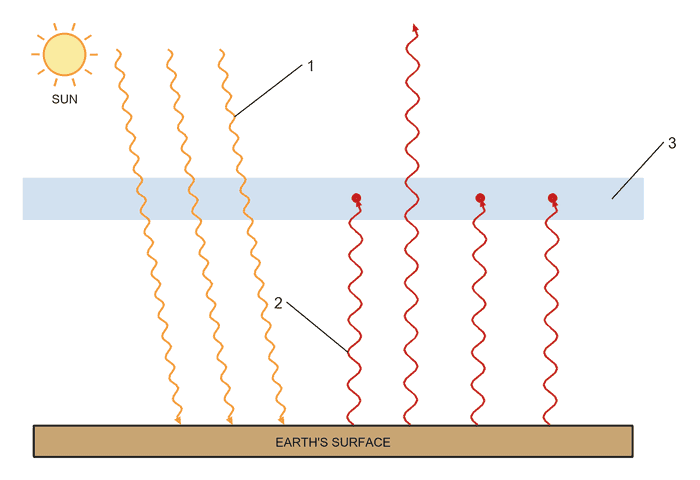
(i) Name the effect shown in the figure. What happens to most of the rays 2 when they reach part 3 ?
(ii) Rays 1 pass through part 3, but most of the rays 2 do not. In what way do the two kinds of rays differ ?
(iii) Name two gases whose accumulation in part 3 increases this effect. Explain, on the same principle, why the air inside a car parked in the sun with its windows closed becomes very hot.
- 393 marks
Question 39
A newspaper report says that all new motor vehicles sold in a city must now be "BS VI compliant".
(i) What do the letters BS stand for ? Which pollutants in the exhaust of automobiles do these norms mainly aim to cut down ?
(ii) Name the body which sets the time and the standards of these norms in India. On which foreign norms are the BS numbers based ?
(iii) These norms deal with vehicles only. Name two devices which are fitted to the tall chimneys of factories to control air pollution, and state the kind of air pollutant they help to remove from the smoke.
- 404 marks
Question 40
A housing society joins the Swachh Bharat Abhiyan. As its first step, it decides to stop the use of single-use plastics in all its homes.
(i) One goal of the Swachh Bharat Abhiyan is an "ODF India". What does this mean, and how was this goal to be reached ?
(ii) What are single-use plastics ? Give two examples. Why does discarded plastic remain a problem for a very long time ?
(iii) Describe how a plastic bag thrown into a street drain may finally harm an animal living in the sea. State two habits by which the members of the society can lessen the use of plastic.
- 411 mark
Question 41
Class 10 Sample Paper 1 · Section A
Name the following:
The agents that cause pollution and bring undesirable changes in the environment.
- 421 mark
Question 42
Class 10 Sample Paper 1 · Section A
Fill in the blank:
.......... is a greenhouse gas.
- 431 mark
Question 43
Class 10 Sample Paper 1 · Section A
Fill in the blank:
.......... causes corrosion of marble or brick surfaces.
- 441 mark
Question 44
Class 10 Sample Paper 1 · Section A
Name the following:
A biodegradable waste.
- 451 mark
Question 45
Class 10 Sample Paper 2 · Section A
Name the following:
The rise in the temperature of the earth due to high emission of greenhouse gases.