
Opening your dashboard
Class 10 Biology Chapter 15: Population – The Increasing Numbers and Rising Problems Solutions
49 textbook questions with step-by-step answers, free to read, for ICSE 2026-27.
Get talked through Ch 15, not just shown the answer
Reading a finished solution is not the same as being able to do it. The AI tutor takes one question at a time and works it with you, in your own words, until you can.
- Ask it out loud, in your own words
- It gives you the next step, not the answer
- Stuck on part (ii)? Start there
49 questions with solutions
1–11 marks · Mixed difficulty
- 11 mark
Question 1
Name the three great cultural revolutions that favoured a steep rise in population.
Solve with AIWritten solution
Solution:
Concept: A cultural revolution is a big change in the way people live. Each one gave man better means of getting food and a livelihood, so more people survived, and each was followed by a rapid rise in population.
Step 1 — The first revolution: tool-making.
In the stone age man learnt to make tools of stones, sticks and bones. With these tools he could hunt even large animals, so he got more food and more people survived.
Step 2 — The second revolution: agriculture.
About 10,000 years ago man began to live in settled communities. He domesticated animals, sowed crops and stored food, so food became regular and the population rose again.
Step 3 — The third revolution: science and industry.
This began around the seventeenth century. Rapidly growing industries gave more jobs, more comfort and more food, and the population rose steeply once more.
Step 4 — See the pattern on the growth curve.
After each revolution the population rose steeply and then stayed almost steady for a long period, until the next revolution pushed it up again.
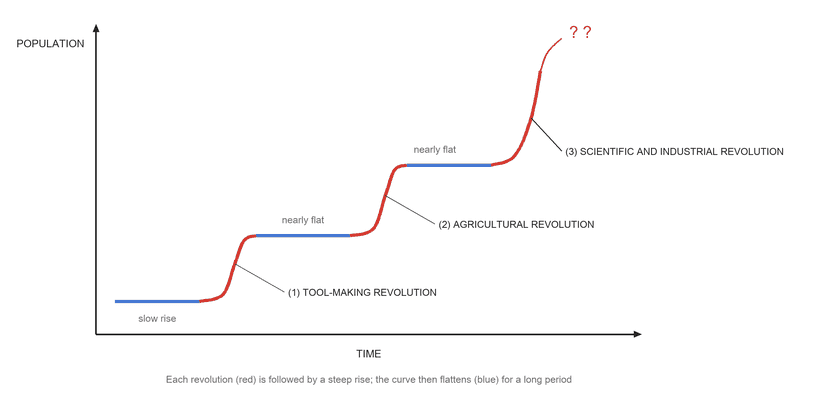
Therefore, the three great cultural revolutions are the tool-making revolution, the agricultural revolution and the scientific and industrial revolution.
- 21 mark
Question 2
Mention two areas of medical sciences which have indirectly contributed to high growth in human population.
Solve with AIWritten solution
Solution:
Concept: The population grows when births are more than deaths. Medical science does not add births; it cuts down deaths. That is why its effect on population growth is called indirect.
Step 1 — Name the two areas.
The two areas of medical science are antibiotics and prophylactic vaccinations (immunisation). Antibiotics cure infections that once killed people. Vaccinations protect against many fatal diseases in advance ("prophylactic" means guarding beforehand).
Step 2 — Follow the cause and effect.
These twentieth-century discoveries sharply reduced the death rate in all age groups, specially among infants and the old.
→ More children in each family lived to reach the reproductive age.
→ They too had children, so the population grew faster.

Watch out: Medicine did not raise the birth rate. It let more people survive, which is why its contribution is indirect.
Therefore, the two areas are antibiotics and prophylactic vaccinations (immunisation); they raised the population indirectly by lowering the death rate.
- 31 mark
Question 3
Is the present day human population growth following a J-shaped curve or S-shaped curve?
Solve with AIWritten solution
Solution:
Concept: A J-shaped curve keeps rising more and more steeply and does not level off. An S-shaped curve rises and then flattens out at the top, when the population becomes steady.
Step 1 — Look at how the world population is changing.
The world population reached 1 billion only in 1804, but it had reached 8 billion by 2022. Each new billion is being added faster than the one before, so the curve is still rising steeply.
Step 2 — Compare with the two shapes.
The population has not stopped rising or become steady, so it does not yet show the flat top of an S-shaped curve. We do not know whether it will go on rising or soon stabilise, which is why the chapter's growth curve ends in two question marks.
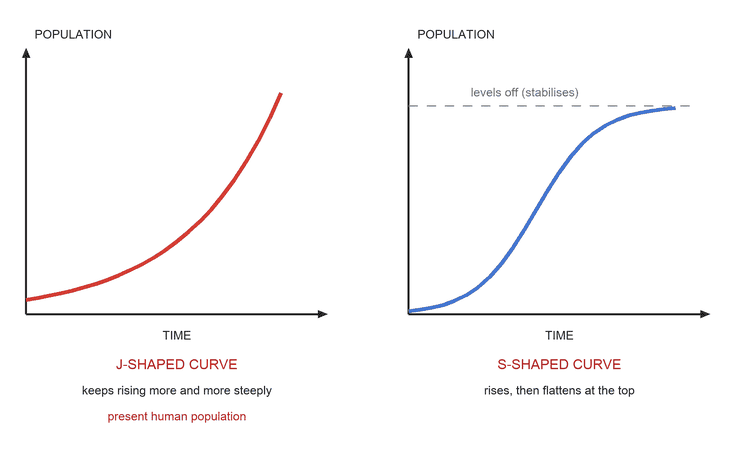
Therefore, the present day human population growth is following a J-shaped curve.
- 41 mark
Question 4
Write any six factors which have contributed to a rapid rise of human population in recent times in the world.
Solve with AIWritten solution
Solution:
Concept: A population rises sharply when the death rate falls while the birth rate stays high. All six factors below work by cutting down deaths.
Step 1 — Factors that improved health.
- Better health care for all age groups: there are more health care centres, hospitals and practising doctors.
- Fewer deaths due to better medical aid: regular vaccination programmes have controlled or even wiped out many diseases, and more patients get cured and live longer.
- Large scale immunisation against fatal diseases.
Step 2 — Factors that improved food.
- Food shortages minimised by the green revolution: more food is produced and stored, so there are very few starvation deaths.
- Improved nutrition, specially for growing children: they keep healthy, suffer less from diseases and live longer.
Step 3 — The factor that saved babies.
- Fewer infant deaths: in older times 1 or more of the 4 to 6 children of a family would not survive; today most newborn babies survive.
Step 4 — Put the effect together.
More and more children now reach the reproductive age. So even if a couple has only 2 to 3 children, the total population rises sharply.

Therefore, the six factors are better health care, fewer deaths due to medical aid, large scale immunisation, food shortages minimised, improved nutrition and fewer infant deaths.
- 52 marks
Question 5
Give the approximate figures for the population in India in million at (a) the beginning and (b) the end of twentieth century.
(a) .......... (b) ..........
Solve with AIWritten solution
Solution:
Concept: India counts its people in a census every ten years. The twentieth century ran from 1901 to 2000, so we read the 1901 figure for its beginning and the figures around 2000 for its end.
Step 1 — Read the figure for the beginning.
The 1901 census gives the population at the beginning of the twentieth century: about 238 million.
Step 2 — Read the figure for the end.
At the end of the century the population was about 1000 million (one billion). The 2001 census, taken just after the century ended, recorded 1027 million.
Step 3 — See what the figures show.
The population became more than four times as large in one century. Except for a slight fall between 1911 and 1921 (252 to 251 million), it rose at every census.
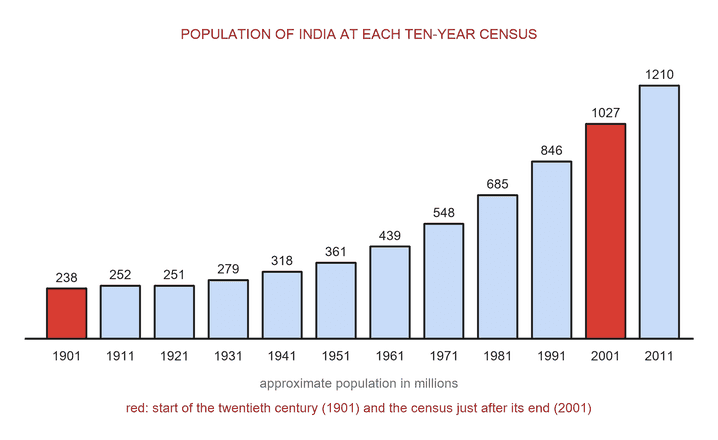
Note: the census of 1951 counted about 361 million people; the bar chart shows this figure.
Therefore, the population of India was about (a) 238 million at the beginning and (b) about 1000 million at the end of the twentieth century.
- 63 marks
Question 6
Mention whether the following statements are True (T) or False (F).
(i) Urbanisation is the enlargement of towns covering a very large area together with modern facilities. (T/F)
(ii) Rising population is leading to an increased coverage of land for raising forests. (T/F)
(iii) Coal and iron are inexhaustible resources. (T/F)
Solve with AIWritten solution
Solution:
Concept: A growing population needs more land and more resources. Exhaustible (non-renewable) resources cannot be replaced once they are used up.
Step 1 — Statement (i): urbanisation.
True. Villages turn into towns, towns into cities and cities into megacities with modern facilities. As this happens, more buildings, roads, railway lines and industries spread over the open land. This process is called urbanisation.
Step 2 — Statement (ii): forests.
False. A rising population needs land for cultivation and housing, so forests are cut down (deforestation). The land under forests is shrinking, not increasing. Raising forests by planting more trees is afforestation, which is the remedy, not what is happening.

Step 3 — Statement (iii): coal and iron.
False. Coal and iron are exhaustible (non-renewable) resources. Coal cannot be formed again during a lifetime, and minerals such as iron, once finished, can never be replaced.
Watch out: 'inexhaustible' means never used up. Only sources like sunlight and wind are inexhaustible; coal and iron are not.
Therefore, (i) True, (ii) False, (iii) False.
- 73 marks
Question 7
Fill up the blanks by choosing the right option.
(i) Public conveyances like buses and railways are .......... (necessities/luxuries).
(ii) Many sets of garments per member in a family is .......... (a necessity/fashion).
(iii) Petroleum is a resource of the same category as that of .......... (copper/ground water).
Solve with AIWritten solution
Solution:
Concept: Separate real needs from the wants that come with rising living standards, and renewable resources (which get replaced) from non-renewable ones (which do not).
Step 1 — Blank (i): public conveyances.
Buses and railways carry a large population to work and school every day. They are necessities, not luxuries.
Step 2 — Blank (ii): many sets of garments.
A person needs only a few sets of clothes. Many sets per member is fashion, a sign of rising living standards that use up more resources.
Step 3 — Blank (iii): petroleum.
Petroleum is non-renewable: its reserves may be used up within about 150 years. Copper is also non-renewable, because a mineral once finished can never be replaced. Ground water is renewable, because rain refills it. So petroleum is in the same category as copper.

Therefore, the blanks are (i) necessities, (ii) fashion, (iii) copper.
- 84 marks
Question 8
Give the technical terms for the following :
(i) Statistical study of human population.
(ii) Number of deaths per 1000 people per year.
(iii) Number of individuals per sq. km. at any given time.
(iv) Difference between birth rate and death rate.
Solve with AIWritten solution
Solution:
Concept: Demography is the study of human population. It uses a few basic terms: population density, birth rate, death rate and growth rate.
Step 1 — Term (i): the study itself.
The statistical study of human population is demography. The word comes from demos (people) + graphos (measurement). It studies the size, density and distribution of the population.
Step 2 — Term (ii): deaths.
The number of deaths per 1000 people per year is the death rate (mortality). In India it has fallen sharply over the last century because of better health care.
Step 3 — Term (iii): crowding.
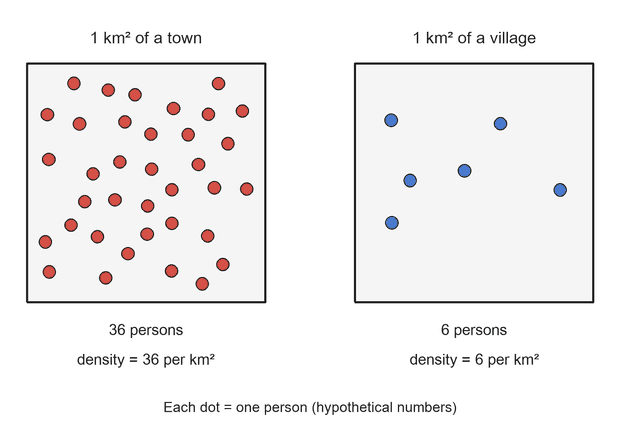
The number of individuals per square kilometre at any given time is the population density. Towns and larger cities have a greater population density than rural areas.
Step 4 — Term (iv): birth rate minus death rate.
The difference between the birth rate and the death rate is the growth rate of population. While the birth rate is higher than the death rate, the population grows; if it is lower, the population declines.

Therefore, the terms are (i) demography, (ii) death rate (mortality), (iii) population density and (iv) growth rate of population.
- 91 mark
Question 9
List any three consequences of high population density.
Solve with AIWritten solution
Solution:
Concept: Population density is the number of people per square kilometre. When it rises beyond what a country can support, the same income and resources are shared by more people, so each person gets less.
Step 1 — First consequence: income.
The national income is shared by more people, so the per capita income comes down.
Step 2 — Second consequence: resources.
More people use up more land, minerals, wood and fuel, so these natural resources decrease.
Step 3 — Third consequence: health.
Crowding, poor housing and too little food and medical care mean that general health goes down.
Step 4 — See the overall result.
Together these lower the quality of life. This is why there is a pressing need for population control measures.

Therefore, three consequences of high population density are: per capita income comes down, natural resources decrease and general health goes down.
- 101 mark
Question 10
List any five major disadvantages of having large families.
Solve with AIWritten solution
Solution:
Concept: In a large family, a limited income and limited care are shared among too many members, so each one gets less.
Step 1 — Disadvantages for the family as a whole.
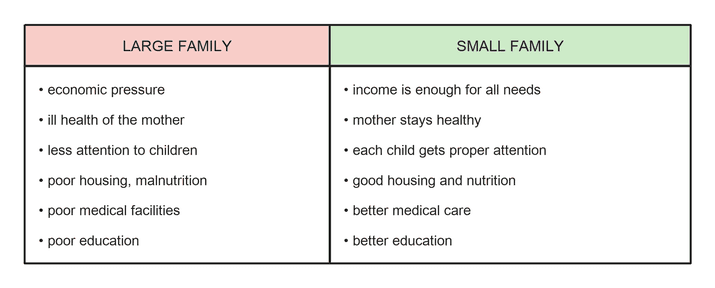
- Economic pressure: the family income falls short of its needs.
- Poor housing and malnutrition: the money is not enough for a proper home and good food.
Step 2 — Disadvantage for the mother.
- Ill health of the mother, due to repeated pregnancies.
Step 3 — Disadvantages for the children.
- Less attention to each child.
- Poor medical facilities and poor education for the children.
Step 4 — Compare with a small family.
A small family avoids each of these problems, which is why people should be made aware of the advantages of small families.

Therefore, five disadvantages of large families are economic pressure, ill health of the mother, less attention to each child, poor housing and malnutrition, and poor medical facilities and poor education.
- 111 mark
Question 11
What are the age restrictions for marriage for boys and girls respectively in India?
Solve with AIWritten solution
Solution:
Concept: The law fixes a minimum age for marriage. A later marriage delays the first child, which is one of the steps of population control.
Step 1 — State the two ages.
In India, boys may marry only at 21 years or above, and girls only at 18 years or above.
Step 2 — See why the rule matters.
These are the lowest ages allowed by law. Following this restriction strictly delays child-bearing and so helps to slow down the growth of population.
Watch out: The question asks for boys first and girls second, so write 21 years, then 18 years.
Therefore, the age restrictions for marriage in India are 21 years for boys and 18 years for girls.
- 121 mark
Question 12
What are the three aspects covered under family welfare?
Solve with AIWritten solution
Solution:
Concept: Family welfare is wider than family planning alone. It covers planning a small family and also caring for the mother and the children.
Step 1 — The first aspect.
Family planning in terms of having a small family.
Step 2 — The second aspect.
Total welfare of the small family, including the diet and nutrition of the child and of the pregnant mother.
Step 3 — The third aspect.
Subsequent care of the children, such as immunisation and oral rehydration therapy (ORT), to make sure the young ones survive.
Step 4 — Know where help is given.
The sign of family welfare in India is the inverted red triangle. It is displayed at family welfare centres, where help or advice about family planning is available free of cost.
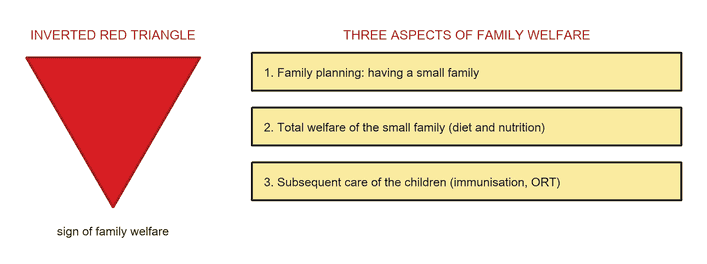
Therefore, the three aspects of family welfare are family planning, the total welfare of the small family and the subsequent care of the children.
- 134 marks
Question 13
State whether the following statements are True (T) or False (F). If false, write the correct word for the one which is wrong.
Statement T/F Correct (i) Some vitamin preparations prevent the release of the egg from the ovary. .......... .......... (ii) Use of a condom for contraception is a barrier method. .......... .......... (iii) IUDs prevent implantation of embryo in vagina. .......... .......... (iv) Tubectomy is performed on females. .......... .......... Solve with AIWritten solution
Solution:
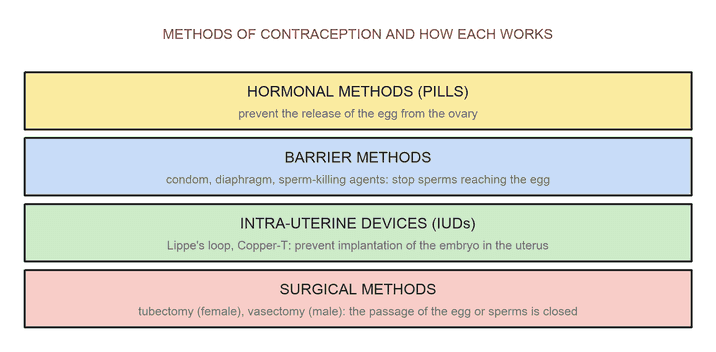
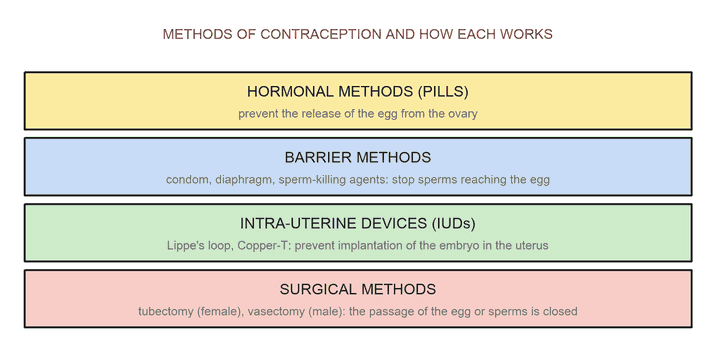
Concept: Each method of contraception blocks one step on the way to a pregnancy: hormonal pills stop the release of the egg, barriers stop the sperms reaching it, IUDs stop the embryo implanting in the uterus, and surgery closes the passage of the egg or the sperms.
Step 1 — Statement (i): preparations that stop the egg.
False. The correct word is hormonal. Hormonal preparations, taken as tablets commonly called contraceptive pills, prevent the release of the egg from the ovary. Vitamins do not do this.
Step 2 — Statement (ii): the condom.
True. A condom stops the sperms from being deposited in the vagina. It acts as a physical barrier, like the diaphragm.
Step 3 — Statement (iii): where IUDs act.
False. The correct word is uterus. IUDs such as Lippe's loop and Copper-T are fitted inside the uterus, and they prevent the implantation of the embryo there. The embryo never implants in the vagina.
Step 4 — Statement (iv): tubectomy.
True. In tubectomy the fallopian tubes (oviducts) of the female are cut and tied. The corresponding operation in the male is vasectomy.
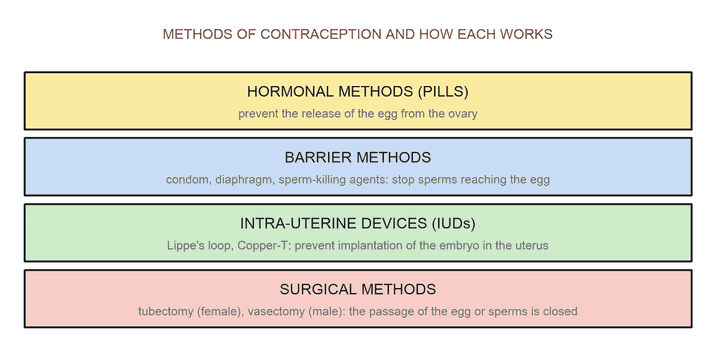
Therefore, (i) False (hormonal), (ii) True, (iii) False (uterus), (iv) True.
- 142 marks
Question 14
Write the full form of MTP. In what circumstances is it recommended?
Solve with AIWritten solution
Solution:
Concept: MTP is the medical ending of a pregnancy that has already begun. It is a last step, not a method of contraception.
Step 1 — Write the full form.
MTP stands for Medical Termination of Pregnancy (induced abortion).
Step 2 — State when it is recommended.
It is recommended when:
- the woman has become pregnant and the couple does not want to have the child, or
- a special test gives definite evidence of a serious genetic disease in the embryo.
Step 3 — State how it must be done.
In these cases the foetus can be removed, but only by a trained doctor at a hospital. The chapter states that it is legally permitted only within 5 months of pregnancy, and any woman who wants it can have it done free at a government hospital.
Note: the MTP (Amendment) Act, 2021 now allows termination up to 20 weeks, and up to 24 weeks for special categories of women.
Therefore, MTP is Medical Termination of Pregnancy; it is recommended when the child is unwanted or the embryo has a serious genetic disease.
- 151 mark
Question 15
The statistical study of human population is :
Solve with AIAnswer
(A) Population density
(B) Population growth
- Correct
(C) Demography
(D) Population explosion
Answer: (C) Demography
Concept: Demography (demos: people + graphos: measurement) is the statistical study of human population: its size, density, distribution and vital statistics.
Step 1 — See what is being asked.
The question asks for the name of the study itself, not for one of the quantities it measures.
Step 2 — Pick the study.
Population density, birth rate, death rate and growth rate are the statistics that demography works with. The study is demography.
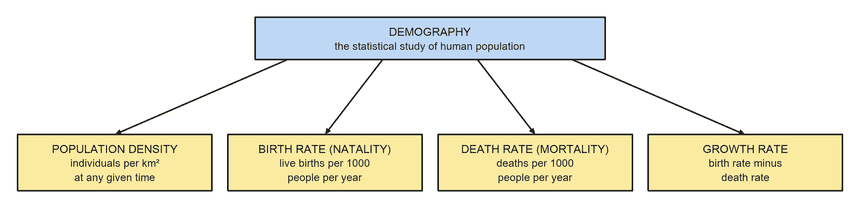
Why the other options are wrong:
- (A) Population density: population density is only one quantity: the number of individuals per square kilometre at a given time.
- (B) Population growth: population growth is the increase in numbers, not the study of population.
- (D) Population explosion: population explosion is the rapid and massive rise in the world population, not a study.
Therefore, the statistical study of human population is demography, option (C).
- 161 mark
Question 16
Surgical method of sterilization in women involves cutting and tying of :
Solve with AIAnswer
(A) Ureter
- Correct
(B) Fallopian tube
(C) Uterus
(D) Urethra
Answer: (B) Fallopian tube
Concept: In tubectomy (surgical sterilisation of the female) the fallopian tubes (oviducts) are cut and tied, which closes the passage of the egg.
Step 1 — Recall the path of the egg.
The egg passes from the ovary towards the uterus through the fallopian tube. Fertilisation normally happens in this tube.
Step 2 — See what the operation does.
In tubectomy the abdomen is opened and both tubes are cut and tied with nylon thread. The egg and the sperms can no longer meet, so pregnancy cannot occur.
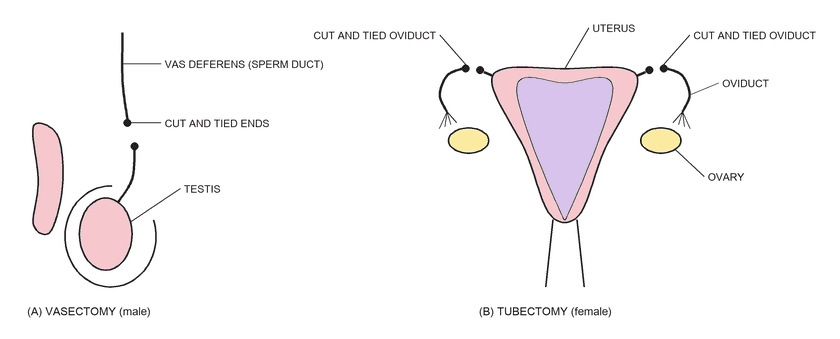
Why the other options are wrong:
- (A) Ureter: the ureter carries urine from the kidney to the bladder; it is not touched in sterilisation.
- (C) Uterus: the uterus is left intact in tubectomy; only the tubes leading to it are tied.
- (D) Urethra: the urethra is the passage that carries urine out of the body; it is not cut in sterilisation.
Therefore, surgical sterilisation in women involves cutting and tying of the fallopian tubes, option (B).
- 171 mark
Question 17
When the number of individuals added to the population exceeds the number of individuals lost, there is :
Solve with AIAnswer
(A) Decrease in carrying capacity
- Correct
(B) Exponential population growth
(C) Zero population growth
(D) Decrease in biotic potential
Answer: (B) Exponential population growth
Concept: Growth rate = birth rate − death rate. When additions (births) are more than losses (deaths), the population grows, and with unchecked additions it grows exponentially (in geometrical progression).
Step 1 — Compare additions and losses.
Here more individuals are added than are lost, so the population must be growing.
Step 2 — See why the growth is exponential.
Each larger generation adds still more children, so the numbers are multiplied at each step: 1, 2, 4, 8, 16. In the chapter's model, 10 couples with 4 children per couple grow from a total of 60 people to 600 people in 60 years, ten times as many.

Why the other options are wrong:
- (A) Decrease in carrying capacity: carrying capacity depends on the resources of the environment, not on births exceeding deaths.
- (C) Zero population growth: zero population growth means the additions are exactly equal to the losses.
- (D) Decrease in biotic potential: biotic potential is the maximum reproductive capacity of a species; it does not fall because more are born.
Therefore, when additions exceed losses there is exponential population growth, option (B).
- 181 mark
Question 18
The symbol of family welfare is :
Solve with AIAnswer
(A) Red circle
(B) Green triangle
(C) Red square
- Correct
(D) Red inverted triangle
Answer: (D) Red inverted triangle
Concept: The sign of family welfare in India is the inverted red triangle. It is displayed at family welfare centres and hospitals where family planning advice is given free of cost.
Step 1 — Check the colour.
The sign is red.
Step 2 — Check the shape and position.
It is a triangle standing on its tip, that is, inverted. Only option (D) has both the right colour and the right shape.
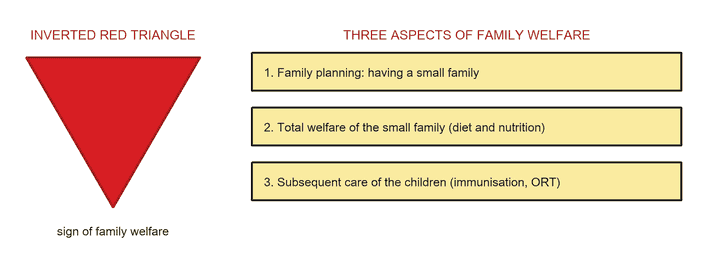
Why the other options are wrong:
- (A) Red circle: the sign is a triangle, not a circle.
- (B) Green triangle: the triangle is red and inverted, not green.
- (C) Red square: the sign is a triangle, not a square.
Therefore, the symbol of family welfare is the red inverted triangle, option (D).
- 191 mark
Question 19
Death rate is the number of deaths :
Solve with AIAnswer
- Correct
(A) per 1000 people per year
(B) per 100 people per decade
(C) per 1000 people per decade
(D) per 100 people per year
Answer: (A) per 1000 people per year
Concept: The death rate (mortality) is the number of deaths per 1000 people per year.
Step 1 — Fix the base.
The rate is counted for every 1000 people of the population.
Step 2 — Fix the period.
It is counted for one year. The birth rate uses the same base and period, so the two can be subtracted to give the growth rate of population.
Watch out: Both parts must match: 1000 people AND one year. An option with only one of them right is still wrong.
Why the other options are wrong:
- (B) per 100 people per decade: both the base (100 instead of 1000) and the period (a decade instead of a year) are wrong.
- (C) per 1000 people per decade: the base is right, but the period is one year, not a decade.
- (D) per 100 people per year: the period is right, but the base is 1000 people, not 100.
Therefore, death rate is the number of deaths per 1000 people per year, option (A).
- 201 mark
Question 20
What was directly responsible for the rapid rise of world population in the twentieth century ?
Solve with AIAnswer
(A) Better education and jobs
(B) Religious and social customs
- Correct
(C) Better healthcare
(D) Increased food production
Answer: (C) Better healthcare
Concept: A population rises fast when the death rate falls while the birth rate stays high. In the twentieth century better health care (antibiotics, vaccinations, hospitals) sharply reduced deaths in all age groups.
Step 1 — Find what changed in the twentieth century.
There were more hospitals and doctors, regular vaccination programmes, cures for many diseases and far fewer infant deaths.
Step 2 — Follow the effect.
Fewer people died, so more children reached the reproductive age and had children of their own. This is what directly made the population rise so fast.

Why the other options are wrong:
- (A) Better education and jobs: better education and jobs tend to make families smaller, so they slow the growth instead of raising it.
- (B) Religious and social customs: religious and social customs favour large families, but they existed earlier too, so they cannot explain the sudden twentieth-century rise.
- (D) Increased food production: more food production helped people survive, but the direct cause was the sharp fall in the death rate due to medical care.
Therefore, the rapid rise of world population in the twentieth century was directly due to better healthcare, option (C).
- 211 mark
Question 21
Which of the following is not a non-conventional source of energy ?
Solve with AIAnswer
(A) Nuclear energy
(B) Tidal energy
- Correct
(C) Petroleum energy
(D) Wind energy
Answer: (C) Petroleum energy
Concept: Conventional sources of energy, such as coal and petroleum, have been in use since long. Non-conventional sources, such as solar, nuclear, tidal and wind energy, are the newer ones being developed.
Step 1 — Decode the double negative.
"Not a non-conventional source" means a conventional source.
Step 2 — Pick the conventional one.
Of the four options, only petroleum is conventional. The other three are new sources being used to meet the rising demand for energy.

Watch out: Read 'not a non-conventional' carefully: the two negatives cancel, so the question wants the conventional source.
Why the other options are wrong:
- (A) Nuclear energy: nuclear energy is a newer source, so it is non-conventional.
- (B) Tidal energy: tidal energy is a newer source, so it is non-conventional.
- (D) Wind energy: wind energy is a newer source, so it is non-conventional.
Therefore, petroleum energy is the one that is not a non-conventional source, option (C).
- 221 mark
Question 22
Birth rate is technically termed as :
Solve with AIAnswer
(A) Population density
- Correct
(B) Natality
(C) Carrying capacity
(D) Mortality
Answer: (B) Natality
Concept: Birth rate, technically called natality, is the number of live births per 1000 people of the population per year.
Step 1 — Match the term.
The technical word for birth rate is natality, just as mortality is the word for death rate.
Step 2 — See an example.
If there were 440 live births in a year in a population of 20,000, the birth rate would be 440 ÷ 20,000 × 1000 = 22 per 1000 per year.

Watch out: Natality (births) and mortality (deaths) are easy to swap; 'natal' means birth.
Why the other options are wrong:
- (A) Population density: population density is the number of individuals per square kilometre.
- (C) Carrying capacity: carrying capacity is the largest population an environment can support.
- (D) Mortality: mortality is the technical term for the death rate, not the birth rate.
Therefore, birth rate is technically termed natality, option (B).
- 231 mark
Question 23
Which of the following is an exhaustible source of energy ?
Solve with AIAnswer
- Correct
(A) Fossil fuels
(B) Nuclear energy
(C) Solar energy
(D) Wind energy
Answer: (A) Fossil fuels
Concept: An exhaustible source of energy gets used up and cannot be replaced. Fossil fuels (coal and petroleum) are fast depleting; once finished, they cannot be formed again during a lifetime.
Step 1 — Check the fossil fuels.
At the present rate of use the reserves of petroleum may run out within about 150 years, and coal may last only a little longer.
Step 2 — Check the other options.
Sunlight and wind keep coming, so they never run out. The chapter groups nuclear energy with the new non-conventional sources used to meet the rising demand. So the source that the chapter names as exhaustible is fossil fuels.
Why the other options are wrong:
- (B) Nuclear energy: nuclear power uses uranium, which is also limited in the earth, but the chapter treats nuclear energy as a new non-conventional source; fossil fuels are the clear example of an exhaustible source.
- (C) Solar energy: solar energy comes from the sun every day, so it is inexhaustible.
- (D) Wind energy: wind energy is produced again and again by moving air, so it is inexhaustible.
Therefore, the exhaustible source of energy is fossil fuels, option (A).
- 241 mark
Question 24
What are the age restrictions for marriage by law for boys and girls in India ?
Solve with AIAnswer
(A) 18 years, 21 years
(B) 21 years, 19 years
- Correct
(C) 21 years, 18 years
(D) 18 years, 17 years
Answer: (C) 21 years, 18 years
Concept: By law the minimum age for marriage in India is 21 years for boys and 18 years for girls.
Step 1 — Note the order asked.
The question names boys first and girls second, so the pair must read: boys' age, then girls' age.
Step 2 — Fill in the ages.
Boys: 21 years; girls: 18 years. This is the pair 21 years, 18 years.
Watch out: Keep the order of the question: boys first, girls second.
Why the other options are wrong:
- (A) 18 years, 21 years: this gives the ages the wrong way round (18 for boys, 21 for girls).
- (B) 21 years, 19 years: the age for boys is right, but the age for girls is 18, not 19.
- (D) 18 years, 17 years: both ages are too low; the law requires 21 for boys and 18 for girls.
Therefore, the age restrictions are 21 years for boys and 18 years for girls, option (C).
- 251 mark
Question 25
The following questions are Assertion-Reason based questions. Choose the answer based on the codes given below.
(1) A is True and R is False
(2) A is False and R is True
(3) Both A and R are True
(4) Both A and R are False
Assertion (A): Population density is the number of individuals in an area of 100 square kilometers per year.
Reason (R): Population density gives us an idea of all the living organisms of different species in a particular area every year.
Solve with AIAnswer
(A) (1) A is True and R is False
(B) (2) A is False and R is True
(C) (3) Both A and R are True
- Correct
(D) (4) Both A and R are False
Answer: (D) (4) Both A and R are False
Concept: Population density is the number of individuals of one population per square kilometre at any given time. To answer, judge the Assertion, then the Reason, then pick the code.
Step 1 — Judge the Assertion.
False. Density is counted per one square kilometre and at a given time, not per 100 square kilometres per year.
Step 2 — Judge the Reason.
False. Population density refers to the individuals of one population (here, humans), not to all the organisms of different species. It is also counted at a given time, not every year.
Step 3 — Choose the code.
Both statements are false, which is code (4).
Why the other options are wrong:
- (A) (1) A is True and R is False: code (1) says A is true, but A is false.
- (B) (2) A is False and R is True: code (2) says R is true, but R is false.
- (C) (3) Both A and R are True: code (3) says both are true, but neither statement is true.
Therefore, both A and R are false, option (D).
- 261 mark
Question 26
The following questions are Assertion-Reason based questions. Choose the answer based on the codes given below.
(1) A is True and R is False
(2) A is False and R is True
(3) Both A and R are True
(4) Both A and R are False
Assertion (A): Tubectomy is a temporary method of contraception for males in which the sperm ducts are cut and ligated with a nylon thread.
Reason (R): Tubectomy closes the passage of the sperms. The sperm duct is also known as vas deferens, which stores the sperms for some days during which they mature and become motile.
Solve with AIAnswer
(A) (1) A is True and R is False
(B) (2) A is False and R is True
(C) (3) Both A and R are True
- Correct
(D) (4) Both A and R are False
Answer: (D) (4) Both A and R are False
Concept: Tubectomy is a permanent surgical method for females: the fallopian tubes are cut and tied. The male operation is vasectomy, in which the vas deferens is cut and tied.
Step 1 — Judge the Assertion.
False, on three counts. Tubectomy is done on females, not males; it cuts the oviducts, not the sperm ducts; and it is a permanent method, not a temporary one. (The operation it describes is vasectomy, and even that is permanent.)
Step 2 — Judge the Reason.
False. Tubectomy closes the passage of the egg, not of the sperms. Also, sperms are stored and mature in the epididymis; the vas deferens only carries them.
Step 3 — Choose the code.
Both statements are false, which is code (4).
Watch out: Tubectomy is for females (tubes = fallopian tubes); vasectomy is for males (vas deferens).
Why the other options are wrong:
- (A) (1) A is True and R is False: code (1) says A is true, but A is false.
- (B) (2) A is False and R is True: code (2) says R is true, but R is false.
- (C) (3) Both A and R are True: code (3) says both are true, but neither statement is true.
Therefore, both A and R are false, option (D).
- 271 mark
Question 27
The following questions are Assertion-Reason based questions. Choose the answer based on the codes given below.
(1) A is True and R is False
(2) A is False and R is True
(3) Both A and R are True
(4) Both A and R are False
Assertion (A): Fossil fuels are renewable and non-conventional sources of energy.
Reason: (R): The underground reserves of coal and petroleum are depleting fast. People should look at other non-conventional sources of energy like solar energy, tidal energy, etc. for their use.
Solve with AIAnswer
(A) (1) A is True and R is False
- Correct
(B) (2) A is False and R is True
(C) (3) Both A and R are True
(D) (4) Both A and R are False
Answer: (B) (2) A is False and R is True
Concept: Fossil fuels (coal and petroleum) are non-renewable and conventional sources of energy: they have been used since long and cannot be formed again during a lifetime.
Step 1 — Judge the Assertion.
False. Fossil fuels are exhaustible (non-renewable) and conventional, the very opposite of what A says.
Step 2 — Judge the Reason.
True. The underground reserves of coal and petroleum are fast depleting, so we must turn to non-conventional sources such as solar and tidal energy.
Step 3 — Choose the code.
A is false and R is true, which is code (2).
Why the other options are wrong:
- (A) (1) A is True and R is False: code (1) has it the wrong way round: A is false and R is true.
- (C) (3) Both A and R are True: code (3) says both are true, but A is false.
- (D) (4) Both A and R are False: code (4) says both are false, but R is true.
Therefore, A is false and R is true, option (B).
- 281 mark
Question 28
Give the technical term for the statistical study of human population of a region.
Solve with AIWritten solution
Solution:
Concept: The word demography comes from demos (people) + graphos (measurement).
Step 1 — Name the term.
The statistical study of the human population of a region is called demography.
Step 2 — Say what it covers.
It studies the size, density and distribution of the population and its vital statistics, such as the birth rate and the death rate.
Therefore, the technical term is demography.
- 291 mark
Question 29
Name two surgical techniques (one for the human male and another for the human female) that can be used to prevent pregnancy.
Solve with AIWritten solution
Solution:
Concept: Surgical methods are permanent methods of contraception. They close the duct that carries the sperms (in the male) or the egg (in the female).
Step 1 — The method for the human male.
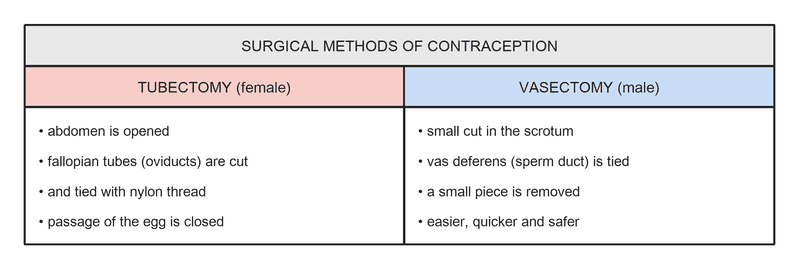
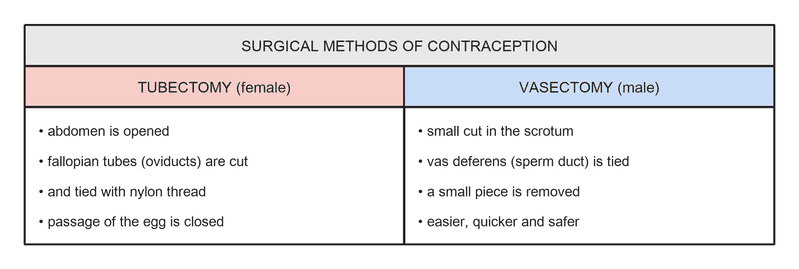
Vasectomy: a small cut is made in the scrotum and the vas deferens (sperm duct) from each testis is tied, so the sperms cannot pass out.
Step 2 — The method for the human female.
Tubectomy: the abdomen is opened and the fallopian tubes (oviducts) are cut and tied with nylon thread, so the egg cannot meet the sperms.
Therefore, the two surgical techniques are vasectomy (male) and tubectomy (female).
- 307 marks
Question 30
Mention whether the following statements are true (T) or false (F).
(a) Vasectomy is the surgical method of sterilisation in human males. (T/F)
(b) Tubectomy is the placing of a diaphragm on the cervix. (T/F)
(c) Cow was the first domesticated animal. (T/F)
(d) Rapidly growing industries favoured population rise. (T/F)
(e) Present human population growth is following arithmetic progression. (T/F)
(f) Birth rate (natality) is the number of live births per hundred people of population per decade. (T/F)
(g) Tubectomy is a popular surgical method of contraception in human males. (T/F)
Solve with AIWritten solution
Solution:
Concept: Check each statement against the facts of the chapter; a statement is false if even one part of it is wrong.
Step 1 — Statement (a): vasectomy.
True. In vasectomy the vas deferens (sperm duct) from each testis is tied through a small cut in the scrotum. This is surgical sterilisation in males.
Step 2 — Statement (b): tubectomy.
False. Tubectomy is the cutting and tying of the fallopian tubes. Placing a diaphragm on the cervix is a barrier method.
Step 3 — Statement (c): the first domesticated animal.
False. The dog was the first animal to be domesticated, not the cow.
Step 4 — Statement (d): industries.
True. Rapidly growing industries gave more jobs, more comforts and more food, so the population rose.
Step 5 — Statement (e): the pattern of growth.
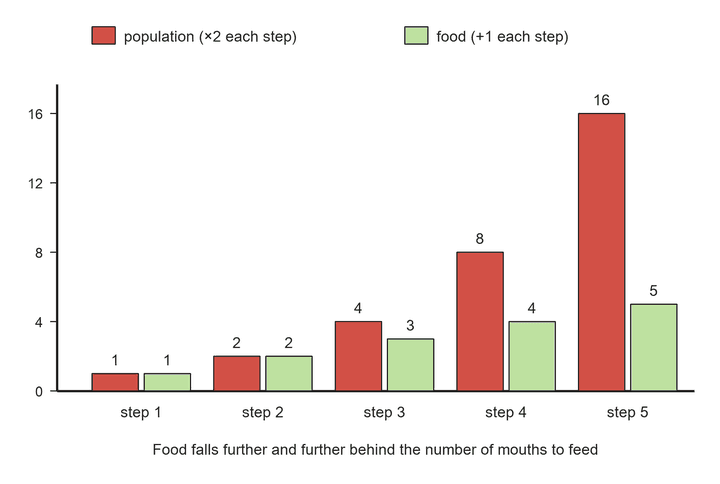
False. Human population grows in geometrical progression (1, 2, 4, 8, 16). It is food production that rises in arithmetic progression (1, 2, 3, 4, 5).
Step 6 — Statement (f): the birth rate.
False. Birth rate is counted per 1000 people per year, not per hundred people per decade.
Step 7 — Statement (g): tubectomy in males.
False. Tubectomy is performed on females. The surgical method for males is vasectomy.
Therefore, (a) T, (b) F, (c) F, (d) T, (e) F, (f) F, (g) F.
- 312 marks
Question 31
Give two advantages of a small family.
Solve with AIWritten solution
Solution:
Concept: With fewer children, the family's income and care go further, so every member is better off.
Step 1 — First advantage: a better standard of living.
The family income is enough for good food, housing and other needs, so there is less economic pressure.
Step 2 — Second advantage: better care of each child.
Each child gets more attention and better health care, nutrition and education. The mother's health is also protected, because she does not go through repeated pregnancies.
Therefore, two advantages of a small family are a better standard of living and better care of each child.
- 322 marks
Question 32
List three major landmarks in human history which contributed to the sudden rise in population of the world.
Solve with AIWritten solution
Solution:
Concept: Three cultural revolutions each gave man better means of getting food and a livelihood, and each was followed by a sudden rise in population.
Step 1 — The tool-making revolution.
Stone-age man made tools of stones, sticks and bones, so he could hunt even large animals and get more food.
Step 2 — The agricultural revolution.
About 10,000 years ago man settled down, domesticated animals and began to sow crops and store food.
Step 3 — The scientific and industrial revolution.
From around the seventeenth century, industries gave more jobs, more comfort and more food.
Step 4 — See the pattern.
After each rise the population became nearly steady, or rose very slowly, for a long period until the next revolution.
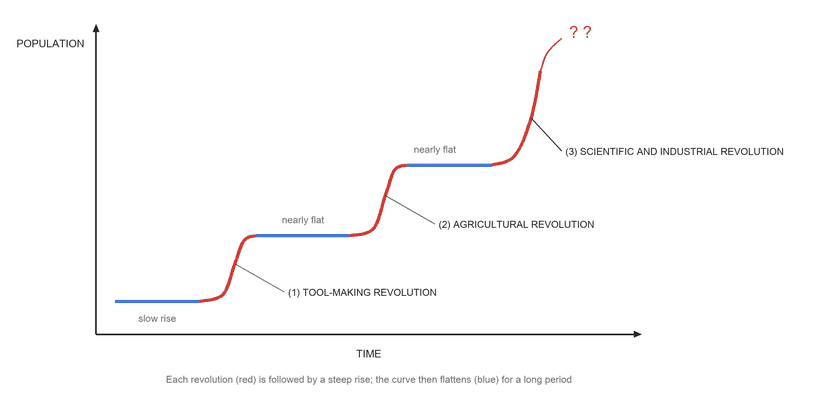
Therefore, the three landmarks are the tool-making revolution, the agricultural revolution and the scientific and industrial revolution.
- 333 marks
Question 33
What is meant by family welfare centres ? What is the symbol of family welfare in our country ?
Solve with AIWritten solution
Solution:
Concept: Family welfare covers planning a small family and caring for the mother and children. The government gives this help free at family welfare centres.
Step 1 — Say what family welfare centres are.
Family welfare centres are offices and hospitals where any help or advice about family planning, and about the welfare of the mother and children, is available free of cost.
Step 2 — Say what they cover.
Family welfare has three aspects: family planning in terms of having a small family; the total welfare of the small family (the diet and nutrition of the child and of the pregnant mother); and the later care of the children, such as immunisation and oral rehydration therapy.
Step 3 — Name the symbol.
The symbol of family welfare in our country is the inverted red triangle. It is prominently displayed at all such offices and hospitals.
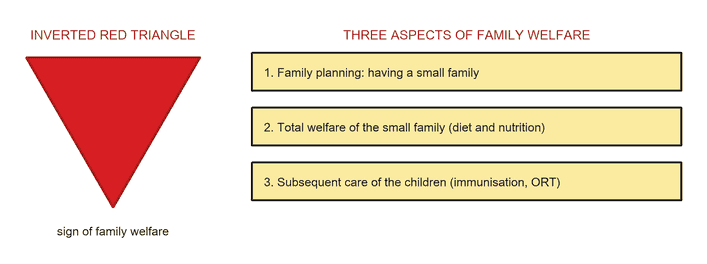
Therefore, family welfare centres give free family planning help and advice, and their symbol is the inverted red triangle.
- 342 marks
Question 34
Sterilisation in men means preventing the flow of sperms into the seminal vesicles by cutting and ligating the vas deferens. Can there be a corresponding operation made in women ? If yes, where ?
Solve with AIWritten solution
Solution:
Concept: Sterilisation works by closing the duct that carries the gametes. In the male this is the vas deferens; in the female it is the fallopian tube (oviduct), which carries the egg.
Step 1 — Answer the first part.
Yes. There is a corresponding operation in women, called tubectomy.
Step 2 — Say where it is made.
It is made on the fallopian tubes (oviducts). The abdomen is opened and both oviducts are cut and tied with nylon thread, which closes the passage of the egg.
Step 3 — Compare with the male operation.
In men, cutting and tying the vas deferens stops the sperms. In women, cutting and tying the oviducts stops the egg. In both cases the egg and the sperms cannot meet, so there is no pregnancy.
Therefore, yes, the corresponding operation in women is tubectomy, made on the fallopian tubes (oviducts).
- 352 marks
Question 35
Write the full forms of the following abbreviations :
(a) IUDs
(b) MTP
Solve with AIWritten solution
Solution:
Concept: Both abbreviations come from the methods of family planning.
Step 1 — Expand IUDs.
IUDs are Intra-Uterine Devices, such as Lippe's loop and Copper-T, which are fitted inside the uterus. They do not stop fertilisation, but they prevent the implantation of the embryo.
Step 2 — Expand MTP.
MTP is Medical Termination of Pregnancy: induced abortion, in which the foetus is removed by a trained doctor at a hospital. It is a last step, not a method of contraception.
Therefore, (a) IUDs: Intra-Uterine Devices; (b) MTP: Medical Termination of Pregnancy.
- 362 marks
Question 36
Explain briefly the relationship between poverty and population and how one affects the other.
Solve with AIWritten solution
Solution:
Concept: Poverty and a rising population feed each other in a vicious circle: each one makes the other worse.
Step 1 — How poverty raises the population.
Poor, often illiterate families see children as helping hands who will earn.
→ High infant mortality makes them have more children, so that some survive.
→ Poverty also gives them no recreation other than sex.
→ So poor families tend to be large.
Step 2 — How the population raises poverty.
More people share the same limited resources.
→ The per capita income falls and jobs become scarce.
→ Food, housing, health care and education become inadequate, so more people stay poor.

Step 3 — How the circle can be broken.
People must be educated about the advantages of small families, and population control measures must be adopted. A smaller family then has more income per member, which lifts it out of poverty.
Therefore, poverty leads to large families, and a large population keeps people poor; each one causes and worsens the other.
- 372 marks
Question 37
Mention two reasons for the rapid increase of population in India.
Solve with AIWritten solution
Solution:
Concept: The population of India rises fast because the birth rate remains high for social and economic reasons, while the death rate has fallen.
Step 1 — First reason: illiteracy.
Most rural people are ignorant of how the reproductive system works and of family planning, so they do not limit the size of their families.
Step 2 — Second reason: desire for a male child.
Families go on having children until they get a son, because a son is thought essential for keeping up the name of the family and for helping the aged parents.

Step 3 — Other valid reasons.
Traditional beliefs, high infant mortality, economic reasons (children as helping hands), religious and social customs, and lack of recreation also keep the birth rate high.
Therefore, two reasons for the rapid increase of population in India are illiteracy and the desire for a male child.
- 385 marks
Question 38
Match the terms given in column A with those in column B.
Column A Column B (a) Forest (i) Arithmetic progression (b) Food (ii) Geometric progression (c) Population (iii) Deforestation (d) Coal (iv) Afforestation (e) Flash floods (v) Renewable source of energy (vi) Non-renewable source of energy Solve with AIWritten solution
Solution:
Concept: Population rises by multiplying (geometric progression) while food rises by adding (arithmetic progression). Forests are renewable; coal is not. Cutting forests (deforestation) brings floods.
Step 1 — Match (a) forest.
Forests can be maintained and even improved by afforestation, so a forest is a renewable source of energy (wood): (a) → (v).
Step 2 — Match (b) food and (c) population.
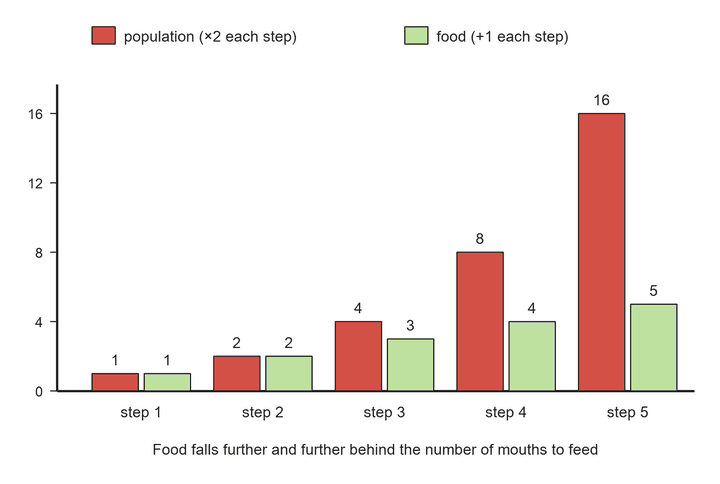
Food production rises by adding at each step: 1, 2, 3, 4, 5, so (b) → (i) arithmetic progression. Population rises by multiplying at each step: 1, 2, 4, 8, 16, so (c) → (ii) geometric progression.
Step 3 — Match (d) coal.
Coal is a fossil fuel; once finished, it cannot be formed again during a lifetime, so (d) → (vi) non-renewable source of energy.
Step 4 — Match (e) flash floods.
Forests hold the soil particles firmly and so prevent floods. When forests are cut, flash floods follow, so (e) → (iii) deforestation.
Step 5 — Write the matched table.
Column A Column B (a) Forest (v) Renewable source of energy (b) Food (i) Arithmetic progression (c) Population (ii) Geometric progression (d) Coal (vi) Non-renewable source of energy (e) Flash floods (iii) Deforestation (iv) Afforestation is left unmatched.
Watch out: Do not match flash floods with afforestation; planting trees prevents floods, cutting them causes floods.
Therefore, (a)–(v), (b)–(i), (c)–(ii), (d)–(vi), (e)–(iii).
- 395 marks
Question 39
Given below are some sets of paired terms. The first pair indicates the relationship between the two terms. Rewrite and complete the second pair on a similar basis.
(a) Death rate : Mortality :: Birth rate : ..........
(b) Tubectomy : Oviduct :: Vasectomy : ..........
(c) Intrauterine device : Copper-T :: Oral pills : ..........
(d) Barrier method : Diaphragms :: Surgical method : ..........
(e) Cutting down of forests : Deforestation :: Planting more trees : ..........
Solve with AIWritten solution
Solution:
Concept: Find the relationship in the first pair (a technical term, a part, an example, an activity) and keep the same relationship in the second pair.
Step 1 — Pair (a): term for a rate.
Mortality is the technical term for death rate, so the technical term for birth rate is natality.
Step 2 — Pair (b): operation : duct cut.
In tubectomy the oviduct is cut and tied, so in vasectomy the duct cut and tied is the vas deferens.
Step 3 — Pair (c): method : example.
Copper-T is an example of an intrauterine device, so the answer must be an example of oral pills: Mala-D (a hormonal pill that prevents the release of the egg from the ovary).
Step 4 — Pair (d): method : example.
The diaphragm is an example of a barrier method, so an example of a surgical method is tubectomy (or vasectomy).
Step 5 — Pair (e): activity : term.
Cutting down forests is called deforestation, so planting more trees is called afforestation.
Watch out: In (c) and (d) the first pair goes from a method to one example of it, so the blank needs an example, not a category.
Note: the earlier answer to (c), 'hormonal method', reversed the relationship (it names the category, not an example); it has been corrected to Mala-D.
Therefore, the second pairs are completed by (a) natality, (b) vas deferens, (c) Mala-D, (d) tubectomy and (e) afforestation.
- 4010 marks
Question 40
Define the following terms :
(a) Population
(b) Population density
(c) Demography
(d) Resources
(e) Growth rate of population
Solve with AIWritten solution
Solution:
Concept: Each definition gives the exact meaning of the term as used in the study of human population.
Step 1 — Define population.
Population is the total number of individuals of a species (here, human beings) living in a particular area at a given time. For example, the population of India at the 2011 census was about 1210 million.
Step 2 — Define population density.
Population density is the number of individuals per square kilometre at any given time. Towns and larger cities have a greater population density than the rural areas.
Step 3 — Define demography.
Demography is the statistical study of human population: its size, density, distribution and vital statistics. The word comes from demos (people) + graphos (measurement).

Step 4 — Define resources.
Resources are any substance (natural or artificial), energy or organism used by humans for their welfare. Six main resources are under pressure from the rising population: food, water, land, forests, energy and minerals.
Step 5 — Define growth rate of population.
The growth rate of population is the difference between the birth rate and the death rate. While the birth rate exceeds the death rate the population grows; if it is lower, the population declines.
Therefore, the five terms are defined above: population (number living in an area), population density (per km²), demography (statistical study), resources (used for human welfare) and growth rate (birth rate − death rate).
- 4110 marks
Question 41
Distinguish between the following pairs :
(a) Exhaustible and Inexhaustible resources.
(b) Conventional and Non-conventional sources of energy.
(c) Natality and Mortality.
(d) Tubectomy and Vasectomy.
(e) Deforestation and Afforestation.
Solve with AIWritten solution
Solution:
Concept: To distinguish two terms, give matching points of difference side by side, with examples.
Step 1 — Exhaustible and inexhaustible resources.
Exhaustible resources run out with use; inexhaustible ones do not.
Exhaustible resources Inexhaustible resources Limited in amount; get used up and cannot be replaced once finished Not used up however much they are used e.g. coal, petroleum, minerals like iron and copper e.g. solar energy, wind energy Must be used carefully Should be used more and more Step 2 — Conventional and non-conventional sources of energy.
Conventional sources are the old ones; non-conventional sources are the newer ones being developed.
Conventional sources Non-conventional sources In use since long New sources being developed now e.g. coal, petroleum e.g. solar, nuclear, tidal, wind energy, biogas Their underground reserves are fast depleting Needed to meet the rising demand for energy Step 3 — Natality and mortality.
Natality adds people to the population; mortality removes them. The difference between the two is the growth rate of population.
Natality Mortality Birth rate: number of live births per 1000 people per year Death rate: number of deaths per 1000 people per year Adds individuals to the population Removes individuals from the population Step 4 — Tubectomy and vasectomy.
Both are permanent surgical methods of contraception, one for each sex.
Tubectomy Vasectomy Performed on females Performed on males Fallopian tubes (oviducts) are cut and tied; abdomen is opened Vas deferens is cut and tied through a small cut in the scrotum Closes the passage of the egg Stops the sperms from passing out Step 5 — Deforestation and afforestation.
One removes forests; the other restores them.
Deforestation Afforestation Cutting down of forests Planting more trees Leads to soil erosion, floods, droughts and global warming Maintains and improves forests and the environment A serious outcome of rising population: land is needed for cultivation and housing Possible because forests are a renewable resource Therefore, each pair differs as shown in the tables: (a) used up / not used up, (b) old / new sources, (c) births / deaths, (d) female / male operation, (e) cutting / planting trees.
- 423 marks
Question 42
What do you mean by the 3Rs in the context of sustainable development ?
Solve with AIWritten solution
Solution:
Concept: Sustainable development meets the needs of the present without spoiling the ability of future generations to meet their own needs. The 3Rs are three habits that save resources and reduce waste.
Step 1 — Reduce.
Cut down the excessive use of natural resources, for example by switching off lights and fans when they are not needed.
Step 2 — Reuse.
Use things again instead of throwing them away, for example glass jars and cloth bags.
Step 3 — Recycle.
Process used materials into new products, for example paper, plastic, metal and glass.

Step 4 — See why they are needed.
Rising numbers and rising living standards are using up natural resources very fast. Some of these are non-renewable, so once lost they are lost for ever. With the 3Rs, and more use of renewable resources such as solar energy and wind power, the resources last longer.
Therefore, the 3Rs are Reduce, Reuse and Recycle; together they save resources for the future, which is sustainable development.
- 433 marks
Question 43
Our resources cannot keep pace with the rising population. Give three examples in support of this statement.
Solve with AIWritten solution
Solution:
Concept: With the rise in population, the demand for resources grows faster than their production, so supply falls short.
Step 1 — Example 1: food.
Population grows in geometrical progression (1, 2, 4, 8 …) but food production rises only in arithmetic progression (1, 2, 3, 4 …). So food falls further and further behind the number of mouths to feed.
Step 2 — Example 2: water.
More people need more water, but clean, germ-free drinking water is becoming scarce, mainly because rivers, ponds and lakes are being polluted.
Step 3 — Example 3: land and forests.
More land is used for houses, factories and cultivation, and forests are cut down, so usable land and forest cover keep shrinking.

Step 4 — Other resources under the same pressure.
Energy and minerals are also running short: the reserves of petroleum may be used up within about 150 years, and minerals, once finished, can never be replaced.
Therefore, three examples are the shortage of food, of clean water, and of land and forests.
- 443 marks
Question 44
How can the knowledge of the process of reproduction help people in limiting the size of their families ? Give two concrete examples.
Solve with AIWritten solution
Solution:
Concept: A child results when a sperm fertilises an egg and the embryo implants in the uterus. Knowing these steps, couples can block one of them (contraception) and so plan a small family.
Step 1 — Use the knowledge to block a step.
Each method of contraception stops one step: the release of the egg, the meeting of sperm and egg, or the implantation of the embryo.
Step 2 — Example 1: a barrier method.
A condom used by the man prevents the sperms from being deposited in the vagina, so fertilisation cannot occur.
Step 3 — Example 2: a surgical method.
In vasectomy the vas deferens is cut and tied, so sperms cannot pass out. In tubectomy the oviducts are cut and tied, so the egg cannot meet the sperm.
Step 4 — Other methods built on the same knowledge.
Hormonal pills prevent the release of the egg from the ovary, and intra-uterine devices prevent the implantation of the embryo in the uterus.
Therefore, knowing how fertilisation and implantation happen lets people block them; two examples are the condom (barrier) and vasectomy / tubectomy (surgical).
- 453 marks
Question 45
What is the idea behind the phrase "population explosion" ?
Solve with AIWritten solution
Solution:
Concept: The phrase compares the rise in population to an explosion: sudden, very large and dangerous.
Step 1 — Say what the phrase refers to.
Population explosion is the rapid and massive rise in the world population over the last few hundred years, specially in the twentieth century.
Step 2 — Say why it happened.
The death rate fell sharply because of better health care, vaccination, antibiotics and more food, while the birth rate remained high.
Step 3 — Say why it is dangerous.
The population is growing so fast that resources like food, water, land and energy cannot keep pace. This leads to unemployment, poverty, pollution and a lower quality of life.
Step 4 — See it in numbers.
The world population reached 1 billion in 1804 and took 123 more years to reach 2 billion (1927). But it took only 11 years to go from 7 billion (2011) to 8 billion (2022).

Therefore, "population explosion" means a sudden, massive rise in population that resources cannot keep pace with.
- 463 marks
Question 46
Given below are hypothetical figures in regard to population (in crores) of two countries A and B during the last three decades.
Country 1971 1981 1991 A 6.4 9.6 10.6 B 15.7 15.7 15.3 Fill in the blanks :
(a) Rate of growth of population of country .......... has declined between years .......... and ..........
(b) The country .......... shows negative population growth between years .......... and ..........
(c) The country .......... shows zero population growth between years .......... and ..........
Solve with AIWritten solution
Solution:
Concept: To see how the growth rate changes, find the change in population in each decade and compare the decades. A smaller rise means growth has slowed; no change is zero growth; a fall is negative growth.
Step 1 — Find the change in each decade.
Subtract each census figure from the next one (all figures in crores). For country A, 9.6 − 6.4 gives +3.2 and 10.6 − 9.6 gives +1.0. For country B, 15.7 − 15.7 gives 0 and 15.3 − 15.7 gives −0.4.
Country 1971 1981 1991 Change 1971–81 Change 1981–91 A 6.4 9.6 10.6 +3.2 +1.0 B 15.7 15.7 15.3 0 −0.4 Step 2 — Blank (a): growth that has slowed.
Country A rose by 3.2 crore in 1971–1981 but by only 1.0 crore in 1981–1991. Its population still rises, but more slowly, so its rate of growth declined between 1981 and 1991.

Step 3 — Blank (b): negative growth.
Country B fell from 15.7 to 15.3 crore in 1981–1991. A fall in population is negative growth.
Step 4 — Blank (c): zero growth.
Country B stayed at 15.7 crore in 1971–1981. No change means zero growth.
Watch out: A declining growth rate is not negative growth: country A's population still rises, only more slowly.
Therefore, (a) country A, between 1981 and 1991; (b) country B, between 1981 and 1991; (c) country B, between 1971 and 1981.
- 4711 marks
Question 47
Observe the diagrams (A) and (B) given below and answer the following questions.
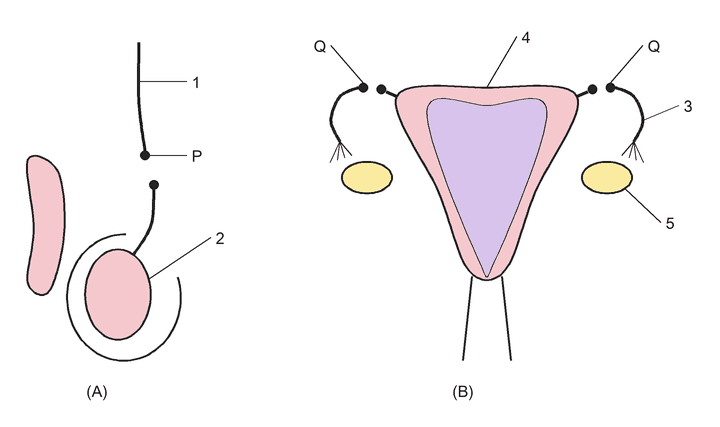
(a) Label the parts 1 to 5.
(b) What does figure A depict ?
(c) What does figure B depict ?
(d) Comment on P and Q.
(e) Mention one function each of part 2 and 4.
Solve with AIWritten solution
Solution:
Concept: Figure (A) shows the male sterilisation operation, vasectomy, and figure (B) the female one, tubectomy. In both, the duct that carries the gametes is cut and tied.
Step 1 — Label the parts 1 to 5.
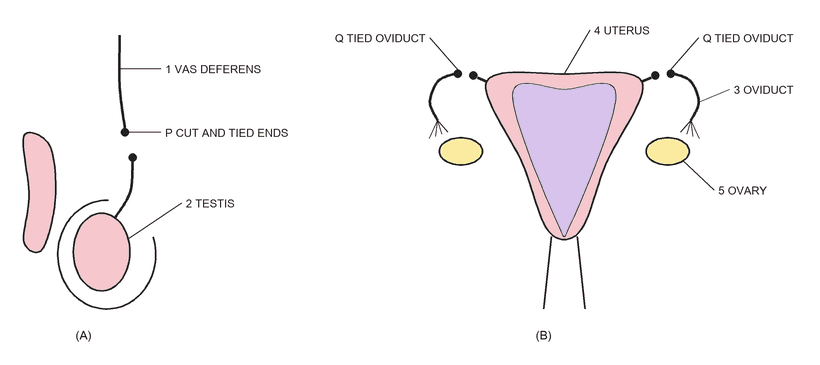
1 – Vas deferens (sperm duct); 2 – Testis; 3 – Oviduct (fallopian tube); 4 – Uterus; 5 – Ovary.
Step 2 — Say what figure A depicts.
Figure A depicts vasectomy, surgical sterilisation in the male. A small cut is made in the scrotum, the vas deferens from each testis is tied at two places, and the small piece between the ties is removed.
Step 3 — Say what figure B depicts.
Figure B depicts tubectomy, surgical sterilisation in the female. The abdomen is opened and the fallopian tubes (oviducts) are cut and tied with nylon thread.
Step 4 — Comment on P and Q.
P marks the cut and tied ends of the vas deferens, so the sperms cannot pass out. Q marks the cut and tied oviducts, which closes the passage of the egg so it cannot meet the sperms. In both cases fertilisation is prevented.
Step 5 — Give one function each of parts 2 and 4.
Part 2, the testis, produces the sperms (and the male hormone testosterone). Part 4, the uterus, is where the embryo gets implanted and develops into the foetus.
Therefore, (a) 1 vas deferens, 2 testis, 3 oviduct, 4 uterus, 5 ovary; (b) vasectomy; (c) tubectomy; (d) P and Q are the cut and tied ducts; (e) the testis produces sperms, the uterus holds the developing embryo.
- 484 marks
Question 48
Kishan and Malti are married and have three children. They have decided not to have any more children and are considering permanent surgical methods of contraception.
(a) Which surgical method can Kishan undergo ?
(b) Can Malti also undergo some sort of a permanent surgical method like Kishan as answered by you in (a)?
(c) Out of (a) and (b), explain why (a) is preferred over (b) when considering permanent contraception ?
Solve with AIWritten solution
Solution:
Concept: The permanent surgical method for the male is vasectomy and for the female is tubectomy. Vasectomy is the simpler operation.
Step 1 — Part (a): the method for Kishan.
Kishan can undergo vasectomy. The vas deferens (sperm duct) from each testis is tied, and a small piece between the two ties is removed.
Step 2 — Part (b): the method for Malti.
Yes. Malti can undergo tubectomy, in which her fallopian tubes (oviducts) are cut and tied.

Step 3 — Part (c): why vasectomy is preferred.
Vasectomy needs only a small cut in the scrotum, while tubectomy needs the abdomen to be opened. So vasectomy is easier, quicker and safer. It also has no harmful effect on manliness or on the pleasure of intercourse. That is why, between a couple, it is better if the husband is operated.
Therefore, (a) vasectomy; (b) yes, tubectomy; (c) vasectomy is preferred because it is a simpler, quicker and safer operation than tubectomy.
- 494 marks
Question 49
Rising population is one of the major issues that India is facing currently. It has adversely impacted the environment as well as food production capacity. Answer the questions that follow :
(a) Mention two main factors responsible for population explosion.
(b) 'It is the need of the hour to adopt population control measures'. Give two reasons to substantiate the above statement.
(c) Mention two Intro Uterine Devices (IUDs) that are commonly used for contraception in India.
Solve with AIWritten solution
Solution:
Concept: The population explodes when births stay high while deaths fall; control is needed because resources cannot keep up and the environment suffers.
Step 1 — Part (a): two factors for the population explosion.
- Illiteracy and ignorance about the reproductive system and family planning.
- Desire for a male child, together with traditional beliefs and the view that children are helping hands.
Step 2 — Part (b): first reason for control.
Resources cannot keep pace. Food production rises in arithmetic progression while population rises in geometric progression, so food, water, land and energy run short.
Step 3 — Part (b): second reason for control.
The environment and living standards suffer. More people mean more deforestation and pollution, lower per capita income, unemployment and poorer health.
Step 4 — Part (c): two IUDs.
Copper-T and Lippe's loop are the IUDs commonly used in India. They are fitted inside the uterus; they do not stop fertilisation but prevent the implantation of the embryo.
Therefore, (a) illiteracy and the desire for a male child; (b) resources cannot keep pace and the environment and living standards suffer; (c) Copper-T and Lippe's loop.
What Class 10 Biology Ch 15 covers
The sections of the chapter, in the order the book takes them. Every question above comes from one of these.
- 01Rising Population – A Global Threat
- 02World Population Through the Ages
- 03Rapid Rise in Population
- 04Population Explosion – A Serious Global Concern
- 05Population in India
- 06Factors Responsible for Population Explosion in India
More ways to study this chapter
The same chapter asked three other ways. Practise it, revise it, and see what the board has set on Ch 15 before.
- Competency-Based Questions (CBQ)Case study questions: a situation, and the part of the chapter that answers it.40questionsOpen
- Previous Year QuestionsQuestions that have actually appeared in board papers, each tagged with its year.29questionsOpen
- Practice QuestionsExtra questions per chapter, for when one attempt at a method is not enough.44questionsOpen
Ch 15 in past ICSE papers
The same chapter as the board has actually asked it. These are worded differently from the textbook exercise, which is the point of reading them.
- 11 mark
Board paper question 1
Name the following:
The number of individuals inhabiting per unit area.
Solve with AIWritten solution
Solution:
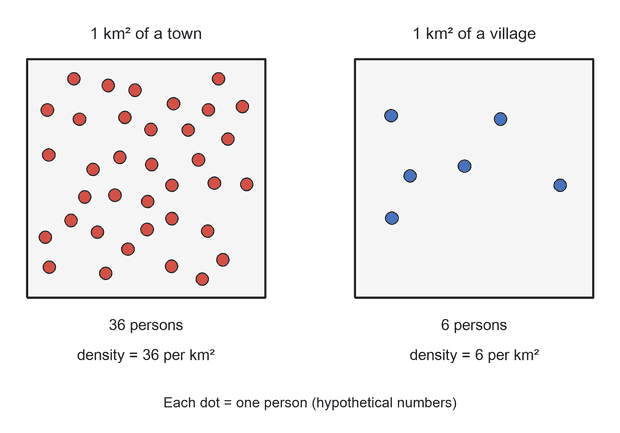
Concept: Population density is the number of individuals living per unit area (per square kilometre, km²) at a given time. It tells us how crowded a place is.
Step 1 — Match the description.
'Number of individuals per unit area' is the definition of population density.
Step 2 — Give an example.
Towns and cities have a much higher population density than villages, because many more people live on each km² of land.
Therefore, the term is population density.
- 21 mark
Board paper question 2
Choose the correct answer from the four options given below:
Surgical method of sterilization in a woman involves cutting and tying of:
Solve with AIAnswer
(A) Ureter
(B) Uterus
(C) Urethra
- Correct
(D) Oviduct
Answer: (D) Oviduct
Concept: Sterilisation is a permanent, surgical method of birth control. It blocks the tube that carries the gametes: the oviducts (fallopian tubes) in a woman (tubectomy) or the sperm ducts (vasa deferentia) in a man (vasectomy).
Step 1 — Name the operation.
Surgical sterilisation of a woman is tubectomy: the oviducts (fallopian tubes) are cut and tied.
Step 2 — Say why it works.
With the oviducts closed, the egg and the sperms cannot meet, so fertilisation cannot take place.
Why the other options are wrong:
- (A) Ureter: the ureter carries urine from the kidney to the urinary bladder; it is not a reproductive organ.
- (B) Uterus: the uterus is where the embryo develops; tubectomy leaves it untouched.
- (C) Urethra: the urethra carries urine out of the body; cutting it would not stop fertilisation.
Therefore, tubectomy involves cutting and tying of the oviducts, option (D).
- 31 mark
Board paper question 3
Match the item given in Column A with the most appropriate one in Column B.
Column A Column B Birth rate dynamic body balance Hyperglycemia Hypoglycemia Natality static body balance vehicular standards nucleosome Solve with AIWritten solution
Solution:
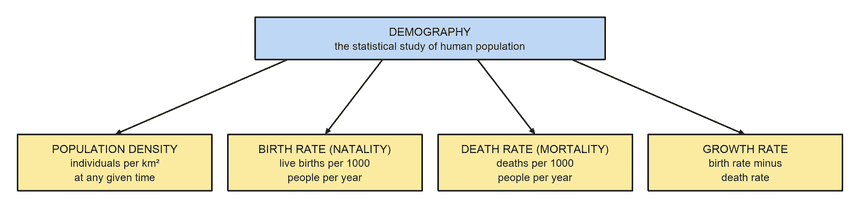
Concept: Demography measures a population with a few rates, each counted per 1000 people per year: the birth rate (natality) counts live births, the death rate (mortality) counts deaths, and the growth rate is the birth rate minus the death rate.
Step 1 — Find the match.
Birth rate has a technical name in population studies: natality.
Step 2 — Rule out the rest.
The other Column B items belong elsewhere: vehicular standards to Euro norms, nucleosome to DNA and histones, hyperglycemia and hypoglycemia to blood sugar, and static or dynamic body balance to parts of the ear.
Therefore, Birth rate — Natality.
- 41 mark
Board paper question 4
Differentiate between the following pairs on the basis of what is mentioned in brackets:
Demography and Population density [Definition]
Solve with AIWritten solution
Solution:
Concept: Demography is the whole subject; population density is one of the measurements it uses.
Step 1 — Define demography.
Demography is the statistical study of human population: its size, density, distribution, births and deaths.
Step 2 — Define population density.
Population density is the number of individuals per square kilometre at a given time.
Therefore, demography is the statistical study of human population, while population density is the number of individuals per km² at a given time.
- 51 mark
Board paper question 5
Give appropriate biological or technical terms for the following:
The difference between the birth rate and the death rate.
Solve with AIWritten solution
Solution:
Concept: Demography measures a population with a few rates, each counted per 1000 people per year: the birth rate (natality) counts live births, the death rate (mortality) counts deaths, and the growth rate is the birth rate minus the death rate.
Step 1 — Name the term.
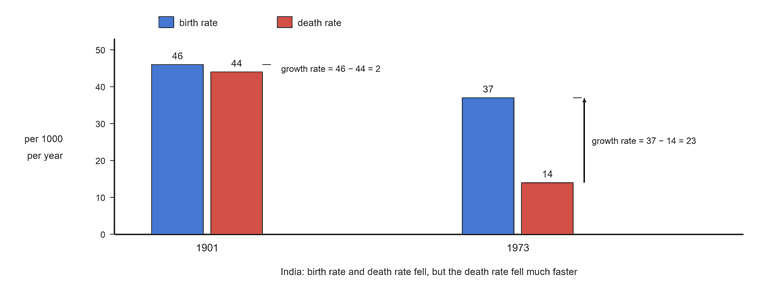
The difference between the birth rate and the death rate is the growth rate of population (natural growth rate).
Step 2 — Read its sign.
If the birth rate is higher than the death rate, the population grows; if it is lower, the population falls.
Step 3 — Use the book's figures.
The book gives India's rates as about 46 and 44 per 1000 in 1901, and about 37 and 14 per 1000 in 1973.
The death rate fell much faster than the birth rate, so the growth rate rose.
Therefore, the difference between the birth rate and the death rate is the growth rate of population.
- 61 mark
Board paper question 6
Give biological explanations for the following:
Education is very important for population control.
Solve with AIWritten solution
Solution:
Concept: Most causes of a high birth rate, such as illiteracy, ignorance and old beliefs, are removed by education.
Step 1 — See the problem.
Illiterate people often do not know how the reproductive system works or how pregnancy can be prevented, and they may hold beliefs such as 'children are a gift of God' or 'a son is a must'.
Step 2 — See what education changes.
Population education teaches the advantages of a small family, the legal age of marriage (18 years for girls, 21 for boys) and the methods of family planning.

Step 3 — Link it to population.
Educated couples marry later, space their children and have fewer of them, so the birth rate falls and population growth slows down.
Therefore, education is important for population control because it makes people aware of family planning and of the benefits of a small family, which lowers the birth rate.
All 29 board paper questions for this chapter, solved the same way.
Class 10 Biology Ch 15 questions students ask
How many questions are there in Class 10 Biology Ch 15?
49 questions. Every one is solved step by step on this page.
Are these Class 10 Biology solutions free?
Yes. Every question and its full working is free to read, with no account needed.
Can I download the Class 10 Biology Ch 15 solutions as a PDF?
There is no PDF to download. Every solution is on this page instead, which means it is searchable, always the current syllabus, and readable on a phone. Use your browser's print option if you want it on paper.