
Opening your dashboard
Class 10 Biology Chapter 15 Population – The Increasing Numbers and Rising Problems: Previous Year Questions
29 questions on Chapter 15, each solved step by step. Class 10 Biology, ICSE 2026-27.
29 questions with solutions
1–2 marks · Easy difficulty
- 11 mark
Question 1
Name the following:
The number of individuals inhabiting per unit area.
Solve with AIWritten solution
Solution:
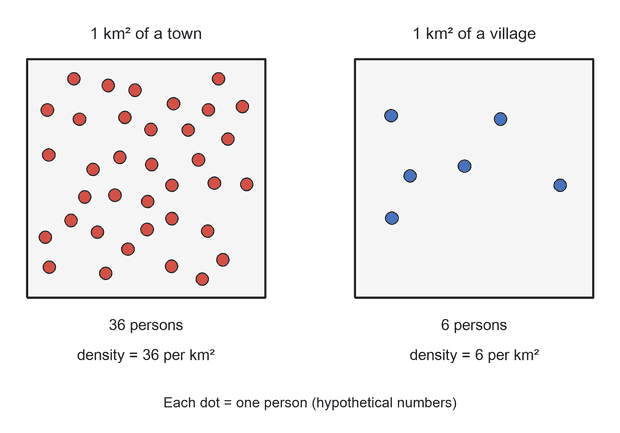
Concept: Population density is the number of individuals living per unit area (per square kilometre, km²) at a given time. It tells us how crowded a place is.
Step 1 — Match the description.
'Number of individuals per unit area' is the definition of population density.
Step 2 — Give an example.
Towns and cities have a much higher population density than villages, because many more people live on each km² of land.
Therefore, the term is population density.
- 21 mark
Question 2
Choose the correct answer from the four options given below:
Surgical method of sterilization in a woman involves cutting and tying of:
Solve with AIAnswer
(A) Ureter
(B) Uterus
(C) Urethra
- Correct
(D) Oviduct
Answer: (D) Oviduct
Concept: Sterilisation is a permanent, surgical method of birth control. It blocks the tube that carries the gametes: the oviducts (fallopian tubes) in a woman (tubectomy) or the sperm ducts (vasa deferentia) in a man (vasectomy).
Step 1 — Name the operation.
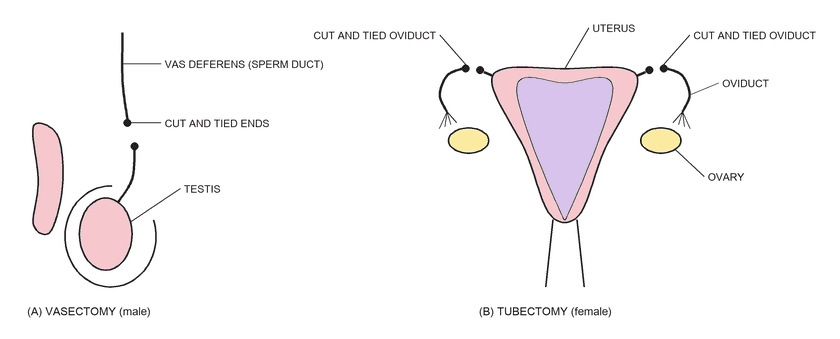
Surgical sterilisation of a woman is tubectomy: the oviducts (fallopian tubes) are cut and tied.
Step 2 — Say why it works.
With the oviducts closed, the egg and the sperms cannot meet, so fertilisation cannot take place.
Why the other options are wrong:
- (A) Ureter: the ureter carries urine from the kidney to the urinary bladder; it is not a reproductive organ.
- (B) Uterus: the uterus is where the embryo develops; tubectomy leaves it untouched.
- (C) Urethra: the urethra carries urine out of the body; cutting it would not stop fertilisation.
Therefore, tubectomy involves cutting and tying of the oviducts, option (D).
- 31 mark
Question 3
Match the item given in Column A with the most appropriate one in Column B.
Column A Column B Birth rate dynamic body balance Hyperglycemia Hypoglycemia Natality static body balance vehicular standards nucleosome Solve with AIWritten solution
Solution:
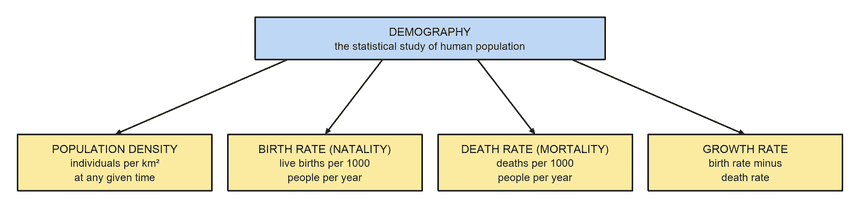
Concept: Demography measures a population with a few rates, each counted per 1000 people per year: the birth rate (natality) counts live births, the death rate (mortality) counts deaths, and the growth rate is the birth rate minus the death rate.
Step 1 — Find the match.
Birth rate has a technical name in population studies: natality.
Step 2 — Rule out the rest.
The other Column B items belong elsewhere: vehicular standards to Euro norms, nucleosome to DNA and histones, hyperglycemia and hypoglycemia to blood sugar, and static or dynamic body balance to parts of the ear.
Therefore, Birth rate — Natality.
- 41 mark
Question 4
Differentiate between the following pairs on the basis of what is mentioned in brackets:
Demography and Population density [Definition]
Solve with AIWritten solution
Solution:
Concept: Demography is the whole subject; population density is one of the measurements it uses.
Step 1 — Define demography.
Demography is the statistical study of human population: its size, density, distribution, births and deaths.
Step 2 — Define population density.
Population density is the number of individuals per square kilometre at a given time.
Therefore, demography is the statistical study of human population, while population density is the number of individuals per km² at a given time.
- 51 mark
Question 5
Give appropriate biological or technical terms for the following:
The difference between the birth rate and the death rate.
Solve with AIWritten solution
Solution:
Concept: Demography measures a population with a few rates, each counted per 1000 people per year: the birth rate (natality) counts live births, the death rate (mortality) counts deaths, and the growth rate is the birth rate minus the death rate.
Step 1 — Name the term.
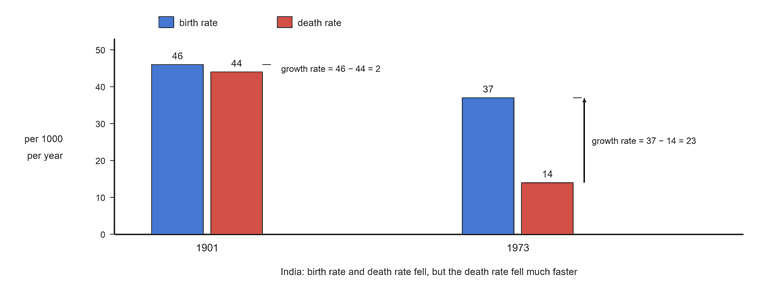
The difference between the birth rate and the death rate is the growth rate of population (natural growth rate).
Step 2 — Read its sign.
If the birth rate is higher than the death rate, the population grows; if it is lower, the population falls.
Step 3 — Use the book's figures.
The book gives India's rates as about 46 and 44 per 1000 in 1901, and about 37 and 14 per 1000 in 1973.
The death rate fell much faster than the birth rate, so the growth rate rose.
Therefore, the difference between the birth rate and the death rate is the growth rate of population.
- 61 mark
Question 6
Give biological explanations for the following:
Education is very important for population control.
Solve with AIWritten solution
Solution:
Concept: Most causes of a high birth rate, such as illiteracy, ignorance and old beliefs, are removed by education.
Step 1 — See the problem.
Illiterate people often do not know how the reproductive system works or how pregnancy can be prevented, and they may hold beliefs such as 'children are a gift of God' or 'a son is a must'.
Step 2 — See what education changes.
Population education teaches the advantages of a small family, the legal age of marriage (18 years for girls, 21 for boys) and the methods of family planning.

Step 3 — Link it to population.
Educated couples marry later, space their children and have fewer of them, so the birth rate falls and population growth slows down.
Therefore, education is important for population control because it makes people aware of family planning and of the benefits of a small family, which lowers the birth rate.
- 71 mark
Question 7
Give suitable biological reasons for the following statements :
The birth rate in India is very high.
Solve with AIWritten solution
Solution:
Concept: India's population grew fast because the death rate fell sharply (better medical care) while the birth rate stayed high for social and economic reasons.
Step 1 — Ignorance.
A large part of the population, especially in villages, is illiterate and does not know about the reproductive system or family planning.
Step 2 — Social and economic reasons.
Traditional beliefs (children as a gift of God), the desire for a male child, high infant mortality (more children so that some survive) and economic reasons (children as helping hands) make families have many children.

Therefore, the birth rate in India is high mainly because of illiteracy and social beliefs, such as the desire for a son and seeing children as helping hands.
- 81 mark
Question 8
Explain the following terms:
(v) Population density
Solve with AIWritten solution
Solution:
Concept: Population density is the number of individuals living per unit area (per square kilometre, km²) at a given time. It tells us how crowded a place is.
Step 1 — Define the term.
Population density is the number of individuals living per square kilometre (km²) of area at a given time.
Step 2 — Read the figure.
In the figure (made-up numbers), the same 1 km² holds 36 people in a town and only 6 in a village, so the town's density (36 per km²) is greater.
Therefore, population density is the number of individuals per square kilometre at a given time.
- 91 mark
Question 9
Give the biological reasons for the following statements:
(iv) Medical discoveries such as antibiotics and vaccinations have indirectly contributed to the sharp rise in human population.
Solve with AIWritten solution
Solution:
Concept: Medicines did not raise the number of births; they lowered the number of deaths, and that changed the balance between the two.
Step 1 — Fewer deaths.
Antibiotics cure infections that once killed people, and vaccinations protect against many deadly diseases in advance. Deaths of all age groups, especially infants and the old, fell sharply.
Step 2 — More people reach parenthood.
More children survived to the reproductive age and had children of their own.

Step 3 — Why the rise is called indirect.
The death rate fell while the birth rate stayed high, so the population rose fast. These discoveries were meant to save lives, not to increase population, so their effect on numbers is indirect.
Therefore, antibiotics and vaccinations lowered the death rate while the birth rate stayed high, which indirectly caused a sharp rise in population.
- 101 mark
Question 10
Differentiate between the following pairs on the basis of what is mentioned in the brackets:
(iii) Population control and Swachh Bharat Abhiyan (One objective)
Solve with AIWritten solution
Solution:
Concept: Population control aims at fewer births; Swachh Bharat Abhiyan aims at a cleaner country.
Step 1 — Objective of population control.
To reduce the rate of growth of population (small families), so that there is less pressure on resources and a better quality of life.
Step 2 — Objective of Swachh Bharat Abhiyan.
To make India clean: clean streets and public places, proper disposal of waste and an end to open defecation. It is the Clean India Mission started by the Government of India in 2014.
Step 3 — Write the difference.
Set the two objectives side by side.
Population control Swachh Bharat Abhiyan Objective: to reduce the growth rate of population Objective: to keep the country clean Therefore, population control aims to slow population growth, while Swachh Bharat Abhiyan aims to make India clean.
- 111 mark
Question 11
Give appropriate biological technical terms for the following:
(ii) Number of live births per 1000 people per year.
Solve with AIWritten solution
Solution:
Concept: Demography measures a population with a few rates, each counted per 1000 people per year: the birth rate (natality) counts live births, the death rate (mortality) counts deaths, and the growth rate is the birth rate minus the death rate.
Step 1 — Name the term.
The number of live births per 1000 people per year is the birth rate (natality).
Step 2 — See how it is worked out.
For example, 440 live births in a year in a population of 20,000 give:

Therefore, the term is birth rate (natality).
- 121 mark
Question 12
Give appropriate biological technical terms for the following:
(vii) A surgical method of fertility control in human males.
Solve with AIWritten solution
Solution:
Concept: Sterilisation is a permanent, surgical method of birth control. It blocks the tube that carries the gametes: the oviducts (fallopian tubes) in a woman (tubectomy) or the sperm ducts (vasa deferentia) in a man (vasectomy).
Step 1 — Name the method.
The surgical method of fertility control in men is vasectomy.
Step 2 — Say what is done.
The vas deferens (sperm duct) from each testis is cut and tied, so the semen carries no sperms. It is simpler and quicker than tubectomy.
Therefore, the surgical method of fertility control in human males is vasectomy.
- 131 mark
Question 13
The statistical study of human population is called:
Solve with AIAnswer
(A) Mortality
- Correct
(B) Demography
(C) Natality
(D) Equality
Answer: (B) Demography
Concept: The word demography comes from Greek: demos = people and graphein = to write or describe.
Step 1 — Recall the definition.
Demography is the statistical study of human population: its size, density, distribution, births and deaths.
Step 2 — Place the other terms.
Birth rate (natality), death rate (mortality), density and growth rate are measurements used in demography.
Why the other options are wrong:
- (A) Mortality: mortality is the death rate (deaths per 1000 people per year), one measurement, not the whole study.
- (C) Natality: natality is the birth rate (live births per 1000 people per year), also one measurement.
- (D) Equality: equality is a social idea, not the study of population.
Therefore, the statistical study of human population is called demography, option (B).
- 141 mark
Question 14
Explain the term 'Population density'.
Solve with AIWritten solution
Solution:
Concept: Population density is the number of individuals living per unit area (per square kilometre, km²) at a given time. It tells us how crowded a place is.
Step 1 — Define the term.
Population density is the number of individuals living per square kilometre (km²) of area at a given time.
Step 2 — Give an example.
A town has a higher population density than a village, because many more people live on each square kilometre of its land.
Therefore, population density is the number of individuals per km² at a given time.
- 152 marks
Question 15
Name the two surgical methods of population control.
Solve with AIWritten solution
Solution:
Concept: Sterilisation is a permanent, surgical method of birth control. It blocks the tube that carries the gametes: the oviducts (fallopian tubes) in a woman (tubectomy) or the sperm ducts (vasa deferentia) in a man (vasectomy).
Step 1 — Tubectomy (in the female).
The abdomen is opened and the oviducts (fallopian tubes) are cut and tied. The egg can no longer meet the sperms, so fertilisation cannot take place.
Step 2 — Vasectomy (in the male).
A small cut is made in the scrotum, and the vas deferens (sperm duct) from each testis is tied and a small piece between the two ties is removed. The semen then carries no sperms.
The figure shows where the cut and tie are made in each method.
Therefore, the two surgical methods are tubectomy (in females) and vasectomy (in males).
- 162 marks
Question 16
Mention two factors responsible for population explosion in India.
Solve with AIWritten solution
Solution:
Concept: India's population grew fast because the death rate fell sharply (better medical care) while the birth rate stayed high for social and economic reasons.
Step 1 — Illiteracy.
Much of the rural population is illiterate and does not know how the reproductive system works or how pregnancy can be prevented.
Step 2 — Desire for a male child.
Many families believe a son is needed to carry on the family name and to support the parents in old age, so they keep having children until a son is born.
Other factors are traditional beliefs, high infant mortality, economic reasons (children as helping hands), religious and social customs, and lack of recreation.
Therefore, two factors responsible for population explosion in India are illiteracy and the desire for a male child.
- 172 marks
Question 17
Name any two resources which come under pressure due to rising population.
Solve with AIWritten solution
Solution:
Concept: Every extra person needs food, water, land and energy, so a fast-rising population uses up resources faster than they can be replaced.
Step 1 — Food.
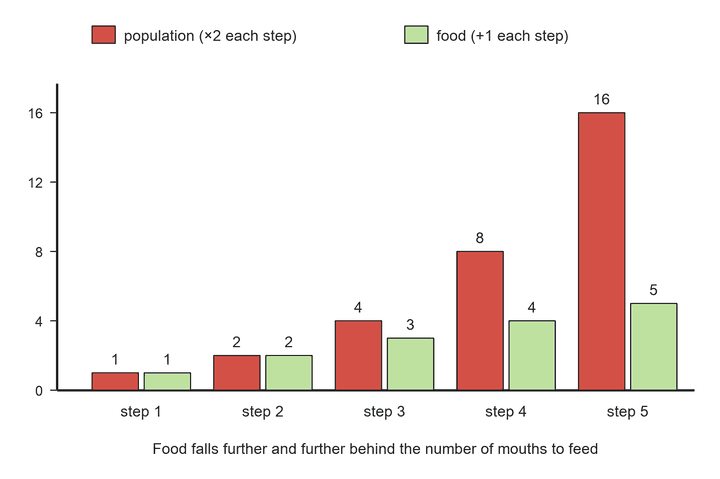
More mouths must be fed from limited farmland. (Malthus argued that population tends to grow faster than food production; the book shows this as 1, 2, 4, 8, 16 against 1, 2, 3, 4, 5.)
Step 2 — Water.
Clean, safe drinking water becomes scarcer as demand rises and rivers, ponds and lakes get polluted.
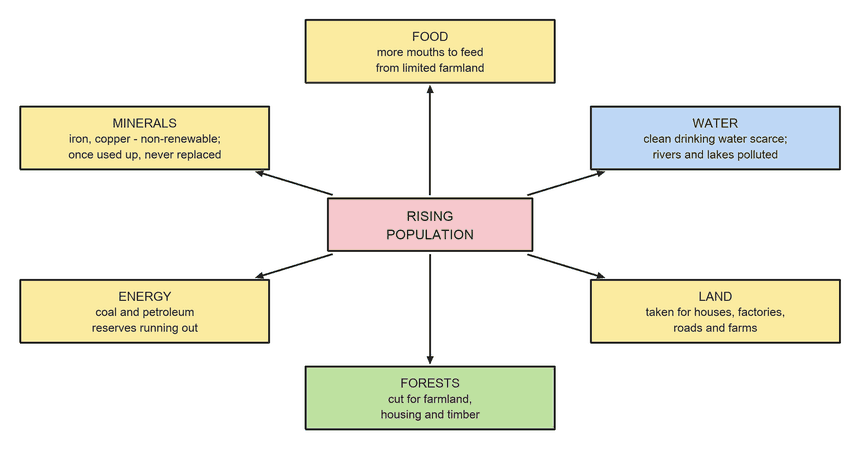
Land, forests, energy (coal and petroleum) and minerals are also under pressure.
Therefore, two resources under pressure are food and water.
- 181 mark
Question 18
Birth rate is the number of live births per thousand persons in:
Solve with AIAnswer
- Correct
(A) 1 year
(B) 2 years
(C) 10 years
(D) 20 years
Answer: (A) 1 year
Concept: Demography measures a population with a few rates, each counted per 1000 people per year: the birth rate (natality) counts live births, the death rate (mortality) counts deaths, and the growth rate is the birth rate minus the death rate.
Step 1 — Recall the definition.
The birth rate (natality) is the number of live births per 1000 people per year.
Step 2 — See an example.
440 live births in one year in a population of 20,000 give:
Why the other options are wrong:
- (B) 2 years: a 2-year count would include two years' births and roughly double the figure.
- (C) 10 years: 10 years is the gap between two censuses, not the period used for the birth rate.
- (D) 20 years: 20 years is not the period used for any of the population rates.
Therefore, the birth rate counts live births per 1000 persons in 1 year, option (A).
- 191 mark
Question 19
Give the biological term for the surgical method of contraception in human females.
Solve with AIWritten solution
Solution:
Concept: Sterilisation is a permanent, surgical method of birth control. It blocks the tube that carries the gametes: the oviducts (fallopian tubes) in a woman (tubectomy) or the sperm ducts (vasa deferentia) in a man (vasectomy).
Step 1 — Name the method.
The surgical method of contraception in women is tubectomy.
Step 2 — Say what is done.
The fallopian tubes (oviducts) are cut and tied, so the egg cannot meet the sperms and pregnancy is prevented.
Therefore, the term is tubectomy.
- 202 marks
Question 20
"Birth rate in India is very high." Mention two reasons in support of the statement.
Solve with AIWritten solution
Solution:
Concept: India's population grew fast because the death rate fell sharply (better medical care) while the birth rate stayed high for social and economic reasons.
Step 1 — Illiteracy.
A large part of the population, especially in villages, is illiterate and does not know about the reproductive system or methods of family planning.
Step 2 — High infant mortality.
Where many infants die, poorer families feel it safer to have more children so that at least some survive.
Other reasons are children as helping hands, the desire for a male child, traditional and religious beliefs, and lack of recreation.
Therefore, two reasons for the high birth rate in India are illiteracy and high infant mortality.
- 211 mark
Question 21
The number of live births per thousand people per year is called:
Solve with AIAnswer
(A) Mortality
(B) Population density
(C) Population growth rate
- Correct
(D) Natality
Answer: (D) Natality
Concept: Demography measures a population with a few rates, each counted per 1000 people per year: the birth rate (natality) counts live births, the death rate (mortality) counts deaths, and the growth rate is the birth rate minus the death rate.
Step 1 — Recall the definition.
Natality (birth rate) is the number of live births per 1000 people per year.
Step 2 — Match the stem.
The stem describes exactly this, so the term is natality.
Why the other options are wrong:
- (A) Mortality: mortality is the death rate: deaths per 1000 people per year.
- (B) Population density: population density is the number of individuals per km² at a given time; it counts area, not births.
- (C) Population growth rate: population growth rate is the birth rate minus the death rate, not the birth rate alone.
Therefore, the term is natality, option (D).
- 222 marks
Question 22
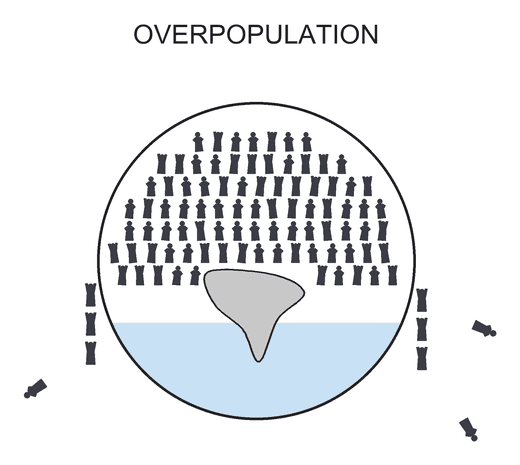
In the last century, the human population has increased tremendously. Death rate has reduced and life expectancy has increased. This rapid growth has placed significant pressure on resources. Global cooperation is needed for environmental preservation.
(a) Mention any one reason for reduction in the death rate.
(b) Name any one resource that is under pressure due to population explosion.
Solve with AIWritten solution
Solution:
Concept: The death rate fell because of better medical care, and the extra people press on natural resources.
Step 1 — One reason the death rate fell.
Better medical care: antibiotics and large-scale vaccination against deadly diseases. Fewer people, especially infants, die of disease, and people live longer.
Step 2 — One resource under pressure.
Food: many more mouths must be fed from limited farmland. (Water, land, forests, energy and minerals are also under pressure.)
Therefore, (a) better medical care (antibiotics and vaccination) reduced the death rate; (b) food is a resource under pressure.
- 232 marks
Question 23
The need to limit the size of the family is more vital today than ever before. Give two reasons.
Solve with AIWritten solution
Solution:
Concept: Today the death rate is low, so almost every child grows up; a large family now adds far more people than before, while resources stay limited.
Step 1 — Resources cannot keep pace.
Land, water, forests, energy and minerals are limited, and every extra person needs a share. The book shows Malthus's model: population doubling (1, 2, 4, 8, 16) while food rises by steps (1, 2, 3, 4, 5), so food falls further behind.
Step 2 — Quality of life falls.
A large family lowers the income per person. The mother's health suffers, and the children get less attention, poorer food and less education. A small family can give each child proper food, health care and education.
Therefore, limiting family size is more vital today because nearly all children now survive, resources cannot keep pace, and a small family gives a better quality of life.
- 241 mark
Question 24
A health organization wants to educate the rural audience about population control using visually engaging methods. Which of these would be effective?
P. Posters
Q. Loudspeakers
R. Film shows
S. Street plays
Solve with AIAnswer
- Correct
(A) P, R and S
(B) Q, R and S
(C) P, Q and R
(D) P, Q and S
Answer: (A) P, R and S
Concept: A visually engaging method is one that people see.
Step 1 — Sort the four methods.
Posters (P) are seen, film shows (R) are seen and heard, and street plays (S) are acted out in front of the audience. A loudspeaker (Q) is heard but not seen.
Step 2 — Choose.
The visual methods are P, R and S.
Why the other options are wrong:
- (B) Q, R and S: it includes Q, the loudspeaker, which is only heard, and leaves out the posters.
- (C) P, Q and R: it includes the loudspeaker (Q) and leaves out the street plays.
- (D) P, Q and S: it includes the loudspeaker (Q) and leaves out the film shows.
Therefore, the effective visual methods are posters, film shows and street plays, option (A).
- 251 mark
Question 25
Give the biological/technical terms for the following:
(d) The surgical technique for females that can be used to prevent pregnancy.
Solve with AIWritten solution
Solution:
Concept: Sterilisation is a permanent, surgical method of birth control. It blocks the tube that carries the gametes: the oviducts (fallopian tubes) in a woman (tubectomy) or the sperm ducts (vasa deferentia) in a man (vasectomy).
Step 1 — Name the technique.
The surgical technique for females is tubectomy.
Step 2 — Say how it prevents pregnancy.
The fallopian tubes (oviducts) are cut and tied, which closes the path of the egg, so fertilisation cannot take place.
Therefore, the technique is tubectomy.
- 261 mark
Question 26
Explain the term 'Population Density' with reference to human beings.
Solve with AIWritten solution
Solution:
Concept: Population density is the number of individuals living per unit area (per square kilometre, km²) at a given time. It tells us how crowded a place is.
Step 1 — Define the term.
Population density is the number of individuals living per square kilometre (km²) of area at a given time.
Step 2 — Apply it to human beings.
For human beings it is the number of persons living on each km² of a country or region; towns and big cities have a much higher density than villages.
Therefore, population density of human beings is the number of persons per km² of an area at a given time.
- 271 mark
Question 27
The surgical method of sterilisation in a male involves ligation of the:
Solve with AIAnswer
(A) Oviduct
- Correct
(B) Sperm Duct
(C) Testis
(D) Uterus
Answer: (B) Sperm Duct
Concept: Sterilisation is a permanent, surgical method of birth control. It blocks the tube that carries the gametes: the oviducts (fallopian tubes) in a woman (tubectomy) or the sperm ducts (vasa deferentia) in a man (vasectomy).
Step 1 — Name the operation.
Sterilisation of the male is vasectomy: a small cut is made in the scrotum and the vas deferens (sperm duct) from each testis is tied, with a small piece between the ties removed.
Step 2 — Say why it works.
Sperms can no longer pass out, so the semen carries no sperms.
Why the other options are wrong:
- (A) Oviduct: the oviduct belongs to the female; tying it is tubectomy.
- (C) Testis: the testis makes the sperms; vasectomy does not touch it.
- (D) Uterus: the uterus is a female organ where the embryo develops.
Therefore, vasectomy involves ligation of the sperm duct, option (B).
- 281 mark
Question 28
What is one way women can contribute to controlling population explosion in India?
Solve with AIAnswer
(A) By having more children to contribute to the workforce.
- Correct
(B) By making informed choices about family planning methods.
(C) By ignoring health care services.
(D) By relying on men to make decisions about family size.
Answer: (B) By making informed choices about family planning methods.
Concept: Population control depends on couples knowing and using family-planning methods; the woman bears and cares for the children, so her informed choice matters.
Step 1 — Why the woman's choice matters.
An informed woman can decide when to have a child, space the next one and keep the family small.
Step 2 — How she does it.
With proper advice she can choose a suitable method, such as pills, an intra-uterine device (Copper-T) or tubectomy.
Why the other options are wrong:
- (A) By having more children to contribute to the workforce: having more children increases the population instead of controlling it.
- (C) By ignoring health care services: health-care services give family-planning advice and keep children alive; ignoring them leads to more infant deaths and more births.
- (D) By relying on men to make decisions about family size: leaving the decision to men alone takes away the woman's informed choice, which is what keeps families small.
Therefore, women can help by making informed choices about family planning methods, option (B).
- 291 mark
Question 29
What do you understand by the term birth rate in population?
Solve with AIWritten solution
Solution:
Concept: Demography measures a population with a few rates, each counted per 1000 people per year: the birth rate (natality) counts live births, the death rate (mortality) counts deaths, and the growth rate is the birth rate minus the death rate.
Step 1 — Define the term.
The birth rate (natality) is the number of live births per 1000 people of the population per year.
Step 2 — See how it is worked out.
For example, 440 live births in a year in a population of 20,000 give:
Therefore, the birth rate is the number of live births per 1000 people per year.