
Opening your dashboard
Class 10 Biology Chapter 15 Population – The Increasing Numbers and Rising Problems: Practice Questions
44 questions on Chapter 15, each worked through on its own page with the AI tutor. Class 10 Biology, ICSE 2026-27.
44 questions
1–5 marks · Mixed difficulty
- 11 mark
Question 1
Bloom's level: Remember
About 10,000 years ago, when man began to live in settled communities and practise agriculture, the total world population was approximately :
- 21 mark
Question 2
Bloom's level: Remember
The highest annual growth rate of world population ever recorded was about 2.1%, in the year :
- 31 mark
Question 3
Bloom's level: Remember
At the present rate of consumption, the world's reserves of petroleum may be exhausted within about :
- 41 mark
Question 4
Bloom's level: Remember
A couple following the natural calendar method keeps away from mating during which days of the menstrual cycle ?
- 51 mark
Question 5
Bloom's level: Understand
The rising human population is described as the most serious problem the world faces today mainly because :
- 61 mark
Question 6
Bloom's level: Understand
Between a husband and wife, it is often recommended that the husband undergoes the surgical method of contraception because :
- 71 mark
Question 7
Bloom's level: Understand
Rising population is called a threat to the world as a whole and not to any one country because :
- 81 mark
Question 8
Bloom's level: Apply
A district has an area of and a population of 10,00,000. Its population density is :
- 91 mark
Question 9
Bloom's level: Apply
A couple already has four daughters and decides to have another child because they feel a son is needed to carry on the family name and to support them in old age. This reflects which factor of population explosion in India ?
- 101 mark
Question 10
Bloom's level: Analyse
Assertion (A): The scientific and industrial revolution favoured a rise in human population.
Reason (R): As communities grew, there were widespread outbreaks of infectious diseases due to close contact of people.
- 111 mark
Question 11
Bloom's level: Analyse
Assertion (A): The population of a country can grow faster even when its birth rate is falling.
Reason (R): Growth rate is the difference between the birth rate and the death rate, so if the death rate falls more sharply than the birth rate, the growth rate rises.
- 121 mark
Question 12
Bloom's level: Evaluate
Assertion (A): Medical termination of pregnancy (MTP) should not be treated as a method of contraception.
Reason (R): MTP removes a foetus after pregnancy has begun, whereas contraception prevents pregnancy from occurring.
- 132 marks
Question 13
Bloom's level: Understand
Explain how (a) raising the age of marriage and (b) spacing the birth of children help to slow down population growth.
- 142 marks
Question 14
Bloom's level: Understand
Better health care means that more people survive. Why, then, is the rapid rise in human population described as alarming rather than as good news ? Give two reasons.
- 152 marks
Question 15
Bloom's level: Understand
A graph of human population over time shows three steep rises, each after a great cultural revolution, separated by long flattened stretches. Explain why the curve rises steeply after each revolution and then flattens.
- 162 marks
Question 16
Bloom's level: Understand
Explain how illiteracy and high infant mortality each lead to larger families in India.
- 172 marks
Question 17
Bloom's level: Apply
Imagine a group of 5 couples. Each couple has 4 children; the children pair off into couples when they grow up, and each new couple again has 4 children. How many great-grandchildren will the original 5 couples have ?
- 182 marks
Question 18
Bloom's level: Apply
A village has plenty of sunshine and many cattle, but its people cut trees from a nearby forest for firewood. Suggest two non-conventional sources of energy the village could use instead, and state one benefit to the forest.
- 192 marks
Question 19
Bloom's level: Apply
Between the 2001 and 2011 censuses, India's population grew by about 17.7%, adding about 181.5 million people. Use these figures to estimate India's population in 2001 and in 2011 (in millions).
- 202 marks
Question 20
Bloom's level: Apply
About two-thirds of the world population lives in developing nations, and India and China together make up about one-third of it. If the world population is 8 billion, estimate (a) the number of people in developing nations and (b) the combined population of India and China.
- 212 marks
Question 21
Bloom's level: Analyse
A hilly region loses much of its forest to make room for new housing colonies. Analyse how this can lead to (a) flash floods and (b) a change in climate.
- 222 marks
Question 22
Bloom's level: Evaluate
A student argues : "India is a large country with plenty of land, so we do not need to control our population." Evaluate this argument using facts from the chapter.
- 234 marks
Question 23
Bloom's level: Apply
Study these figures for world population :
Time World population About 50,000 years ago about 1 million About 10,000 years ago about 5.3 million 1804 1 billion 1927 2 billion 1974 4 billion (a) How many years did the world take to go from 1 billion to 2 billion, and from 2 billion to 4 billion ?
(b) By how many times did the population grow between 50,000 and 10,000 years ago ?
(c) Name three changes in man's way of life about 10,000 years ago that made the population grow faster.
- 244 marks
Question 24
Bloom's level: Apply
Case: Neha and Arun have just married. They want to delay their first child for two years and, after the first child, keep a gap of at least three years before deciding on a second. They do not want any permanent operation now.
(a) Why are tubectomy and vasectomy not suitable for them at present ?
(b) Suggest three suitable methods, one each of the hormonal, barrier and intra-uterine type, and state how each one prevents pregnancy.
(c) Arun says, "With a Copper-T fitted, the egg can never be fertilised." Is he right ? Explain.
- 254 marks
Question 25
Bloom's level: Apply
A town has an area of and a population of 50,000. In one year, 1,100 live births and 400 deaths were recorded.
(a) Calculate the birth rate and the death rate of the town.
(b) Calculate its growth rate per 1000 people, and express it as a percentage.
(c) Calculate the population density of the town. Will the population of the town rise or fall if these rates continue ? Why ?
- 264 marks
Question 26
Bloom's level: Analyse
Study the census figures for India :
Year Population (millions) Year Population (millions) 1911 252 1951 361 1921 251 1981 685 1931 279 2011 1210 Also, India's birth : death ratio was in 1901 and in 1973.
(a) In which decade did India's population fall ? By how much ?
(b) By how many million did the population increase from 1951 to 2011 ? About how many times did it become ?
(c) Work out the growth (births minus deaths per 1000) for 1901 and 1973. Use your answer to explain why India's population rose so sharply after 1951.
- 274 marks
Question 27
Bloom's level: Evaluate
Case: In a village meeting on the growing number of families with five or six children, the sarpanch says, "People here have many children only because they are poor. If the government gives every family more money, the problem will solve itself."
(a) Name three other factors from the chapter that also lead to large families in such villages.
(b) Evaluate the sarpanch's claim. Is money alone likely to solve the problem ?
(c) Suggest two measures that would work better, with a reason for each.
- 283 marks
Question 28
Bloom's level: Analyse
Population, if unchecked, rises in a geometrical progression (1, 2, 4, 8, …), while food production rises in an arithmetic progression (1, 2, 3, 4, …). Suppose that at the start there is 1 unit of food for 1 unit of population.
(a) Write the population and the food for the first seven steps.
(b) At the seventh step, what fraction of a unit of food is available per unit of population ?
(c) What does this tell us, and what are two ways of preventing it ?
- 295 marks
Question 29
Bloom's level: Create
Construct a summary table of the methods of contraception described in the chapter, with the columns : Type of method, Example(s), How it prevents pregnancy, and Temporary or permanent. Include hormonal, barrier, intra-uterine, natural and surgical methods.
- 305 marks
Question 30
Bloom's level: Create
Prepare a flow chart that summarises the chapter in four linked stages :
(a) Three causes of the rapid rise in population.
(b) The result — population explosion — and three resources that come under pressure.
(c) Three problems faced by society, and three control measures that break the chain.
- 311 mark
Question 31
World Population Day is observed every year on :
- 321 mark
Question 32
Intra-uterine devices such as the Copper-T prevent pregnancy by :
- 331 mark
Question 33
Assertion (A): Forests are regarded as a renewable resource.
Reason (R): By careful management and by planting more trees, the existing forests can be maintained and even improved.
- 342 marks
Question 34
The birth rate of a town with 45,000 people was 24 last year. During that year 405 deaths were registered in the town.
(i) How many live births took place in the town last year ?
(ii) Find the death rate of the town, and hence the growth rate of its population.
- 352 marks
Question 35
State how each of the following has contributed to the population explosion in India :
(i) economic reasons
(ii) lack of recreation
- 362 marks
Question 36
In older times an average family used to have 4 to 6 children, of whom one or more would not survive.
(i) State two reasons why far fewer infants die today.
(ii) Explain why the total population rises sharply now, even if a couple has only 2 or 3 children.
- 372 marks
Question 37
The population of a country rose from 60 million to 120 million in thirty years. The area of the country, 4,00,000 , remained the same.
(i) Calculate the population density of the country before and after the rise.
(ii) State any two problems that arise when the population density of a country increases beyond its means.
- 384 marks
Question 38
The figure is a diagrammatic curve of the growth of the human population. The numbers 1, 2 and 3 mark the three great cultural revolutions, each of which favoured a steep rise in the population.

(i) Name the revolutions 1, 2 and 3.
(ii) What does the flattened part of the curve after each steep rise show ?
(iii) Why does the curve end in two branches with question marks ? Name two kinds of discoveries of medical science in the twentieth century which made the population rise very rapidly.
- 393 marks
Question 39
The bar chart shows the approximate population of India at the censuses from 1901 to 2011.
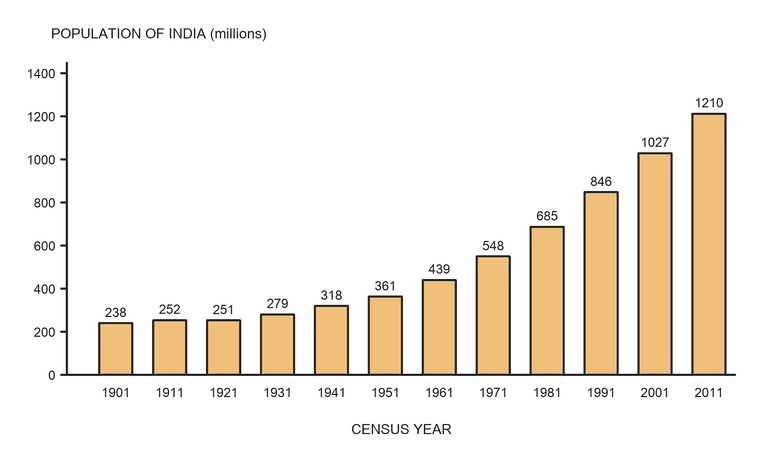
(i) Between which two censuses did the population of India fall slightly ? By how many millions did it fall ?
(ii) By how many millions did the population rise between 1951 and 2011 ?
(iii) In India the ratio of birth rate to death rate was 46 : 44 in 1901 and 37 : 14 in 1973. Use these figures to explain why the population has risen so sharply since 1951.
- 404 marks
Question 40
Methods of contraception help a couple to limit the size of the family.
(i) Name the barrier method which (1) is used by men only, and (2) is a round latex cap fitted on the mouth of the uterus.
(ii) How do the hormonal pills prevent pregnancy ?
(iii) After tubectomy the ovaries of a woman go on producing eggs as before. Explain how the operation still prevents pregnancy, and name the corresponding operation in men.
- 411 mark
Question 41
Class 10 Sample Paper 1 · Section A
Name the following:
A surgical procedure for male contraception.
- 421 mark
Question 42
Class 10 Sample Paper 1 · Section A
What is urbanisation?
- 431 mark
Question 43
Class 10 Sample Paper 2 · Section A
What is a census?
- 442 marks
Question 44
Class 10 Sample Paper 2 · Section B
What are contraceptives?