Solution:
Concept: To distinguish two terms, give matching points of difference side by side, with examples.
Step 1 — Exhaustible and inexhaustible resources.
Exhaustible resources run out with use; inexhaustible ones do not.
| Exhaustible resources | Inexhaustible resources |
|---|
| Limited in amount; get used up and cannot be replaced once finished | Not used up however much they are used |
| e.g. coal, petroleum, minerals like iron and copper | e.g. solar energy, wind energy |
| Must be used carefully | Should be used more and more |
Step 2 — Conventional and non-conventional sources of energy.
Conventional sources are the old ones; non-conventional sources are the newer ones being developed.
| Conventional sources | Non-conventional sources |
|---|
| In use since long | New sources being developed now |
| e.g. coal, petroleum | e.g. solar, nuclear, tidal, wind energy, biogas |
| Their underground reserves are fast depleting | Needed to meet the rising demand for energy |
Step 3 — Natality and mortality.
Natality adds people to the population; mortality removes them. The difference between the two is the growth rate of population.
| Natality | Mortality |
|---|
| Birth rate: number of live births per 1000 people per year | Death rate: number of deaths per 1000 people per year |
| Adds individuals to the population | Removes individuals from the population |
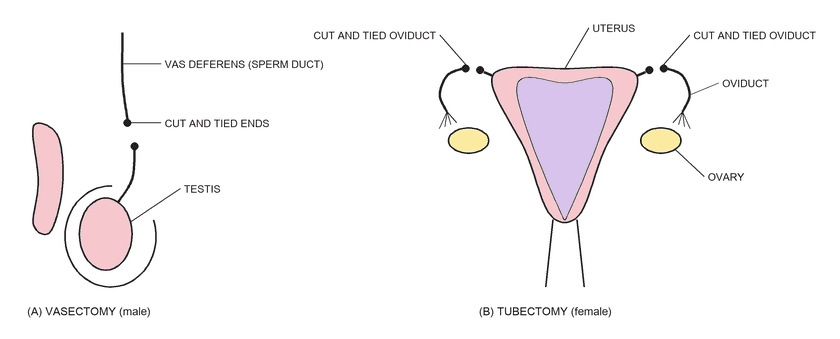
Step 4 — Tubectomy and vasectomy.
Both are permanent surgical methods of contraception, one for each sex.
| Tubectomy | Vasectomy |
|---|
| Performed on females | Performed on males |
| Fallopian tubes (oviducts) are cut and tied; abdomen is opened | Vas deferens is cut and tied through a small cut in the scrotum |
| Closes the passage of the egg | Stops the sperms from passing out |
Step 5 — Deforestation and afforestation.
One removes forests; the other restores them.
| Deforestation | Afforestation |
|---|
| Cutting down of forests | Planting more trees |
| Leads to soil erosion, floods, droughts and global warming | Maintains and improves forests and the environment |
| A serious outcome of rising population: land is needed for cultivation and housing | Possible because forests are a renewable resource |
Therefore, each pair differs as shown in the tables: (a) used up / not used up, (b) old / new sources, (c) births / deaths, (d) female / male operation, (e) cutting / planting trees.
