
Opening your dashboard
Class 10 Biology Chapter 15 Population – The Increasing Numbers and Rising Problems: Competency-Based Questions (CBQ)
40 questions on Chapter 15, each worked through on its own page with the AI tutor. Class 10 Biology, ICSE 2026-27.
40 questions
1–5 marks · Mixed difficulty
- 11 mark
Question 1
Cognitive domain: Application
The registrar of a district recorded live births in one year. The health department's report for the same year gives the birth rate of the district as . What was the population of the district that year ?
- 21 mark
Question 2
Cognitive domain: Analysis
The graph shows how the birth rate and the death rate of a country changed over a long period. Four years are marked W, X, Y and Z.
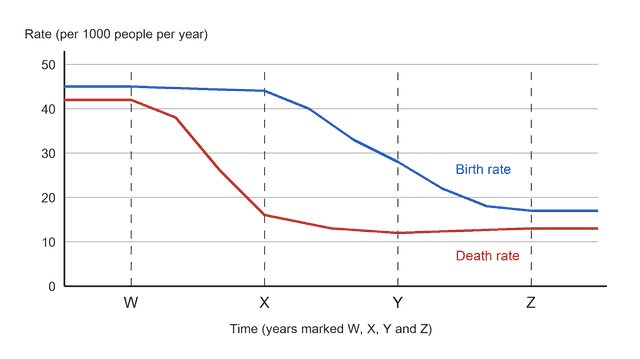
In which of the marked years was the population of the country growing the fastest ?
- 31 mark
Question 3
Cognitive domain: Application
At a family welfare centre a woman is advised to have a Copper-T fitted. She asks the nurse, "Will this device stop the sperm from meeting the egg ?" Which reply agrees with your chapter ?
- 41 mark
Question 4
Cognitive domain: Analysis
A health worker asked four families of a village, each with five or more children, why they had a large family.
Family Reply P "More children means more hands to work and earn for the family." Q "Children are a gift of God and a sign of prosperity." R "We kept trying until we had a son to keep up the family name." S "Babies often die here, so we had more to be sure that at least some would live." A maternity home and a regular immunisation programme are then started in the village. Which family's reason for having a large family is removed most directly by this step ?
- 51 mark
Question 5
Cognitive domain: Understanding
Assertion (A): The population of a country can rise sharply even when most couples have only two or three children.
Reason (R): With better health care most new-born babies now survive, so more and more children reach the reproductive age.
- 61 mark
Question 6
Cognitive domain: Understanding
Assertion (A): Petroleum is a non-renewable resource.
Reason (R): Petroleum is called a conventional source of energy because it has been in use since long.
- 71 mark
Question 7
Cognitive domain: Application
The approximate population of India was million in 2001 and million in 2011. A student assumes that exactly the same number of people will be added in the next ten years.
On this assumption the population in 2021 would be about ______ million; but if the population went on growing unchecked, in geometrical progression, the figure would be ______ than this.
- 81 mark
Question 8
Cognitive domain: Understanding
A historian finds that the number of people in a river valley rose steeply soon after they learnt to sow crops, store food and domesticate animals. The number then remained almost steady for thousands of years, until rapidly growing industries and new medicines appeared.
The first steep rise followed the ______ revolution, and the second followed the ______ revolution.
- 91 mark
Question 9
Cognitive domain: Application
Kavita is years old and Rajan is years old. Their families want to hold their wedding as early as the law allows.
The wedding can take place only after ______ more years, and Rajan will then be ______ years old.
- 102 marks
Question 10
Cognitive domain: Application
The Sharma family of four lives in a city flat. They own a car and three motorcycles, buy new clothes every month, and throw away old newspapers, bottles and gadgets with the daily garbage. All their electricity comes from a coal-fired power station.
Name the idea from your chapter that the family should follow to reduce its pressure on natural resources, and suggest three changes, one for each of the ways in which this idea can be achieved.
- 112 marks
Question 11
Cognitive domain: Evaluation
A student reads that the annual growth rate of the world population was at its highest, , in 1962 and has been going down ever since. He concludes: "So the world population has been falling since 1962."
Is his conclusion correct ? Justify your answer with two points.
- 122 marks
Question 12
Cognitive domain: Analysis
The table shows how the land of a district was used in two different years. In this period the population of the district became three times as large.
Use of land 1990 2020 Forest Agriculture Buildings, roads and industries Other open land Identify the process that these figures show, stating which uses of land have lost area to it. Mention two problems that the loss of forest can bring to the district.
- 135 marks
Question 13
Cognitive domain: Analysis
Case: A planning officer has the following figures for three districts of a state for the same year. Assume that no one moves into or out of the districts.
District Population Area () Birth rate Death rate P Q R (a) Calculate the population density of each district. Which district is the most crowded ?
(b) Calculate the growth rate of population of each district. In which district is the population declining ? Give the reason.
(c) How many people will be added to the population of district P in one year ?
(d) The officer says, "District Q is the most crowded, so its population must be growing the fastest." Do the figures support him ? Mention two problems district P will face if its present growth continues.
- 144 marks
Question 14
Cognitive domain: Evaluation
Case: Sunita, a village health worker, has prepared a chart for a meeting on family welfare. Before the meeting she asks a Class 10 student to check it against the textbook.
No. Statement on the chart 1 In tubectomy the fallopian tubes are cut and tied to close the passage of the egg. 2 In vasectomy the testes are removed, so no sperms are produced. 3 Vasectomy is an easier, quicker and safer operation than tubectomy. 4 Medical termination of pregnancy (MTP) is a method of contraception that a couple can use regularly. (a) Two statements on the chart are wrong. Identify them and write each one correctly.
(b) A man at the meeting says he is afraid that vasectomy will harm his manliness. Is his fear justified ? What does your chapter recommend for a couple choosing between the two operations ?
(c) Sunita plans to end her talk by saying, "Family welfare simply means having fewer children." Judge this statement.
- 155 marks
Question 15
Cognitive domain: Creativity
Case: The students of Class 10 have adopted a nearby village for a project on population education. A survey shows that many people there cannot read, that most families want at least one son, and that many parents fear that some of their children may not survive. The class has chart paper, colours, a loudspeaker and the help of the village health worker.
(a) Design a wall poster for the village: state the sign you would place at the top and why, write a slogan of your own, and describe two pictures you would draw to carry the message.
(b) Plan one other activity that would reach the people who cannot read, and state the main message it should carry.
(c) Write one message each that would answer the two beliefs found in the survey (the wish for a son, and the fear that children may not survive).
(d) Suggest one way in which the class could find out, after a few years, whether its campaign has worked.
- 162 marks
Question 16
CISCE Competency-Focused Practice Questions (2024) · Cognitive domain: Analysis
In our country, the infant mortality rate is high, but the population is still increasing in India. Explain.
- 172 marks
Question 17
CISCE Competency-Focused Practice Questions (2024) · Cognitive domain: Analysis & Recall
Give two examples of natural resources which cannot keep pace with the rising population.
- 181 mark
Question 18
Cognitive domain: Application
Your chapter estimates that the world population was about million some years ago, and about million some years ago. Suppose that the same number of people was added every year during these years.
About how many people were added to the world population in an average year of this long period ?
- 191 mark
Question 19
Cognitive domain: Application
The table in your chapter gives the approximate population of India as million in and million in .
By what percentage did the population of India grow during these ten years ?
- 201 mark
Question 20
Cognitive domain: Analysis
In ten years the total income of a country rose by , while its population rose by .
What happened to the average income of a person (the per capita income) of this country ?
- 211 mark
Question 21
Cognitive domain: Understanding
Assertion (A): A small country can have a higher population density than a bigger country that has more people.
Reason (R): Population density is the number of individuals per square kilometre of area at a given time.
- 221 mark
Question 22
Cognitive domain: Understanding
Assertion (A): Cutting down a large forest brings more rain to the region.
Reason (R): Forests add moisture to the air by transpiration.
- 231 mark
Question 23
Cognitive domain: Understanding
A museum is setting up four exhibits on the growth of human culture and wants to show them in the order in which they happened.
P. Hunting large animals with stone tools, sheltering in a cave and roasting the flesh on a fire.
Q. Living in a hut in a settled community, with a tame dog and a store of grain from sown crops.
R. Making tools and weapons of bronze and iron in place of the old stone ones.
S. Working in a rapidly growing industry of a town.
Which option arranges the exhibits in the correct order, earliest first ?
- 241 mark
Question 24
Cognitive domain: Understanding
A village on the edge of a big city has grown for twenty years and is now a part of the city. This is an example of urbanisation.
Which of the following is not an outcome of urbanisation described in your chapter ?
- 251 mark
Question 25
Cognitive domain: Analysis
The bar chart shows the population density of four countries in , as given in your chapter.
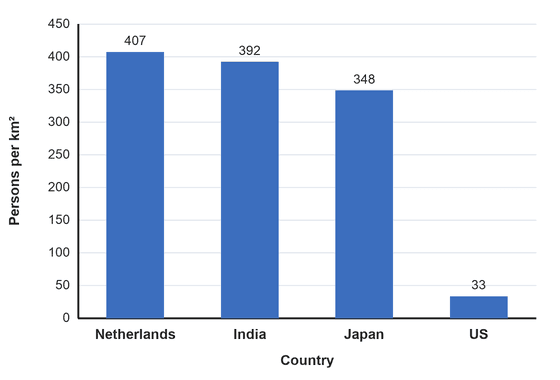
Which conclusion is supported by the chart ?
- 261 mark
Question 26
Cognitive domain: Analysis
The table gives the number of deaths per people per year in four age groups of a country, before and after antibiotics and vaccination programmes were introduced.
Age group Before After Infants (below year) to years to years years and above (Hypothetical data.)
Your chapter says that these medical discoveries made more children per family reach the reproductive age. The figures of which age groups show this most directly ?
- 272 marks
Question 27
Cognitive domain: Analysis
In fifteen years the population of a town doubled, but the farms around it hardly grew in area. The shopkeepers say that the prices of grain and vegetables, and the rents of houses, have gone up year after year.
Using your chapter, give two reasons to show how the rising population has led to this rise in prices.
- 282 marks
Question 28
Cognitive domain: Evaluation
Meena, a young married woman, finds that she is pregnant, but she and her husband do not want a child at present. Her neighbour says, "Don't worry. Take some tablets from the chemist at home and end the pregnancy. Terminating a pregnancy is just one more method of contraception, like the pills."
Evaluate the neighbour's advice with two points from your chapter.
- 292 marks
Question 29
Cognitive domain: Evaluation
Your chapter says: "If there are no further checks or controls, the population in the next years would become so much that only square foot of earth per person would be available."
Ravi reads this and says, "So this is bound to happen, and there is no use doing anything about it."
Evaluate Ravi's conclusion with two points.
- 302 marks
Question 30
Cognitive domain: Understanding
In India every birth and every death must be registered at an office. A student asks, "Why does the government insist on this ? It is only paperwork."
Explain why the registration is important for the study of a population, and name two measures of a population that can be worked out from it.
- 312 marks
Question 31
Cognitive domain: Creativity
Our resources cannot keep pace with a population that keeps on rising.
Create one everyday analogy from an Indian setting, such as a hostel, a school canteen or a colony water tank, that explains this to a friend. State what stands for the population and what stands for the resources in your analogy.
- 323 marks
Question 32
Cognitive domain: Application
The Indian Population Clock in your chapter says that India has a little more than billion people and that the present yearly growth rate is . It also says that between the censuses of and the population grew by million.
(a) About how many people does India add in one year at the present growth rate ?
(b) About how many people were added in an average year between and ?
(c) Compare your answers to (a) and (b). Does the comparison show that India's population problem has ended ? Give a reason.
- 333 marks
Question 33
Cognitive domain: Analysis
(Hypothetical data.) A small island country has million tonnes of petroleum under its sea bed. At present it uses million tonnes every year. Because of its rising population and its rising standard of living, the yearly use goes up by million tonnes each year, that is, , , , , … million tonnes in the successive years.
(a) For how many years would the petroleum last if the use stayed at million tonnes every year ?
(b) How much petroleum is used in the first years if the use rises as described ? How much more is this than the use at a steady million tonnes a year ?
(c) Explain why the petroleum will last much less than your answer to (a). Name two measures from your chapter that the country should adopt.
- 343 marks
Question 34
Cognitive domain: Analysis
A student writes nine items from the chapter on slips of paper.
Slip Item Regular vaccination programmes Shrinking forests Raising the age of marriage Fewer deaths of infants Shortage of clean drinking water Fitting a Copper-T Desire for a male child Pollution of air, water and soil by industries Teaching people the advantages of a small family (a) Which three slips are causes of the rapid rise of population ?
(b) Which three slips are problems created by the rising population, and which three are measures to control it ?
(c) Slips and describe good things. Why are they still placed among the causes of the rapid rise of population ?
- 353 marks
Question 35
Cognitive domain: Evaluation
In a town both the birth rate and the death rate are . The mayor says, "Our growth rate is zero, so our population will stay the same, and we need not worry about the pressure on our resources. We can go on building roads and buying more cars and gadgets."
(a) Find the growth rate of the town. What happens to its population over the years if nobody moves in or out ?
(b) Which part of the mayor's statement is correct, and which part is not ? Give a reason from your chapter.
(c) Suggest one step the town should take.
- 363 marks
Question 36
Cognitive domain: Application
The table gives figures for a town in two years.
Population Hospital beds Forest area (hectares) Water supplied (litres per day) crore crore (Hypothetical data.)
(a) Find the number of persons for each hospital bed, the water for each person in litres per day, and the forest area for each persons (in hectares), for both the years.
(b) Which of the three problems that follow from a high population density in your chapter does each of the three results show ?
(c) Suggest one measure that would help to solve these problems at their root.
- 375 marks
Question 37
Cognitive domain: Analysis
Case: The table gives the year in which the world population reached each billion, according to your chapter.
Population reached Year billion billion billion billion billion billion billion billion (a) Find the number of years the world took to add the rd billion, the th billion and the th billion people.
(b) Find the average number of people added in a year while the rd billion and while the th billion were being added.
(c) Your chapter says that the yearly growth rate of the world population was highest, , in , and has been going down since then. Find the years taken to add the th billion and the th billion. While the th billion was being added, the world population was about billion on average. Find the average yearly growth rate in that period, and explain why the th billion was still added faster than the th.
- 384 marks
Question 38
Cognitive domain: Creativity
Case: Your teacher wants the class to see how the size of a family decides whether a population rises quickly or stays steady. She gives you coins to stand for the persons ( couples) of the first generation in the model of population growth in your chapter. In that model every couple has an average of children, and the population becomes about times as large in about years.
(a) Design a simple coin activity that will show how the population grows through the generations. Say what each coin stands for, and what the students do to get the next generation.
(b) The chapter's table shows that after years the total population is persons. In a second run every couple has only children. What total would the students get after years ? How many times as large as the second total is the first ?
(c) State the lesson of the activity, and give one way in which the model is not true to real life.
- 395 marks
Question 39
Cognitive domain: Analysis
The figure shows the female reproductive organs in a simplified form. Four sites are marked P, Q, R and S.

(a) Name the parts marked P, Q, R and S.
(b) Four methods of contraception act at these four sites: tubectomy, Copper-T, a diaphragm and oral contraceptive pills. For each method, write the site (P, Q, R or S) where it acts and how it prevents pregnancy.
(c) Fertilisation normally takes place in the oviduct. Write, in order, the sites (from P, Q, R and S) that a sperm passes from the vagina to the place of fertilisation. Use this route to explain how the diaphragm and tubectomy both keep the sperm away from the egg, although they act at different sites.
- 404 marks
Question 40
Cognitive domain: Evaluation
Case: (Hypothetical data.) A school reviewed its use of resources in a month before and after a plan for sustainable development.
Resource Before the plan After the plan Electricity from the coal-based grid (units) Electricity from rooftop solar panels (units) New paper bought (reams) Waste paper given for recycling (reams) (a) Your chapter gives three ways of achieving sustainable development. Which way does each of these actions show: using solar panels, giving waste paper for recycling, and buying less new paper ?
(b) What percentage of the school's electricity now comes from the solar panels ? By what percentage did the electricity taken from the grid fall ?
(c) The principal announces, "We have cut our use of electricity by ." Evaluate the claim, and suggest one step that would reduce the use of electricity.