Solution:
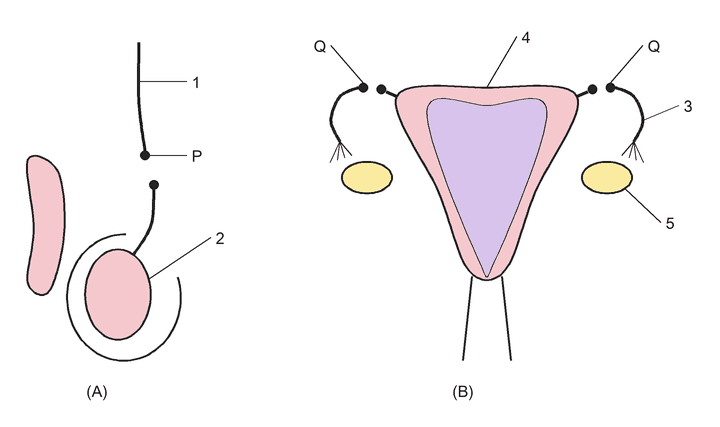
Concept: Figure (A) shows the male sterilisation operation, vasectomy, and figure (B) the female one, tubectomy. In both, the duct that carries the gametes is cut and tied.
Step 1 — Label the parts 1 to 5.
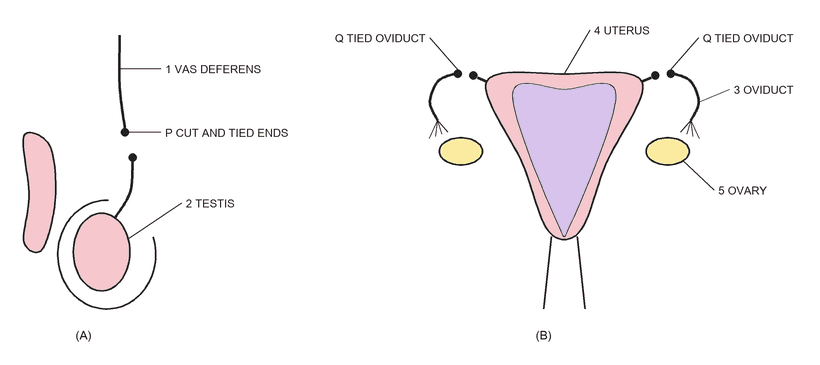
1 – Vas deferens (sperm duct); 2 – Testis; 3 – Oviduct (fallopian tube); 4 – Uterus; 5 – Ovary.
Step 2 — Say what figure A depicts.
Figure A depicts vasectomy, surgical sterilisation in the male. A small cut is made in the scrotum, the vas deferens from each testis is tied at two places, and the small piece between the ties is removed.
Step 3 — Say what figure B depicts.
Figure B depicts tubectomy, surgical sterilisation in the female. The abdomen is opened and the fallopian tubes (oviducts) are cut and tied with nylon thread.
Step 4 — Comment on P and Q.
P marks the cut and tied ends of the vas deferens, so the sperms cannot pass out. Q marks the cut and tied oviducts, which closes the passage of the egg so it cannot meet the sperms. In both cases fertilisation is prevented.
Step 5 — Give one function each of parts 2 and 4.
Part 2, the testis, produces the sperms (and the male hormone testosterone). Part 4, the uterus, is where the embryo gets implanted and develops into the foetus.
Therefore, (a) 1 vas deferens, 2 testis, 3 oviduct, 4 uterus, 5 ovary; (b) vasectomy; (c) tubectomy; (d) P and Q are the cut and tied ducts; (e) the testis produces sperms, the uterus holds the developing embryo.