Solution:
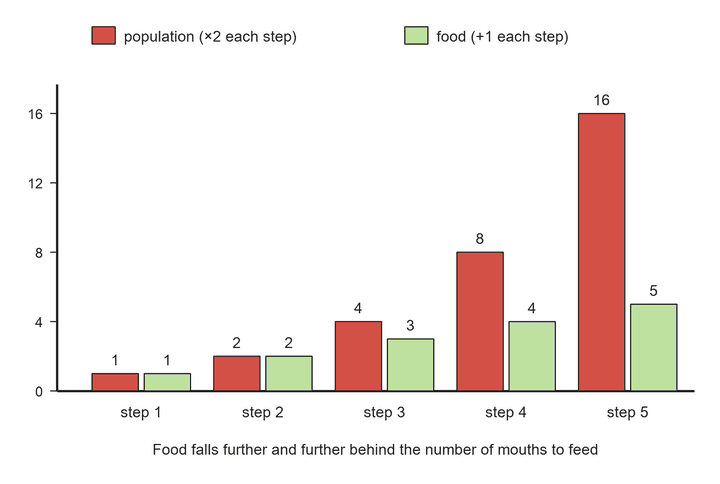
Concept: Population rises by multiplying (geometric progression) while food rises by adding (arithmetic progression). Forests are renewable; coal is not. Cutting forests (deforestation) brings floods.
Step 1 — Match (a) forest.
Forests can be maintained and even improved by afforestation, so a forest is a renewable source of energy (wood): (a) → (v).
Step 2 — Match (b) food and (c) population.
Food production rises by adding at each step: 1, 2, 3, 4, 5, so (b) → (i) arithmetic progression. Population rises by multiplying at each step: 1, 2, 4, 8, 16, so (c) → (ii) geometric progression.
Step 3 — Match (d) coal.
Coal is a fossil fuel; once finished, it cannot be formed again during a lifetime, so (d) → (vi) non-renewable source of energy.
Step 4 — Match (e) flash floods.
Forests hold the soil particles firmly and so prevent floods. When forests are cut, flash floods follow, so (e) → (iii) deforestation.
Step 5 — Write the matched table.
| Column A | Column B |
|---|
| (a) Forest | (v) Renewable source of energy |
| (b) Food | (i) Arithmetic progression |
| (c) Population | (ii) Geometric progression |
| (d) Coal | (vi) Non-renewable source of energy |
| (e) Flash floods | (iii) Deforestation |
(iv) Afforestation is left unmatched.
Watch out: Do not match flash floods with afforestation; planting trees prevents floods, cutting them causes floods.
Therefore, (a)–(v), (b)–(i), (c)–(ii), (d)–(vi), (e)–(iii).
