
Opening your dashboard
Class 9 Physics Chapter 3: Laws of Motion Solutions
190 textbook questions with step-by-step answers, free to read, for ICSE 2026-27.
Get talked through Ch 3, not just shown the answer
Reading a finished solution is not the same as being able to do it. The AI tutor takes one question at a time and works it with you, in your own words, until you can.
- Ask it out loud, in your own words
- It gives you the next step, not the answer
- Stuck on part (ii)? Start there
190 questions with solutions
1–5 marks · Mixed difficulty
The first 85 solutions are on this page. This chapter is a long one, so the rest open on their own page to keep this one quick to load.
- 11 mark
Question 1
A force can change :
Solve with AIAnswer
(A) the size or shape of a body
(B) the state of rest or of motion of a body
(C) the dimensions of a body
- Correct
(D) All of the above
Answer: (D) All of the above
Concept: A force is a push or a pull. A force can start a body moving, stop it, change its speed or change its direction of motion (that is, change its state of rest or of motion). On a body that is not rigid, a force can also change its size or its shape.
Step 1 — List what a force can do.
A force can start, stop, speed up, slow down or turn a body, so it can change the body's state of rest or of motion. Pressing a lump of clay or stretching a spring shows that a force can also change the size or shape of a body.
Step 2 — Match the list with the options.
Option (A) is the change of size or shape, option (B) is the change of the state of rest or motion, and option (C), the dimensions of a body, is just its size again. All three are real effects of a force, so the complete answer is all of the above.
Watch out: Do not stop at the first true option; when every listed effect is correct, the answer is 'All of the above'.
Note: The printed answer line shows the letter (a) with the text 'All of the above'; the text is option (D), so the letter is a misprint.
Why the other options are wrong:
- (A) the size or shape of a body: This is a true effect of force, but it is only one of the effects listed, so it is not the complete answer.
- (B) the state of rest or of motion of a body: This is also a true effect of force, but it leaves out the change of size and shape.
- (C) the dimensions of a body: A force can change the dimensions of a non-rigid body, but this too is only one of the effects.
Therefore, a force can change all the listed things, option (D).
- 21 mark
Question 2
Which of the following is a contact force ?
Solve with AIAnswer
(A) electrostatic force
(B) gravitational force
- Correct
(C) frictional force
(D) magnetic force.
Answer: (C) frictional force
Concept: Contact forces act only when the body and the thing exerting the force touch each other: friction, normal reaction, tension in a string and a push or pull with the hand are examples. Non-contact forces (forces at a distance) act even when the bodies do not touch: the gravitational, electrostatic and magnetic forces are examples. A non-contact force becomes weaker as the bodies move apart and stronger as they come closer.
Step 1 — Ask whether the bodies must touch.
For each force we check whether it can act across a gap, or only when two surfaces are pressed together.
Step 2 — Pick the force that needs touching.
Friction acts along the surface where two bodies touch, when one moves or tries to move over the other. Lift the book off the table and the friction is gone. So frictional force is a contact force.
Why the other options are wrong:
- (A) electrostatic force: Electrostatic force acts between charged bodies even when they are apart, so it is a non-contact force.
- (B) gravitational force: Gravitational force acts between masses across empty space, so it is a non-contact force.
- (D) magnetic force: A magnet attracts an iron nail from a distance, so magnetic force is a non-contact force.
Therefore, the contact force is the frictional force, option (C).
- 31 mark
Question 3
The non-contact force is :
Solve with AIAnswer
(A) force of reaction
- Correct
(B) force due to gravity
(C) tension in string
(D) force of friction
Answer: (B) force due to gravity
Concept: Non-contact forces (forces at a distance) act even when the bodies do not touch: the gravitational, electrostatic and magnetic forces are examples. A non-contact force becomes weaker as the bodies move apart and stronger as they come closer.
Step 1 — Ask whether the bodies must touch.
We look for the force that can act on a body even when nothing touches it.
Step 2 — Pick the force at a distance.
The earth pulls a falling ball downwards while the ball is in the air and touches nothing. So the force due to gravity is a non-contact force.
Why the other options are wrong:
- (A) force of reaction: The force of reaction (normal reaction) acts only where two surfaces press on each other, so it is a contact force.
- (C) tension in string: Tension acts only through a string tied to the body, so it is a contact force.
- (D) force of friction: Friction acts only between surfaces that touch, so it is a contact force.
Therefore, the non-contact force is the force due to gravity, option (B).
- 41 mark
Question 4
A ball placed on a table starts rolling down when the table is tilted. This is an example of :
Solve with AIAnswer
(A) contact force
- Correct
(B) non-contact force
(C) both (a) and (b)
(D) none of these
Answer: (B) non-contact force
Concept: Non-contact forces (forces at a distance) act even when the bodies do not touch: the gravitational, electrostatic and magnetic forces are examples. A non-contact force becomes weaker as the bodies move apart and stronger as they come closer.
Step 1 — Find the force that makes the ball roll.
On a level table the ball stays at rest. When the table is tilted, the ball starts rolling down the slope, so the force that sets it moving is the earth's downward pull, gravity.
Step 2 — Decide the kind of force.
The earth pulls the ball without touching it, so gravity is a non-contact force. The table only supports the ball; its push is at right angles to the surface and does not drive the ball down the slope.
Watch out: The ball touches the table, but the force that makes it roll is gravity, which acts at a distance.
Why the other options are wrong:
- (A) contact force: The contact forces from the table (normal reaction and friction) do not pull the ball down the slope, so the rolling is not an example of a contact force.
- (C) both (a) and (b): Only one kind of force makes the ball roll, and it is gravity, a non-contact force; so 'both' is not correct.
- (D) none of these: This cannot be right, because gravity, a non-contact force, clearly causes the rolling.
Therefore, the ball rolling down the tilted table is an example of a non-contact force, option (B).
- 51 mark
Question 5
When a comb is rubbed on dry hair, it gets charged. This is an example of :
Solve with AIAnswer
(A) Gravitational force
(B) normal reaction force
(C) magnetic force
- Correct
(D) electrostatic force
Answer: (D) electrostatic force
Concept: Non-contact forces (forces at a distance) act even when the bodies do not touch: the gravitational, electrostatic and magnetic forces are examples. A non-contact force becomes weaker as the bodies move apart and stronger as they come closer.
Step 1 — See what rubbing does.
Rubbing the comb on dry hair transfers electric charge, so the comb becomes charged.
Step 2 — Name the force.
A charged comb attracts small bits of paper from a distance. A force between charged bodies is called the electrostatic force.
Why the other options are wrong:
- (A) Gravitational force: Gravitational force acts because of mass, not because of charge, and rubbing does not change the mass.
- (B) normal reaction force: Normal reaction acts only where two surfaces press on each other; it has nothing to do with charging.
- (C) magnetic force: Magnetic force acts between magnets, or a magnet and iron; a charged comb is not a magnet.
Therefore, the charged comb is an example of electrostatic force, option (D).
- 61 mark
Question 6
The nature of gravitational force is always :
Solve with AIAnswer
(A) repulsive
- Correct
(B) attractive
(C) depends on the bodies involved
(D) None of the above
Answer: (B) attractive
Concept: Newton's law of gravitation: every body attracts every other body with a force that is directly proportional to the product of their masses and inversely proportional to the square of the distance between their centres: .
Step 1 — Recall what gravity does.
Every mass attracts every other mass. The earth pulls a stone down, the sun holds the planets in orbit, and two books on a table attract each other very weakly.
Step 2 — Ask whether it can ever repel.
No case of gravitational repulsion is known. So gravitational force is always attractive.
Watch out: Electrostatic and magnetic forces can attract or repel, but gravity can only attract.
Why the other options are wrong:
- (A) repulsive: Gravity never pushes two masses apart, so it is never repulsive.
- (C) depends on the bodies involved: Whatever the bodies are, gravity between them is attractive; only its size depends on the masses and the distance.
- (D) None of the above: This cannot be right, because gravity is always attractive, which is option (B).
Therefore, the gravitational force is always attractive, option (B).
- 71 mark
Question 7
The magnitude of a non-contact force between two bodies ......... with an increase in their separation and ..... with a decrease in their separation.
Solve with AIAnswer
(A) increases, decreases
- Correct
(B) decreases, increases
(C) increases, increases
(D) decreases, decreases
Answer: (B) decreases, increases
Concept: Non-contact forces (forces at a distance) act even when the bodies do not touch: the gravitational, electrostatic and magnetic forces are examples. A non-contact force becomes weaker as the bodies move apart and stronger as they come closer.
Step 1 — Think of a magnet and a pin.
A magnet pulls an iron pin strongly when it is close, and hardly at all when it is far away. The same is true of gravitational and electrostatic forces.
Step 2 — Fill in the blanks.
So the force decreases when the separation increases, and increases when the separation decreases.
Why the other options are wrong:
- (A) increases, decreases: This is the reverse of what happens: the force becomes weaker, not stronger, as the bodies move apart.
- (C) increases, increases: The force cannot increase both when the bodies move apart and when they come closer.
- (D) decreases, decreases: The force cannot decrease both when the bodies move apart and when they come closer.
Therefore, the force decreases with an increase in separation and increases with a decrease, option (B).
- 81 mark
Question 8
On doubling the separation between two bodies, the magnitude of the non-contact force between them becomes :
Solve with AIAnswer
(A) one-eighth
(B) one-half
- Correct
(C) one-fourth
(D) remains the same
Answer: (C) one-fourth
Concept: The gravitational force between two masses (and the electrostatic force between two charges) varies inversely as the square of the distance between them: .
Step 1 — Write the proportion.
Let the force be when the separation is . Since varies as , we compare the new force at separation with by taking a ratio.
Step 2 — State the result.
The new force is one-fourth of the old force.
Watch out: The force goes as the square of the distance, so doubling the distance divides the force by , that is by 4, not by 2.
Why the other options are wrong:
- (A) one-eighth: One-eighth would need the force to vary as , which is not the law.
- (B) one-half: One-half would need the force to vary as ; it varies as .
- (D) remains the same: The force depends on the separation, so it cannot stay the same.
Therefore, the force becomes one-fourth, option (C).
- 91 mark
Question 9
A spring balance works on the principle of :
Solve with AIAnswer
(A) gravitational force
(B) magnetic force
- Correct
(C) restoring elastic force
(D) frictional force
Answer: (C) restoring elastic force
Concept: A spring that is stretched or compressed exerts a restoring (elastic) force that tries to bring it back to its natural length: a compressed spring pushes outwards and a stretched spring pulls inwards.
Step 1 — See what happens when a load is hung.
The load stretches the spring of the balance. The stretched spring pulls back on the load with a restoring force.
Step 2 — Link the stretch to the force.
The spring stops stretching when its restoring force equals the pull of the load. A larger load stretches it more, so the stretch, read on the scale, measures the force. The balance therefore works on the restoring elastic force of the spring.
Why the other options are wrong:
- (A) gravitational force: Gravity pulls the load down, but the balance measures that pull through the restoring force of its spring.
- (B) magnetic force: No magnet is used in a spring balance, so magnetic force plays no part.
- (D) frictional force: A spring balance does not depend on friction; friction would only spoil the reading.
Therefore, a spring balance works on the restoring elastic force, option (C).
- 101 mark
Question 10
A horizontal spring with two object A and B attached to its two ends are shown in the figure below. If the spring is compressed, it ..... each object and if it is stretched, it ...... each object.
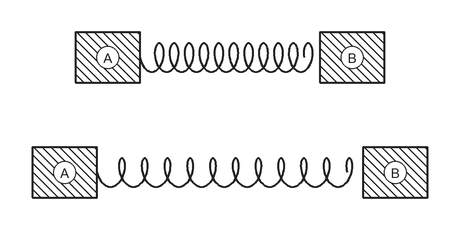 Solve with AI
Answer
- Correct
(A) pushes, pulls
(B) pulls, pushes
(C) pushes, pushes
(D) pulls, pulls
Answer: (A) pushes, pulls
Concept: A spring that is stretched or compressed exerts a restoring (elastic) force that tries to bring it back to its natural length: a compressed spring pushes outwards and a stretched spring pulls inwards.
Step 1 — Compressed spring.
When the spring is compressed it is shorter than its natural length, so it tries to get longer. It therefore pushes A and B outwards, away from each other.
Step 2 — Stretched spring.
When the spring is stretched it is longer than its natural length, so it tries to get shorter. It therefore pulls A and B inwards, towards each other.
Watch out: The restoring force always acts to bring the spring back to its natural length, so it reverses when the spring changes from compressed to stretched.
Why the other options are wrong:
- (B) pulls, pushes: This swaps the two cases: a compressed spring pushes and a stretched spring pulls.
- (C) pushes, pushes: A stretched spring does not push; it pulls the objects towards each other.
- (D) pulls, pulls: A compressed spring does not pull; it pushes the objects away from each other.
Therefore, a compressed spring pushes each object and a stretched spring pulls each object, option (A).
- 111 mark
Question 11
Define a contact force.
Solve with AIWritten solution
Solution:
Concept: Contact forces act only when the body and the thing exerting the force touch each other: friction, normal reaction, tension in a string and a push or pull with the hand are examples.
Step 1 — Say what 'contact' means.
Contact means that the body and the agent exerting the force touch each other.
Step 2 — Write the definition.
The forces which act on a body only when they are in physical contact with it are called contact forces.
Step 3 — Give examples.
Frictional force, normal reaction, tension in a string and the push of a hand on a door are contact forces.
Therefore, a contact force is a force that acts on a body only when the agent exerting it is in physical contact with the body.
- 121 mark
Question 12
Define a non-contact force.
Solve with AIWritten solution
Solution:
Concept: Non-contact forces (forces at a distance) act even when the bodies do not touch: the gravitational, electrostatic and magnetic forces are examples. A non-contact force becomes weaker as the bodies move apart and stronger as they come closer.
Step 1 — Say what 'non-contact' means.
Non-contact means that the force acts across a gap, with nothing touching the body.
Step 2 — Write the definition.
The forces which act on a body without any physical contact with it, that is from a distance, are called non-contact forces (or forces at a distance).
Step 3 — Give examples.
Gravitational force, electrostatic force and magnetic force are non-contact forces.
Therefore, a non-contact force is a force that acts on a body from a distance, without any physical contact.
- 132 marks
Question 13
Classify the following amongst contact and non-contact forces :
(a) frictional force, (b) normal reaction force, (c) force of tension in a string, (d) gravitational force, (e) electrostatic force, (f) magnetic force.
Solve with AIWritten solution
Solution:
Concept: Contact forces act only when the body and the thing exerting the force touch each other: friction, normal reaction, tension in a string and a push or pull with the hand are examples.
Non-contact forces (forces at a distance) act even when the bodies do not touch: the gravitational, electrostatic and magnetic forces are examples. A non-contact force becomes weaker as the bodies move apart and stronger as they come closer.
Step 1 — Test each force for touching.
Friction, normal reaction and tension act only where the bodies touch (a surface or a string). Gravitational, electrostatic and magnetic forces act across empty space.
Step 2 — Sort them into a table.
We place each force in its column.
Contact forces Non-contact forces (a) frictional force (d) gravitational force (b) normal reaction force (e) electrostatic force (c) force of tension in a string (f) magnetic force Therefore, (a), (b) and (c) are contact forces, and (d), (e) and (f) are non-contact forces.
- 142 marks
Question 14
Give one example in each case where :
(a) the force is of contact, and (b) force is at a distance.
Solve with AIWritten solution
Solution:
Concept: Contact forces act only when the body and the thing exerting the force touch each other: friction, normal reaction, tension in a string and a push or pull with the hand are examples.
Non-contact forces (forces at a distance) act even when the bodies do not touch: the gravitational, electrostatic and magnetic forces are examples. A non-contact force becomes weaker as the bodies move apart and stronger as they come closer.
Step 1 — Choose a contact force.
When we push a box along the floor, our hands touch the box, so the push (muscular force) is a contact force.
Step 2 — Choose a force at a distance.
A falling apple is pulled down by the earth's gravitational force, although the earth does not touch it while it falls.
Therefore, (a) pushing a box with our hands is a contact force, and (b) the earth's pull on a falling apple is a force at a distance.
- 152 marks
Question 15
State one factor on which the magnitude of a non-contact force depends. How does it depend on the factor stated by you ?
Solve with AIWritten solution
Solution:
Concept: Non-contact forces (forces at a distance) act even when the bodies do not touch: the gravitational, electrostatic and magnetic forces are examples. A non-contact force becomes weaker as the bodies move apart and stronger as they come closer.
Step 1 — Name the factor.
The size of a non-contact force depends on the separation (distance) between the two bodies.
Step 2 — Say how it depends.
The force decreases as the separation increases and increases as the separation decreases. For gravitational and electrostatic forces it varies inversely as the square of the separation, so doubling the distance makes the force one-fourth.
Therefore, a non-contact force depends on the separation between the bodies: the larger the separation, the smaller the force.
- 161 mark
Question 16
The separation between two masses is reduced to half. How is the magnitude of gravitational force between them affected ?
Solve with AIWritten solution
Solution:
Concept: The gravitational force between two masses (and the electrostatic force between two charges) varies inversely as the square of the distance between them: .
Step 1 — Set up the ratio.
Let the force be at separation , and when the separation is reduced to . Since the force varies as , we divide the two forces.
Step 2 — State the result.
So the new force is four times the old force.
Watch out: Halving the distance does not double the force; because of the square, it makes the force four times.
Therefore, the gravitational force becomes four times its earlier value.
- 172 marks
Question 17
Give one example in each of the following cases where a force :
(a) stops a moving body. (b) moves a stationary body. (c) changes the size of a body. (d) changes the shape of a body.
Solve with AIWritten solution
Solution:
Concept: A force is a push or a pull. A force can start a body moving, stop it, change its speed or change its direction of motion (that is, change its state of rest or of motion). On a body that is not rigid, a force can also change its size or its shape.
Step 1 — A force stopping a moving body.
A fielder stops a moving cricket ball with his hands; the force of his hands brings the ball to rest.
Step 2 — A force moving a stationary body.
Kicking a football lying on the ground sets it moving.
Step 3 — A force changing the size.
Stretching a rubber band or a spring makes it longer, so its size changes.
Step 4 — A force changing the shape.
Pressing a lump of dough or clay changes its shape.
Therefore, (a) a fielder stopping a ball, (b) kicking a football at rest, (c) stretching a rubber band and (d) pressing dough are examples of the four effects of force.
- 183 marks
Question 18
Explain by giving two examples each of :
(a) Contact forces, and (b) Non-contact forces.
Solve with AIWritten solution
Solution:
Concept: Contact forces act only when the body and the thing exerting the force touch each other: friction, normal reaction, tension in a string and a push or pull with the hand are examples.
Non-contact forces (forces at a distance) act even when the bodies do not touch: the gravitational, electrostatic and magnetic forces are examples. A non-contact force becomes weaker as the bodies move apart and stronger as they come closer.
Step 1 — Contact force: friction.
When a book is pushed along a table, the table surface, which touches the book, exerts a force of friction on it opposite to its motion. If the book is lifted off the table, the friction disappears, so friction needs contact.
Step 2 — Contact force: tension.
A bucket hanging from a rope is held up by the tension in the rope tied to it. If the rope is cut, this pull disappears at once, so tension also needs contact.
Step 3 — Non-contact force: gravity.
A mango falls from a tree because the earth pulls it down with the gravitational force, although the earth does not touch the mango while it falls.
Step 4 — Non-contact force: magnetism.
A magnet attracts an iron nail kept a little away from it; the nail moves towards the magnet without being touched, so the magnetic force acts at a distance.
Therefore, friction and tension are two contact forces, while gravitational and magnetic forces are two non-contact forces.
- 193 marks
Question 19
State the effects of a force applied on (i) a non-rigid, and (ii) a rigid body. How does the effect of the force differ in the two cases ?
Solve with AIWritten solution
Solution:
Concept: A rigid body is one whose particles keep fixed distances from each other, so its size and shape do not change under a force. A non-rigid body is one whose size or shape can be changed by a force.
A force is a push or a pull. A force can start a body moving, stop it, change its speed or change its direction of motion (that is, change its state of rest or of motion). On a body that is not rigid, a force can also change its size or its shape.
Step 1 — Force on a non-rigid body.
In a non-rigid body the distances between particles can change. So a force can change its size (stretching a spring) or its shape (pressing clay or a sponge). If the body is free to move, the force can also change its state of rest or of motion.
Step 2 — Force on a rigid body.
In a rigid body the distances between particles stay fixed, so its size and shape do not change. A force can only move it (start, stop or change its motion) or, if it is pivoted, turn it about the pivot.
Step 3 — Compare the two cases.
On a non-rigid body a force can change the dimensions of the body. On a rigid body a force never changes the dimensions; it only produces or changes motion, either straight-line motion or turning.
Watch out: Real bodies change shape a little under a large force; 'rigid' means the change is too small to notice.
Therefore, a force can change the size or shape of a non-rigid body, but it can only move or turn a rigid body without changing its size or shape.
- 203 marks
Question 20
What is a frictional force ? Draw a neat labelled diagram showing a frictional force acting on a body.
Solve with AIWritten solution
Solution:
Concept: Friction is the force that acts along the surface of contact between two bodies when one moves, or tries to move, over the other. It always acts opposite to the (attempted) relative motion.
Step 1 — Define frictional force.
When a body moves, or tries to move, over the surface of another body, a force acts on it along the surface of contact, opposite to its motion. This force is the force of friction; it is a contact force.
Step 2 — Describe the diagram.
A block is pulled to the right by an applied force F on a rough floor. The floor exerts the frictional force f on the block towards the left, along the surface of contact.

Step 3 — See its effect.
Friction is the reason a ball rolling on the ground slows down and stops.
Watch out: Friction acts along the surface, opposite to the motion; it is not drawn upwards or downwards.
Therefore, friction is the contact force along the surface of contact that opposes the motion, as shown by f in the diagram.
- 213 marks
Question 21
What is a normal reaction force ? Draw a neat labelled diagram showing a normal reaction force acting on a body.
Solve with AIWritten solution
Solution:
Concept: A body pressing on a surface is pushed back by the surface. This push, at right angles (normal) to the surface of contact, is called the normal reaction R.
Step 1 — Define normal reaction.
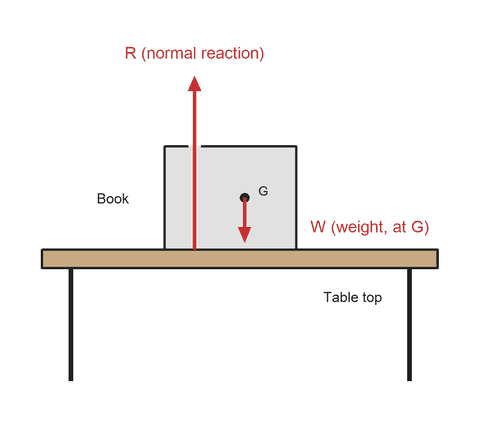
A book placed on a table presses on the table because of its weight. The table pushes back on the book with an upward force, perpendicular (normal) to the surface of contact. This force is called the normal reaction R; it is a contact force.
Step 2 — Describe the diagram.
The weight W of the book acts vertically downwards at its centre of gravity G. The table exerts the normal reaction R on the book vertically upwards, at the surface of contact.
Step 3 — Compare the two forces.
The book stays at rest, so the upward R balances the downward W, and the two are equal in size.
Watch out: R acts on the book (pushed by the table); the book's push on the table is a different force acting on the table.
Therefore, the normal reaction is the upward push R of the surface on the book, at right angles to the surface, as shown in the diagram.
- 225 marks
Question 22
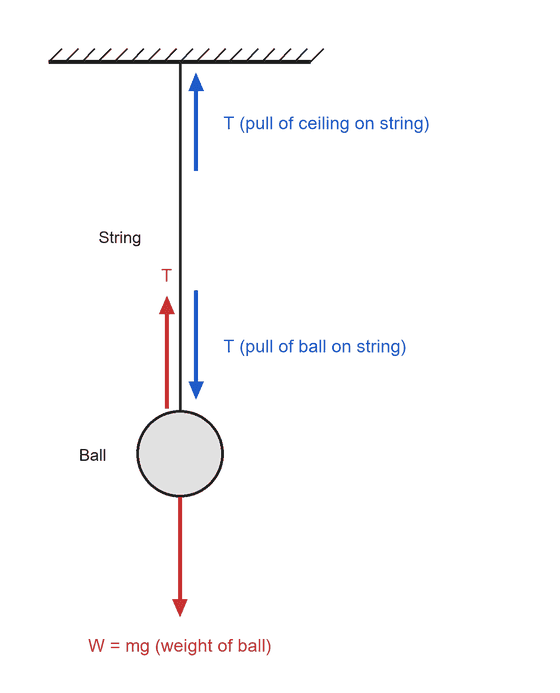
(a) A ball is hanging by a string from the ceiling of the roof. Draw a neat labelled diagram showing the forces acting on the ball and the string.
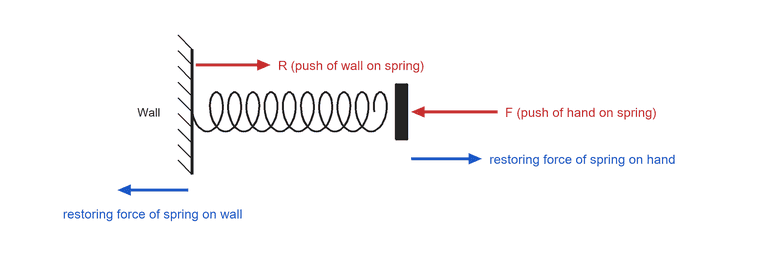
(b) A spring is compressed against a rigid wall. Draw a neat and labelled diagram showing the forces acting on the spring.
(c) A wooden block is placed on a table top. Name the forces acting on the block and draw a neat and labelled diagram to show the point of application and direction of these forces.
Solve with AIWritten solution
Solution:
Concept: A stretched string pulls on each body tied to its ends. This pull along the string is called the tension T. A spring that is stretched or compressed exerts a restoring (elastic) force that tries to bring it back to its natural length: a compressed spring pushes outwards and a stretched spring pulls inwards. A body pressing on a surface is pushed back by the surface. This push, at right angles (normal) to the surface of contact, is called the normal reaction R.
(a) Ball hanging by a string
Step 1 — Forces on the ball.
The earth pulls the ball downwards with its weight W, equal to mg. The string pulls the ball upwards with the tension T. The ball is at rest, so T equals W.
Step 2 — Forces on the string.
At its lower end the ball pulls the string downwards with a force T. At its upper end the ceiling pulls the string upwards with an equal force T. These two equal and opposite pulls keep the string taut.
(b) Spring compressed against a rigid wall
Step 3 — Forces on the spring.
The hand pushes the free end of the spring towards the wall with a force F. The wall pushes the other end away from the wall with the reaction R, equal to F.
Step 4 — Restoring forces of the spring.
The compressed spring tries to regain its natural length, so it pushes outwards on both the hand and the wall with its restoring force.
(c) Wooden block on a table top
Step 5 — Name the forces.
Two forces act on the block: its weight W, acting vertically downwards at its centre of gravity G, and the normal reaction R of the table, acting vertically upwards at the surface of contact.
Step 6 — Compare the forces.
The block is at rest, so R and W are equal and opposite.
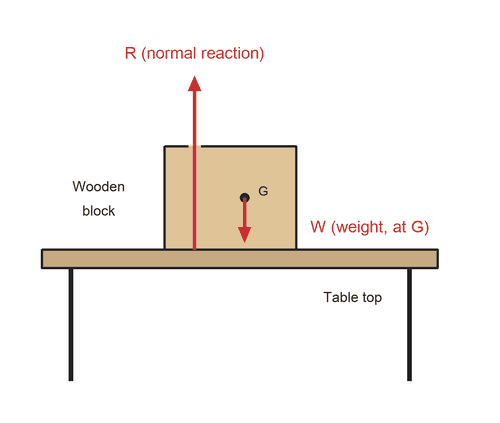
Watch out: Draw each force from the point where it acts on the body named in the question, and do not mix up the forces on the ball with the forces on the string.
Therefore, (a) the ball has W down and T up, and the string has T down and T up; (b) the spring has F towards the wall and R away from it, while its restoring force pushes outwards; (c) the block has W down at G and R up at the surface of contact.
- 231 mark
Question 23
Newton's first law includes :
Solve with AIAnswer
(A) the definition of inertia
(B) the definition of force
- Correct
(C) both (a) and (b)
(D) none of the above
Answer: (C) both (a) and (b)
Concept: Newton's first law of motion: a body continues in its state of rest or of uniform motion in a straight line unless an external force is applied on it.
Step 1 — Read the first part of the law.
The law says that a body, left to itself, stays at rest or keeps moving uniformly in a straight line. This tendency to keep its state is inertia, so the law defines inertia; that is why it is also called the law of inertia.
Step 2 — Read the second part of the law.
The law says the state changes only when an external force acts. So a force is that which changes, or tends to change, the state of rest or of motion of a body. This is the qualitative definition of force.
Step 3 — Combine the two parts.
The first law therefore contains both the definition of inertia and the definition of force.
Why the other options are wrong:
- (A) the definition of inertia: The law does define inertia, but it also defines force, so (A) alone is incomplete.
- (B) the definition of force: The law does define force (qualitatively), but it also defines inertia, so (B) alone is incomplete.
- (D) none of the above: This cannot be right, because the first law does include both definitions.
Therefore, Newton's first law includes both the definition of inertia and of force, option (C).
- 241 mark
Question 24
Force is a .......... quantity.
Solve with AIAnswer
(A) scalar
- Correct
(B) vector
(C) directionless
(D) none of these
Answer: (B) vector
Concept: A scalar has magnitude only; a vector has both magnitude and direction.
Step 1 — See whether direction matters for a force.
Pushing a box forward and pushing it backward with the same strength give opposite effects, so the effect of a force depends on its direction as well as its size.
Step 2 — Classify force.
A quantity with both magnitude and direction is a vector, so force is a vector quantity.
Why the other options are wrong:
- (A) scalar: A scalar has magnitude only, like mass or time; a force also needs a direction.
- (C) directionless: A force always acts in some direction, so it is never directionless.
- (D) none of these: This cannot be right, because force is a vector, which is option (B).
Therefore, force is a vector quantity, option (B).
- 251 mark
Question 25
The property of an object by virtue of which it tends to retain its state of rest or of motion is called :
Solve with AIAnswer
(A) friction
- Correct
(B) inertia
(C) force
(D) mass
Answer: (B) inertia
Concept: Inertia is the property of a body by which it tends to stay in its state of rest or of uniform motion and resists any change in that state. Mass is the measure of inertia: the greater the mass, the greater the inertia.
Step 1 — Read the description.
The stem describes the property by which a body tends to keep its state of rest or of motion.
Step 2 — Name the property.
This property is called inertia; a body cannot change its state by itself.
Watch out: Mass is the measure of inertia, not the property itself.
Why the other options are wrong:
- (A) friction: Friction is a force that opposes motion between surfaces; it is not a property of a single body.
- (C) force: Force is the cause that changes the state of rest or of motion, the opposite idea.
- (D) mass: Mass measures how much inertia a body has, but the property itself is called inertia.
Therefore, the property is called inertia, option (B).
- 261 mark
Question 26
The property of inertia is more in :
Solve with AIAnswer
(A) a car
- Correct
(B) a truck
(C) a horse cart
(D) a toy car.
Answer: (B) a truck
Concept: Inertia is the property of a body by which it tends to stay in its state of rest or of uniform motion and resists any change in that state. Mass is the measure of inertia: the greater the mass, the greater the inertia.
Step 1 — Link inertia with mass.
The greater the mass of a body, the greater its inertia.
Step 2 — Compare the masses.
Of a car, a truck, a horse cart and a toy car, the truck has the largest mass, so it has the most inertia; it is the hardest to start or to stop.
Why the other options are wrong:
- (A) a car: A car has less mass than a truck, so it has less inertia.
- (C) a horse cart: A horse cart has less mass than a truck, so it has less inertia.
- (D) a toy car: A toy car has the least mass of all, so it has the least inertia.
Therefore, inertia is more in a truck, option (B).
- 271 mark
Question 27
A force is needed to :
Solve with AIAnswer
- Correct
(A) change the state of motion or state of rest of the body
(B) keep the body in motion
(C) keep the body stationary
(D) keep the velocity of body constant.
Answer: (A) change the state of motion or state of rest of the body
Concept: Newton's first law of motion: a body continues in its state of rest or of uniform motion in a straight line unless an external force is applied on it.
Step 1 — Ask what a body does by itself.
By the first law, a body at rest stays at rest, and a moving body keeps moving with the same velocity, without any force.
Step 2 — Find when a force is needed.
A force is needed only to change the state of rest or of motion, for example to start, stop, speed up or turn the body.
Watch out: In daily life a push seems needed to keep things moving only because friction and air resistance act against the motion.
Why the other options are wrong:
- (B) keep the body in motion: A moving body keeps moving by itself; a force is not needed just to keep it in motion.
- (C) keep the body stationary: A body at rest stays at rest without any force.
- (D) keep the velocity of body constant: Constant velocity is uniform motion, which needs no force by the first law.
Therefore, a force is needed to change the state of rest or of motion of a body, option (A).
- 281 mark
Question 28
A tennis ball and a cricket ball, both are stationary. To start motion in them :
Solve with AIAnswer
(A) a less force is required for the cricket ball than for the tennis ball
- Correct
(B) a less force is required for the tennis ball than for the cricket ball
(C) same force is required for both the balls
(D) nothing can be said.
Answer: (B) a less force is required for the tennis ball than for the cricket ball
Concept: Inertia is the property of a body by which it tends to stay in its state of rest or of uniform motion and resists any change in that state. Mass is the measure of inertia: the greater the mass, the greater the inertia.
Step 1 — Compare the masses.
A tennis ball (about 58 g) is much lighter than a cricket ball (about 160 g).
Step 2 — Compare the inertia of rest.
Less mass means less inertia of rest, so a smaller force is needed to start the tennis ball moving in the same way as the cricket ball.
Why the other options are wrong:
- (A) a less force is required for the cricket ball than for the tennis ball: This reverses the comparison: the heavier cricket ball has more inertia and needs the larger force.
- (C) same force is required for both the balls: The same force would be needed only if the two balls had the same mass.
- (D) nothing can be said: We can compare them, because inertia depends on mass and the masses are different.
Therefore, less force is required for the tennis ball than for the cricket ball, option (B).
- 291 mark
Question 29
A student has four balls — table tennis ball, tennis ball, cricket ball and a football. The correct ascending order of inertia is :
Solve with AIAnswer
- Correct
(A) table tennis ball, tennis ball, football, cricket ball
(B) cricket ball, football, tennis ball, table tennis ball
(C) table tennis ball, football, cricket ball, tennis ball
(D) football, cricket ball, table tennis ball, tennis ball
Answer: (A) table tennis ball, tennis ball, football, cricket ball
Concept: Inertia is the property of a body by which it tends to stay in its state of rest or of uniform motion and resists any change in that state. Mass is the measure of inertia: the greater the mass, the greater the inertia.
Step 1 — Turn inertia into mass.
Inertia depends on mass, so arranging the balls in ascending order of inertia means arranging them from the lightest to the heaviest.
Step 2 — Place the two lightest balls.
The table tennis ball (about 2.7 g) is the lightest and the tennis ball (about 58 g) comes next, so the order must begin with these two.
Step 3 — Check the options.
Only option (A) begins with the table tennis ball followed by the tennis ball, so it is the book's answer.
Note: This is the printed key. By actual mass a football (about 410–450 g) is heavier than a cricket ball (about 156–163 g), so the true ascending order is table tennis ball, tennis ball, cricket ball, football, which is not among the options; (A) is the closest option.
Why the other options are wrong:
- (B) cricket ball, football, tennis ball, table tennis ball: This starts with the heavy balls, so it is a descending order, not an ascending one.
- (C) table tennis ball, football, cricket ball, tennis ball: This puts the tennis ball last, although it is lighter than both the football and the cricket ball.
- (D) football, cricket ball, table tennis ball, tennis ball: This starts with heavy balls and ends with light ones, so it is not ascending.
Therefore, the expected order is table tennis ball, tennis ball, football, cricket ball, option (A).
- 301 mark
Question 30
Which one of the following is not an example of inertia of rest ?
Solve with AIAnswer
(A) When a train suddenly starts moving forward, the passenger standing in the compartment tends to fall backwards.
(B) When a hanging carpet is beaten with a stick, dust particles start falling out of it.
(C) On shaking the branches of a tree, the fruits fall down.
- Correct
(D) When a passenger jumps out of a moving train, he falls down.
Answer: (D) When a passenger jumps out of a moving train, he falls down
Concept: Inertia of rest is the tendency of a body at rest to stay at rest. Inertia of motion is the tendency of a moving body to keep moving with the same speed in the same direction.
Step 1 — Decide what each body was doing before.
In inertia of rest the body (or part of it) was at rest and tends to stay at rest. In inertia of motion it was moving and tends to keep moving.
Step 2 — Look at the passenger jumping out.
The passenger jumping out of a moving train is already moving with the train. When his feet touch the ground they stop, but the upper part of his body keeps moving forward, so he falls. This is inertia of motion, not inertia of rest.
Why the other options are wrong:
- (A) When a train suddenly starts moving forward, the passenger standing in the compartment tends to fall backwards: The passenger's upper body tends to stay at rest while his feet move forward with the train, so this is inertia of rest.
- (B) When a hanging carpet is beaten with a stick, dust particles start falling out of it: The carpet moves when beaten, but the dust particles stay at rest and get separated, so this is inertia of rest.
- (C) On shaking the branches of a tree, the fruits fall down: The branches move, but the fruits tend to stay at rest, so their stalks break; this is inertia of rest.
Therefore, the passenger jumping out of a moving train is not an example of inertia of rest, option (D).
- 311 mark
Question 31
An athlete often runs before taking a long jump. This is an example of :
Solve with AIAnswer
(A) Newtons' first law
(B) inertia of rest
(C) inertia of motion
- Correct
(D) both (a) and (c)
Answer: (D) both (a) and (c)
Concept: Newton's first law of motion: a body continues in its state of rest or of uniform motion in a straight line unless an external force is applied on it. Inertia of rest is the tendency of a body at rest to stay at rest. Inertia of motion is the tendency of a moving body to keep moving with the same speed in the same direction.
Step 1 — See why the athlete runs.
By running, the athlete gains a large forward speed before he takes off.
Step 2 — Name the effect.
After take-off his body keeps moving forward with that speed because of inertia of motion, so he covers a longer distance.
Step 3 — Link it to the first law.
Inertia of motion is exactly what Newton's first law describes: a moving body keeps moving unless a force stops it. So both (a) and (c) apply.
Why the other options are wrong:
- (A) Newtons' first law: Newton's first law does apply, but inertia of motion also applies, so (A) alone is incomplete.
- (B) inertia of rest: The athlete is moving, not at rest, when he jumps, so this is not inertia of rest.
- (C) inertia of motion: Inertia of motion does apply, but it is the first law at work, so (C) alone is incomplete.
Therefore, running before a long jump is an example of both Newton's first law and inertia of motion, option (D).
- 321 mark
Question 32
In inertia of motion, the body continues to be in a state of motion with .......... speed in .......... direction unless an external force is applied.
Solve with AIAnswer
(A) variable, zigzag
- Correct
(B) same, same
(C) same, variable
(D) variable, same
Answer: (B) same, same
Concept: Inertia of rest is the tendency of a body at rest to stay at rest. Inertia of motion is the tendency of a moving body to keep moving with the same speed in the same direction.
Step 1 — Recall inertia of motion.
A moving body, left to itself, keeps moving uniformly in a straight line.
Step 2 — Fill in the blanks.
Uniform motion in a straight line means the same speed in the same direction.
Why the other options are wrong:
- (A) variable, zigzag: A change of speed or a zigzag path needs a force, so it is not inertia of motion.
- (C) same, variable: A change of direction needs a force, so the direction cannot vary.
- (D) variable, same: A change of speed needs a force, so the speed cannot vary.
Therefore, the body continues with the same speed in the same direction, option (B).
- 331 mark
Question 33
Name the physical quantity which causes motion in a body.
Solve with AIWritten solution
Solution:
Concept: By the first law, a force is that external cause which changes, or tends to change, the state of rest or of uniform motion of a body. This tells us what a force does (a qualitative definition), but not how to measure it.
Step 1 — Ask what starts motion.
A body at rest stays at rest unless something pushes or pulls it.
Step 2 — Name the quantity.
That push or pull is a force, so force is the physical quantity that causes motion in a body.
Therefore, the physical quantity which causes motion in a body is force.
- 341 mark
Question 34
Is force needed to keep a moving body in motion ?
Solve with AIWritten solution
Solution:
Concept: Newton's first law of motion: a body continues in its state of rest or of uniform motion in a straight line unless an external force is applied on it.
Step 1 — Apply the first law.
By Newton's first law, a moving body keeps moving with the same speed in the same direction by itself, so no force is needed to keep it moving.
Step 2 — Explain the everyday experience.
In daily life we seem to need a force to keep things moving only because friction and air resistance act against the motion; the force we apply just balances them.
Watch out: A force is needed only to change motion, not to keep it.
Therefore, no force is needed to keep a moving body in uniform motion.
- 351 mark
Question 35
A ball is moving on a perfectly smooth horizontal surface. If no force is applied on it, will its speed decrease, increase or remain unchanged ?
Solve with AIWritten solution
Solution:
Concept: Newton's first law of motion: a body continues in its state of rest or of uniform motion in a straight line unless an external force is applied on it.
Step 1 — List the forces along the motion.
A perfectly smooth surface has no friction, and no other force is applied, so no force acts along the direction of motion.
Step 2 — Apply the first law.
With no force acting, the ball keeps moving uniformly because of its inertia of motion.
Therefore, the speed of the ball will remain unchanged.
- 361 mark
Question 36
What is Galileo's law of inertia ?
Solve with AIWritten solution
Solution:
Concept: Galileo studied balls rolling on smooth inclined planes and concluded that motion continues by itself unless something stops it.
Step 1 — State the law.
Galileo's law of inertia: a body continues to be in its state of rest or of uniform motion unless an external force is applied on it.
Step 2 — Recall the experiment.
A ball rolling down one smooth inclined plane rises to nearly the same height on a second plane. If the second plane is made horizontal, the ball would keep rolling for ever if there were no friction.
Therefore, Galileo's law of inertia says that a body keeps its state of rest or of uniform motion unless an external force acts on it.
- 371 mark
Question 37
State Newton's first law of motion.
Solve with AIWritten solution
Solution:
Concept: The first law is also called the law of inertia, because it describes how a body keeps its state by itself.
Step 1 — State the law.
Newton's first law of motion: a body continues to be in its state of rest or of uniform motion in a straight line unless an external force is applied on it.
Therefore, a body stays at rest or in uniform straight-line motion unless an external force acts on it.
- 381 mark
Question 38
Give qualitative definition of force on the basis of Newton's first law of motion.
Solve with AIWritten solution
Solution:
Concept: Newton's first law of motion: a body continues in its state of rest or of uniform motion in a straight line unless an external force is applied on it.
Step 1 — See what the law tells us.
The first law says a body changes its state of rest or of uniform motion only when an external force acts on it.
Step 2 — Write the definition.
So force is that external cause which changes, or tends to change, the state of rest or of uniform motion of a body in a straight line.
Step 3 — Explain the word 'qualitative'.
This definition tells us what a force does, but not how to measure it, so it is a qualitative definition.
Therefore, force is the external cause which changes or tends to change the state of rest or of uniform motion of a body.
- 392 marks
Question 39
Name the factor on which inertia of a body depends and state how it depends on the factor stated by you.
Solve with AIWritten solution
Solution:
Concept: Inertia is the property of a body by which it tends to stay in its state of rest or of uniform motion and resists any change in that state. Mass is the measure of inertia: the greater the mass, the greater the inertia.
Step 1 — Name the factor.
The inertia of a body depends on its mass.
Step 2 — Say how it depends.
The greater the mass, the greater the inertia: a heavier body is harder to start, to stop or to turn.
Therefore, inertia depends on mass, and the more the mass, the more the inertia.
- 401 mark
Question 40
Name the two kinds of inertia.
Solve with AIWritten solution
Solution:
Concept: Inertia is the property of a body by which it tends to stay in its state of rest or of uniform motion and resists any change in that state. Mass is the measure of inertia: the greater the mass, the greater the inertia.
Step 1 — Inertia of rest.
Inertia of rest is the tendency of a body at rest to remain at rest.
Step 2 — Inertia of motion.
Inertia of motion is the tendency of a moving body to keep moving with the same speed in the same direction.
Therefore, the two kinds of inertia are inertia of rest and inertia of motion.
- 412 marks
Question 41
Give one example of each of the following :
(a) inertia of rest, and (b) inertia of motion.
Solve with AIWritten solution
Solution:
Concept: Inertia of rest is the tendency of a body at rest to stay at rest. Inertia of motion is the tendency of a moving body to keep moving with the same speed in the same direction.
Step 1 — Inertia of rest.
When a bus suddenly starts, a standing passenger tends to fall backwards. His feet move with the bus, but the upper part of his body tends to stay at rest.
Step 2 — Inertia of motion.
When a moving bus suddenly stops, a standing passenger tends to fall forwards. His feet stop with the bus, but the upper part of his body tends to keep moving.
Therefore, (a) falling backwards when a bus starts shows inertia of rest, and (b) falling forwards when a moving bus stops shows inertia of motion.
- 421 mark
Question 42
An aeroplane is moving uniformly at a constant height under the action of two forces (i) upward force (lift) and (ii) downward force (weight). What is the net force on the aeroplane.
Solve with AIWritten solution
Solution:
Concept: Newton's first law of motion: a body continues in its state of rest or of uniform motion in a straight line unless an external force is applied on it.
Step 1 — Read the motion.
The aeroplane moves uniformly at a constant height, so its velocity does not change; its acceleration is zero.
Step 2 — Apply the first law.
A body whose velocity does not change has no net force on it. So the upward lift and the downward weight are equal and opposite, and they cancel.
Watch out: The forward thrust and the air drag also balance in uniform flight; the question names only the vertical pair.
Therefore, the net force on the aeroplane is zero.
- 432 marks
Question 43
A ball moving on a table top eventually stops. Explain the reason.
Solve with AIWritten solution
Solution:
Concept: Newton's first law of motion: a body continues in its state of rest or of uniform motion in a straight line unless an external force is applied on it. Friction is the force that acts along the surface of contact between two bodies when one moves, or tries to move, over the other. It always acts opposite to the (attempted) relative motion.
Step 1 — Say what would happen with no force.
By the first law, the ball would keep moving with the same speed if no force acted on it.
Step 2 — Find the force that acts.
The table top is not perfectly smooth, so a force of friction acts on the ball opposite to its motion; air resistance also opposes it a little.
Step 3 — See the effect.
This opposing force keeps reducing the speed of the ball until it comes to rest.
Watch out: The ball does not stop because it 'runs out of motion'; it stops because an external force acts on it.
Therefore, the ball stops because friction (and a little air resistance) opposes its motion.
- 442 marks
Question 44
What is meant by the term inertia ?
Solve with AIWritten solution
Solution:
Concept: Inertia comes from the first law: a body cannot change its state of rest or of motion by itself.
Step 1 — Define inertia.
Inertia is the property of a body by virtue of which it tends to remain in its state of rest if it is at rest, or in its state of uniform motion in a straight line if it is moving, and resists any change in that state.
Step 2 — Name what it depends on.
Inertia depends on the mass of the body: a body of greater mass has greater inertia.
Step 3 — Give an example.
A heavy almirah is much harder to push from rest than an empty chair, because it has more inertia.
Therefore, inertia is the tendency of a body to keep its state of rest or of uniform motion, and it is greater for a body of greater mass.
- 453 marks
Question 45
Give two examples to show that greater the mass, greater is the inertia of the body.
Solve with AIWritten solution
Solution:
Concept: Inertia is the property of a body by which it tends to stay in its state of rest or of uniform motion and resists any change in that state. Mass is the measure of inertia: the greater the mass, the greater the inertia.
Step 1 — Example 1: starting a cart.
It is easy to push an empty cart, but much harder to push a loaded cart. The loaded cart has more mass, so it has more inertia of rest and needs a larger force to start moving.
Step 2 — Example 2: stopping a ball.
A cricket ball and a tennis ball are thrown towards us with the same speed. The tennis ball is easier to stop. The cricket ball has more mass, so it has more inertia of motion and needs a larger force to stop it.
Therefore, both examples show that the greater the mass, the greater the inertia of a body.
- 462 marks
Question 46
'More the mass, more difficult it is to move the body from rest'. Explain this statement by giving an example.
Solve with AIWritten solution
Solution:
Concept: Inertia is the property of a body by which it tends to stay in its state of rest or of uniform motion and resists any change in that state. Mass is the measure of inertia: the greater the mass, the greater the inertia.
Step 1 — Explain the statement.
Inertia of rest is the tendency of a body to stay at rest. A body of more mass has more inertia of rest, so a larger force is needed to bring it out of rest.
Step 2 — Give an example.
We can easily kick a football lying on the ground and set it moving. If we kick a stone of the same size, it hardly moves and our foot gets hurt. The stone has much more mass, so it has more inertia of rest.
Therefore, the more the mass, the more the inertia of rest, and the more difficult it is to move the body from rest.
- 472 marks
Question 47
Two equal and opposite forces act on a stationary body. Will the body move ? Give reason to your answer.
Solve with AIWritten solution
Solution:
Concept: Newton's first law of motion: a body continues in its state of rest or of uniform motion in a straight line unless an external force is applied on it.
Step 1 — Add the two forces.
Two equal forces in opposite directions cancel each other, so the net force on the body is zero.
Step 2 — Apply the first law.
A body at rest stays at rest unless a net external force acts on it. With zero net force, the body stays stationary because of its inertia of rest.
Therefore, the body will not move, because the net force on it is zero.
- 482 marks
Question 48
Two equal and opposite forces act on a moving object. How is its motion affected ? Give reason.
Solve with AIWritten solution
Solution:
Concept: Newton's first law of motion: a body continues in its state of rest or of uniform motion in a straight line unless an external force is applied on it.
Step 1 — Add the two forces.
Two equal and opposite forces balance each other, so the net force on the moving object is zero.
Step 2 — Apply the first law.
With no net force, the object continues in its state of uniform motion because of its inertia of motion.
Watch out: Balanced forces do not slow a moving body down; they leave its velocity unchanged.
Therefore, the motion is not affected: the object keeps moving with the same speed in the same direction.
- 492 marks
Question 49
Why does a person fall when he jumps out from a moving train ?
Solve with AIWritten solution
Solution:
Concept: Inertia of rest is the tendency of a body at rest to stay at rest. Inertia of motion is the tendency of a moving body to keep moving with the same speed in the same direction.
Step 1 — Before the jump.
Inside the train the person's whole body moves forward with the speed of the train.
Step 2 — On landing.
When his feet touch the ground, friction quickly brings his feet to rest. The upper part of his body keeps moving forward with the speed of the train because of inertia of motion.
Step 3 — The result.
So his upper body moves ahead of his feet and he falls forward, in the direction in which the train was moving. To avoid falling, he should run forward for some distance after landing.
Therefore, a person jumping out of a moving train falls forward because of the inertia of motion of the upper part of his body.
- 502 marks
Question 50
Why does a coin placed on a card, drop into the tumbler when the card is rapidly flicked with the finger ?
Solve with AIWritten solution
Solution:
Concept: Inertia of rest is the tendency of a body at rest to stay at rest. Inertia of motion is the tendency of a moving body to keep moving with the same speed in the same direction.
Step 1 — Start of the experiment.
The coin and the card are both at rest on top of the tumbler.
Step 2 — Flicking the card.
When the card is flicked rapidly, the force acts on the card only, for a very short time, so the card shoots away. The friction between card and coin acts for too short a time to move the coin, so the coin tends to stay at rest because of its inertia of rest.
Step 3 — The coin falls.
With the card gone, nothing supports the coin, so gravity pulls it down into the tumbler.
Watch out: If the card is pulled slowly, friction has time to drag the coin along, so the flick must be rapid.
Therefore, the coin drops into the tumbler because its inertia of rest keeps it in place while the card is flicked away.
- 513 marks
Question 51
Why does a ball thrown vertically upwards in a moving train, come back to the thrower's hand ?
Solve with AIWritten solution
Solution:
Concept: Inertia of rest is the tendency of a body at rest to stay at rest. Inertia of motion is the tendency of a moving body to keep moving with the same speed in the same direction.
Step 1 — Before the throw.
The ball moves forward with the same horizontal speed as the train and the thrower.
Step 2 — During the flight.
The ball is thrown vertically, so it gets only an upward push and no horizontal force. Because of its inertia of motion, it keeps moving forward horizontally with the speed of the train all the time it is in the air.
Step 3 — The result.
The thrower's hand also moves forward with the same speed, so the ball stays exactly above the hand and falls back into it.
Watch out: This holds when the train moves with uniform velocity; if the train speeds up or slows down, the ball lands behind or ahead of the hand.
Therefore, the ball returns to the thrower's hand because its inertia of motion keeps it moving forward with the train.
- 522 marks
Question 52
People often shake branches of a tree for getting down its fruits. Why ?
Solve with AIWritten solution
Solution:
Concept: Inertia of rest is the tendency of a body at rest to stay at rest. Inertia of motion is the tendency of a moving body to keep moving with the same speed in the same direction.
Step 1 — Shaking the branch.
When the branch is shaken, it moves suddenly to and fro.
Step 2 — The fruits stay behind.
The fruits tend to stay at rest because of their inertia of rest, so a jerk acts on the stalks joining them to the branch.
Step 3 — The fruits fall.
The stalks break, the fruits get detached, and gravity pulls them down.
Therefore, fruits fall when the branches are shaken because of their inertia of rest.
- 534 marks
Question 53
State and explain the law of inertia (or Newton's first law of motion).
Solve with AIWritten solution
Solution:
Concept: Newton's first law of motion: a body continues in its state of rest or of uniform motion in a straight line unless an external force is applied on it.
Step 1 — State the law.
Newton's first law of motion: a body continues to be in its state of rest or of uniform motion in a straight line unless an external force is applied on it.
Step 2 — It describes inertia.
A body cannot change its state by itself. If it is at rest it stays at rest (inertia of rest); if it is moving it keeps moving with the same speed in the same straight line (inertia of motion). That is why the law is also called the law of inertia. A book lying on a table stays there until someone pushes it; a ball rolling on a very smooth floor goes a long way before stopping.
Step 3 — It defines force.
To change the state of rest or of uniform motion of a body, an external force is needed. So a force is that which changes, or tends to change, the state of rest or of uniform motion of a body (a qualitative definition).
Step 4 — Why moving bodies stop in daily life.
A ball rolling on the ground stops after some time because friction and air resistance act on it as external forces opposite to its motion, not because it runs out of motion.
Step 5 — Galileo's support for the law.
A ball rolling down a smooth inclined plane on to a smooth horizontal surface would go on moving for ever if there were no friction.
Therefore, the law of inertia says a body keeps its state of rest or of uniform straight-line motion until an external force changes it; it describes inertia and defines force.
- 545 marks
Question 54
Explain the following :
(a) When a train suddenly moves forward, the passenger standing in the compartment tends to fall backwards.
(b) When a corridor train suddenly starts, the sliding doors of some compartments may open.
(c) After alighting from a moving bus, one has to run for some distance in the direction of bus in order to avoid falling.
(d) Dust particles are removed from a carpet by beating it.
(e) It is advantageous to run before taking a long jump.
Solve with AIWritten solution
Solution:
Concept: Inertia of rest is the tendency of a body at rest to stay at rest. Inertia of motion is the tendency of a moving body to keep moving with the same speed in the same direction.
Step 1 — (a) Passenger falls backwards.
The passenger is at rest with the train. When the train suddenly moves forward, his feet, in contact with the floor, move forward with it, but his upper body tends to stay at rest because of inertia of rest. So he tends to fall backwards.
Step 2 — (b) Sliding doors open.
The sliding doors move along the length of the train. When the train suddenly starts, the compartment moves forward but an unlocked door tends to stay at rest because of inertia of rest. So the door slides backwards relative to the compartment, and some doors open.
Step 3 — (c) Running after alighting.
In the bus the person's whole body moves forward with the bus. When he alights, his feet stop on touching the road, but his upper body keeps moving forward because of inertia of motion, so he may fall forward. Running forward for some distance keeps his feet moving with his upper body, so his speed falls gradually and he does not fall.
Step 4 — (d) Beating a carpet.
When the carpet is beaten with a stick, it is suddenly set moving, but the dust particles tend to stay at rest because of inertia of rest. So they separate from the carpet and fall out.
Step 5 — (e) Running before a long jump.
By running, the athlete gains a large forward speed. After take-off his body keeps moving forward with this speed because of inertia of motion, so he covers a longer distance.
Watch out: Decide in each case whether the body (or part of it) was at rest or moving before the change; that tells you which kind of inertia is at work.
Therefore, (a), (b) and (d) are due to inertia of rest, while (c) and (e) are due to inertia of motion.
- 551 mark
Question 55
The force needed to stop a moving body in a definite time depends on :
Solve with AIAnswer
(A) mass of the body
(B) velocity of the body
- Correct
(C) both (a) and (b)
(D) none of these
Answer: (C) both (a) and (b)
Concept: The linear momentum of a body is the product of its mass and its velocity, . It is a vector in the direction of the velocity, and its S.I. unit is kg m s, which is the same as N s. By the second law, force is the change of momentum divided by the time taken, . For the same change of momentum, a longer stopping time means a smaller force.
Step 1 — Find what the force must remove.
To stop a moving body, the force must reduce its momentum to zero. In a fixed time the force needed is the momentum divided by the time.
Step 2 — Read off the factors.
For a fixed , the force is larger when the mass is larger and larger when the velocity is larger. A loaded truck is harder to stop than a car at the same speed, and a fast ball is harder to stop than a slow one.
Why the other options are wrong:
- (A) mass of the body: Mass matters, but so does velocity: a fast ball needs more force to stop than a slow ball of the same mass.
- (B) velocity of the body: Velocity matters, but so does mass: a truck needs more force to stop than a car at the same speed.
- (D) none of these: This cannot be right, because the force depends on both mass and velocity.
Therefore, the force depends on both the mass and the velocity of the body, option (C).
- 561 mark
Question 56
The linear momentum of a body of mass m moving with velocity v is :
Solve with AIAnswer
(A)
(B)
- Correct
(C)
(D)
Answer: (C)
Concept: The linear momentum of a body is the product of its mass and its velocity, . It is a vector in the direction of the velocity, and its S.I. unit is kg m s, which is the same as N s.
Step 1 — Recall the definition.
Linear momentum is the product of the mass and the velocity of the body.
Step 2 — Write it in symbols.
For mass and velocity the momentum is .
Why the other options are wrong:
- (A) : is a ratio, not a product, and has the unit m s kg, not that of momentum.
- (B) : is a ratio, not a product, and would get smaller as the body moves faster.
- (D) : is the reciprocal of momentum, which gets smaller as the body moves faster.
Therefore, the linear momentum is , option (C).
- 571 mark
Question 57
The unit of linear momentum is :
Solve with AIAnswer
- Correct
(A) N s
(B) kg m s
(C) N s
(D) kg m s
Answer: (A) N s
Concept: The linear momentum of a body is the product of its mass and its velocity, . It is a vector in the direction of the velocity, and its S.I. unit is kg m s, which is the same as N s.
Step 1 — Build the unit from the definition.
Momentum is mass times velocity, so its unit is the unit of mass times the unit of velocity.
Step 2 — Rewrite it with the newton.
Since 1 N is 1 kg m s, multiplying by a second gives the same unit.
Step 3 — Match the options.
So the unit of momentum can be written as N s.
Watch out: Kg m s (with the power ) is the newton, the unit of force, not of momentum.
Why the other options are wrong:
- (B) kg m s: kg m s is the newton, the unit of force.
- (C) N s: N s is newton per second, the unit of a rate of change of force, not of momentum.
- (D) kg m s: Mass appears only once in momentum, so the unit cannot contain kg.
Therefore, the unit of linear momentum is N s, option (A).
- 581 mark
Question 58
Linear momentum is a :
Solve with AIAnswer
(A) scalar quantity
- Correct
(B) vector quantity
(C) directionless quantity
(D) none of these
Answer: (B) vector quantity
Concept: The linear momentum of a body is the product of its mass and its velocity, . It is a vector in the direction of the velocity, and its S.I. unit is kg m s, which is the same as N s.
Step 1 — Look at the two factors.
In , mass is a scalar but velocity is a vector with a direction.
Step 2 — Decide the nature of momentum.
A scalar times a vector is a vector in the same direction, so momentum has the direction of the velocity. It is a vector quantity.
Why the other options are wrong:
- (A) scalar quantity: A scalar has no direction, but momentum points along the velocity.
- (C) directionless quantity: Momentum always has the direction of the velocity, so it is not directionless.
- (D) none of these: This cannot be right, because momentum is a vector, which is option (B).
Therefore, linear momentum is a vector quantity, option (B).
- 591 mark
Question 59
Newton's first law of motion defines force :
Solve with AIAnswer
(A) quantitatively
- Correct
(B) qualitatively
(C) both (a) and (b)
(D) none of these
Answer: (B) qualitatively
Concept: By the first law, a force is that external cause which changes, or tends to change, the state of rest or of uniform motion of a body. This tells us what a force does (a qualitative definition), but not how to measure it.
Step 1 — See what the first law says about force.
The first law tells us that a force changes, or tends to change, the state of rest or of motion of a body.
Step 2 — Decide the kind of definition.
This says what a force does but gives no way to measure it, so it is a qualitative definition. The quantitative definition, , comes from the second law.
Why the other options are wrong:
- (A) quantitatively: The first law gives no way to measure a force; the measure comes from the second law.
- (C) both (a) and (b): Only the qualitative part comes from the first law, so 'both' is not correct.
- (D) none of these: This cannot be right, because the first law does define force qualitatively.
Therefore, Newton's first law defines force qualitatively, option (B).
- 601 mark
Question 60
According to Newton's second law, the acceleration produced in a body is :
Solve with AIAnswer
(A) inversely proportional to the force applied on it
- Correct
(B) directly proportional to the force applied on it
(C) not dependent on force
(D) none of these
Answer: (B) directly proportional to the force applied on it
Concept: For a body of constant mass , the second law gives , where is the acceleration. So : the acceleration is directly proportional to the force and inversely proportional to the mass.
Step 1 — Write the acceleration.
From the second law, for a body of mass the acceleration is the force divided by the mass.
Step 2 — Keep the mass fixed.
For the same body, does not change, so is directly proportional to : doubling the force doubles the acceleration.
Watch out: Acceleration is inversely proportional to the mass, not to the force.
Why the other options are wrong:
- (A) inversely proportional to the force applied on it: Acceleration is inversely proportional to the mass; it is directly proportional to the force.
- (C) not dependent on force: With no force there is no acceleration, so acceleration does depend on force.
- (D) none of these: This cannot be right, because (B) is the correct relation.
Therefore, the acceleration is directly proportional to the force applied, option (B).
- 611 mark
Question 61
The correct form of Newton's second law is :
Solve with AIAnswer
- Correct
(A)
(B)
(C)
(D)
Answer: (A) force = rate of change of momentum
Concept: Newton's second law of motion: the rate of change of momentum of a body is directly proportional to the force applied on it, and the change of momentum takes place in the direction of the force.
Step 1 — Write the law in symbols.
Force equals the rate of change of momentum, so the general form is .
Step 2 — See why this is the correct form.
This form holds in every case, even when the mass changes (as in a rocket burning fuel) or the speed is close to the speed of light. The other forms are special cases or are wrong.
Watch out: is true only when the mass stays constant.
Why the other options are wrong:
- (B) mass × rate of change of velocity: This is , a special case that holds only when the mass is constant.
- (C) velocity × rate of change of mass: This takes only the change of mass into account and leaves out the change of velocity.
- (D) mass × velocity: is the momentum itself, not the force.
Therefore, the correct form of the second law is force = rate of change of momentum, option (A).
- 621 mark
Question 62
The mathematical expression of Newton's second law of motion is :
Solve with AIAnswer
(A) F = m × v
- Correct
(B) F = m × a
(C) F = pv
(D) F = m/a
Answer: (B) F = m × a
Concept: For a body of constant mass , the second law gives , where is the acceleration. So : the acceleration is directly proportional to the force and inversely proportional to the mass.
Step 1 — Start from the second law.
Force is the rate of change of momentum. For a body of constant mass the momentum changes only because the velocity changes.
Step 2 — Write the result.
The rate of change of velocity is the acceleration, so force equals mass times acceleration: .
Why the other options are wrong:
- (A) F = m × v: is momentum, not force.
- (C) F = pv: (momentum times velocity) is not an expression for force; its unit is not the newton.
- (D) F = m/a: Force grows with both mass and acceleration, so it cannot be their ratio.
Therefore, the mathematical expression of the second law is , option (B).
- 631 mark
Question 63
For a given force F, the graph plotted for acceleration against mass is :
Solve with AIAnswer
(A)
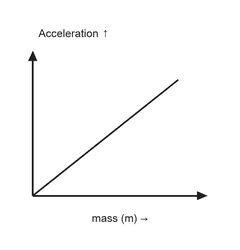
(B)

(C)
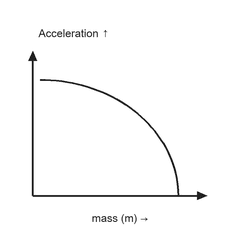
- Correct
(D)
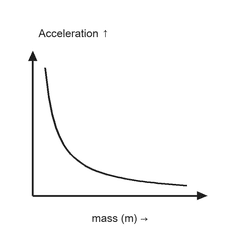
Answer: (D) falling curve that flattens out (rectangular hyperbola)
Concept: For a body of constant mass , the second law gives , where is the acceleration. So : the acceleration is directly proportional to the force and inversely proportional to the mass.
Step 1 — Write a in terms of m.
For a given force , the acceleration is the force divided by the mass.
Step 2 — Work out the shape.
So is inversely proportional to , and stays constant. When is small, is large; as grows, keeps falling but never reaches zero. This graph is a rectangular hyperbola: it falls steeply at first and then flattens out towards the mass axis.
Step 3 — Match the picture.
Only graph (D) falls steeply and then flattens out without touching the axis.
Watch out: A falling curve is not enough; the curve for must never reach zero.
Why the other options are wrong:
- (A) rising straight line: A rising straight line would mean increases with , the opposite of .
- (B) horizontal line: A horizontal line would mean does not depend on at all.
- (C) curve falling to zero: This curve falls slowly at first and then steeply, and it reaches zero at a finite mass, which never does.
Therefore, the graph of acceleration against mass for a given force is the rectangular hyperbola, option (D).
- 641 mark
Question 64
The acceleration produced in a body by a force of a given magnitude depends on :
Solve with AIAnswer
(A) size of the body
(B) shape of the body
- Correct
(C) mass of the body
(D) none of these
Answer: (C) mass of the body
Concept: For a body of constant mass , the second law gives , where is the acceleration. So : the acceleration is directly proportional to the force and inversely proportional to the mass.
Step 1 — Write the acceleration.
For a given force, .
Step 2 — Find what it depends on.
Only the mass of the body appears, so for a fixed force the acceleration depends on the mass: the larger the mass, the smaller the acceleration.
Why the other options are wrong:
- (A) size of the body: The size of the body does not appear in ; a small heavy body and a large light one behave according to their masses.
- (B) shape of the body: The shape of the body does not appear in .
- (D) none of these: This cannot be right, because the acceleration depends on the mass.
Therefore, the acceleration depends on the mass of the body, option (C).
- 651 mark
Question 65
The S.I. unit of force is :
Solve with AIAnswer
(A) dyne
(B) g cm s
- Correct
(C) Newton
(D) Joule
Answer: (C) Newton
Concept: The S.I. unit of force is the newton (N): 1 N is the force that gives a mass of 1 kg an acceleration of 1 m s. The C.G.S. unit is the dyne: 1 dyne gives a mass of 1 g an acceleration of 1 cm s.
Step 1 — Recall the S.I. unit.
In the S.I. system mass is in kg and acceleration in m s, so force is in kg m s, which is named the newton (N).
Step 2 — Check the other options.
The dyne and g cm s are the same C.G.S. unit, and the joule is a unit of energy.
Why the other options are wrong:
- (A) dyne: The dyne is the C.G.S. unit of force, not the S.I. unit.
- (B) g cm s: g cm s is the dyne, the C.G.S. unit of force.
- (D) Joule: The joule is the S.I. unit of work and energy, not of force.
Therefore, the S.I. unit of force is the newton, option (C).
- 661 mark
Question 66
1 Newton is equal to :
Solve with AIAnswer
(A) dyne
(B) dyne
(C) dyne
- Correct
(D) dyne
Answer: (D) dyne
Concept: The S.I. unit of force is the newton (N): 1 N is the force that gives a mass of 1 kg an acceleration of 1 m s. The C.G.S. unit is the dyne: 1 dyne gives a mass of 1 g an acceleration of 1 cm s.
Step 1 — Write 1 N in base units.
One newton is one kilogram times one metre per second squared.
Step 2 — Change to dyne.
Since 1 g cm s is 1 dyne, one newton is dyne.
Watch out: Convert both the kilogram (1000 g) and the metre (100 cm); converting only one gives or .
Why the other options are wrong:
- (A) dyne: dyne converts only the kilograms to grams and forgets the metres.
- (B) dyne: dyne uses a wrong power of ten; 1000 × 100 is .
- (C) dyne: dyne uses a wrong power of ten; 1000 × 100 is .
Therefore, 1 newton is dyne, option (D).
- 671 mark
Question 67
The force required to produce an acceleration of 5 m s in a body of mass 2 kg is :
Solve with AIAnswer
(A) 2.5 N
(B) 20 N
- Correct
(C) 10 N
(D) 25 N
Answer: (C) 10 N
Concept: For a body of constant mass , the second law gives , where is the acceleration. So : the acceleration is directly proportional to the force and inversely proportional to the mass.
Step 1 — Write what is given.
The mass is 2 kg and the acceleration is 5 m s.
Step 2 — Use F = ma.
We multiply the mass by the acceleration.
Watch out: Multiply mass by acceleration; do not divide one by the other.
Why the other options are wrong:
- (A) 2.5 N: 2.5 N comes from dividing 5 by 2 instead of multiplying.
- (B) 20 N: 20 N is twice the correct product; 2 × 5 is 10.
- (D) 25 N: 25 N is 5 × 5, using the acceleration twice instead of the mass.
Therefore, the force required is 10 N, option (C).
- 681 mark
Question 68
According to Newton's second law of motion, the change in momentum takes place in a direction :
Solve with AIAnswer
(A) opposite to the direction of force applied
(B) perpendicular to the direction of force applied
- Correct
(C) similar to the direction of force applied
(D) none of these
Answer: (C) similar to the direction of force applied
Concept: Newton's second law of motion: the rate of change of momentum of a body is directly proportional to the force applied on it, and the change of momentum takes place in the direction of the force.
Step 1 — Read the law.
The second law says the change in momentum takes place in the direction of the force.
Step 2 — Check with an example.
Pushing a moving trolley from behind increases its forward momentum; pushing it from the front reduces it. The change is always along the push.
Why the other options are wrong:
- (A) opposite to the direction of force applied: The change of momentum is along the force, not opposite to it.
- (B) perpendicular to the direction of force applied: The change of momentum is along the force, not at right angles to it.
- (D) none of these: This cannot be right, because the law gives the direction: along the force.
Therefore, the change in momentum takes place in the direction of the force applied, option (C).
- 691 mark
Question 69
For relation F = mΔv/Δt to hold true, the condition(s) necessary is/are :
Solve with AIAnswer
(A) velocities are equal to the velocity of light
(B) velocities are much smaller than the velocity of light
(C) mass remains constant
- Correct
(D) both (b) and (c)
Answer: (D) both (b) and (c)
Concept: Newton's second law of motion: the rate of change of momentum of a body is directly proportional to the force applied on it, and the change of momentum takes place in the direction of the force.
Step 1 — Start from the general form.
The general law is written first below. It takes the second form only if does not change, because only then can be taken outside the change.
Step 2 — List what keeps m constant.
The mass stays constant when nothing is added to or lost from the body (condition (c)), and when its speed is much smaller than the speed of light (condition (b)), because at speeds near light the mass of a body increases.
Step 3 — Combine the conditions.
Both (b) and (c) are needed.
Why the other options are wrong:
- (A) velocities are equal to the velocity of light: At speeds equal to that of light the mass would not stay constant, so the relation fails.
- (B) velocities are much smaller than the velocity of light: This condition is needed, but the mass must also not be gained or lost, so (B) alone is incomplete.
- (C) mass remains constant: This condition is needed, but the speed must also be much less than that of light, so (C) alone is incomplete.
Therefore, the relation needs both (b) and (c), option (D).
- 701 mark
Question 70
Two balls of masses 4m and 8m are in motion with velocities 2v and v respectively. The ratio of their momentum would be :
Solve with AIAnswer
(A) 2 : 1
(B) 1 : 2
- Correct
(C) 1 : 1
(D) 1 : 4
Answer: (C) 1 : 1
Concept: The linear momentum of a body is the product of its mass and its velocity, . It is a vector in the direction of the velocity, and its S.I. unit is kg m s, which is the same as N s.
Step 1 — Momentum of the first ball.
The first ball has mass and velocity .
Step 2 — Momentum of the second ball.
The second ball has mass and velocity .
Step 3 — Take the ratio.
Both momenta are , so they are equal.
Watch out: Momentum uses both mass and velocity; comparing only one of them gives a wrong ratio.
Why the other options are wrong:
- (A) 2 : 1: 2 : 1 is the ratio of the velocities alone, ignoring the masses.
- (B) 1 : 2: 1 : 2 is the ratio of the masses alone, ignoring the velocities.
- (D) 1 : 4: 1 : 4 does not come from the masses, the velocities or their product.
Therefore, the ratio of their momenta is 1 : 1, option (C).
- 712 marks
Question 71
Define linear momentum and state its S.I. unit.
Solve with AIWritten solution
Solution:
Concept: The linear momentum of a body is the product of its mass and its velocity, . It is a vector in the direction of the velocity, and its S.I. unit is kg m s, which is the same as N s.
Step 1 — Define linear momentum.
The product of the mass of a body and its velocity is called its linear momentum.
Step 2 — Say its direction.
It is a vector quantity, in the direction of the velocity.
Step 3 — Give the S.I. unit.
Mass is in kg and velocity in m s, so the S.I. unit is kg m s, which is the same as N s.
Therefore, linear momentum is mass × velocity, and its S.I. unit is kg m s (or N s).
- 722 marks
Question 72
A body of mass m moving with a velocity v is acted upon by a force. Write expression for change in momentum in each of the following cases : (i) when , (ii) when , and (iii) when but m does not remain constant. Here c is the speed of light.
Solve with AIWritten solution
Solution:
Concept: The linear momentum of a body is the product of its mass and its velocity, . It is a vector in the direction of the velocity, and its S.I. unit is kg m s, which is the same as N s. The change in momentum is ; it reduces to only when the mass stays constant.
Step 1 — (i) When v << c.
At speeds much smaller than the speed of light the mass stays constant, so only the velocity changes and the change in momentum is .
Step 2 — (ii) When v → c.
At speeds close to the speed of light the mass of the body also changes with its velocity, so the change in momentum is .
Step 3 — (iii) When v << c but m changes.
If the mass changes, as in a rocket burning its fuel, both and change, so the change in momentum is .
Therefore, the change in momentum is (i) , (ii) and (iii) .
- 732 marks
Question 73
Two bodies A and B of same mass are moving with velocities v and 2v respectively. Compare their (i) inertia, (ii) momentum.
Solve with AIWritten solution
Solution:
Concept: Inertia is the property of a body by which it tends to stay in its state of rest or of uniform motion and resists any change in that state. Mass is the measure of inertia: the greater the mass, the greater the inertia. The linear momentum of a body is the product of its mass and its velocity, . It is a vector in the direction of the velocity, and its S.I. unit is kg m s, which is the same as N s.
Step 1 — (i) Compare inertia.
Inertia depends only on mass. A and B have the same mass, so their inertia is in the ratio 1 : 1.
Step 2 — (ii) Compare momentum.
The momentum of A is and of B is , so we divide them.
Watch out: Inertia does not depend on velocity, so the faster body does not have more inertia.
Therefore, (i) inertia of A : inertia of B is 1 : 1, and (ii) momentum of A : momentum of B is 1 : 2.
- 742 marks
Question 74
Two balls A and B of masses m and 2m are in motion with velocities 2v and v respectively. Compare : (i) their inertia, (ii) their momentum, and (iii) the force needed to stop them in the same time.
Solve with AIWritten solution
Solution:
Concept: Inertia is the property of a body by which it tends to stay in its state of rest or of uniform motion and resists any change in that state. Mass is the measure of inertia: the greater the mass, the greater the inertia. The linear momentum of a body is the product of its mass and its velocity, . It is a vector in the direction of the velocity, and its S.I. unit is kg m s, which is the same as N s. By the second law, force is the change of momentum divided by the time taken, . For the same change of momentum, a longer stopping time means a smaller force.
Step 1 — (i) Compare inertia.
Inertia is in the ratio of the masses:
Step 2 — (ii) Compare momentum.
We find each momentum and compare.
The momenta are equal, so the ratio is 1 : 1.
Step 3 — (iii) Compare the stopping forces.
To stop a body in time the force is the momentum divided by . Both have equal momentum and the same , so the forces are in the ratio 1 : 1.
Therefore, (i) inertia is 1 : 2, (ii) momentum is 1 : 1, and (iii) the force needed to stop them in the same time is 1 : 1.
- 752 marks
Question 75
Name the S.I. unit of force and define it.
Solve with AIWritten solution
Solution:
Concept: For a body of constant mass , the second law gives , where is the acceleration. So : the acceleration is directly proportional to the force and inversely proportional to the mass.
Step 1 — Name the unit.
The S.I. unit of force is the newton (N).
Step 2 — Define it.
1 newton is the force which, acting on a body of mass 1 kg, produces in it an acceleration of 1 m s.
Therefore, the S.I. unit of force is the newton, the force that gives 1 kg an acceleration of 1 m s.
- 762 marks
Question 76
What is the C.G.S. unit of force ? How is it defined?
Solve with AIWritten solution
Solution:
Concept: For a body of constant mass , the second law gives , where is the acceleration. So : the acceleration is directly proportional to the force and inversely proportional to the mass.
Step 1 — Name the unit.
The C.G.S. unit of force is the dyne.
Step 2 — Define it.
1 dyne is the force which, acting on a body of mass 1 g, produces in it an acceleration of 1 cm s.
Therefore, the C.G.S. unit of force is the dyne, the force that gives 1 g an acceleration of 1 cm s.
- 772 marks
Question 77
Name the S.I. and C.G.S. units of force. How are they related ?
Solve with AIWritten solution
Solution:
Concept: The S.I. unit of force is the newton (N): 1 N is the force that gives a mass of 1 kg an acceleration of 1 m s. The C.G.S. unit is the dyne: 1 dyne gives a mass of 1 g an acceleration of 1 cm s.
Step 1 — Name the units.
The S.I. unit of force is the newton (N) and the C.G.S. unit is the dyne.
Step 2 — Relate them.
We change kilograms to grams and metres to centimetres.
Since 1 g cm s is 1 dyne, one newton is dyne.
Watch out: Both the mass and the length must be converted, giving 1000 × 100.
Therefore, the S.I. unit is the newton, the C.G.S. unit is the dyne, and 1 N is dyne.
- 782 marks
Question 78
Name the two factors on which the force needed to stop a moving body in a given time depends.
Solve with AIWritten solution
Solution:
Concept: The linear momentum of a body is the product of its mass and its velocity, . It is a vector in the direction of the velocity, and its S.I. unit is kg m s, which is the same as N s. By the second law, force is the change of momentum divided by the time taken, . For the same change of momentum, a longer stopping time means a smaller force.
Step 1 — First factor: mass.
A heavier body, such as a loaded truck, needs a larger force to stop in a given time than a lighter one, such as a car, moving with the same velocity.
Step 2 — Second factor: velocity.
A faster body needs a larger force than a slower one of the same mass; a fast cricket ball is harder to stop than a slow one.
Step 3 — Combine them.
Together the two factors make up the momentum, mass × velocity, which the force must remove.
Therefore, the force needed depends on the mass and the velocity of the body, that is on its momentum.
- 793 marks
Question 79
Show that the rate of change of momentum = mass × acceleration. Under what condition does this relation hold ?
Solve with AIWritten solution
Solution:
Concept: The linear momentum of a body is the product of its mass and its velocity, . It is a vector in the direction of the velocity, and its S.I. unit is kg m s, which is the same as N s.
Step 1 — Write the momenta.
Let a body of mass change its velocity from to in time . Its initial momentum is and its final momentum is .
Step 2 — Find the change of momentum.
We subtract and take outside, since it is constant.
Step 3 — Divide by the time.
The rate of change of momentum is the change divided by .
Step 4 — Recognise the acceleration.
The fraction is the acceleration , so the rate of change of momentum equals , mass × acceleration.
Step 5 — State the condition.
Taking outside is allowed only if the mass stays constant. This needs the speed to be much smaller than the speed of light, and no mass to be gained or lost.
Therefore, rate of change of momentum = mass × acceleration, provided the mass of the body remains constant.
- 803 marks
Question 80
State Newton's second law of motion. What information do you get from it ?
Solve with AIWritten solution
Solution:
Concept: Newton's second law of motion: the rate of change of momentum of a body is directly proportional to the force applied on it, and the change of momentum takes place in the direction of the force.
Step 1 — State the law.
Newton's second law of motion: the rate of change of momentum of a body is directly proportional to the force applied on it, and the change in momentum takes place in the direction of the force.
Step 2 — It measures force.
It gives a way to measure force (a quantitative definition): for a body of constant mass.
Step 3 — Acceleration and force.
For a given mass, the acceleration is directly proportional to the force.
Step 4 — Acceleration and mass.
For a given force, the acceleration is inversely proportional to the mass.
Step 5 — Direction and unit.
The change in momentum, and the acceleration, are in the direction of the force. The law also defines the unit of force: 1 N gives 1 kg an acceleration of 1 m s.
Therefore, the second law relates force to the rate of change of momentum, and from it we get , the dependence of acceleration on force and mass, and the unit of force.
- 812 marks
Question 81
How does Newton's second law of motion differ from first law of motion ?
Solve with AIWritten solution
Solution:
Concept: Newton's first law of motion: a body continues in its state of rest or of uniform motion in a straight line unless an external force is applied on it. Newton's second law of motion: the rate of change of momentum of a body is directly proportional to the force applied on it, and the change of momentum takes place in the direction of the force.
Step 1 — Compare them point by point.
We set the two laws side by side.
Newton's first law Newton's second law Gives the qualitative definition of force: a force changes the state of rest or motion. Gives the quantitative definition of force, a way to measure it: . Describes inertia. Describes how the momentum changes under a force. Deals with the case when no net force acts. Deals with the case when a net force acts, and gives the acceleration produced. Step 2 — Sum up the difference.
The first law tells us what a force does, while the second law tells us how much force is needed, or how much acceleration it produces.
Therefore, the first law defines force qualitatively and describes inertia, while the second law defines force quantitatively through .
- 822 marks
Question 82
Write the mathematical form of Newton's second law of motion. State condition if any.
Solve with AIWritten solution
Solution:
Concept: Newton's second law of motion: the rate of change of momentum of a body is directly proportional to the force applied on it, and the change of momentum takes place in the direction of the force.
Step 1 — Write the general form.
Force equals the rate of change of momentum.
Step 2 — Write the constant-mass form.
If the mass does not change, it can be taken outside.
Step 3 — State the condition.
The form holds only when the mass of the body remains constant, that is when the velocity is much smaller than the speed of light and no mass is gained or lost.
Therefore, the second law is , which becomes only for a body of constant mass.
- 833 marks
Question 83
State Newton's second law of motion. Under what condition does it take the form ?
Solve with AIWritten solution
Solution:
Concept: Newton's second law of motion: the rate of change of momentum of a body is directly proportional to the force applied on it, and the change of momentum takes place in the direction of the force.
Step 1 — State the law.
Newton's second law of motion: the rate of change of momentum of a body is directly proportional to the force applied on it, and the change in momentum takes place in the direction of the force.
Step 2 — Find the rate of change of momentum.
For a body of constant mass whose velocity changes from to in time , we divide the change of momentum by .
Step 3 — Apply the proportion.
By the law the force is proportional to , so it equals times some constant .
The newton is chosen so that is 1, which gives the form below.
Step 4 — State the condition.
This form holds when the mass of the body remains constant, that is when its velocity is much smaller than the speed of light (and no mass is gained or lost).
Therefore, the second law takes the form when the mass of the body remains constant.
- 843 marks
Question 84
How can Newton's first law of motion be obtained from the second law of motion ?
Solve with AIWritten solution
Solution:
Concept: For a body of constant mass , the second law gives , where is the acceleration. So : the acceleration is directly proportional to the force and inversely proportional to the mass.
Step 1 — Put F = 0 in the second law.
If no external force acts, is zero, so is zero. The mass is not zero, so the acceleration must be zero.
Step 2 — Read what zero acceleration means.
With zero acceleration the velocity does not change. If the body was at rest it stays at rest; if it was moving with velocity , it keeps moving with velocity in the same straight line.
Step 3 — Compare with the first law.
This is exactly what Newton's first law says, so the first law is a special case of the second law.
Therefore, with no force the second law gives zero acceleration, which is exactly Newton's first law.
- 853 marks
Question 85
Why does a glass vessel break when it falls on a hard floor, but it does not break when it falls on a carpet ?
Solve with AIWritten solution
Solution:
Concept: By the second law, force is the change of momentum divided by the time taken, . For the same change of momentum, a longer stopping time means a smaller force.
Step 1 — Compare the change of momentum.
In both cases the vessel strikes with the same momentum and is brought to rest, so the change of momentum is the same.
Step 2 — Hard floor.
A hard floor stops the vessel in a very short time, so the force on it, change of momentum ÷ time, is very large, and the vessel breaks.
Step 3 — Carpet.
A carpet is soft and gets pressed in, so it stops the vessel over a longer time. The force on the vessel is therefore much smaller, and it does not break.
Therefore, the vessel breaks on a hard floor because it is stopped in a very short time, giving a large force, but not on a carpet, which stops it more slowly.
- 863 marks
Question 86
Use Newton's second law of motion to explain the following :
(a) A cricketer pulls his hands back while catching a fast moving cricket ball.
(b) An athlete prefers to land on sand instead of hard floor while taking a high jump.
- 874 marks
Question 87
Draw graphs to show the dependence of (i) acceleration on force for a constant mass, and (ii) force on mass for a constant acceleration.
- 884 marks
Question 88
How does the acceleration produced by a given force depend on mass of the body ? Draw a graph to show it.
- 894 marks
Question 89
How does acceleration vary with the force applied for a given body ? Show it with the help of a graph.
- 903 marks
Question 90
A body of mass 5 kg is moving with velocity 2 m s. Calculate its linear momentum.
- 913 marks
Question 91
The linear momentum of a ball of mass 50 g is 0.5 kg m s. Find its velocity.
- 923 marks
Question 92
A force of 15 N acts on a body of mass 2 kg. Calculate the acceleration produced.
- 933 marks
Question 93
A force of 10 N acts on a body of mass 5 kg. Find the acceleration produced.
- 943 marks
Question 94
Calculate the magnitude of force which when applied on a body of mass 0.5 kg produces an acceleration of 5 m s.
- 954 marks
Question 95
A force of 10 N acts on a body of mass 2 kg for 3 s, initially at rest. Calculate : (i) the velocity acquired by the body, and (ii) change in momentum of the body.
- 964 marks
Question 96
A force acts for 10 s on a stationary body of mass 100 kg after which the force ceases to act. The body moves through a distance of 100 m in the next 5 s. Calculate : (i) the velocity acquired by the body, (ii) the acceleration produced by the force, and (iii) the magnitude of the force.
- 974 marks
Question 97
Fig. 3.11 shows the velocity-time graph of a particle of mass 100 g moving in a straight line. Calculate the force acting on the particle.
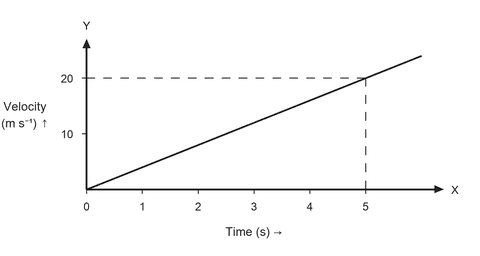
(Hint : Acceleration = slope of v–t graph)
- 983 marks
Question 98
A force causes an acceleration of 10 m s in a body of mass 500 g. What acceleration will be caused by the same force in a body of mass 5 kg ?
- 993 marks
Question 99
A cricket ball of mass 150 g moving at a speed of 25 m s is brought to rest by a player in 0.03 s. Find the average force applied by the player.
- 1003 marks
Question 100
A force acts for 0.1 s on a body of mass 2.0 kg initially at rest. The force is then withdrawn and the body moves with a velocity of 2 m s. Find the magnitude of force.
- 1013 marks
Question 101
A body of mass 500 g, initially at rest, is acted upon by a force which causes it to move a distance of 4 m in 2 s, Calculate the force applied.
- 1023 marks
Question 102
A car of mass 480 kg moving at a speed of 54 km h is stopped by applying brakes in 10 s. Calculate the force applied by the brakes.
- 1034 marks
Question 103
A car is moving with a uniform velocity of 30 m s. It is stopped in 2 s by applying a force of 1500 N through its brakes. Calculate : (a) the change in momentum of car, (b) the retardation produced in car, and (c) the mass of the car.
- 1044 marks
Question 104
A bullet of mass 50 g moving with an initial velocity of 100 m s, strikes a wooden block and comes to rest after penetrating a distance 2 cm in it. Calculate : (i) initial momentum of the bullet, (ii) final momentum of the bullet, (iii) retardation caused by the wooden block, and (iv) resistive force exerted by the wooden block
- 1051 mark
Question 105
Newton's third law :
- 1061 mark
Question 106
Which law of motion explains how a force acts on a body or an object ?
- 1071 mark
Question 107
To every action there is always :
- 1081 mark
Question 108
Action and reaction act on the :
- 1091 mark
Question 109
The motion of a boat moving away from the shore is an example of :
- 1101 mark
Question 110
In an interaction of two bodies A and B, which of the following statements is correct ?
- 1111 mark
Question 111
A footballer hits a football with a force of 10 N. What force does the footballer experience ?
- 1121 mark
Question 112
Out of the following statements, which one is correct ?
- 1131 mark
Question 113
Which of the following are examples of Newton's third law of motion ?
(i) While catching a ball, the cricketer withdraws his hands along with the ball.
(ii) Athletes often land on sand after taking a high jump
(iii) Motion of a man on ground
- 1141 mark
Question 114
State Newton's third law of motion.
- 1152 marks
Question 115
Name and state the action and reaction in the following cases :
(a) firing a bullet from a gun, (b) hammering a nail, (c) a book lying on a table, (d) a moving rocket, (e) a person walking on the floor, (f) a moving train colliding with a stationary train.
- 1161 mark
Question 116
'The action and reaction both act simultaneously.' Is this statement true ?
- 1171 mark
Question 117
'The action and reaction are equal in magnitude'. Is this statement true ?
- 1182 marks
Question 118
Comment on the statement 'the sum of action and reaction on a body is zero'.
[Hint : The statement is wrong]
- 1192 marks
Question 119
State the usefulness of Newton's third law of motion.
- 1203 marks
Question 120
State and explain the law of action and reaction, by giving two examples.
- 1212 marks
Question 121
Explain the motion of a rocket with the help of Newton's third law.
- 1222 marks
Question 122
When a shot is fired from a gun, the gun gets recoiled. Explain.
- 1232 marks
Question 123
When you step ashore from a stationary boat, it tends to leave the shore. Explain.
- 1242 marks
Question 124
When two spring balances joined at their free ends, are pulled apart, both show the same reading. Explain.
- 1252 marks
Question 125
To move a boat ahead in water, the boatman has to push the water backwards by his oar. Explain.
- 1262 marks
Question 126
A person pushing a wall hard is liable to fall back. Give reason.
- 1272 marks
Question 127
A light ball falling on ground, after striking the ground rises upwards. Explain the reason.
- 1283 marks
Question 128
A boy pushes a wall with a force of 10 N towards east. What force is exerted by the wall on the boy ?
- 1294 marks
Question 129
In Fig. 3.17, a block of weight 15 N is hanging from a rigid support by a string. What force is exerted by
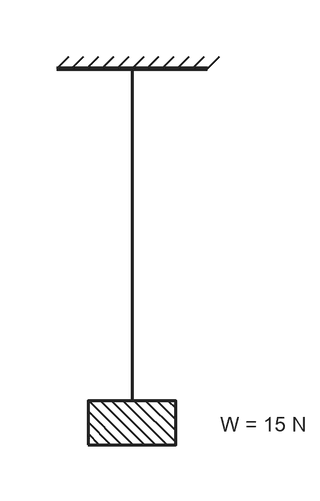
(a) block on the string, (b) string on the block.
Name them and show them in the diagram.
- 1301 mark
Question 130
The gravitational force between two bodies is :
- 1311 mark
Question 131
The gravitational force of attraction between two particles is because of :
- 1321 mark
Question 132
The law of gravitation was given by :
- 1331 mark
Question 133
The force of attraction acting between two bodies is :
- 1341 mark
Question 134
The value of gravitational constant G depends on :
- 1351 mark
Question 135
The value of G is :
- 1361 mark
Question 136
The value of gravitational constant G changes with the change in :
- 1371 mark
Question 137
The gravitational force between two masses is :
- 1381 mark
Question 138
The force of attraction between two masses each of 1 kg kept at a separation of 1 m is :
- 1391 mark
Question 139
The gravitational force of attraction between the two bodies of masses 60 kg and 40 kg separated by a distance 10 m is : (where G = N m kg).
- 1401 mark
Question 140
The S.I. unit of g is :
- 1411 mark
Question 141
The relationship between g and G is :
- 1421 mark
Question 142
The value of g on a planet depends on :
- 1431 mark
Question 143
A body is projected vertically upward with an initial velocity u. If acceleration due to gravity is g, the time for which it remains in air, is :
- 1441 mark
Question 144
An object falling freely from rest reaches ground in 2 s. If acceleration due to gravity is 9.8 m s, the velocity of the object on reaching the ground will be:
- 1451 mark
Question 145
A body of mass 25 kg is taken from the earth to the moon. If the value of g on moon is 1.6 m s, then the weight of the body on moon is :
- 1461 mark
Question 146
The relationship between weight and mass is :
- 1471 mark
Question 147
The S.I. unit of weight is :
- 1481 mark
Question 148
The mass of a body :
- 1492 marks
Question 149
State Newton's law of gravitation.
- 1501 mark
Question 150
State whether the gravitational force between two masses is attractive or repulsive ?
- 1511 mark
Question 151
Write an expression for the gravitational force of attraction between two bodies of masses and separated by a distance r.
- 1521 mark
Question 152
How is the gravitational force between two masses affected if the separation between them is doubled ?
- 1531 mark
Question 153
Define gravitational constant G.
- 1541 mark
Question 154
Write the numerical value of gravitational constant G with its S.I. unit.
- 1552 marks
Question 155
Define the term acceleration due to gravity ? Write its S.I. unit.
- 1561 mark
Question 156
Write down the average value of g on the earth's surface.
- 1571 mark
Question 157
How are g and G related ?
- 1581 mark
Question 158
A body falls freely under gravity from rest and reaches the ground in time t. Write an expression for the height fallen by the body.
- 1591 mark
Question 159
A body is thrown vertically upwards with an initial velocity u. Write an expression for the maximum height attained by the body.
- 1601 mark
Question 160
State the S.I. units of (a) mass and (b) weight.
- 1611 mark
Question 161
The value of g at the centre of the earth is zero. What will be the weight of a body of mass m kg at the centre of the earth ?
- 1621 mark
Question 162
Which of the following quantity does not change by change of place of a body : mass or weight ?
- 1632 marks
Question 163
How does the gravitational force of attraction between two masses depend on the distance between them ?
- 1643 marks
Question 164
What is the importance of the law of gravitation?
- 1652 marks
Question 165
What do you understand by the term force due to gravity ?
- 1662 marks
Question 166
Write an expression for the force due to gravity on a body of mass m and explain the meaning of the symbols used in it.
- 1673 marks
Question 167
How is the acceleration due to gravity on the surface of the earth related to its mass and radius ?
- 1682 marks
Question 168
Define the terms mass and weight.
- 1693 marks
Question 169
Distinguish between mass and weight.
- 1702 marks
Question 170
Explain the meaning of the following statement '1 kgf = 9.8 N'.
- 1713 marks
Question 171
The force of attraction between two bodies at a certain separation is 10 N. What will be the force of attraction between them if the separation is reduced to half ?
- 1723 marks
Question 172
Write the approximate weight of a body of mass 5 kg. What assumption have you made ?
- 1734 marks
Question 173
Calculate the weight of a body of mass 10 kg in (a) kgf and (b) newton. Take g = 9.8 m s.
- 1743 marks
Question 174
State the magnitude and direction of the force of gravity acting on a body of mass 5 kg. Take g = 9.8 m s.
- 1753 marks
Question 175
The weight of a body is 2.0 N. What is the mass of the body ? (g = 10 m s)
- 1764 marks
Question 176
The weight of a body on earth is 98 N where the acceleration due to gravity is 9.8 m s. What will be its (a) mass and (b) weight on moon where the acceleration due to gravity is 1.6 m s ?
- 1773 marks
Question 177
A man weighs 600 N on earth. What would be his approximate weight on moon ? Give reason for your answer ?
- 1783 marks
Question 178
What is the (a) force of gravity and (b) weight of a block of mass 10.5 kg ? Take g = 10 m s.
- 1794 marks
Question 179
A ball is released from a height and it reaches the ground in 3 s. If g = 9.8 m s, find :
(a) the height from which the ball was released, (b) the velocity with which the ball will strike the ground.
- 1803 marks
Question 180
What force, in newton, your muscles need to apply to hold a mass of 5 kg in your hand ? State the assumption.
- 1814 marks
Question 181
A ball is thrown vertically upwards. It goes to a height 20 m and then returns to the ground. Taking acceleration due to gravity g to be 10 m s, find :
(a) the initial velocity of the ball (b) the final velocity of the ball on reaching the ground and (c) the total time of journey of the ball.
- 1823 marks
Question 182
A body is dropped from the top of a tower. It acquires a velocity 20 m s on reaching the ground. Calculate the height of the tower. (Take g = 10 m s)
- 1834 marks
Question 183
A ball is thrown vertically upwards. It returns 6 s later. Calculate : (i) the greatest height reached by the ball, and (ii) the initial velocity of the ball. (Take g = 10 m s)
- 1843 marks
Question 184
A pebble is thrown vertically upwards with a speed of 20 m s. How high will it be after 2 s ? (Take g = 10 m s)
- 1854 marks
Question 185
(a) How long will a stone take to fall to the ground from the top of a building 80 m high and (b) what will be the velocity of the stone on reaching the ground ? (Take g = 10 m s)
- 1863 marks
Question 186
A body falls from the top of a building and reaches the ground 2.5 s later. How high is the building ? (Take g = 9.8 m s)
- 1874 marks
Question 187
A ball is thrown vertically upwards with an initial velocity of 49 m s. Calculate : (i) the maximum height attained, (ii) the time taken by it before it reaches the ground again. (Take g = 9.8 m s).
- 1883 marks
Question 188
A stone is dropped freely from the top of a tower and it reaches the ground in 4 s. Taking g = 10 m s, calculate the height of the tower.
- 1894 marks
Question 189
A pebble is dropped freely in a well from its top. It takes 20 s for the pebble to reach the water surface in the well. Taking g = 10 m s and speed of sound = 330 m s, find : (i) the depth of water surface, and (ii) the time when echo is heard after the pebble is dropped.
- 1904 marks
Question 190
A ball is thrown vertically upwards from the top of a tower with an initial velocity of 19.6 m s.
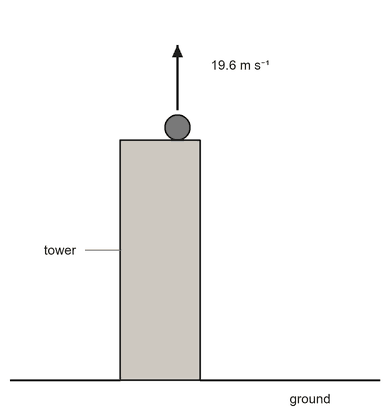
The ball reaches the ground after 5 s. Calculate : (i) the height of the tower, (ii) the velocity of ball on reaching the ground. Take g = 9.8 m s.
What Class 9 Physics Ch 3 covers
The sections of the chapter, in the order the book takes them. Every question above comes from one of these.
- 01Effect of Force
- 02Contact Forces
- 03Non-Contact Forces
- 04Newton's First Law of Motion
- 05Mass and Inertia
- 06Linear Momentum
More ways to study this chapter
The same chapter asked three other ways. Practise it, revise it, and see what the board has set on Ch 3 before.
Class 9 Physics Ch 3 questions students ask
How many questions are there in Class 9 Physics Ch 3?
190 questions. Every one is solved step by step on this page.
Are these Class 9 Physics solutions free?
Yes. Every question and its full working is free to read, with no account needed.
Can I download the Class 9 Physics Ch 3 solutions as a PDF?
There is no PDF to download. Every solution is on this page instead, which means it is searchable, always the current syllabus, and readable on a phone. Use your browser's print option if you want it on paper.