
Question 1294 marksEasy
In Fig. 3.17, a block of weight 15 N is hanging from a rigid support by a string. What force is exerted by
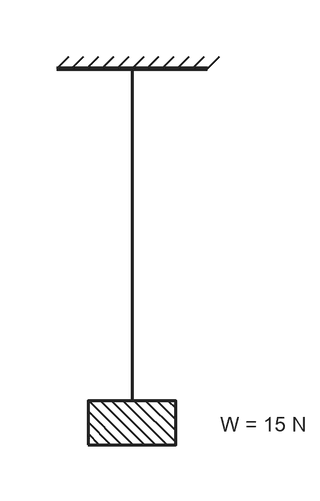
(a) block on the string, (b) string on the block.
Name them and show them in the diagram.
Confirming your payment
Sign up now and get 250 free tokens.
Laws of Motion · Question 129 of 190
In Fig. 3.17, a block of weight 15 N is hanging from a rigid support by a string. What force is exerted by
(a) block on the string, (b) string on the block.
Name them and show them in the diagram.
Solution:
Concept: Newton's third law of motion: to every action there is an equal and opposite reaction. The action and the reaction act at the same time, on two different bodies, so they never cancel each other. A stretched string pulls on each body tied to its ends. This pull along the string is called the tension T.
Step 1 — (a) Force of the block on the string.
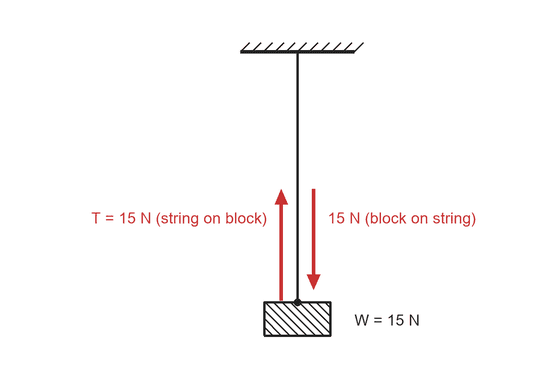
The block hangs at rest, so it pulls the string downwards with a force equal to its weight, 15 N downwards. This pull is the action.
Step 2 — (b) Force of the string on the block.
By the third law, the string pulls the block upwards with an equal force, 15 N upwards. This pull is the tension T in the string, the reaction.
Step 3 — Show them in the diagram.
In the diagram the tension acts on the block (upwards) and the block's pull acts on the string (downwards).
Watch out: The block's pull on the string equals its weight in size, but the weight itself is the earth's pull on the block; the action–reaction pair here is block-on-string and string-on-block.
Therefore, (a) the block pulls the string down with 15 N, and (b) the string pulls the block up with 15 N, the tension; the two form an action–reaction pair.