
Opening your dashboard
Class 9 Physics Chapter 3 Laws of Motion: Competency-Based Questions (CBQ)
40 questions on Chapter 3, each worked through on its own page with the AI tutor. Class 9 Physics, ICSE 2026-27.
40 questions
1–5 marks · Mixed difficulty
- 11 mark
Question 1
Competency: Application & Analysis
On a level road, the engine of a car of mass 1200 kg provides a resultant forward force of 3000 N. A trailer is now hooked to the car. With the same resultant forward force of 3000 N, the car and the trailer together have an acceleration of 1.5 m s. The mass of the trailer is :
- 21 mark
Question 2
Competency: Understanding & Analysis
A box is pulled along a rough horizontal floor by a rope. The figure shows four forces that act on the box, marked P, Q, R and S.
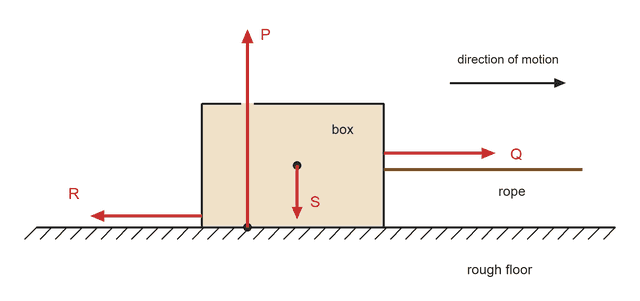
Which statement about these forces is correct ?
- 31 mark
Question 3
Competency: Application
A space probe has its engines switched off. When it is at a distance from the centre of a planet, the gravitational force of the planet on it is 3600 N. It drifts away until its distance from the centre of the planet is . The gravitational force on the probe is now :
- 41 mark
Question 4
Competency: Analysis
Inside an orbiting space station, every object floats and a spring balance reads zero whatever is hung from it. An astronaut has two identical closed boxes. One is empty and the other is packed with tools. Which test will tell her which box is the full one ?
- 51 mark
Question 5
Competency: Understanding & Analysis
Assertion (A): A swimmer who pushes the wall of a pool backwards with her feet with a force of 300 N is pushed forwards by the wall with a force of 300 N.
Reason (R): Action and reaction act on the same body, so they cancel each other.
- 61 mark
Question 6
Competency: Understanding
Assertion (A): On the moon, where there is no air, a hammer and a feather released together from the same height reach the surface at the same time.
Reason (R): At a given place, the acceleration due to gravity is the same for all bodies, whatever their mass.
- 72 marks
Question 7
Competency: Analysis & Evaluation
Two small metal spheres carry electric charges of the same kind, so they repel each other. A student measures the force of repulsion for different distances between the centres of the spheres. Her readings are given below.
Distance between the centres Force of repulsion 4 cm 0.072 N 8 cm 0.018 N (a) Her friend says, "The readings show that the force becomes half when the distance is doubled." Do the readings support this ? Show your working.
(b) Predict the force of repulsion when the distance between the centres is 16 cm.
- 82 marks
Question 8
Competency: Evaluation
A spacecraft is travelling in deep space, far away from every star and planet, at a steady speed of 15 km s. Its engines are then switched off. A student says, "With no engine to push it, the spacecraft will slow down and finally stop, just as a bicycle does when you stop pedalling."
Judge the student's statement. Give your reasons, and explain why the bicycle does stop.
- 92 marks
Question 9
Competency: Analysis & Application
A trolley of mass 2 kg moves along a straight, smooth track while a constant force acts on it in the direction of its motion. A motion sensor gives the linear momentum of the trolley at intervals of one second, as shown below.
Time (s) 0 1 2 3 Linear momentum (kg m s) 1.0 2.5 4.0 5.5 (a) Use the table to find the force acting on the trolley.
(b) Find the velocity of the trolley at 3 s, and its acceleration.
- 102 marks
Question 10
Competency: Understanding & Application
In a safety test, a car moving at 50 km h is driven into a fixed, thick concrete barrier. The front of the car is crushed by about 60 cm and the car comes to rest. The barrier is neither dented nor moved.
(a) State the two effects that the force exerted by the barrier has produced on the car.
(b) In this collision, which of the two, the car or the barrier, behaves as a rigid body and which as a non-rigid body ? Give a reason for your answer.
- 114 marks
Question 11
Competency: Analysis & Application
Case study: At an airport, a porter pushes a loaded luggage trolley of total mass 40 kg along a straight, level corridor. The speed-time graph of the trolley is shown below. Between 4 s and 10 s the porter pushes the trolley forwards with a force of 12 N.
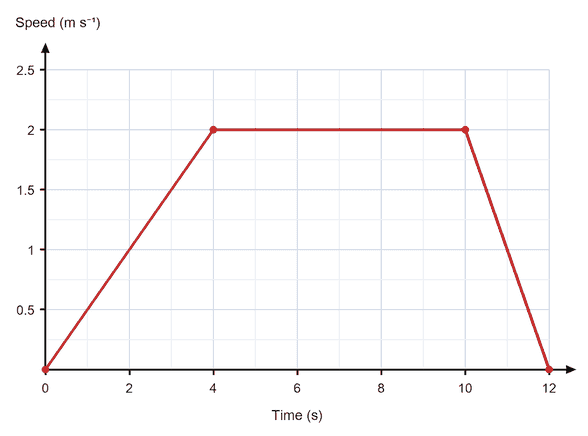
(a) Find the acceleration of the trolley during the first 4 s, and the resultant force on it during this time.
(b) What is the resultant force on the trolley between 4 s and 10 s ? Hence find the force of friction on the trolley.
(c) Take the force of friction to be the same throughout the motion. Find the force with which the porter pushes the trolley during the first 4 s. Then show that friction alone could not have stopped the trolley in the last 2 s, and find the backward pull that the porter must have applied.
- 124 marks
Question 12
Competency: Analysis & Evaluation
Case study: A company tests three cycle helmets, X, Y and Z. In each test a model head of mass 5 kg, wearing the helmet, strikes a hard surface at 6 m s and is brought to rest. The time taken to stop the head is measured. The head is taken to be safe if the average force on it stays below 4000 N.
Helmet Lining Time taken to stop the head X hard plastic only 0.002 s Y thin foam 0.006 s Z thick foam 0.010 s (a) Calculate the change in linear momentum of the head in a test. Is it different for the three helmets ?
(b) Calculate the average force on the head with each helmet.
(c) Which helmet passes the test ? The makers of this helmet advertise, "Our helmet is safe because it reduces the change in momentum of your head." Judge this claim and state the correct reason.
- 134 marks
Question 13
Competency: Analysis & Evaluation
Case study: Riya (mass 40 kg) and Arjun (mass 60 kg) stand at rest, facing each other, on roller skates on a smooth, level floor. Riya pushes Arjun with a steady force of 120 N for 0.5 s. They then move apart. (Neglect friction.)
(a) State the magnitude and direction of the force that acts on Riya during the push. Name the law you have used.
(b) Calculate the acceleration of each of them during the push, and the speed of each at the end of the push.
(c) Afterwards Arjun says, "I moved away more slowly than Riya, so her push on me must have been weaker than my push on her." Judge his statement, giving your reason.
- 144 marks
Question 14
Competency: Application & Creation
Your class wants to find the value of the acceleration due to gravity, , at your school. You are given a long measuring tape, a stopwatch and a small steel ball.
(a) Plan the experiment. State what you will measure, how you will measure it, and the relation you will use to calculate .
(b) In one trial, the ball is dropped from a balcony 7.2 m above the ground, and the average time of fall is 1.2 s. Calculate the value of from these readings.
(c) Suggest two ways of making your result more reliable.
- 154 marks
Question 15
Competency: Analysis & Evaluation
Case study: A robot rover of mass 900 kg is built and tested on the earth and then sent to Mars. The values of the acceleration due to gravity are given below.
Place Acceleration due to gravity Surface of the earth 9.8 m s Surface of Mars 3.7 m s (a) State the mass of the rover on Mars. Calculate its weight on the earth and on Mars.
(b) On Mars, the wheel of the rover knocks a stone off the edge of a cliff 7.4 m high. The stone falls from rest. Find the time it takes to reach the bottom and the speed with which it strikes. (Mars has very little air; neglect its resistance.)
(c) An engineer says, "The rover is much lighter on Mars. So on level ground its motors will need a much smaller force there than on the earth to give it an acceleration of 0.2 m s." Judge this statement with a calculation. (Neglect friction.)
- 161 mark
Question 16
Competency: Understanding
Four observations are listed in the first column and four effects of a force in the second column.
Observation Effect of the force P. A footballer kicks a ball lying on the ground and it starts rolling 4. Change from motion to rest Q. A hockey player flicks a moving ball with her stick and it goes off in a new direction 1. Change in the shape or size of the body R. A potter presses a lump of wet clay and it becomes a bowl 3. Change from rest to motion S. A cyclist pulls the brake levers and the cycle comes to a halt 2. Change in the direction of motion Which option matches every observation with its effect ?
- 171 mark
Question 17
Competency: Analysis
A worker in a godown pushes a crate of mass 20 kg horizontally along a rough floor with a force of 60 N. The crate does not move. (Take m s.) Which statement about the forces on the crate is correct ?
- 181 mark
Question 18
Competency: Analysis
An iron ball is hung from a rigid support by a thread A. A second thread B, of the same kind, is tied to the bottom of the ball, as shown.

Kabir pulls the lower end of thread B downward, first with a slowly increasing pull and then, using a fresh pair of threads, with a sudden hard jerk. Which thread breaks in each case ?
- 191 mark
Question 19
Competency: Analysis
The graph shows how the acceleration of each of two bodies, X and Y, depends on the force applied to it. Both graphs are straight lines through the origin.
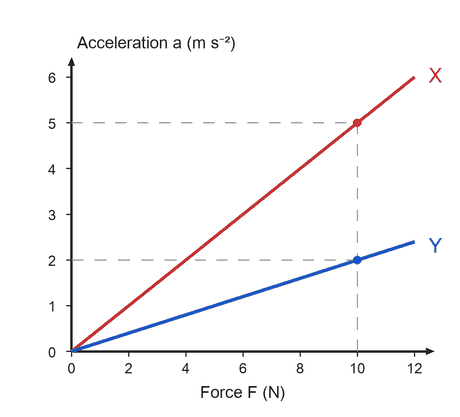
What is the mass of body Y ?
- 201 mark
Question 20
Competency: Analysis
In a computer simulation, a student keeps the masses and of two spheres fixed and changes the distance between their centres. She plots the gravitational force on the vertical axis against on the horizontal axis and gets a straight line through the origin. What does the slope of this line represent ?
- 211 mark
Question 21
Competency: Application
A stone is dropped from rest from the top of a tall sea cliff. Ignore the resistance of air and take m s. The distance the stone falls during the third second of its fall, that is, between s and s, is :
- 221 mark
Question 22
Competency: Analysis
On a smooth glass table a bar magnet of mass 200 g and an iron nail of mass 5 g are placed 3 cm apart. Both are free to move. They are attracted towards each other and move together. Which statement is correct ?
- 231 mark
Question 23
Competency: Application
A vegetable seller's handcart, with its load, has a total mass of 150 kg. It rolls along a level road at 2 m s and the seller stops it with a steady braking force of 150 N, which takes 2 s. On another day the same loaded cart rolls at 4 m s and is stopped with the same steady braking force of 150 N. How long does it take to stop ?
- 241 mark
Question 24
Competency: Understanding
Assertion (A): The universal gravitational constant has the same value on the earth, on the moon and on Jupiter, but the acceleration due to gravity is different on each of them.
Reason (R): The acceleration due to gravity on a planet is , so it depends on the mass and the radius of the planet, while is a constant of nature.
- 251 mark
Question 25
Competency: Analysis
Assertion (A): At the highest point of its path, a ball thrown vertically upwards has zero acceleration.
Reason (R): At the highest point of its path, the velocity of the ball is zero for an instant.
- 262 marks
Question 26
Competency: Understanding
A parachutist and her parachute together have a mass of 70 kg. After the parachute has opened she comes down at a steady speed of 5 m s. (Take m s.)
(a) Name the two forces acting on her and the parachute. State whether each is a contact force or a non-contact force.
(b) Compare the sizes of the two forces and give a reason. Find the force of the air on the parachute.
- 272 marks
Question 27
Competency: Creativity
A school science club plans a race of balloon-powered cars. A light toy car carries an inflated balloon fixed on its top with the mouth of the balloon pointing backward. When the mouth is opened, the car moves forward.
(a) Name the law of motion that explains why the car moves forward, and state the action and the reaction.
(b) Suggest two changes to the car so that it accelerates faster. Give the reason for each, using the laws of motion.
- 282 marks
Question 28
Competency: Analysis
A student pushes a trolley on a smooth, level bench with the same steady force each time. She starts it from rest, pushes for exactly 2.0 s, and measures its speed at the end of the push. She repeats the trial after adding loads, and obtains the readings below.
Total mass of trolley and load Speed at the end of the push 2.0 kg 0.60 m s 3.0 kg 0.40 m s 4.0 kg 0.30 m s (a) Find the product (total mass speed) for each row. What do you notice ?
(b) Use Newton's second law, in terms of linear momentum, to find the force with which she pushes the trolley.
- 292 marks
Question 29
Competency: Application
A cricket ball of mass 0.16 kg and a football of mass 0.40 kg roll along a level lawn, and each has the same linear momentum of 0.80 kg m s. The grass stops each ball with a steady backward force of 0.20 N. (Hypothetical data.)
(a) Find the speed of each ball.
(b) Find the time taken to stop each ball. What do you notice about the two times ?
- 302 marks
Question 30
Competency: Application
A toy cart of mass 1.5 kg stands on a smooth table. A steady force of dyne is applied to it. (1 N dyne.)
(a) Express the force in newton.
(b) Find the acceleration of the cart in m s and in cm s.
(c) Check the value in cm s by using the C.G.S. units of force and mass directly.
- 312 marks
Question 31
Competency: Evaluation
A marble lies on the smooth floor of a bus moving steadily along a straight road at 10 m s, and it stays at rest relative to the floor. The driver suddenly applies the brakes and the marble moves towards the front of the bus. Rohan says, "A force pushed the marble forward."
(a) Is Rohan right ? Give your reason.
(b) How does the marble move relative to the road during the braking ? (Neglect friction on the marble.)
- 323 marks
Question 32
Competency: Application
A carpenter finds that the iron head of her hammer is loose on its wooden handle. She holds the hammer upright with the head at the top, and bangs the lower end of the handle on the ground a few times. The head becomes tight.
(a) Explain, using the idea of inertia, why the head becomes tight.
(b) She has two hammers with heads of mass 0.5 kg and 1.0 kg. Each head is swung at 4 m s and is stopped by the nail in 0.005 s. Find the average force on the nail from each head. (Hypothetical data.) Which hammer drives the nail better ?
- 333 marks
Question 33
Competency: Application
The gravitational force with which the earth attracts the moon is about N. The mass of the earth is kg and the mass of the moon is kg.
(a) State the force with which the moon attracts the earth, with its direction, and name the law you used.
(b) Find the acceleration of the moon and of the earth caused by this force.
(c) How many times is the acceleration of the moon greater than that of the earth ? How is this related to the masses ?
- 343 marks
Question 34
Competency: Application
In a physics class, a student says, "The unit of linear momentum can also be written as N s."
(a) Show, using the definition of the newton, that N s and kg m s are the same unit.
(b) A gas thruster on a space-walking astronaut of mass 60 kg, who is initially at rest, pushes her with a steady force of 12 N for 5 s. Find the momentum she gains in N s and in kg m s, and her speed afterwards. (Hypothetical data.)
- 353 marks
Question 35
Competency: Analysis
A drone of mass 1.2 kg is tested in four situations. The lift force is the upward force on the drone from its rotors. Take m s and neglect the resistance of air.
Situation Motion of the drone Lift force A hovering at one spot ? B climbing straight up at a steady 3 m s ? C speeding up while climbing 15 N D speeding up while moving down 9 N (a) Find the lift force in A and B, and name the law of motion you used.
(b) Find the acceleration of the drone in C and in D, giving the direction in each case.
- 363 marks
Question 36
Competency: Evaluation
A bathroom scale is marked in kg. Priya, whose mass is 40 kg, stands on it on the earth and it reads 40 kg. Take the acceleration due to gravity as m s on the earth and m s on the moon.
(a) What does a spring scale like this actually measure, the mass or the weight of the body on it ?
(b) What would the scale read if Priya stood on it on the moon ?
(c) Priya says, "The scale shows my mass, so a beam balance, which compares masses, would also read 6.4 kg on the moon." Judge her statement.
- 374 marks
Question 37
Competency: Analysis
Case study: In a warehouse, a robot cart of mass 5 kg carries small parcels along a straight, level track with very little friction. A sensor on the cart records its linear momentum every moment, and the readings are drawn as the graph below. The cart starts from rest, is driven forward for a while, then runs freely, and finally a brake is applied until the sensor stops recording.
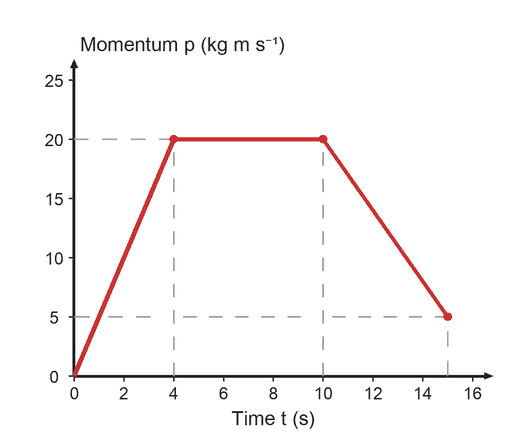
(a) Find the force on the cart during the first 4 s.
(b) What is the force on the cart from 4 s to 10 s ? Find the speed of the cart then, and say what kind of motion this is.
(c) Find the magnitude and direction of the force during the braking from 10 s to 15 s, and the speed of the cart at 15 s.
- 384 marks
Question 38
Competency: Application
Case study: On a farm, a tractor pulls two trolleys, P and Q, along a level, hard track. Trolley P (mass 1000 kg) is behind the tractor and trolley Q (mass 2000 kg) is joined to the back of P by a chain. The hook of the tractor pulls P forward with a steady force of 1500 N. Friction can be neglected. The chain between P and Q can bear a pull of at most 1100 N without breaking. (Hypothetical data.)
(a) Find the acceleration of the trolleys.
(b) Find the tension in the chain between P and Q.
(c) The farmer now loads sacks on Q so that its mass becomes 4000 kg, and the tractor again pulls P with 1500 N. Will the chain break ? Support your answer by calculation, and find the largest pull on P that the chain can safely carry with this load.
- 395 marks
Question 39
Competency: Analysis
Case study: In a laboratory, Neha pulls a wooden block along a level table with a spring balance and uses a motion sensor to measure the acceleration of the block for different readings of the balance. The table is rough, and the friction on the block while it is sliding is constant. She does not know the mass of the block. Her results are shown below.
Pull on the block (N) 2 3 5 7 9 Acceleration (m s) 0 0 1.0 2.0 3.0 (a) For the pulls of 2 N and 3 N the block does not move. What is the force of friction in each case ? Name the law you used.
(b) Use the readings for the pulls of 5 N and 7 N to find the mass of the block.
(c) Find the force of friction on the block when it is sliding, and predict the acceleration for a pull of 12 N.
- 404 marks
Question 40
Competency: Evaluation
Case study: A small pond boat of mass 240 kg has a water-jet drive. A pump sucks in still water and throws it out backward, so that the water leaves the boat with the speed shown. The boatman can choose one of three pump settings. In the table, "water thrown out" is the mass of water that leaves the boat each second. Neglect the resistance of the water and the air, and take the boat to be just starting from rest, so each speed is measured relative to the still pond. (Hypothetical data.)
Setting Water thrown out each second Speed of the water 1 8 kg 4 m s 2 12 kg 5 m s 3 16 kg 6 m s (a) For setting 2, find the momentum that the water gains each second, and hence the force that the boat exerts on the water.
(b) State the force on the boat and its direction. Which law of motion do you use ? Find the starting acceleration of the boat at setting 3.
(c) The boatman says that setting 2 is enough to give the boat an acceleration of 0.3 m s. Is he right ? Which is the lowest setting that will do ?