Solution:
Concept: For uniform acceleration a, with initial velocity u, final velocity v, time t and distance S: v=u+at, S=ut+21at2 and v2=u2+2aS. Take upwards as positive, so the acceleration is −g.
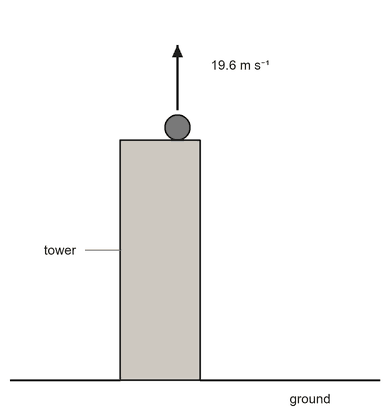
Given: u=19.6 m s−1 upwards, t=5 s, g=9.8 m s−2.
Step 1 — (i) Find the displacement in 5 s.
We use S=ut+21at2, with u = +19.6 m s−1, and a = −9.8 m s−2.
S=19.6×5−21×9.8×52=98−122.5=−24.5 m
Step 2 — Read the height of the tower.
The minus sign means the ball ends 24.5 m below the top of the tower, that is at the ground. So the tower is 24.5 m high.
Step 3 — (ii) Find the final velocity.
We use v=u+at.
v=19.6−9.8×5=19.6−49=−29.4 m s−1
The minus sign shows the velocity is downwards.
Watch out: Keep the signs: the upward throw and the downward acceleration have opposite signs.
Therefore, (i) the tower is 24.5 m high and (ii) the ball reaches the ground at 29.4 m s−1, downwards.