
Question 974 marksEasy
Fig. 3.11 shows the velocity-time graph of a particle of mass 100 g moving in a straight line. Calculate the force acting on the particle.
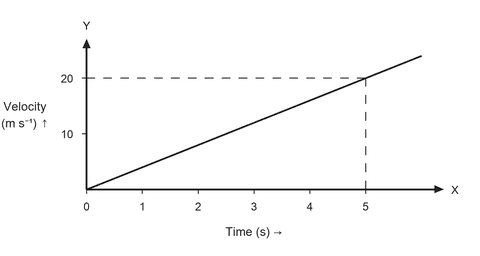
(Hint : Acceleration = slope of v–t graph)
Confirming your payment
Sign up now and get 250 free tokens.
Laws of Motion · Question 97 of 190
Fig. 3.11 shows the velocity-time graph of a particle of mass 100 g moving in a straight line. Calculate the force acting on the particle.
(Hint : Acceleration = slope of v–t graph)
Solution:
Concept: The slope of a velocity-time graph gives the acceleration. For a body of constant mass , the second law gives , where is the acceleration. So : the acceleration is directly proportional to the force and inversely proportional to the mass.
Given: g; the v–t graph in Fig. 3.11.
Step 1 — Read the graph.
The graph is a straight line from zero velocity at the start to 20 m s after 5 s, so the acceleration is uniform.
Step 2 — Find the acceleration from the slope.
The slope is the change in velocity divided by the change in time.
Step 3 — Change the mass to kg.
100 g is 0.1 kg.
Step 4 — Find the force.
We multiply the mass by the acceleration.
Watch out: Change 100 g to 0.1 kg before multiplying; using 100 would give 400 N.
Therefore, the force acting on the particle is 0.4 N.