Solution:
Concept: A stretched string pulls on each body tied to its ends. This pull along the string is called the tension T. A spring that is stretched or compressed exerts a restoring (elastic) force that tries to bring it back to its natural length: a compressed spring pushes outwards and a stretched spring pulls inwards. A body pressing on a surface is pushed back by the surface. This push, at right angles (normal) to the surface of contact, is called the normal reaction R.
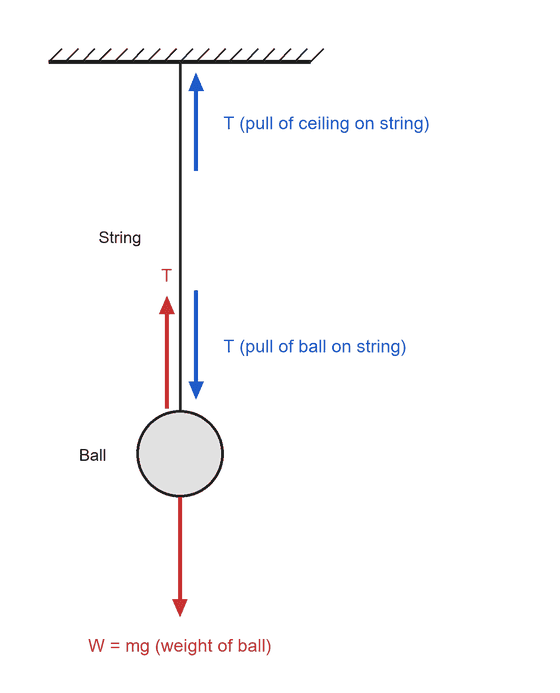
(a) Ball hanging by a string
Step 1 — Forces on the ball.
The earth pulls the ball downwards with its weight W, equal to mg. The string pulls the ball upwards with the tension T. The ball is at rest, so T equals W.
Step 2 — Forces on the string.
At its lower end the ball pulls the string downwards with a force T. At its upper end the ceiling pulls the string upwards with an equal force T. These two equal and opposite pulls keep the string taut.
(b) Spring compressed against a rigid wall
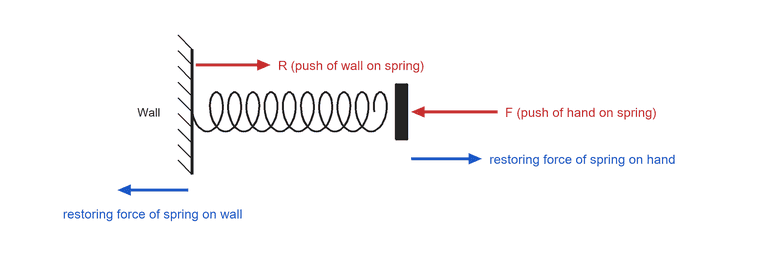
Step 3 — Forces on the spring.
The hand pushes the free end of the spring towards the wall with a force F. The wall pushes the other end away from the wall with the reaction R, equal to F.
Step 4 — Restoring forces of the spring.
The compressed spring tries to regain its natural length, so it pushes outwards on both the hand and the wall with its restoring force.
(c) Wooden block on a table top
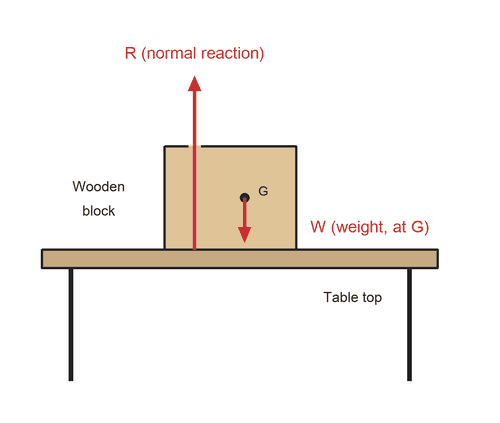
Step 5 — Name the forces.
Two forces act on the block: its weight W, acting vertically downwards at its centre of gravity G, and the normal reaction R of the table, acting vertically upwards at the surface of contact.
Step 6 — Compare the forces.
The block is at rest, so R and W are equal and opposite.
Watch out: Draw each force from the point where it acts on the body named in the question, and do not mix up the forces on the ball with the forces on the string.
Therefore, (a) the ball has W down and T up, and the string has T down and T up; (b) the spring has F towards the wall and R away from it, while its restoring force pushes outwards; (c) the block has W down at G and R up at the surface of contact.
