
Opening your dashboard
Class 9 Maths Chapter 21: Solids Solutions
43 textbook questions with step-by-step answers, free to read, for ICSE 2026-27.
Get talked through Ch 21, not just shown the answer
Reading a finished solution is not the same as being able to do it. The AI tutor takes one question at a time and works it with you, in your own words, until you can.
- Ask it out loud, in your own words
- It gives you the next step, not the answer
- Stuck on part (ii)? Start there
43 questions with solutions
1–3 marks · Mixed difficulty
The first 38 solutions are on this page. This chapter is a long one, so the rest open on their own page to keep this one quick to load.
- 11 mark
Question 1
The area of a square on the diagonal of a cube is 48 cm². Each edge of the cube is :
Solve with AIAnswer
(A) 2 cm
- Correct
(B) 4 cm
(C) 6 cm
(D) 8 cm
Answer: (B) 4 cm
Concept: A cube is a cuboid whose length, breadth and height are all equal to its edge . So its volume is , its total surface area is (six equal square faces) and its diagonal is .
Step 1 — Find the diagonal of the cube.
Let each edge be cm. The diagonal of a cube joins opposite corners through the inside. By Pythagoras' theorem used twice, its square is the sum of the squares of the three edges.
Step 2 — Use the area of the square on the diagonal.
A square on the diagonal has the diagonal as its side, so its area is . This area is 48 cm².
An edge is a length, so we take the positive square root: each edge is 4 cm.
Watch out: The diagonal of the cube is , not the face diagonal .
Why the other options are wrong:
- (A) 2 cm: An edge of 2 cm gives a square of area cm², not 48 cm².
- (C) 6 cm: An edge of 6 cm gives a square of area cm².
- (D) 8 cm: An edge of 8 cm gives a square of area cm².
Therefore, each edge of the cube is 4 cm, option (B).
- 21 mark
Question 2
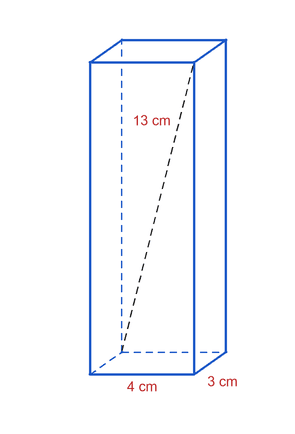
A cuboid has length = 4 cm, breadth = 3 cm and diagonal = 13 cm. The volume of the cube is :
 Solve with AI
Answer
(A) 156 cm³
(B) 288 cm³
- Correct
(C) 144 cm³
(D) 78 cm³
Answer: (C) 144 cm³
Concept: For a cuboid of length , breadth and height : volume , total surface area , and the diagonal (the longest rod that fits) .
Step 1 — Find the height from the diagonal.
Let the height be cm. The diagonal of a cuboid is , so its square is the sum of the three squares.
So the height is 12 cm.
Step 2 — Find the volume.
The volume of a cuboid is length × breadth × height.
So the volume is 144 cm³.
Watch out: The 13 cm is the diagonal, not the height; find the height first.
Note: The stem says "the volume of the cube"; the solid described is the cuboid, so we find the cuboid's volume.
Why the other options are wrong:
- (A) 156 cm³: 156 is , which wrongly uses the diagonal as the height.
- (B) 288 cm³: 288 is twice the correct volume of 144 cm³.
- (D) 78 cm³: 78 is half of , so it also uses the diagonal as the height.
Therefore, the volume is 144 cm³, option (C).
- 31 mark
Question 3
A cuboid with dimensions 12 cm × 9 cm × 2 cm is made of a metal. It is melted and recast into a solid cube. The edge of the cube is :
Solve with AIAnswer
- Correct
(A) 6 cm
(B) 12 cm
(C) 15 cm
(D) 8 cm
Answer: (A) 6 cm
Concept: When a solid is melted and recast into another shape, no metal is lost or gained, so the volume stays the same.
Step 1 — Find the volume of metal.
The volume of the cuboid is length × breadth × height.
So there is 216 cm³ of metal.
Step 2 — Find the edge of the cube.
The cube has the same volume, so . We look for the number whose cube is 216.
So each edge of the cube is 6 cm.
Watch out: Take the cube root of the volume, not the square root or a third of it.
Why the other options are wrong:
- (B) 12 cm: A 12 cm cube has volume cm³, far more than 216 cm³.
- (C) 15 cm: A 15 cm cube has volume cm³.
- (D) 8 cm: An 8 cm cube has volume cm³.
Therefore, the edge of the cube is 6 cm, option (A).
- 41 mark
Question 4
The dimensional ratio of a cuboid is 3 : 2 : 1. If its volume is 1296 cm³; the actual dimensions of the cuboid are :
Solve with AIAnswer
(A) 12 cm, 12 cm and 8 cm
(B) 8 cm, 8 cm and 12 cm
(C) 12 cm, 12 cm and 12 cm
- Correct
(D) 18 cm, 12 cm and 6 cm
Answer: (D) 18 cm, 12 cm and 6 cm
Concept: When quantities are in a ratio , write them as , and for one unknown . The volume of a cuboid is length × breadth × height.
Step 1 — Write the dimensions with one unknown.
The ratio is 3 : 2 : 1, so we take the dimensions as , and cm.
Step 2 — Use the volume.
The volume is the product of the three dimensions.
Step 3 — Write the dimensions.
We put into , and .
So the dimensions are 18 cm, 12 cm and 6 cm.
Watch out: Find from , not from .
Why the other options are wrong:
- (A) 12 cm, 12 cm and 8 cm: 12, 12 and 8 are not in the ratio 3 : 2 : 1, and their product is 1152, not 1296.
- (B) 8 cm, 8 cm and 12 cm: 8, 8 and 12 are not in the ratio 3 : 2 : 1, and their product is 768.
- (C) 12 cm, 12 cm and 12 cm: Three equal sides are in the ratio 1 : 1 : 1, and the volume would be 1728 cm³.
Therefore, the dimensions are 18 cm, 12 cm and 6 cm, option (D).
- 51 mark
Question 5
A tank with dimensions 12 m, 10 m and 8 m is dug and the soil taken out of it is spread uniformly on a field of length = 40 m and breadth = 32 m. The rise in level of the field is :
Solve with AIAnswer
(A) 7·5 m
(B) 7·5 cm
- Correct
(C) 75 cm
(D) 75 m
Answer: (C) 75 cm
Concept: Soil dug out and spread evenly keeps its volume: volume of soil = area of the field × rise in level.
Step 1 — Find the volume of soil dug out.
The soil fills the shape of the tank, so its volume is the tank's volume.
So 960 m³ of soil is taken out.
Step 2 — Find the area of the field.
The field is a rectangle.
So the area is 1280 m².
Step 3 — Find the rise in level.
Spread evenly, the soil forms a thin cuboid on the field, so its height is volume ÷ area.
So the level rises by 0.75 m. Since 1 m = 100 cm, this is 75 cm.
Watch out: Change 0.75 m to centimetres by multiplying by 100.
Why the other options are wrong:
- (A) 7·5 m: 7.5 m is ten times the correct rise of 0.75 m.
- (B) 7·5 cm: 7.5 cm is one-tenth of the correct rise of 75 cm.
- (D) 75 m: 75 m is 100 times the correct rise of 0.75 m.
Therefore, the level of the field rises by 75 cm, option (C).
- 61 mark
Question 6
Through the pipe of uniform cross-section (12 cm²) water flows with the speed of 20 cm/s. The volume of water that flows in 1 minute is :
Solve with AIAnswer
- Correct
(A) 0·0144 m³
(B) 0·144 m³
(C) 144 cm³
(D) 240 cm³
Answer: (A) 0·0144 m³
Concept: Water flowing through a pipe fills, every second, a column whose base is the cross-section of the pipe and whose length is the distance the water moves in that second. So volume per second = area of cross-section × speed, with both in the same units. Useful conversions: 1 m = 100 cm, so 1 m² = 10,000 cm² and 1 m³ = 10,00,000 cm³; 1 litre = 1,000 cm³ and 1 m³ = 1,000 litres.
Step 1 — Find the flow in one second.
In one second the water moves 20 cm along the pipe, so it fills a column 12 cm² in area and 20 cm long.
So 240 cm³ flows each second.
Step 2 — Find the flow in one minute.
One minute is 60 seconds.
So 14,400 cm³ flows in one minute.
Step 3 — Change to cubic metres.
Since 1 m³ = 10,00,000 cm³, we divide by 10,00,000.
So the volume is 0.0144 m³.
Watch out: 1 m³ is 10,00,000 cm³, not 1,000 cm³ or 10,000 cm³.
Why the other options are wrong:
- (B) 0·144 m³: 0.144 m³ is ten times the correct volume.
- (C) 144 cm³: 144 cm³ is only one-hundredth of the 14,400 cm³ that flows.
- (D) 240 cm³: 240 cm³ flows in one second, not in one minute.
Therefore, the volume of water that flows in 1 minute is 0.0144 m³, option (A).
- 71 mark
Question 7
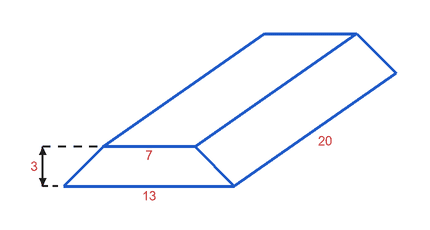
In the given figure, all the dimensions are given in cm. The volume of the solid is :
 Solve with AI
Answer
(A) 7 cm × 13 cm × 20 cm
(B) (7 + 13) × 20 × 3 cm³
(C) (7 + 13) × 3 × 20 cm³
- Correct
(D) (7 + 13) × 3 × 20 cm³
Answer: (D) (7 + 13) × 3 × 20 cm³
Concept: A solid of uniform cross-section (a prism) has the same cross-section all along its length. Its volume is area of the cross-section × length.
Step 1 — Identify the cross-section.
The solid has the same trapezium at every point along its 20 cm length. The trapezium has parallel sides 7 cm and 13 cm, and the distance between them is 3 cm.
Step 2 — Find the area of the trapezium.
The area of a trapezium is × (sum of the parallel sides) × (distance between them).
So the cross-section is 30 cm².
Step 3 — Find the volume.
We multiply the area of the cross-section by the length.
This is option (D), which equals 600 cm³.
Watch out: The area of a trapezium needs the factor .
Why the other options are wrong:
- (A) 7 cm × 13 cm × 20 cm: It multiplies the two parallel sides and the length; is not the area of the trapezium.
- (B) (7 + 13) × 20 × 3 cm³: It leaves out the , so it gives 1200 cm³, twice the volume.
- (C) (7 + 13) × 3 × 20 cm³: It uses instead of , so it gives 300 cm³, half the volume.
Therefore, the volume of the solid is (7 + 13) × 3 × 20 cm³, option (D).
- 83 marks
Question 8
The length, breadth and height of a rectangular solid are in the ratio 5 : 4 : 2. If the total surface area is 1216 cm², find the length, the breadth and the height of the solid.
Solve with AIWritten solution
Solution:
Concept: For a cuboid of length , breadth and height : volume , total surface area , and the diagonal (the longest rod that fits) .
Given: Length : breadth : height = 5 : 4 : 2, total surface area = 1216 cm².
Step 1 — Write the dimensions with one unknown.
The ratio is 5 : 4 : 2, so we take length , breadth and height cm.
Step 2 — Write the total surface area.
We put the three dimensions into the formula for the total surface area.
Step 3 — Solve for x.
The total surface area is 1216 cm².
A length is positive, so .
Step 4 — Find the dimensions.
We multiply 4 by 5, 4 and 2.
Watch out: Each pair of faces is counted twice, so do not forget the 2 in front of the bracket.
Therefore, the length is 20 cm, the breadth is 16 cm and the height is 8 cm.
- 93 marks
Question 9
The volume of a cube is 729 cm³. Find its total surface area.
Solve with AIWritten solution
Solution:
Concept: A cube is a cuboid whose length, breadth and height are all equal to its edge . So its volume is , its total surface area is (six equal square faces) and its diagonal is .
Given: Volume of the cube = 729 cm³.
Step 1 — Find the edge.
Let the edge be cm. The volume of a cube is , so we need the number whose cube is 729.
So the edge is 9 cm.
Step 2 — Find the total surface area.
A cube has six equal square faces, each of area 9 × 9 cm².
Watch out: Find the edge first; 6 × 729 is not the surface area.
Therefore, the total surface area of the cube is 486 cm².
- 103 marks
Question 10
The dimensions of a Cinema Hall are 100 m, 60 m and 15 m. How many persons can sit in the hall, if each requires 150 m³ of air ?
Solve with AIWritten solution
Solution:
Concept: The volume of a cuboid is length × breadth × height. Number of persons = total air ÷ air for one person.
Given: Hall 100 m × 60 m × 15 m; air for each person = 150 m³.
Step 1 — Find the volume of the hall.
The hall is a cuboid.
So the hall holds 90,000 m³ of air.
Step 2 — Find the number of persons.
Each person needs 150 m³, so we divide the volume by 150.
Therefore, 600 persons can sit in the hall.
- 113 marks
Question 11
75 persons can sleep in a room 25 m by 9·6 m. If each person requires 16 m³ of air; find the height of the room.
Solve with AIWritten solution
Solution:
Concept: The volume of a room (a cuboid) is floor area × height.
Given: 75 persons, 16 m³ of air each, floor 25 m by 9.6 m.
Step 1 — Find the volume of the room.
Each of the 75 persons needs 16 m³ of air, so the room holds their total.
So the volume of the room is 1200 m³.
Step 2 — Find the floor area.
The floor is a rectangle 25 m by 9.6 m.
Step 3 — Find the height.
Volume = floor area × height, so height = volume ÷ floor area.
Therefore, the height of the room is 5 m.
- 123 marks
Question 12
The edges of three cubes of metal are 3 cm, 4 cm and 5 cm. They are melted and formed into a single cube. Find the edge of the new cube.
Solve with AIWritten solution
Solution:
Concept: When a solid is melted and recast into another shape, no metal is lost or gained, so the volume stays the same. The volume of a cube of edge is .
Given: Edges 3 cm, 4 cm and 5 cm.
Step 1 — Add the volumes.
Melting does not change the volume, so the new cube's volume is the sum of the three cubes' volumes.
So the new cube has volume 216 cm³.
Step 2 — Find the edge.
We need the number whose cube is 216.
Watch out: Add the volumes, not the edges: 3 + 4 + 5 = 12 cm is wrong.
Therefore, the edge of the new cube is 6 cm.
- 133 marks
Question 13
Three cubes, whose edges are cm, 8 cm and 10 cm respectively, are melted and recast into a single cube of edge 12 cm. Find ''.
Solve with AIWritten solution
Solution:
Concept: When a solid is melted and recast into another shape, no metal is lost or gained, so the volume stays the same. The volume of a cube of edge is .
Given: Edges cm, 8 cm, 10 cm; new cube 12 cm.
Step 1 — Equate the volumes.
No metal is lost, so the three volumes add up to the volume of the new cube.
Step 2 — State x.
The only number whose cube is 216 is 6, so .
Therefore, .
- 143 marks
Question 14
Three equal cubes are placed adjacently in a row.
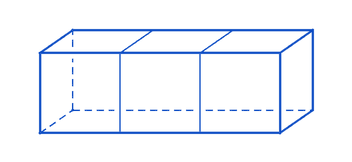
Find the ratio of the total surface area of the resulting cuboid to that of the sum of the total surface areas of the three cubes.
Solve with AIWritten solution
Solution:
Concept: For a cuboid of length , breadth and height : volume , total surface area , and the diagonal (the longest rod that fits) . A cube is a cuboid whose length, breadth and height are all equal to its edge . So its volume is , its total surface area is (six equal square faces) and its diagonal is .
Step 1 — Describe the cuboid.
Let each cube have edge . Three cubes in a row make a cuboid long, broad and high.
Step 2 — Find the T.S.A. of the cuboid.
We use 2(lb + bh + hl).
Step 3 — Find the total for three cubes.
Each cube has surface area .
Step 4 — Write the ratio.
We cancel the common factor .
The cuboid has less area because the four faces that touch inside the row are no longer on the outside.
Watch out: Joining the cubes hides the touching faces, so the areas do not simply add.
Therefore, the required ratio is 7 : 9.
- 153 marks
Question 15
The cost of papering the four walls of a room at 75 paise per square metre is ₹ 240. The height of the room is 5 metres. Find the length and the breadth of the room, if they are in the ratio 5 : 3.
Solve with AIWritten solution
Solution:
Concept: The area of the four walls of a room is . Area = total cost ÷ rate.
Given: Cost ₹ 240 at 75 paise per m², height 5 m, length : breadth = 5 : 3.
Step 1 — Find the area of the four walls.
75 paise is ₹ 0.75. The cost is rate × area, so area = cost ÷ rate.
So the four walls have an area of 320 m².
Step 2 — Write the area of the walls.
Take length and breadth m. The four walls, opened out, form a rectangle of length and height .
Step 3 — Solve for x.
This area is 320 m².
Step 4 — Find the length and the breadth.
We multiply 4 by 5 and by 3.
Watch out: Change 75 paise to ₹ 0.75 before dividing.
Therefore, the length is 20 m and the breadth is 12 m.
- 163 marks
Question 16
The area of a playground is 3650 m². Find the cost of covering it with gravel 1·2 cm deep, if the gravel costs ₹ 6·40 per cubic metre.
Solve with AIWritten solution
Solution:
Concept: The volume of a layer is area × depth, with all lengths in the same unit.
Given: Area 3650 m², depth 1.2 cm, rate ₹ 6.40 per m³.
Step 1 — Change the depth to metres.
Since 1 m = 100 cm, a depth of 1.2 cm is 0.012 m.
Step 2 — Find the volume of gravel.
The gravel forms a thin layer: volume = area × depth.
So 43.8 m³ of gravel is needed.
Step 3 — Find the cost.
Each cubic metre costs ₹ 6.40.
So the cost is ₹ 280.32.
Watch out: Change 1.2 cm to metres (0.012 m) before multiplying.
Therefore, the cost of covering the playground with gravel is ₹ 280.32.
- 173 marks
Question 17
A square plate of side '' cm is 8 mm thick. If its volume is 2880 cm³; find the value of .
Solve with AIWritten solution
Solution:
Concept: The volume of a cuboid is length × breadth × height, with all lengths in the same unit.
Given: Square plate of side cm, 8 mm thick, volume 2880 cm³.
Step 1 — Change the thickness to centimetres.
Since 1 cm = 10 mm, a thickness of 8 mm is 0.8 cm.
Step 2 — Write the volume.
The plate is a cuboid cm by cm by 0.8 cm.
A side is positive, so .
Watch out: 8 mm is 0.8 cm, not 8 cm.
Therefore, .
- 183 marks
Question 18
The external dimensions of a closed wooden box are 27 cm, 19 cm and 11 cm. If the thickness of the wood in the box is 1·5 cm; find :
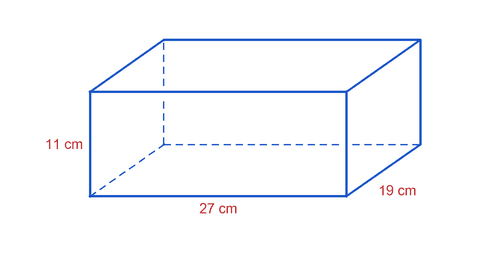
(i) volume of the wood in the box;
(ii) the cost of the box, if wood costs ₹ 1.20 per cm³;
(iii) number of 4 cm cubes that could be placed into the box.
Solve with AIWritten solution
Solution:
Concept: For a cuboid of length , breadth and height : volume , total surface area , and the diagonal (the longest rod that fits) . The wood in a box is external volume − internal volume.
Given: Closed box, external 27 cm × 19 cm × 11 cm, wood 1.5 cm thick, wood at ₹ 1.20 per cm³.
Step 1 — Find the internal dimensions.
The box is closed, so the wood is on both ends of every dimension. Each internal dimension is cm less than the external one.
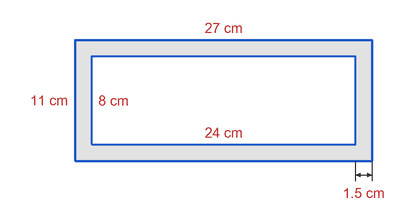
Step 2 — Find the volume of the wood.
The wood fills the space between the outer and inner cuboids.
So (i) the volume of the wood is 2571 cm³.
Step 3 — Find the cost of the box.
Each cm³ of wood costs ₹ 1.20.
So (ii) the box costs ₹ 3,085.20.
Step 4 — Count the 4 cm cubes.
Whole cubes fit along each internal edge, so we divide each internal dimension by 4 and multiply.
Watch out: A closed box loses twice the thickness from every dimension, including the height.
Therefore, (i) the volume of the wood is 2571 cm³; (ii) the box costs ₹ 3,085.20; (iii) 48 cubes of edge 4 cm fit in the box.
- 193 marks
Question 19
A tank 20 m long, 12 m wide and 8 m deep is to be made of iron sheet. It is open at the top.
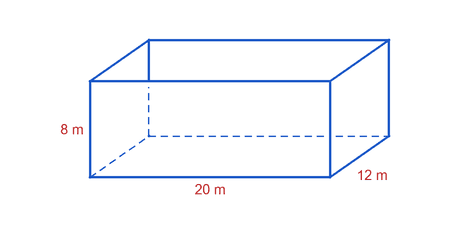
Determine the cost of iron-sheet, at the rate of ₹ 12·50 per metre, if the sheet is 2·5 m wide.
Solve with AIWritten solution
Solution:
Concept: For a tank open at the top, the area to cover is the four walls plus the base . A sheet of fixed width is priced by length: length = area ÷ width.
Given: Tank 20 m × 12 m × 8 m, open at the top; sheet 2.5 m wide at ₹ 12.50 per metre.
Step 1 — Find the area of iron sheet.
The tank is open at the top, so the sheet covers the four walls and the base only.
So 752 m² of sheet is needed.
Step 2 — Find the length of sheet.
The sheet is 2.5 m wide, so its length is area ÷ width.
So 300.8 m of sheet is needed.
Step 3 — Find the cost.
The sheet is sold at ₹ 12.50 per metre of length.
Watch out: The rate is per metre of length, so divide the area by the width first.
Therefore, the cost of the iron sheet is ₹ 3,760.
- 203 marks
Question 20
A closed rectangular box is made of wood of 1·5 cm thickness. The exterior length and breadth are respectively 78 cm and 19 cm, and the capacity of the box is 15 cubic decimetres.

Calculate the exterior height of the box.
Solve with AIWritten solution
Solution:
Concept: The capacity of a box is its internal volume. For a closed box, each internal dimension is the external one minus twice the thickness.
Given: Wood 1.5 cm thick, external length 78 cm, external breadth 19 cm, capacity 15 dm³.
Step 1 — Find the internal length and breadth.
The box is closed and the wood is 1.5 cm thick, so each internal dimension is cm less.
Step 2 — Change the capacity to cm³.
1 dm = 10 cm, so 1 dm³ = 1000 cm³.
Step 3 — Find the internal height.
Capacity is the internal volume, so internal height = capacity ÷ (internal length × breadth).
Step 4 — Find the external height.
We add back the two thicknesses (top and bottom).
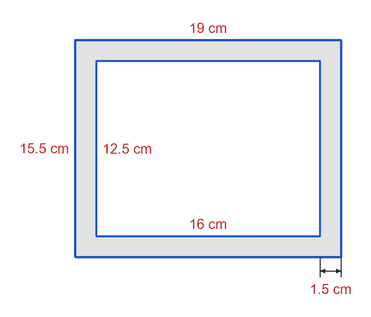
Watch out: Capacity uses the internal dimensions; add the thickness back twice at the end.
Therefore, the exterior height of the box is 15.5 cm.
- 213 marks
Question 21
The square on the diagonal of a cube has an area of 1875 sq. cm. Calculate :
(i) the side of the cube.
(ii) the total surface area of the cube.
Solve with AIWritten solution
Solution:
Concept: A cube is a cuboid whose length, breadth and height are all equal to its edge . So its volume is , its total surface area is (six equal square faces) and its diagonal is .
Given: Area of the square on the diagonal = 1875 cm².
Step 1 — Find the side.
Let the side be cm. The diagonal of a cube is , so the square on it has area .
So (i) the side of the cube is 25 cm.
Step 2 — Find the total surface area.
The six square faces each have area cm².
Watch out: The square on the diagonal has area , not .
Therefore, (i) the side of the cube is 25 cm; (ii) the total surface area is 3,750 cm².
- 223 marks
Question 22
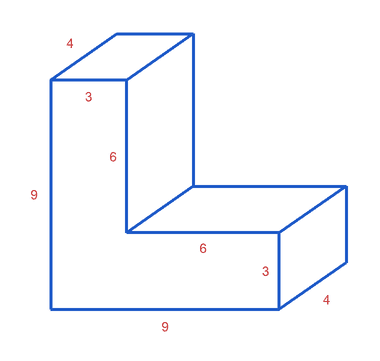
The following figure shows a solid of uniform cross-section. Find the volume of the solid. All measurements are in centimetres.
Assume that all angles in the figure are right angles.
 Solve with AI
Written solution
Solution:
Concept: A solid of uniform cross-section (a prism) has the same cross-section all along its length. Its volume is area of the cross-section × length. An L-shape is split into rectangles to find its area.
Step 1 — Split the cross-section.
The front face is an L-shape. We cut it into two rectangles: the upright part, 3 cm wide and 9 cm high, and the lower part on the right, 6 cm long and 3 cm high (9 − 3 = 6 and 9 − 6 = 3).
Step 2 — Find the area of the cross-section.
We add the areas of the two rectangles.
So the cross-section is 45 cm².
Step 3 — Find the volume.
The solid is 4 cm deep, so we multiply the area by 4.
Watch out: Do not count the corner square twice: the two rectangles must not overlap.
Therefore, the volume of the solid is 180 cm³.
- 233 marks
Question 23
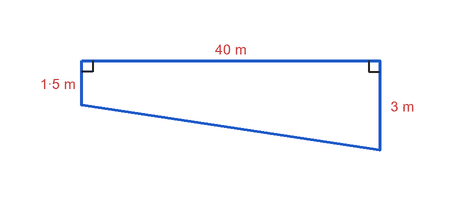
A swimming pool is 40 m long and 15 m wide. Its shallow and deep ends are 1·5 m and 3 m deep respectively. If the bottom of the pool slopes uniformly, find the amount of water in litres required to fill the pool.
 Solve with AI
Written solution
Solution:
Concept: A solid of uniform cross-section (a prism) has the same cross-section all along its length. Its volume is area of the cross-section × length. Useful conversions: 1 m = 100 cm, so 1 m² = 10,000 cm² and 1 m³ = 10,00,000 cm³; 1 litre = 1,000 cm³ and 1 m³ = 1,000 litres.
Given: Pool 40 m long, 15 m wide, depths 1.5 m and 3 m.
Step 1 — Find the area of the side section.
The side of the pool is a trapezium: its parallel sides are the depths 1.5 m and 3 m, and the distance between them is the length 40 m.
So the side section is 90 m².
Step 2 — Find the volume.
The pool is 15 m wide, so the volume is area × width.
Step 3 — Change to litres.
Each cubic metre holds 1000 litres.
Watch out: The parallel sides of the trapezium are the two depths, and the 40 m is the distance between them.
Therefore, 13,50,000 litres of water are needed to fill the pool.
- 243 marks
Question 24
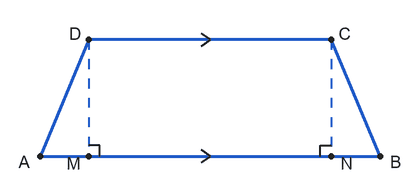
The cross-section of a tunnel perpendicular to its length is a trapezium ABCD as shown in the following figure; also given that :
AM = BN; AB = 7 m; CD = 5 m. The height of the tunnel is 2·4 m. The tunnel is 40 m long. Calculate :
(i) the cost of painting the internal surface of the tunnel (excluding the floor) at the rate of ₹ 5 per m² (sq. metre).
(ii) the cost of paving the floor at the rate of ₹ 18 per m².
Solve with AIWritten solution
Solution:
Concept: The inside surface of a tunnel is its cross-section's perimeter (the parts asked for) × length. Pythagoras' theorem gives a slant side from its horizontal and vertical parts.
Given: AB = 7 m, CD = 5 m, height 2.4 m, AM = BN, length 40 m.
Step 1 — Find AM and BN.
DM and CN are perpendicular to AB, so DCNM is a rectangle. Its opposite sides are equal, so MN is 5 m, the same as DC. Since AM = BN, the rest of AB is shared equally between them.
Step 2 — Find the slant walls.
Triangle AMD has a right angle at M, with AM = 1 m and DM = 2.4 m, so by Pythagoras' theorem:
By symmetry, the other slant wall BC is also 2.6 m.
Step 3 — Find the area to be painted.
The inside surface without the floor is made of the walls AD and BC and the roof DC, each 40 m long.
Step 4 — Find the cost of painting.
The rate is ₹ 5 per m².
So (i) painting costs ₹ 2,040.
Step 5 — Find the cost of paving.
The floor AB is 7 m wide and 40 m long, and the rate is ₹ 18 per m².
So (ii) paving costs ₹ 5,040.
Watch out: The floor AB is not painted, so leave it out of the painted width.
Therefore, (i) the cost of painting is ₹ 2,040; (ii) the cost of paving the floor is ₹ 5,040.
- 253 marks
Question 25
Water is discharged from a pipe of cross-section area 3·2 cm² at the speed of 5m/s. Calculate the volume of water discharged :
(i) in cm³ per sec.
(ii) in litres per minute.
Solve with AIWritten solution
Solution:
Concept: Water flowing through a pipe fills, every second, a column whose base is the cross-section of the pipe and whose length is the distance the water moves in that second. So volume per second = area of cross-section × speed, with both in the same units. Useful conversions: 1 m = 100 cm, so 1 m² = 10,000 cm² and 1 m³ = 10,00,000 cm³; 1 litre = 1,000 cm³ and 1 m³ = 1,000 litres.
Given: Area 3.2 cm², speed 5 m/s.
Step 1 — Change the speed to cm/s.
The area is in cm², so the speed must be in cm/s. Since 1 m = 100 cm:
So the water moves 500 cm each second.
Step 2 — Find the volume per second.
Volume per second = area × speed.
So (i) 1600 cm³ flows each second.
Step 3 — Find the litres per minute.
One minute is 60 seconds, and 1 litre = 1000 cm³.
Watch out: Change 5 m/s to 500 cm/s before multiplying by an area in cm².
Therefore, (i) 1600 cm³ of water is discharged per second; (ii) 96 litres are discharged per minute.
- 263 marks
Question 26
A hose-pipe of cross-section area 2 cm² delivers 1500 litres of water in 5 minutes. What is the speed of water in m/s through the pipe ?
Solve with AIWritten solution
Solution:
Concept: Water flowing through a pipe fills, every second, a column whose base is the cross-section of the pipe and whose length is the distance the water moves in that second. So volume per second = area of cross-section × speed, with both in the same units. Useful conversions: 1 m = 100 cm, so 1 m² = 10,000 cm² and 1 m³ = 10,00,000 cm³; 1 litre = 1,000 cm³ and 1 m³ = 1,000 litres.
Given: Area 2 cm²; 1500 litres in 5 minutes.
Step 1 — Change the volume and time.
Since 1 litre = 1000 cm³, we multiply the litres by 1000. A minute has 60 seconds.
So 15,00,000 cm³ flows in 300 seconds.
Step 2 — Find the flow per second.
We share the volume over 300 seconds.
Step 3 — Find the speed.
Volume per second = area × speed, so speed = volume per second ÷ area.
So the speed is 2500 cm/s. Dividing by 100 changes it to 25 m/s.
Watch out: Work in cm and seconds throughout, then change cm/s to m/s at the end.
Therefore, the speed of the water is 25 m/s.
- 273 marks
Question 27
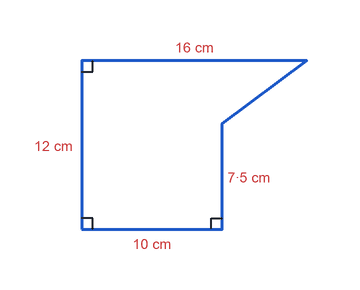
The cross-section of a piece of metal 4 m in length is shown below. Calculate :
(i) the area of the cross-section;
(ii) the volume of the piece of metal in cubic centimetres.
If 1 cubic centimetre of the metal weighs 6·6 g, calculate the weight of the piece of metal to the nearest kg.
Solve with AIWritten solution
Solution:
Concept: A solid of uniform cross-section (a prism) has the same cross-section all along its length. Its volume is area of the cross-section × length. A shape is split into a rectangle and a triangle to find its area.
Given: Metal piece 4 m long; 1 cm³ weighs 6.6 g.
Step 1 — Split the cross-section.
From the figure, the section is a rectangle 10 cm wide and 12 cm high, with a right triangle on its right. The triangle's top side is 16 − 10 = 6 cm and its vertical side is 12 − 7.5 = 4.5 cm.
Step 2 — Find the area of the cross-section.
We add the rectangle and the triangle ( × base × height).
So (i) the area of the cross-section is 133.5 cm².
Step 3 — Find the volume.
The piece is 4 m = 400 cm long.
So (ii) the volume is 53,400 cm³.
Step 4 — Find the weight.
Each cm³ weighs 6.6 g, and 1 kg = 1000 g.
To the nearest kg, this is 352 kg.
Watch out: Change 4 m to 400 cm, because the area is in cm².
Therefore, (i) the area of the cross-section is 133.5 cm²; (ii) the volume is 53,400 cm³; the weight is 352 kg to the nearest kg.
- 283 marks
Question 28
A rectangular water-tank measuring 80 cm × 60 cm × 60 cm is filled from a pipe of cross-sectional area 1·5 cm², the water emerging at 3·2 m/s. How long does it take to fill the tank?
Solve with AIWritten solution
Solution:
Concept: Water flowing through a pipe fills, every second, a column whose base is the cross-section of the pipe and whose length is the distance the water moves in that second. So volume per second = area of cross-section × speed, with both in the same units.
Given: Tank 80 cm × 60 cm × 60 cm, pipe area 1.5 cm², speed 3.2 m/s.
Step 1 — Find the volume of the tank.
The tank is a cuboid.
Step 2 — Find the flow per second.
3.2 m/s is 320 cm/s, and volume per second = area × speed.
Step 3 — Find the time.
Time = volume of the tank ÷ volume per second.
So it takes 600 seconds. Dividing by 60 gives 10 minutes.
Watch out: Change 3.2 m/s to 320 cm/s, because the other lengths are in cm.
Therefore, the tank fills in 10 minutes.
- 293 marks
Question 29
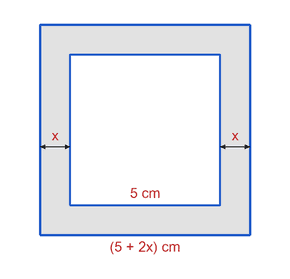
A hollow square-shaped tube open at both ends is made of iron. The internal square is of 5 cm side and the length of the tube is 8 cm.

There are 192 cm³ of iron in this tube. Find its thickness.
Solve with AIWritten solution
Solution:
Concept: The volume of a hollow solid = outer volume − inner (hollow) volume. A wall of thickness adds on both sides, so the outer width is the inner width + .
Given: Inner square side 5 cm, length 8 cm, iron 192 cm³.
Step 1 — Write the external side.
Let the thickness be cm. The iron adds on each side of the 5 cm hole, so the outer square has side cm.
Step 2 — Write the volume of iron.
The iron is the outer square prism minus the inner square hole, both 8 cm long.
Step 3 — Solve for x.
A length is positive, so we take the positive square root.
Watch out: The outer side is , not .
Therefore, the thickness of the iron is 1 cm.
- 303 marks
Question 30
Four identical cubes are joined end to end to form a cuboid.
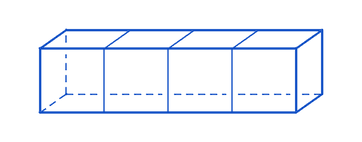
If the total surface area of the resulting cuboid is 648 cm²; find the length of edge of each cube.
Also, find the ratio between the surface area of the resulting cuboid and the surface area of a cube.
Solve with AIWritten solution
Solution:
Concept: For a cuboid of length , breadth and height : volume , total surface area , and the diagonal (the longest rod that fits) . A cube is a cuboid whose length, breadth and height are all equal to its edge . So its volume is , its total surface area is (six equal square faces) and its diagonal is .
Given: Four equal cubes in a row; T.S.A. of the cuboid = 648 cm².
Step 1 — Describe the cuboid.
Let each edge be cm. Four cubes end to end make a cuboid long, broad and high.
Step 2 — Find the edge.
We use the total surface area of the cuboid.
So each edge is 6 cm.
Step 3 — Find the area of one cube.
A cube has six faces of area .
Step 4 — Write the ratio.
We divide both by 216.
So the ratio is 3 : 1.
Watch out: The faces where the cubes touch are not on the outside, so the cuboid has 18 squares of area, not 24.
Therefore, the edge of each cube is 6 cm, and the ratio of the surface areas is 3 : 1.
- 313 marks
Question 31
A rectangular card-board sheet has length 32 cm and breadth 26 cm. Squares each of side 3 cm, are cut from the corners of the sheet and the sides are folded to make a rectangular container.

Find the capacity of the container formed.
Solve with AIWritten solution
Solution:
Concept: Cutting equal squares from the corners and folding up the sides makes an open box: its height is the side of the square, and each base dimension loses twice that side.
Given: Sheet 32 cm × 26 cm, squares of side 3 cm.
Step 1 — Find the base of the container.
A 3 cm square is cut from each corner, so the length and the breadth each lose 3 cm at both ends.
Step 2 — Find the height.
The flaps that fold up are 3 cm wide, so the height is 3 cm.
Step 3 — Find the capacity.
The container is a cuboid.
Watch out: Subtract the 3 cm twice from each side, once for each corner.
Therefore, the capacity of the container is 1560 cm³.
- 323 marks
Question 32
A swimming pool is 18 m long and 8 m wide. Its deep and shallow ends are 2 m and 1·2 m respectively. Find the capacity of the pool, assuming that the bottom of the pool slopes uniformly.
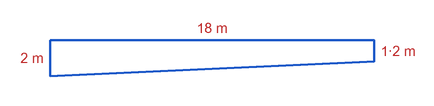 Solve with AI
Written solution
Solution:
Concept: A solid of uniform cross-section (a prism) has the same cross-section all along its length. Its volume is area of the cross-section × length.
Given: Pool 18 m long, 8 m wide, depths 2 m and 1.2 m.
Step 1 — Find the area of the side section.
The side of the pool is a trapezium with parallel sides 2 m and 1.2 m (the depths), 18 m apart.
Step 2 — Find the capacity.
The pool is 8 m wide, so capacity = area × width.
Watch out: The 18 m is the distance between the parallel sides; the 8 m width comes in only at the end.
Therefore, the capacity of the pool is 230.4 m³.
- 333 marks
Question 33
The following figure shows a closed victory-stand whose dimensions are given in cm.
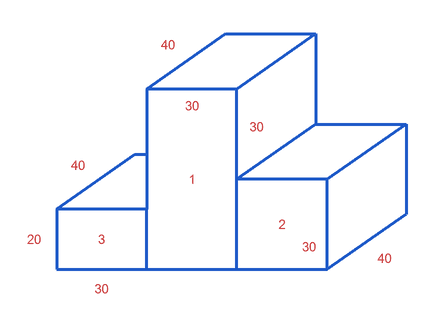
Find the volume and the surface area of the victory stand.
Solve with AIWritten solution
Solution:
Concept: The volume of a solid made of cuboids is the sum of their volumes. Its surface area is the sum of the areas of all the faces that can be seen; faces where two blocks touch are hidden and not counted.
Step 1 — Read the figure.
The stand is three blocks, each 30 cm wide and 40 cm deep. Block 3 is 20 cm high, block 2 is 30 cm high, and block 1 is 30 + 30 = 60 cm high (it rises 30 cm above block 2).
Step 2 — Find the volume.
We add the volumes of the three cuboids, which share the same 30 × 40 base.
Step 3 — Find the front and back.
The front is made of three rectangles 30 cm wide, and the back is the same.
Step 4 — Find the tops.
Each block has a 30 cm by 40 cm top.
Step 5 — Find the side faces.
The ends are block 3's left face (20 cm high) and block 2's right face (30 cm high). Block 1 also shows its sides above the lower blocks: 60 − 20 = 40 cm on the left and 60 − 30 = 30 cm on the right. All are 40 cm deep.
Step 6 — Add the parts.
The base rests on the floor and is left out, as in the book's answer.
Watch out: Do not count the parts of block 1's sides that are covered by blocks 2 and 3.
Note: This follows the book's answer, which leaves out the base the stand rests on. Including the base (90 cm × 40 cm = 3600 cm²) gives 18,600 cm².
Therefore, the volume of the victory stand is 1,32,000 cm³ and its surface area is 15,000 cm².
- 343 marks
Question 34
Each face of a cube has perimeter equal to 32 cm. Find its surface area and its volume.
Solve with AIWritten solution
Solution:
Concept: A cube is a cuboid whose length, breadth and height are all equal to its edge . So its volume is , its total surface area is (six equal square faces) and its diagonal is .
Given: Perimeter of each face = 32 cm.
Step 1 — Find the edge.
Each face is a square with four equal sides, so the edge is the perimeter ÷ 4.
Step 2 — Find the surface area.
A cube has six square faces.
Step 3 — Find the volume.
The volume of a cube is edge³.
Therefore, the surface area is 384 cm² and the volume is 512 cm³.
- 353 marks
Question 35
A school auditorium is 40m long, 30 m broad and 12 m high. If each student requires 1·2 m² of the floor area; find the maximum number of students that can be accomodated in this auditorium. Also, find the volume of air available in the auditorium, for each student.
Solve with AIWritten solution
Solution:
Concept: The number of students is the floor area divided by the floor area one student needs. The air for each student is the volume of the room divided by the number of students.
Given: Auditorium 40 m × 30 m × 12 m; 1.2 m² of floor per student.
Step 1 — Find the floor area.
The floor is a rectangle 40 m by 30 m.
Step 2 — Find the number of students.
Each student needs 1.2 m² of floor.
Step 3 — Find the volume of the auditorium.
The auditorium is a cuboid.
Step 4 — Share the air.
We divide the volume equally among 1000 students.
Watch out: Use the floor area for the number of students, and the volume for the air.
Therefore, at most 1,000 students can be seated, and each gets 14.4 m³ of air.
- 363 marks
Question 36
The internal dimensions of a rectangular box are 12 cm × cm × 9 cm. If the length of the longest rod that can be placed in this box is 17cm; find .
 Solve with AI
Written solution
Solution:
Concept: For a cuboid of length , breadth and height : volume , total surface area , and the diagonal (the longest rod that fits) .
Given: Box 12 cm × cm × 9 cm; longest rod 17 cm.
Step 1 — Use the diagonal.
The longest rod lies along the diagonal of the box, so its length is the diagonal.
Step 2 — State x.
A length is positive, so .
Watch out: The longest rod is the space diagonal, not the diagonal of a face.
Therefore, .
- 373 marks
Question 37
The internal length, breadth and height of a box are 30 cm, 24 cm and 15 cm. Find the largest number of cubes which can be placed inside this box if the edge of each cube is
(i) 3 cm (ii) 4 cm (iii) 5 cm
Solve with AIWritten solution
Solution:
Concept: Cubes are packed in rows along the length, the breadth and the height. Only whole cubes fit along each edge, so the number is the product of the whole-number parts of the three quotients.
Given: Box 30 cm × 24 cm × 15 cm.
Step 1 — Edge 3 cm.
Only whole cubes fit along each edge, so we take the whole-number part of each quotient.
Step 2 — Edge 4 cm.
We divide each edge by 4 and keep only the whole number of cubes.
So only 7 cubes fit along the length.
So only 3 cubes fit along the height.
Step 3 — Edge 5 cm.
We divide each edge by 5 in the same way.
So only 4 cubes fit along the breadth.
Watch out: Do not divide the volumes: is not a whole number of cubes.
Therefore, (i) 400 cubes; (ii) 126 cubes; (iii) 72 cubes.
- 383 marks
Question 38
A rectangular field is 112 m long and 62 m broad. A cubical tank of edge 6 m is dug at each of the four corners of the field and the earth so removed is evenly spread on the remaining field.

Find the rise in level.
Solve with AIWritten solution
Solution:
Concept: Earth spread evenly forms a thin cuboid: its volume = area covered × rise in level.
Given: Field 112 m × 62 m; four cubical tanks of edge 6 m at the corners.
Step 1 — Find the earth dug out.
Each tank is a cube of edge 6 m, and there are four.
Step 2 — Find the area it is spread on.
The tops of the four tanks are holes, so the earth is spread on the field minus four 6 m squares.
Step 3 — Find the rise.
The earth forms a thin layer: rise = volume ÷ area.
In centimetres this is cm.
As a mixed number, is .
Watch out: The earth cannot be spread over the tank openings, so subtract their area.
Therefore, the level of the field rises by cm, about 12.7 cm.
- 393 marks
Question 39
When length of each side of a cube is increased by 3 cm, its volume is increased by 2457 cm³. Find its side. How much will its volume decrease, if length of each side of it is reduced by 20% ?
- 403 marks
Question 40
A rectangular tank 30 cm × 20 cm × 12 cm contains water to a depth of 6 cm. A metal cube of side 10 cm is placed in the tank with its one face resting on the bottom of the tank.

Find the volume of water, in litres, that must be poured in the tank so that the metal cube is just submerged in the water.
- 413 marks
Question 41
The dimensions of a solid metallic cuboid are 72 cm × 30 cm × 75 cm. It is melted and recast into identical solid metal cubes with each of edge 6 cm. Find the number of cubes formed.
Also, find the cost of polishing the surfaces of all the cubes formed at the rate ₹ 150 per sq. m.
- 423 marks
Question 42
The dimensions of a car petrol tank are 50 cm × 32 cm × 24 cm, which is full of petrol. If a car's average consumption is 15 km per litre, find the maximum distance that can be covered by the car.
- 433 marks
Question 43
The dimensions of a rectangular box are in the ratio 4 : 2 : 3. The difference between cost of covering it with paper at ₹ 12 per m² and with paper at the rate of 13.50 per m² is ₹ 1,248. Find the dimensions of the box.
What Class 9 Maths Ch 21 covers
The sections of the chapter, in the order the book takes them. Every question above comes from one of these.
- 01Cuboid
- 02Cube
- 03Cost of an Article
- 04Cross-Section
- 05Flow of Water (or Any Other Liquid)
More ways to study this chapter
The same chapter asked three other ways. Practise it, revise it, and see what the board has set on Ch 21 before.
Class 9 Maths Ch 21 questions students ask
How many questions are there in Class 9 Maths Ch 21?
43 questions. Every one is solved step by step on this page.
Are these Class 9 Maths solutions free?
Yes. Every question and its full working is free to read, with no account needed.
Can I download the Class 9 Maths Ch 21 solutions as a PDF?
There is no PDF to download. Every solution is on this page instead, which means it is searchable, always the current syllabus, and readable on a phone. Use your browser's print option if you want it on paper.