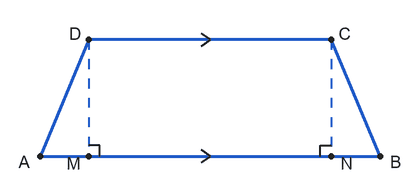
The cross-section of a tunnel perpendicular to its length is a trapezium ABCD as shown in the following figure; also…
Question 243 marksMedium
The cross-section of a tunnel perpendicular to its length is a trapezium ABCD as shown in the following figure; also given that :
AM = BN; AB = 7 m; CD = 5 m. The height of the tunnel is 2·4 m. The tunnel is 40 m long. Calculate :
(i) the cost of painting the internal surface of the tunnel (excluding the floor) at the rate of ₹ 5 per m² (sq. metre).
(ii) the cost of paving the floor at the rate of ₹ 18 per m².
Solution:
Concept: The inside surface of a tunnel is its cross-section's perimeter (the parts asked for) × length. Pythagoras' theorem gives a slant side from its horizontal and vertical parts.
Given: AB = 7 m, CD = 5 m, height 2.4 m, AM = BN, length 40 m.
Step 1 — Find AM and BN.
DM and CN are perpendicular to AB, so DCNM is a rectangle. Its opposite sides are equal, so MN is 5 m, the same as DC. Since AM = BN, the rest of AB is shared equally between them.
AM=27−5=1
Step 2 — Find the slant walls.
Triangle AMD has a right angle at M, with AM = 1 m and DM = 2.4 m, so by Pythagoras' theorem:
AD=12+2.42=1+5.76=6.76=2.6
By symmetry, the other slant wall BC is also 2.6 m.
Step 3 — Find the area to be painted.
The inside surface without the floor is made of the walls AD and BC and the roof DC, each 40 m long.
Width to paint=2.6+5+2.6=10.2Area=10.2×40=408
Step 4 — Find the cost of painting.
The rate is ₹ 5 per m².
Cost=408×5=2040
So (i) painting costs ₹ 2,040.
Step 5 — Find the cost of paving.
The floor AB is 7 m wide and 40 m long, and the rate is ₹ 18 per m².
Floor area=7×40=280Cost=280×18=5040
So (ii) paving costs ₹ 5,040.
Watch out: The floor AB is not painted, so leave it out of the painted width.
Therefore, (i) the cost of painting is ₹ 2,040; (ii) the cost of paving the floor is ₹ 5,040.