
Question 233 marksEasy
A swimming pool is 40 m long and 15 m wide. Its shallow and deep ends are 1·5 m and 3 m deep respectively. If the bottom of the pool slopes uniformly, find the amount of water in litres required to fill the pool.
Confirming your payment
Sign up now and get 250 free tokens.
Solids · Question 23 of 43
A swimming pool is 40 m long and 15 m wide. Its shallow and deep ends are 1·5 m and 3 m deep respectively. If the bottom of the pool slopes uniformly, find the amount of water in litres required to fill the pool.
Solution:
Concept: A solid of uniform cross-section (a prism) has the same cross-section all along its length. Its volume is area of the cross-section × length. Useful conversions: 1 m = 100 cm, so 1 m² = 10,000 cm² and 1 m³ = 10,00,000 cm³; 1 litre = 1,000 cm³ and 1 m³ = 1,000 litres.
Given: Pool 40 m long, 15 m wide, depths 1.5 m and 3 m.
Step 1 — Find the area of the side section.
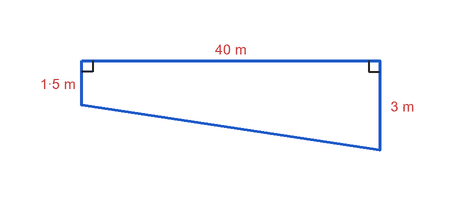
The side of the pool is a trapezium: its parallel sides are the depths 1.5 m and 3 m, and the distance between them is the length 40 m.
So the side section is 90 m².
Step 2 — Find the volume.
The pool is 15 m wide, so the volume is area × width.
Step 3 — Change to litres.
Each cubic metre holds 1000 litres.
Watch out: The parallel sides of the trapezium are the two depths, and the 40 m is the distance between them.
Therefore, 13,50,000 litres of water are needed to fill the pool.