
Opening your dashboard
Class 9 Maths Chapter 21 Solids: Competency-Based Questions (CBQ)
40 questions on Chapter 21, each worked through on its own page with the AI tutor. Class 9 Maths, ICSE 2026-27.
40 questions
1–5 marks · Mixed difficulty
- 11 mark
Question 1
Competency: Understanding
An insulated lunch box is a cuboid. Measured from outside, it is 20 cm long, 15 cm wide and 10 cm high.
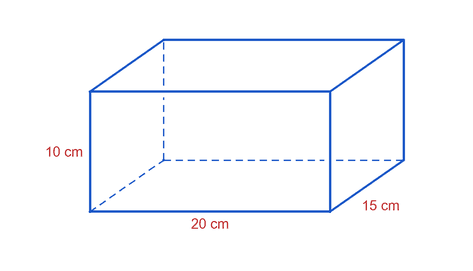
The label says its capacity is 1.8 litres.
The volume of the material used in the walls of the box is
- 21 mark
Question 2
Competency: Application
A glass fish tank is 60 cm long, 30 cm wide and 40 cm high. For the safety of the fish, it is filled only up to 5 cm below the brim.
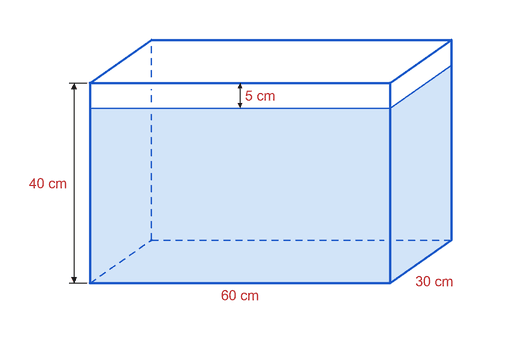
The volume of water in the tank is
- 31 mark
Question 3
Competency: Analysis
A wooden cube of edge 6 cm is painted red on all its faces. It is then cut into 27 equal small cubes.
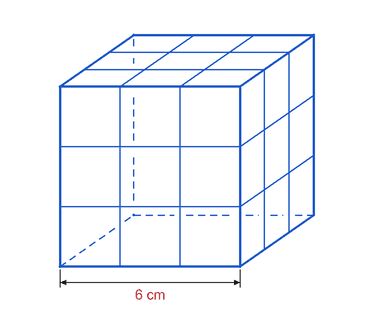
The total area of the faces of the small cubes that are not painted is
- 41 mark
Question 4
Competency: Analysis
Two identical empty tanks are filled by two pipes, each running full.
Pipe P has a cross-section of 4 cm² and the water in it flows at 3 m/s. Pipe Q has a cross-section of 6 cm² and the water in it flows at 2.5 m/s.
Which statement is correct?
- 51 mark
Question 5
Competency: Application
Teak wood is sold at ₹ 45,000 per m³. A carpenter buys a teak beam 4 m long. Its cross-section is a rectangle 20 cm by 15 cm.
The cost of the beam is
- 61 mark
Question 6
Competency: Evaluation
Assertion (A): A tent is 3 m long. Each end of the tent is a triangle of base 2 m and height 1.5 m, and the tent has the same shape all along its length. The tent encloses 4.5 m³ of air.
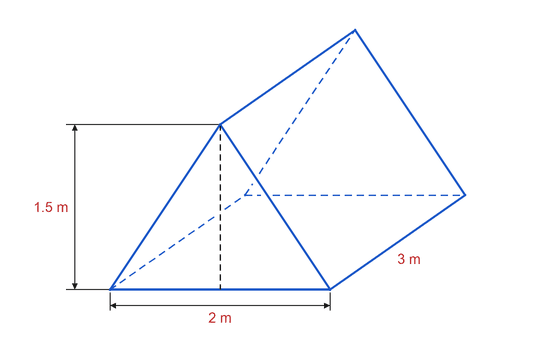
Reason (R): For a solid of uniform cross-section, volume = perimeter of the cross-section × length.
- 72 marks
Question 7
Competency: Evaluation
A shop sells two bars of the same washing soap.
Bar A is a cube of edge 5 cm and costs ₹ 50. Bar B is a cuboid 8 cm × 5 cm × 3 cm and costs ₹ 45.
Meena says, "Bar A is bigger, so it is the better buy." Which bar gives more soap for each rupee? Justify.
- 82 marks
Question 8
Competency: Application
Water stands 20 cm deep in a rectangular tub whose base is 50 cm by 30 cm. Arjun lowers a stone idol into the tub. The idol goes fully under water, no water spills, and the water level rises to 21.2 cm.
Find the volume of the idol.
- 92 marks
Question 9
Competency: Application
A small concrete wedge ramp is built in a skate park. Its cross-section is a right-angled triangle of base 40 cm and height 30 cm. The ramp is 1 m wide.
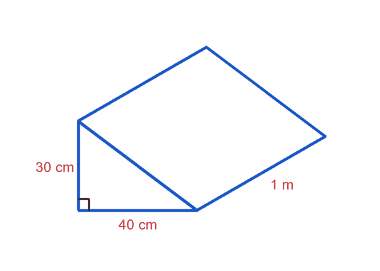
Find (a) the volume of concrete in the ramp, in cm³, and (b) the area of its sloping face.
- 102 marks
Question 10
Competency: Analysis
A full overhead tank is 2 m long, 1.5 m wide and 1 m deep. It is emptied through an outlet pipe in exactly 50 minutes. The water in the pipe flows at a steady 2 m/s.
Work backwards to find the area of cross-section of the pipe, in cm².
- 113 marks
Question 11
Competency: Analysis & Evaluation
The cargo space of a tempo is a cuboid 3 m long, 1.8 m wide and 1.5 m high. It is to be loaded with identical cartons, each 70 cm × 45 cm × 50 cm. Every carton must stand upright on its 70 cm × 45 cm face, and all cartons must face the same way.
The driver divides the volume of the cargo space by the volume of one carton and says, "51 cartons will fit."
(a) Show how the driver got 51.
(b) Find the greatest number of cartons that can really be loaded.
(c) Why is the driver's method not reliable here?
- 123 marks
Question 12
Competency: Creativity
A plumber notes these facts at a house.
- The tank on the roof is a cuboid 2 m long, 1 m wide and 1 m deep, and it is empty.
- The inlet pipe has a cross-section of 4 cm².
- Water flows through the pipe at 2.5 m/s.
Using these facts, frame two questions of your own: one whose answer is a time and one whose answer is a depth of water. Solve both.
- 133 marks
Question 13
Competency: Application & Analysis
A cubical gift box has a total surface area of 1350 cm².
(a) Find the edge of the box.
(b) A ribbon is tied once around the box and then once more around it at right angles to the first round. Each round passes over four faces. A further 25 cm of ribbon is needed for the bow. Find the length of ribbon used.
(c) A sweet box measures 14 cm × 14 cm × 16 cm. Its volume is less than the volume of the gift box. Can it be placed inside the gift box? Give a reason.
- 145 marks
Question 14
Competency: Analysis & Evaluation
Case study — Steps for the school stage
A mason builds a flight of three solid concrete steps leading up to the school stage. The figure shows the cross-section of the steps. All angles are right angles. The steps are 1.2 m wide, and they rest on the ground with the back against the stage wall.
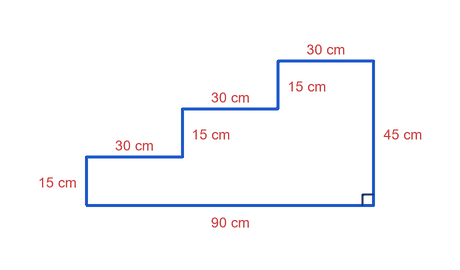
(a) Find the area of the cross-section.
(b) Find the volume of concrete used, in m³, and its cost at ₹ 6,000 per m³.
(c) Tiles are to be laid only on the three flat tops, where people step, and on the three upright front faces of the steps. The mason says, "Tiled area = perimeter of the cross-section × width of the steps." Find the correct tiled area in m², and say what is wrong with the mason's rule here.
- 154 marks
Question 15
Competency: Application & Analysis
Case study — Choosing a pump
A farmer has an empty storage tank 6 m long, 4 m wide and 1.5 m deep. He can hire one of two pumps to fill it. Each pump sends water through its own pipe, which runs full.
Pump Cross-section of pipe Speed of water Hire charge P 10 cm² 2 m/s ₹ 40 per hour Q 12.5 cm² 2.4 m/s ₹ 75 per hour (a) Find the capacity of the tank in litres.
(b) Find how many litres each pump delivers in one minute.
(c) Find the time each pump takes to fill the tank and the hire charge for that time. Which pump costs less, and by how much? Which pump must he hire if the tank has to be full within 4 hours?
- 161 mark
Question 16
Competency: Application
The overhead tank of a housing block has an inside base 2 m long and 1.5 m wide. A float gauge shows the water level as 80 cm in the morning and 65 cm at night. No water was added during the day.
The water used during the day, in litres, is :
- 171 mark
Question 17
Competency: Analysis
Two cubical sweet boxes, P and Q, are wrapped completely in paper. The paper needed for P and Q is in the ratio 4 : 9.
The ratio of the volume of P to the volume of Q is :
- 181 mark
Question 18
Competency: Application
A trench for a water pipe is to be dug along a road. It is 40 m long, 50 cm wide and 1.2 m deep. The digging contractor charges ₹ 85 per m³ of earth removed.
The cost of digging the trench is :
- 191 mark
Question 19
Competency: Application & Analysis
A grain godown is 10 m long. Its cross-section is the same all along the length and is shown in the figure. The walls are 3 m high, the width is 6 m, and the triangular roof rises 2 m above the walls.

The volume enclosed by the godown is :
- 201 mark
Question 20
Competency: Analysis
An empty tank is 3 m long, 2 m wide and 1 m deep. It is filled by an inlet pipe of cross-section 25 cm², in which water flows at 2 m/s. A crack in the tank lets water out through an opening of cross-section 8 cm², where the water leaves at 2.5 m/s. (Hypothetical data.)
The time taken to fill the tank with the crack present is :
- 211 mark
Question 21
Competency: Evaluation
Assertion (A) : A cube of edge 4 cm and a cuboid measuring 8 cm × 4 cm × 2 cm need equal areas of paper to cover them completely.
Reason (R) : The cube and the cuboid have the same volume.
- 221 mark
Question 22
Competency: Analysis
Water flows at 2 m/s through two pipes. Pipe X has a cross-section of 6 cm² and pipe Y has a cross-section of 4 cm².
Assertion (A) : In one minute, pipe X delivers 24 litres more water than pipe Y.
Reason (R) : The volume of water delivered in one second is the area of cross-section times the speed of the water.
- 231 mark
Question 23
Competency: Analysis
A solid cube of wood has edge 5 cm. A small cube of edge 2 cm is cut out of one corner, so the cut-out is a cube that shares three faces with the big cube.
The total surface area of the remaining solid is :
- 241 mark
Question 24
Competency: Analysis
For a certain cube, the number of cubic centimetres in its volume is exactly equal to the number of square centimetres in its total surface area.
The edge of this cube is :
- 251 mark
Question 25
Competency: Application
An empty underground tank of a school is 6 m long, 4 m wide and 1.75 m deep, measured inside. Water tankers bring water, and each tanker carries 12 kilolitres. (1 kilolitre = 1000 litres.)
The least number of tanker loads needed to fill the tank is :
- 262 marks
Question 26
Competency: Analysis
A soap factory packs identical cubical soap cakes in a box. The box is a cuboid 24 cm long, 18 cm wide and 12 cm high inside. It is to be filled completely, with no gaps, by cubes whose edge is a whole number of centimetres, and the edge must be as large as possible.
Find the edge of each cube and the number of cubes in the box.
- 272 marks
Question 27
Competency: Application
A dairy has a milk tank in the shape of a cuboid, 2 m long, 1.2 m wide and 1 m deep inside. The tank is filled to the brim with milk, and all of it is packed in pouches of 500 mL. Each pouch is sold for ₹ 28. (Hypothetical data.)
Find the money the dairy gets from selling all the pouches.
- 282 marks
Question 28
Competency: Application & Analysis
A farmer waters a rectangular plot 20 m long and 15 m wide with a pipe of cross-section 5 cm². The water flows through the pipe at 2.4 m/s, and the pipe runs for 50 minutes. All the water stays on the plot. (Hypothetical data.)
Find the depth of water standing on the plot, in centimetres.
- 292 marks
Question 29
Competency: Analysis & Evaluation
Two metal bars are each 50 cm long. The cross-section of bar A is a square of side 6 cm. The cross-section of bar B is a rectangle 9 cm by 4 cm.
Imran says, "Both cross-sections have the same area, so both bars need the same amount of paint on their four long faces." Is he right? Show your calculation.
- 302 marks
Question 30
Competency: Application & Analysis
A closed water tank in the shape of a cube is painted on the outside, all six faces, at ₹ 45 per m². The painting costs ₹ 1,080. (Hypothetical data.)
Find the capacity of the tank in litres. (Ignore the thickness of the tank.)
- 312 marks
Question 31
Competency: Understanding & Application
A wooden block is a cuboid 20 cm long, 10 cm wide and 6 cm thick. A square hole of side 4 cm is drilled straight through the block, along its 6 cm thickness.
Find the volume of wood that is left.
- 323 marks
Question 32
Competency: Analysis & Evaluation
A crack in a water pipe of a house has an opening of cross-section 0.8 cm². Water escapes through it at 1.5 m/s for 2 hours before the crack is noticed. (Hypothetical data.) A family of 4 uses 135 litres of water per person per day.
(a) Find the number of litres of water wasted.
(b) Find the daily need of the family.
(c) For how many days would the wasted water have met the family's daily need?
- 333 marks
Question 33
Competency: Creativity
A mason must build a straight boundary wall 5 m long, using exactly 1.5 m³ of concrete. The wall is to be 2 m high and to have the same cross-section all along its length.
(a) Find the area of the cross-section of the wall, in cm².
(b) Give the dimensions of one rectangular cross-section and one trapezium cross-section that the mason could use. Show that each uses exactly 1.5 m³.
- 343 marks
Question 34
Competency: Analysis & Evaluation
Rakhi wants to pack straight glass tubes in a closed cubical gift box. The box measures 10 cm along each edge inside. The tubes are 15 cm, 17 cm and 18 cm long.
Which of the three tubes can be placed completely inside the box? Justify your answer.
- 353 marks
Question 35
Competency: Analysis
The areas of the three faces of a cuboid that meet at one corner are 12 cm², 15 cm² and 20 cm². The edges of the cuboid are whole numbers of centimetres.
Find the volume of the cuboid and the length of each edge.
- 363 marks
Question 36
Competency: Evaluation
A tank is 2 m long, 1.5 m wide and 1.2 m deep inside. It is filled through a pipe of cross-section 5 cm², and the water in the pipe flows at 2 m/s. Hira wrote this solution to find the time to fill the empty tank.
Capacity of tank = 2 × 1.5 × 1.2 = 3.6
Water delivered in one second = 5 × 2 = 10
Time = 3.6 ÷ 10 = 0.36 seconds
(a) State the mistake in Hira's solution.
(b) Find the correct time to fill the tank.
- 375 marks
Question 37
Competency: Application & Analysis
Case study: A road-side drain is made of concrete. It is 12 m long and has the same cross-section all along. The figure shows the cross-section, a U-shape with an open channel on top. The channel carries the water.
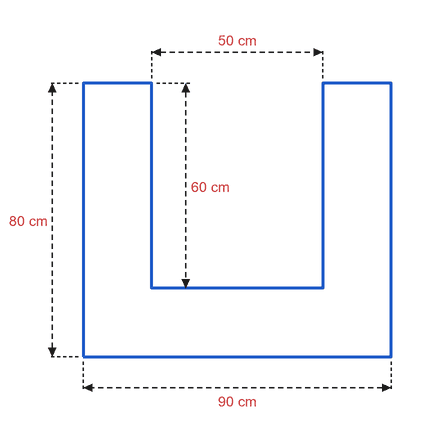
(a) Find the area of the cross-section of the concrete.
(b) Find the volume of concrete used, in m³, and its cost at ₹ 7,500 per m³.
(c) The two inside walls and the floor of the channel are to be plastered at ₹ 45 per m². Find the cost of plastering.
- 384 marks
Question 38
Competency: Analysis & Evaluation
Case study: A rectangular tank is 2.4 m long and 1.5 m wide inside, and 1.2 m deep. A pipe fills it, and nothing is taken out. A student notes the depth of water in the tank every hour. (Hypothetical data.)
Time 8 a.m. 9 a.m. 10 a.m. 11 a.m. Depth of water 15 cm 45 cm 75 cm 105 cm (a) Find the volume of water, in litres, that enters the tank every hour.
(b) The water in the pipe flows at 1.5 m/s. Find the area of cross-section of the pipe, in cm².
(c) At what time will the tank be full, and how many litres will it then hold?
- 395 marks
Question 39
Competency: Analysis & Evaluation
Case study: A classroom is a cuboid 9 m long, 6 m wide and 3.5 m high. It has 2 doors, each 2.1 m by 1 m, and 4 windows, each 1.5 m by 1.2 m. The four walls, without the doors and windows, are to be painted. One litre of paint covers 12 m² for one coat, and two coats are needed. Paint is sold at ₹ 260 per litre, in whole litres. (Hypothetical data.)
(a) Find the area to be painted.
(b) Find the number of litres of paint to be bought and the cost.
(c) The school has air purifiers, each of which cleans 300 m³ of air every hour. A school rule (hypothetical) says the whole air of a classroom must be cleaned at least 4 times every hour. Is one purifier enough for this room? If not, find the least number of purifiers needed.
- 404 marks
Question 40
Competency: Analysis & Evaluation
Case study: A shop sells cubical plastic storage boxes with lids. The table gives the edge and the price of each box. (Hypothetical data.)
Box Edge Price Small 20 cm ₹ 60 Medium 30 cm ₹ 130 Large 40 cm ₹ 240 (a) Find the capacity of each box in litres.
(b) Find the price per litre of capacity for each box, correct to the nearest paisa. Which box gives the most capacity for each rupee?
(c) A grocer needs to store at least 100 litres of rice, using any of these boxes. Find the cheapest way, and its cost.