
Question 143 marksEasy
Three equal cubes are placed adjacently in a row.
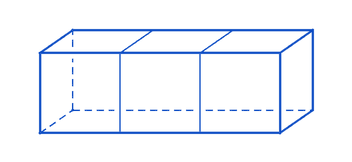
Find the ratio of the total surface area of the resulting cuboid to that of the sum of the total surface areas of the three cubes.
Confirming your payment
Sign up now and get 250 free tokens.
Solids · Question 14 of 43
Three equal cubes are placed adjacently in a row.
Find the ratio of the total surface area of the resulting cuboid to that of the sum of the total surface areas of the three cubes.
Solution:
Concept: For a cuboid of length , breadth and height : volume , total surface area , and the diagonal (the longest rod that fits) . A cube is a cuboid whose length, breadth and height are all equal to its edge . So its volume is , its total surface area is (six equal square faces) and its diagonal is .
Step 1 — Describe the cuboid.
Let each cube have edge . Three cubes in a row make a cuboid long, broad and high.
Step 2 — Find the T.S.A. of the cuboid.
We use 2(lb + bh + hl).
Step 3 — Find the total for three cubes.
Each cube has surface area .
Step 4 — Write the ratio.
We cancel the common factor .
The cuboid has less area because the four faces that touch inside the row are no longer on the outside.
Watch out: Joining the cubes hides the touching faces, so the areas do not simply add.
Therefore, the required ratio is 7 : 9.