Solution:
Concept: A solid of uniform cross-section (a prism) has the same cross-section all along its length. Its volume is area of the cross-section × length. A shape is split into a rectangle and a triangle to find its area.
Given: Metal piece 4 m long; 1 cm³ weighs 6.6 g.
Step 1 — Split the cross-section.
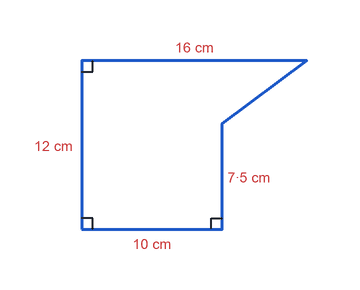
From the figure, the section is a rectangle 10 cm wide and 12 cm high, with a right triangle on its right. The triangle's top side is 16 − 10 = 6 cm and its vertical side is 12 − 7.5 = 4.5 cm.
Step 2 — Find the area of the cross-section.
We add the rectangle and the triangle (21 × base × height).
Area=10×12+21×6×4.5=120+13.5=133.5
So (i) the area of the cross-section is 133.5 cm².
Step 3 — Find the volume.
The piece is 4 m = 400 cm long.
Volume=133.5×400=53,400
So (ii) the volume is 53,400 cm³.
Step 4 — Find the weight.
Each cm³ weighs 6.6 g, and 1 kg = 1000 g.
Weight=53,400×6.6=3,52,440
In kg=10003,52,440=352.44
To the nearest kg, this is 352 kg.
Watch out: Change 4 m to 400 cm, because the area is in cm².
Therefore, (i) the area of the cross-section is 133.5 cm²; (ii) the volume is 53,400 cm³; the weight is 352 kg to the nearest kg.