
Opening your dashboard
Class 7 Physics Chapter 1: Physical Quantities and Measurement Solutions
70 textbook questions with step-by-step answers, free to read, for ICSE 2026-27.
Get talked through Ch 1, not just shown the answer
Reading a finished solution is not the same as being able to do it. The AI tutor takes one question at a time and works it with you, in your own words, until you can.
- Ask it out loud, in your own words
- It gives you the next step, not the answer
- Stuck on part (ii)? Start there
70 questions with solutions
1–4 marks · Mixed difficulty
The first 34 solutions are on this page. This chapter is a long one, so the rest open on their own page to keep this one quick to load.
- 11 mark
Question 1
One litre is equal to :
Solve with AIAnswer
(A) 1 cm
(B) 1 m
(C) cm
- Correct
(D) m
Answer: (D) m
Concept: Volume is the space occupied by an object. Its S.I. unit is the cubic metre (m), the volume of a cube whose every side is 1 m long. Smaller units are the cubic centimetre (cm), the litre (L) and the millilitre (mL). One litre is 1000 cm, one millilitre is 1 cm, and one cubic metre is 1000 litres.
Step 1 — Write the litre in cm³.
By definition, one litre is the volume of 1000 cubic centimetres.
Step 2 — Write the cubic metre in cm³.
Since 1 m = 100 cm, a cube of side 1 m holds 100 × 100 × 100 small cubes of side 1 cm.
Step 3 — Divide to change litre into m³.
One litre is 1000 of these cubic centimetres, so we divide.
Watch out: A litre is a thousandth of a cubic metre, not a thousandth of a cubic centimetre.
Why the other options are wrong:
- (A) 1 cm: 1 cm is one millilitre, which is only a thousandth of a litre.
- (B) 1 m: 1 m is 1000 litres, a thousand times too large.
- (C) cm: cm is a millionth of a litre; the power goes with m, not with cm.
Therefore, one litre is equal to m, option (D).
- 21 mark
Question 2
A metallic piece displaces water of volume 15 mL. The volume of piece is :
Solve with AIAnswer
- Correct
(A) 15 cm
(B) 15 m
(C) 15 × cm
(D) 15 × cm
Answer: (A) 15 cm
Concept: A solid that is completely immersed in a liquid pushes aside (displaces) liquid equal to its own volume. So the volume of an irregular solid is the rise in the liquid level in a measuring cylinder. This is the method of displacement of liquid.
Step 1 — Use the displacement rule.
The metallic piece is immersed in water, so the volume of water it displaces is equal to its own volume. Its volume is therefore 15 mL.
Step 2 — Change mL into cm³.
One millilitre is the same volume as one cubic centimetre, so 15 mL is 15 cm.
Watch out: A volume unit must be a length unit cubed (cm, m); cm means “per cubic centimetre”.
Why the other options are wrong:
- (B) 15 m: 15 m is a million times too large, since 1 m is cm.
- (C) 15 × cm: cm means “per cubic centimetre”, so it is not a unit of volume at all.
- (D) 15 × cm: 15 × cm is 15,000 cm (15 litres), a thousand times too large.
Therefore, the volume of the piece is 15 cm, option (A).
- 31 mark
Question 3
A piece of paper of dimensions 1.5 m × 20 cm has area :
Solve with AIAnswer
(A) 30 m
(B) 300 cm
- Correct
(C) 0.3 m
(D) 3000 m
Answer: (C) 0.3 m
Concept: Area is the surface covered by an object. For a rectangle, area = length × breadth, with both lengths in the same unit. The S.I. unit of area is the square metre (m); a smaller unit is the square centimetre (cm). The area of an irregular lamina is found by counting squares on a graph paper.
Step 1 — Bring both sides to the same unit.
The sides are given in different units, so we change 20 cm into metres before multiplying.
Step 2 — Multiply length by breadth.
The paper is a rectangle, so its area is length × breadth.
Watch out: Never multiply two lengths written in different units (1.5 m × 20 cm).
Why the other options are wrong:
- (A) 30 m: 30 comes from multiplying 1.5 by 20 without first changing 20 cm into metres.
- (B) 300 cm: In centimetres the sides are 150 cm and 20 cm, so the area is 3000 cm, not 300 cm.
- (D) 3000 m: The number 3000 is the area in cm, but m is a unit of volume, so it cannot measure an area.
Therefore, the area of the paper is 0.3 m, option (C).
- 41 mark
Question 4
The correct relation is :
Solve with AIAnswer
(A) d = M × V
- Correct
(B) M = d × V
(C) V = d × M
(D) d = M + V
Answer: (B) M = d × V
Concept: Density is the mass of a unit volume of a substance: . Its S.I. unit is kg m and its C.G.S. unit is g cm. One g cm is the same as 1000 kg m.
Step 1 — Write the definition.
Density is mass divided by volume.
Step 2 — Rearrange for mass.
Multiplying both sides by V removes V from the bottom of the fraction.
Step 3 — Compare with the options.
Option (B) states exactly this relation: mass = density × volume.
Watch out: Density divides mass by volume; it never multiplies them or adds them.
Why the other options are wrong:
- (A): Density is mass divided by volume, not mass multiplied by volume.
- (C): The density relation, rearranged for volume, gives ; volume is not density × mass.
- (D): Mass and volume are different kinds of quantity, so they cannot be added.
Therefore, the correct relation is M = d × V, option (B).
- 51 mark
Question 5
The density of alcohol is 0.8 g cm. In S.I. unit, it will be :
Solve with AIAnswer
(A) 0.8 kg m
(B) 0.0008 kg m
- Correct
(C) 800 kg m
(D) 8 × kg m.
Answer: (C) 800 kg m
Concept: Density is the mass of a unit volume of a substance: . Its S.I. unit is kg m and its C.G.S. unit is g cm. One g cm is the same as 1000 kg m.
Step 1 — Recall the conversion.
Since 1 g = kg and 1 cm = m, one g cm equals 1000 kg m. So we multiply the number by 1000.
Step 2 — Convert.
Now we change the density of alcohol.
Watch out: Change g cm into kg m by multiplying by 1000, not by dividing.
Why the other options are wrong:
- (A) 0.8 kg m: 0.8 keeps the number unchanged; the number must be multiplied by 1000 when the unit changes.
- (B) 0.0008 kg m: 0.0008 comes from dividing by 1000 instead of multiplying.
- (D) 8 × kg m: 8 × is 8000, which is ten times too large.
Therefore, the density of alcohol in S.I. unit is 800 kg m, option (C).
- 61 mark
Question 6
The density of aluminium is 2.7 g cm and of brass is 8.4 g cm. For the same mass, the volume of :
Solve with AIAnswer
(A) both will be same
(B) aluminium will be less than that of brass
- Correct
(C) aluminium will be more than that of brass
(D) nothing can be said.
Answer: (C) aluminium will be more than that of brass
Concept: Density is the mass of a unit volume of a substance: . Its S.I. unit is kg m and its C.G.S. unit is g cm. One g cm is the same as 1000 kg m.
Step 1 — Write volume in terms of density.
Rearranging gives the volume.
Step 2 — Compare for the same mass.
When M is the same, a smaller density gives a larger volume. Aluminium (2.7 g cm) is less dense than brass (8.4 g cm), so the aluminium takes up more space.
Step 3 — Check with numbers.
Take 84 g of each metal. Brass has a volume of 84 ÷ 8.4 = 10 cm, while aluminium has a volume of 84 ÷ 2.7, which is about 31.1 cm.
Watch out: For equal masses, the LESS dense substance has the MORE volume.
Why the other options are wrong:
- (A) both will be same: Equal masses of substances with different densities have different volumes.
- (B) aluminium will be less than that of brass: This is the reverse of the truth: the denser metal, brass, has the smaller volume.
- (D) nothing can be said: The densities are given, so the volumes can be compared.
Therefore, for the same mass, the volume of aluminium will be more than that of brass, option (C).
- 71 mark
Question 7
A block of wood of density 0.8 g cm has a volume of 60 cm. The mass of block will be :
Solve with AIAnswer
(A) 60.8 g
(B) 75 g
- Correct
(C) 48 g
(D) 0.013 g
Answer: (C) 48 g
Concept: Density is the mass of a unit volume of a substance: . Its S.I. unit is kg m and its C.G.S. unit is g cm. One g cm is the same as 1000 kg m.
Step 1 — Choose the formula.
We know the density and the volume, and we want the mass, so we use M = d × V.
Step 2 — Substitute.
Now we put in the values; cm and cm cancel, leaving grams.
Watch out: Multiply density by volume for mass; dividing them gives a wrong number.
Why the other options are wrong:
- (A) 60.8 g: 60.8 comes from adding the density to the volume, which has no meaning.
- (B) 75 g: 75 comes from dividing the volume by the density (60 ÷ 0.8).
- (D) 0.013 g: 0.013 comes from dividing the density by the volume (0.8 ÷ 60).
Therefore, the mass of the block will be 48 g, option (C).
- 81 mark
Question 8
The correct relation for speed is :
Solve with AIAnswer
(A) Speed = distance × time
- Correct
(B) Speed =
(C) Speed =
(D) Speed =
Answer: (B) Speed =
Concept: Speed is the distance travelled by a body in unit time: . Its S.I. unit is m s. Since 1 km is 1000 m and 1 h is 3600 s, 1 km h is m s, and 1 m s is 3.6 km h.
Step 1 — Recall the definition.
Speed is the distance travelled by a body in unit time, that is, in one second or one hour.
Step 2 — Write it as a relation.
The distance travelled in unit time is found by dividing the total distance by the total time.
Why the other options are wrong:
- (A) Speed = distance × time: Distance × time is not speed; the correct rearranged relation is distance = speed × time.
- (C) time ÷ distance: Time ÷ distance is the upside-down of speed, so it is not speed.
- (D) 1 ÷ (distance × time): This relation has no meaning for speed; a larger distance would wrongly give a smaller speed.
Therefore, the correct relation is speed = distance ÷ time, option (B).
- 91 mark
Question 9
A boy travels a distance 150 m in 1 minute. His speed is :
Solve with AIAnswer
(A) 150 m s
- Correct
(B) 2.5 m s
(C) 25 m s
(D) 9 m s.
Answer: (B) 2.5 m s
Concept: Speed is the distance travelled by a body in unit time: . Its S.I. unit is m s. Since 1 km is 1000 m and 1 h is 3600 s, 1 km h is m s, and 1 m s is 3.6 km h.
Step 1 — Change the time into seconds.
The answer is wanted in m s, so the time must be in seconds. One minute is 60 s.
Step 2 — Divide distance by time.
Now we use speed = distance ÷ time.
Watch out: Change minutes into seconds before dividing when the answer is wanted in m s.
Why the other options are wrong:
- (A) 150 m s: 150 m s comes from forgetting to change 1 minute into 60 s.
- (C) 25 m s: 25 m s has the decimal point in the wrong place; 150 ÷ 60 is 2.5.
- (D) 9 m s: 9 is the same speed written in km h (2.5 × 3.6 = 9), not in m s.
Therefore, the speed of the boy is 2.5 m s, option (B).
- 101 mark
Question 10
The density of a substance ............ with the increase in the temperature.
Solve with AIAnswer
(A) increases
- Correct
(B) decreases
(C) remains same
(D) none of the above
Answer: (B) decreases
Concept: Density is the mass of a unit volume of a substance: . Its S.I. unit is kg m and its C.G.S. unit is g cm. One g cm is the same as 1000 kg m.
Step 1 — See what heating does.
When almost any substance is heated, it expands: its volume increases, while its mass stays the same.
Step 2 — Apply d = M ÷ V.
The same mass now fills a larger volume, so the mass in each unit volume becomes less. So the density decreases as the temperature rises.
Step 3 — Note the one exception in the chapter.
Water between 0 °C and 4 °C contracts on heating, so over that small range its density increases. Outside it, the general rule holds.
Watch out: The mass does not change on heating; only the volume changes.
Why the other options are wrong:
- (A) increases: Density would increase only if the substance contracted on heating, which happens only for water from 0 °C to 4 °C.
- (C) remains same: The volume changes with temperature, so the density cannot stay the same.
- (D) none of the above: Option (B) is correct, so “none of the above” cannot be the answer.
Therefore, the density of a substance decreases with the increase in temperature, option (B).
- 111 mark
Question 11
The following question is Assertion-Reason based. Choose the answer based on the codes given below.
Assertion (A) : The density of water decreases when it is cooled from 4°C to 0°C.
Reason (R) : Volume of water increases in cooling from 4°C to 0°C.
Solve with AIAnswer
- Correct
(A) Both A and R are true and R is the correct explanation of A
(B) Both A and R are true and R is not the correct explanation of A
(C) A is true but R is false
(D) A is false but R is true
Answer: (A) Both A and R are true and R is the correct explanation of A
Concept: Water behaves unusually between 0 °C and 4 °C. When it is heated from 0 °C to 4 °C it contracts, and above 4 °C it expands. Its mass does not change, so its density is greatest at 4 °C, about 1 g cm (1000 kg m).
Step 1 — Judge the Assertion.
The density of water is greatest at 4 °C. As water is cooled below 4 °C towards 0 °C, its density becomes less. So the Assertion is true.
Step 2 — Judge the Reason.
Water behaves unusually: on cooling from 4 °C to 0 °C it expands, so its volume increases. So the Reason is also true.
Step 3 — Decide whether R explains A.
The mass of the water stays the same. When the same mass takes up a larger volume, density = mass ÷ volume becomes smaller. So the increase in volume (R) is exactly why the density falls (A), and R is the correct explanation of A.
Watch out: Most liquids contract on cooling, but water from 4 °C down to 0 °C expands.
Why the other options are wrong:
- (B): R does explain A: the rise in volume at constant mass is what lowers the density.
- (C): R is true, because water really expands on cooling from 4 °C to 0 °C.
- (D): A is true, because the density of water is greatest at 4 °C and falls on cooling to 0 °C.
Therefore, both A and R are true and R is the correct explanation of A, option (A).
- 121 mark
Question 12
Fill in the blank :
1 m = ................ cm
Solve with AIWritten solution
Solution:
Concept: Volume is the space occupied by an object. Its S.I. unit is the cubic metre (m), the volume of a cube whose every side is 1 m long. Smaller units are the cubic centimetre (cm), the litre (L) and the millilitre (mL). One litre is 1000 cm, one millilitre is 1 cm, and one cubic metre is 1000 litres.
Step 1 — Change metre into centimetre.
One metre is 100 cm, so a cube of side 1 m has each side 100 cm long.
Step 2 — Cube the length.
The volume of the cube is side × side × side.
Watch out: A cube has three sides, so the factor 100 is used three times, not once.
Therefore, 1 m = cm.
- 131 mark
Question 13
Fill in the blank :
The volume of an irregular solid is determined by the method of .................
Solve with AIWritten solution
Solution:
Concept: A solid that is completely immersed in a liquid pushes aside (displaces) liquid equal to its own volume. So the volume of an irregular solid is the rise in the liquid level in a measuring cylinder. This is the method of displacement of liquid.
Step 1 — See why a formula fails.
An irregular solid, such as a stone, has no fixed length, breadth and height, so its volume cannot be found from a formula.
Step 2 — Use the liquid it pushes aside.
When the solid is lowered completely into water in a measuring cylinder, the water level rises. The rise in level is the volume of water displaced, which equals the volume of the solid.
Therefore, the volume of an irregular solid is determined by the method of displacement of liquid.
- 141 mark
Question 14
Fill in the blank :
Volume of a cube = ................
Solve with AIWritten solution
Solution:
Concept: The volume of a regular object is found from its measured dimensions. For a cuboid, volume = length × breadth × height. For a cube, all three sides are equal, so volume = (one side).
Step 1 — Start from the cuboid.
The volume of a cuboid is length × breadth × height.
Step 2 — Use the property of a cube.
In a cube all three sides are equal, so the product becomes side × side × side, which is the side cubed.
Therefore, volume of a cube = (one side).
- 151 mark
Question 15
Fill in the blank :
The area of an irregular lamina is measured by using a .................
Solve with AIWritten solution
Solution:
Concept: Area is the surface covered by an object. For a rectangle, area = length × breadth, with both lengths in the same unit. The S.I. unit of area is the square metre (m); a smaller unit is the square centimetre (cm). The area of an irregular lamina is found by counting squares on a graph paper.
Step 1 — See why a formula fails.
An irregular lamina, such as a leaf, has no simple shape, so its area cannot be worked out from a formula.
Step 2 — Count squares instead.
Its outline is drawn on a graph paper. The complete squares inside the outline and the squares that are half or more inside are counted, and the count gives the area.
Therefore, the area of an irregular lamina is measured by using a graph paper.
- 161 mark
Question 16
Fill in the blank :
Equal masses of different substances have different ................ .
Solve with AIWritten solution
Solution:
Concept: Density is the mass of a unit volume of a substance: . Its S.I. unit is kg m and its C.G.S. unit is g cm. One g cm is the same as 1000 kg m.
Step 1 — Use the density relation.
The density relation, rearranged for volume, gives .
Step 2 — Apply it to equal masses.
Different substances have different densities, so the same mass divided by different densities gives different volumes. For example, 1 kg of iron takes up much less space than 1 kg of cotton.
Therefore, equal masses of different substances have different volumes.
- 171 mark
Question 17
Fill in the blank :
The S.I. unit of density is ................
Solve with AIWritten solution
Solution:
Concept: Density is the mass of a unit volume of a substance: . Its S.I. unit is kg m and its C.G.S. unit is g cm. One g cm is the same as 1000 kg m.
Step 1 — Write the S.I. units of mass and volume.
The S.I. unit of mass is the kilogram (kg) and the S.I. unit of volume is the cubic metre (m).
Step 2 — Divide the units.
Density is mass ÷ volume, so its unit is kg ÷ m, written kg/m or kg m.
Therefore, the S.I. unit of density is kg m.
- 181 mark
Question 18
Fill in the blank :
1 g cm = ................ kg m.
Solve with AIWritten solution
Solution:
Concept: Density is the mass of a unit volume of a substance: . Its S.I. unit is kg m and its C.G.S. unit is g cm. One g cm is the same as 1000 kg m.
Step 1 — Write grams and cubic centimetres in S.I. units.
One gram is kg, and one cubic centimetre is m.
Step 2 — Divide.
We put these into one gram per cubic centimetre.
Therefore, 1 g cm = 1000 kg m.
- 191 mark
Question 19
Fill in the blank :
36 km h = ................ m s.
Solve with AIWritten solution
Solution:
Concept: Speed is the distance travelled by a body in unit time: . Its S.I. unit is m s. Since 1 km is 1000 m and 1 h is 3600 s, 1 km h is m s, and 1 m s is 3.6 km h.
Step 1 — Find the conversion factor.
One kilometre is 1000 m and one hour is 3600 s.
Step 2 — Multiply by 36.
Now we change 36 km h.
Therefore, 36 km h = 10 m s.
- 201 mark
Question 20
Fill in the blank :
Speed of a vehicle at a particular instant is shown by ................ .
Solve with AIWritten solution
Solution:
Concept: Speed is the distance travelled by a body in unit time: . Its S.I. unit is m s. Since 1 km is 1000 m and 1 h is 3600 s, 1 km h is m s, and 1 m s is 3.6 km h.
Step 1 — See what is asked.
We need the instrument that shows how fast a vehicle is going at a particular moment.
Step 2 — Name it.
Every scooter, car and bus has a speedometer on its dashboard. Its needle or display shows the speed at that instant, usually in km h.
Therefore, speed of a vehicle at a particular instant is shown by the speedometer.
- 211 mark
Question 21
Write true or false :
The S.I. unit of volume is litre.
Solve with AIWritten solution
Solution:
Concept: Volume is the space occupied by an object. Its S.I. unit is the cubic metre (m), the volume of a cube whose every side is 1 m long. Smaller units are the cubic centimetre (cm), the litre (L) and the millilitre (mL). One litre is 1000 cm, one millilitre is 1 cm, and one cubic metre is 1000 litres.
Step 1 — Recall the S.I. unit of volume.
S.I. units of derived quantities are built from the base units. Volume is length × length × length, so its S.I. unit is metre × metre × metre, the cubic metre (m).
Step 2 — Place the litre.
The litre is a convenient everyday unit for liquids, but it is not the S.I. unit. One litre is m. So the statement is false.
Therefore, the statement is false. Correct statement: the S.I. unit of volume is the cubic metre (m).
- 221 mark
Question 22
Write true or false :
A measuring beaker of capacity 200 mL can measure only the volume of 200 mL of a liquid.
Solve with AIWritten solution
Solution:
Concept: Volume is the space occupied by an object. Its S.I. unit is the cubic metre (m), the volume of a cube whose every side is 1 m long. Smaller units are the cubic centimetre (cm), the litre (L) and the millilitre (mL). One litre is 1000 cm, one millilitre is 1 cm, and one cubic metre is 1000 litres.
Step 1 — Recall what a measuring beaker is.
In this chapter a measuring beaker is a vessel with a handle that is used to measure out a fixed volume of a liquid, such as milk or oil, from a large volume. Its capacity (for example 200 mL) is marked on it, and it has no scale of smaller marks.
Step 2 — See what it can measure.
The beaker gives a known volume only when it is completely full. With no marks below the brim, a 200 mL beaker can measure out only 200 mL at a time. So the statement is true.
Step 3 — Compare with a graduated vessel.
A measuring cylinder, or a laboratory beaker with a scale printed on its side, has marks all the way up, so it can measure any volume up to its capacity. The statement would be false for such a vessel, but it is not the measuring beaker described here.
Watch out: Capacity is the volume the beaker holds when full; without a scale, a part-filled beaker gives no reading.
Note: if “measuring beaker” is read as a graduated beaker with a scale on its side, it can measure smaller volumes too, and the statement becomes false. The chapter's measuring beaker has only its capacity marked, so the answer is true.
Therefore, the statement is true: a measuring beaker of capacity 200 mL measures only 200 mL of a liquid, the volume it holds when completely filled.
- 231 mark
Question 23
Write true or false :
cm is a smaller unit of area than m.
Solve with AIWritten solution
Solution:
Concept: Area is the surface covered by an object. For a rectangle, area = length × breadth, with both lengths in the same unit. The S.I. unit of area is the square metre (m); a smaller unit is the square centimetre (cm). The area of an irregular lamina is found by counting squares on a graph paper.
Step 1 — Write one square metre in square centimetres.
One metre is 100 cm, so a square of side 1 m is 100 cm × 100 cm.
Step 2 — Compare.
One square metre holds 10,000 square centimetres, so cm is the smaller unit. The statement is true.
Therefore, the statement is true: cm is a smaller unit of area than m (1 m = 10,000 cm).
- 241 mark
Question 24
Write true or false :
Equal volumes of two different substances have equal masses.
Solve with AIWritten solution
Solution:
Concept: Density is the mass of a unit volume of a substance: . Its S.I. unit is kg m and its C.G.S. unit is g cm. One g cm is the same as 1000 kg m.
Step 1 — Use M = d × V.
For equal volumes, the mass depends only on the density. Different substances have different densities, so equal volumes of them have different masses.
Step 2 — Check with an example.
An iron cube and a wooden cube of the same size do not weigh the same; the iron cube is much heavier because iron is denser. So the statement is false.
Therefore, the statement is false. Correct statement: equal volumes of two different substances have different masses.
- 251 mark
Question 25
Write true or false :
The S.I. unit of density is g cm.
Solve with AIWritten solution
Solution:
Concept: Density is the mass of a unit volume of a substance: . Its S.I. unit is kg m and its C.G.S. unit is g cm. One g cm is the same as 1000 kg m.
Step 1 — Build the S.I. unit.
In S.I. units mass is in kg and volume is in m, so density is in kg m.
Step 2 — Place the C.G.S. unit.
The unit g cm uses the gram and the centimetre, so it is the C.G.S. unit of density. So the statement is false.
Therefore, the statement is false. Correct statement: the S.I. unit of density is kg m (g cm is its C.G.S. unit).
- 261 mark
Question 26
Write true or false :
1 g cm = 1000 kg m.
Solve with AIWritten solution
Solution:
Concept: Density is the mass of a unit volume of a substance: . Its S.I. unit is kg m and its C.G.S. unit is g cm. One g cm is the same as 1000 kg m.
Step 1 — Change both units.
One gram is kg and one cubic centimetre is m.
Step 2 — Decide.
The working gives exactly the value in the statement, so it is true.
Therefore, the statement is true: 1 g cm = 1000 kg m.
- 271 mark
Question 27
Write true or false :
The density of water is maximum at 4°C.
Solve with AIWritten solution
Solution:
Concept: Water behaves unusually between 0 °C and 4 °C. When it is heated from 0 °C to 4 °C it contracts, and above 4 °C it expands. Its mass does not change, so its density is greatest at 4 °C, about 1 g cm (1000 kg m).
Step 1 — Follow the volume of water.
On heating from 0 °C, water contracts until 4 °C and then expands. So a given mass of water has its smallest volume at 4 °C.
Step 2 — Link volume to density.
With the mass fixed, the smallest volume gives the greatest density. So the density of water is maximum at 4 °C, and the statement is true.
Therefore, the statement is true: water has its maximum density (about 1 g cm) at 4 °C.
- 281 mark
Question 28
Write true or false :
The speed 5 m s is less than 25 km h.
Solve with AIWritten solution
Solution:
Concept: Speed is the distance travelled by a body in unit time: . Its S.I. unit is m s. Since 1 km is 1000 m and 1 h is 3600 s, 1 km h is m s, and 1 m s is 3.6 km h.
Step 1 — Bring both speeds to one unit.
Speeds can be compared only in the same unit. We change 5 m s into km h using 1 m s = 3.6 km h.
Step 2 — Compare.
18 km h is less than 25 km h, so the statement is true.
Watch out: 5 looks smaller than 25 only because the units differ; always convert before comparing.
Therefore, the statement is true: 5 m s (= 18 km h) is less than 25 km h.
- 291 mark
Question 29
Write true or false :
The S.I. unit of speed is m s.
Solve with AIWritten solution
Solution:
Concept: Speed is the distance travelled by a body in unit time: . Its S.I. unit is m s. Since 1 km is 1000 m and 1 h is 3600 s, 1 km h is m s, and 1 m s is 3.6 km h.
Step 1 — Use the definition.
Speed is distance ÷ time.
Step 2 — Put in the S.I. units.
In S.I. units distance is in metres and time in seconds, so speed is in metres per second, m s. So the statement is true.
Therefore, the statement is true: the S.I. unit of speed is m s.
- 301 mark
Question 30
Match with the correct option from Column B :
Column A : Volume of a liquid
Choose from Column B :
Column B (i) kg m (ii) m (iii) graph paper (iv) m s (v) measuring cylinder Solve with AIWritten solution
Solution:
Concept: Volume is the space occupied by an object. Its S.I. unit is the cubic metre (m), the volume of a cube whose every side is 1 m long. Smaller units are the cubic centimetre (cm), the litre (L) and the millilitre (mL). One litre is 1000 cm, one millilitre is 1 cm, and one cubic metre is 1000 litres.
Step 1 — See what is being measured.
A liquid has no fixed shape; it takes the shape of its vessel. So its volume is read from a vessel marked with a scale.
Step 2 — Pick the device from Column B.
A measuring cylinder is graduated in mL. The liquid is poured in and the level is read with the eye in line with the bottom of the meniscus.
Therefore, volume of a liquid matches (v) measuring cylinder.
- 311 mark
Question 31
Match with the correct option from Column B :
Column A : Area of a leaf
Choose from Column B :
Column B (i) kg m (ii) m (iii) graph paper (iv) m s (v) measuring cylinder Solve with AIWritten solution
Solution:
Concept: Area is the surface covered by an object. For a rectangle, area = length × breadth, with both lengths in the same unit. The S.I. unit of area is the square metre (m); a smaller unit is the square centimetre (cm). The area of an irregular lamina is found by counting squares on a graph paper.
Step 1 — See what kind of shape it is.
A leaf is an irregular lamina, so no formula gives its area.
Step 2 — Pick the item from Column B.
The outline of the leaf is drawn on a graph paper and the squares inside it are counted.
Therefore, area of a leaf matches (iii) graph paper.
- 321 mark
Question 32
Match with the correct option from Column B :
Column A : S.I. unit of volume
Choose from Column B :
Column B (i) kg m (ii) m (iii) graph paper (iv) m s (v) measuring cylinder Solve with AIWritten solution
Solution:
Concept: Volume is the space occupied by an object. Its S.I. unit is the cubic metre (m), the volume of a cube whose every side is 1 m long. Smaller units are the cubic centimetre (cm), the litre (L) and the millilitre (mL). One litre is 1000 cm, one millilitre is 1 cm, and one cubic metre is 1000 litres.
Step 1 — Build the unit from length.
Volume is length × length × length, and the S.I. unit of length is the metre.
Step 2 — Pick the unit from Column B.
So the S.I. unit of volume is metre cubed, m.
Therefore, S.I. unit of volume matches (ii) m.
- 331 mark
Question 33
Match with the correct option from Column B :
Column A : S.I. unit of density
Choose from Column B :
Column B (i) kg m (ii) m (iii) graph paper (iv) m s (v) measuring cylinder Solve with AIWritten solution
Solution:
Concept: Density is the mass of a unit volume of a substance: . Its S.I. unit is kg m and its C.G.S. unit is g cm. One g cm is the same as 1000 kg m.
Step 1 — Build the unit.
Density is mass ÷ volume, and the S.I. units of mass and volume are kg and m.
Step 2 — Pick the unit from Column B.
So the S.I. unit of density is kg ÷ m, written kg m.
Therefore, S.I. unit of density matches (i) kg m.
- 341 mark
Question 34
Match with the correct option from Column B :
Column A : S.I. unit of speed
Choose from Column B :
Column B (i) kg m (ii) m (iii) graph paper (iv) m s (v) measuring cylinder Solve with AIWritten solution
Solution:
Concept: Speed is the distance travelled by a body in unit time: . Its S.I. unit is m s. Since 1 km is 1000 m and 1 h is 3600 s, 1 km h is m s, and 1 m s is 3.6 km h.
Step 1 — Build the unit.
Speed is distance ÷ time, and the S.I. units of distance and time are the metre and the second.
Step 2 — Pick the unit from Column B.
So the S.I. unit of speed is metre per second, m s.
Therefore, S.I. unit of speed matches (iv) m s.
- 352 marks
Question 35
Define the term volume of an object.
- 362 marks
Question 36
State and define the S.I. unit of volume.
- 373 marks
Question 37
State two smaller units of volume. How are they related to the S.I. unit ?
- 382 marks
Question 38
How will you determine the volume of a cuboid ? Write the formula you will use.
- 392 marks
Question 39
You are required to take out 200 mL of milk from a bucket full of milk. How will you do it?
- 402 marks
Question 40
Define the term density of a substance.
- 413 marks
Question 41
State the S.I. and C.G.S. units of density. How are they related ?
- 422 marks
Question 42
'The density of brass is 8.4 g cm'. What do you mean by the statement ?
- 432 marks
Question 43
Arrange the following substances in order of their increasing density :
(a) iron (b) cork (c) brass (d) water (e) mercury.
- 443 marks
Question 44
How does the density of water change when :
(a) it is heated from 0°C to 4°C,
(b) it is heated from 4°C to 10°C ?
- 452 marks
Question 45
Write the density of water at 4°C.
- 462 marks
Question 46
Explain the meaning of the term speed.
- 472 marks
Question 47
Write the S.I. unit of speed.
- 482 marks
Question 48
A car travels with a speed 12 m s, while a scooter travels with a speed 36 km h. Which of the two travels faster ?
- 494 marks
Question 49
Name two devices which are used to measure the volume of an object. Draw their neat diagrams.
- 504 marks
Question 50
How can you determine the volume of an irregular solid (say a piece of brass) ? Describe in steps with neat diagrams.
- 513 marks
Question 51
Describe the method in steps to find the area of an irregular lamina using a graph paper.
- 524 marks
Question 52
The length, breadth and height of a water tank are 5 m, 2.5 m and 1.25 m respectively. Calculate the capacity of the water tank in (a) m (b) litre.
- 533 marks
Question 53
A solid silver piece is immersed in water contained in a measuring cylinder. The level of water rises from 50 mL to 62 mL. Find the volume of silver piece.
- 543 marks
Question 54
Find the volume of a liquid present in a dish of dimensions 10 cm × 10 cm × 5 cm.
- 553 marks
Question 55
A rectangular field is of length 60 m and breadth 35 m. Find the area of the field.
- 563 marks
Question 56
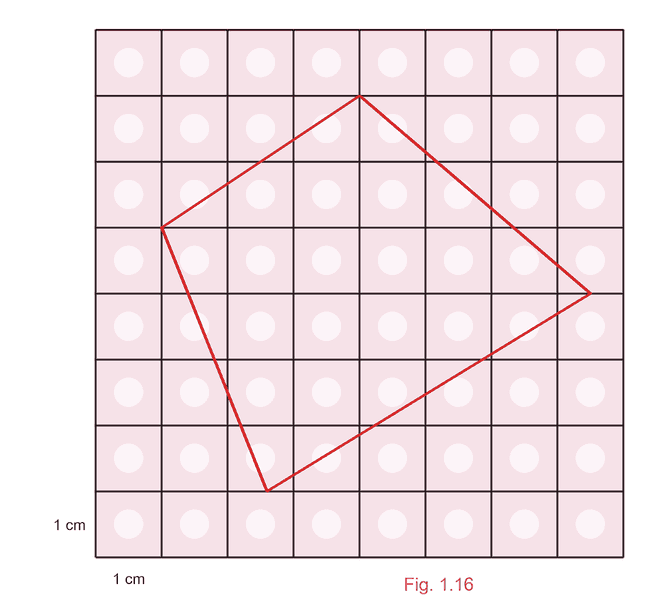
Find the approximate area of an irregular lamina of which boundary line is drawn on the graph paper shown in Fig. 1.16. below.
- 574 marks
Question 57
A piece of brass of volume 30 cm has a mass of 252 g. Find the density of brass in (i) g cm, (ii) kg m.
- 583 marks
Question 58
The mass of an iron ball is 312 g. The density of iron is 7.8 g cm. Find the volume of the ball.
- 593 marks
Question 59
A cork has a volume 25 cm. The density of cork is 0.25 g cm. Find the mass of the cork.
- 603 marks
Question 60
The mass of 5 litre of water is 5 kg. Find the density of water in g cm.
- 614 marks
Question 61
A cubical tank of side 1 m is filled with 800 kg of a liquid. Find : (i) the volume of tank, (ii) the density of liquid in kg m.
- 624 marks
Question 62
A block of iron has dimensions 2 m × 0.5 m × 0.25 m. The density of iron is 7.8 g cm. Find the mass of block.
- 634 marks
Question 63
The mass of a lead piece is 115 g. When it is immersed into a measuring cylinder, the water level rises from 20 mL mark to 30 mL mark. Find : (i) the volume of the lead piece, (ii) the density of the lead in kg m.
- 643 marks
Question 64
The density of copper is 8.9 g cm. What will be its density in kg m ?
- 654 marks
Question 65
A car travels a distance of 15 km in 20 minute. Find the speed of the car in (i) km h, (ii) m s.
- 663 marks
Question 66
How long a train will take to travel a distance of 200 km with a speed of 60 km h ?
- 673 marks
Question 67
A boy travels with a speed of 10 m s for 30 minute. How much distance does he travel?
- 683 marks
Question 68
Express 36 km h in m s.
- 693 marks
Question 69
Express 15 m s in km h.
- 702 marks
Question 70
1 kg of salt occupies more space than 1 kg of copper. Give reason.
What Class 7 Physics Ch 1 covers
The sections of the chapter, in the order the book takes them. Every question above comes from one of these.
- 01Measurement of Volume
- 02Measurement of Volume of Regular Objects
- 03Measurement of Volume of an Irregular Body
- 04Area
- 05Density
- 06Determination of Density of Regular Solids
More ways to study this chapter
The same chapter asked three other ways. Practise it, revise it, and see what the board has set on Ch 1 before.
Class 7 Physics Ch 1 questions students ask
How many questions are there in Class 7 Physics Ch 1?
70 questions. Every one is solved step by step on this page.
Are these Class 7 Physics solutions free?
Yes. Every question and its full working is free to read, with no account needed.
Can I download the Class 7 Physics Ch 1 solutions as a PDF?
There is no PDF to download. Every solution is on this page instead, which means it is searchable, always the current syllabus, and readable on a phone. Use your browser's print option if you want it on paper.