
Question 504 marksMedium
How can you determine the volume of an irregular solid (say a piece of brass) ? Describe in steps with neat diagrams.
Confirming your payment
Sign up now and get 250 free tokens.
Physical Quantities and Measurement · Question 50 of 70
How can you determine the volume of an irregular solid (say a piece of brass) ? Describe in steps with neat diagrams.
Solution:
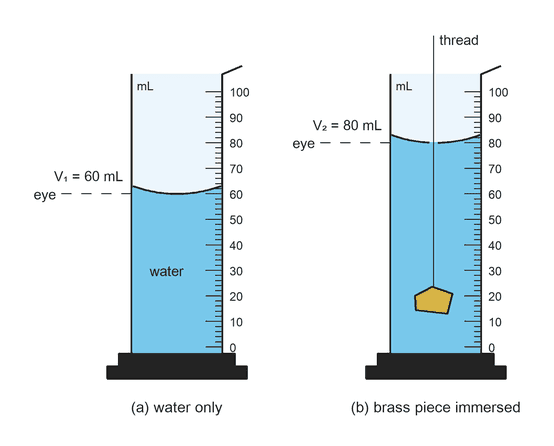
Concept: A solid that is completely immersed in a liquid pushes aside (displaces) liquid equal to its own volume. So the volume of an irregular solid is the rise in the liquid level in a measuring cylinder. This is the method of displacement of liquid.
Step 1 — Collect the apparatus.
We need a measuring cylinder, water, the piece of brass and a fine thread.
Step 2 — Take the first reading.
Place the cylinder on a flat surface and pour in enough water to cover the brass piece fully. With the eye level with the bottom of the meniscus, note the level, (60 mL in figure (a)).
Step 3 — Immerse the brass.
Tie the brass with the thread and lower it gently until it is completely under water, without splashing and without touching the sides (figure (b)).
Step 4 — Take the second reading.
The water level rises. Note the new level, (80 mL in figure (b)).
Step 5 — Find the volume.
The rise in level is the volume of water displaced, which equals the volume of the brass.
With the readings in the figure we get the value below.
Since 1 mL = 1 cm, the volume is 20 cm.
Watch out: The piece must be fully under water; a part above the surface displaces less water.
Therefore, the volume of the brass piece is cm; with the readings shown it is 20 cm.