
Question 513 marksEasy
Describe the method in steps to find the area of an irregular lamina using a graph paper.
Confirming your payment
Sign up now and get 250 free tokens.
Physical Quantities and Measurement · Question 51 of 70
Describe the method in steps to find the area of an irregular lamina using a graph paper.
Solution:
Concept: Area is the surface covered by an object. For a rectangle, area = length × breadth, with both lengths in the same unit. The S.I. unit of area is the square metre (m); a smaller unit is the square centimetre (cm). The area of an irregular lamina is found by counting squares on a graph paper.
Step 1 — Know the squares.
On a graph paper the thick lines are 1 cm apart, so each big square has an area of 1 cm × 1 cm = 1 cm. The thin lines, 1 mm apart, can be used for a finer count.
Step 2 — Draw the outline.
Place the lamina (for example a leaf) on the graph paper, draw its boundary with a sharp pencil and then remove the lamina.
Step 3 — Count the complete squares.
Count the 1 cm squares lying fully inside the boundary and mark each with a tick (✓).
Step 4 — Count the part squares.
Count the squares that are half or more than half inside the boundary and mark each with a dot (•). Leave out the squares that are less than half inside.
Step 5 — Add and find the area.
Add the two counts to get n. Each square is 1 cm, so the area is about n cm. The figure shows an example.
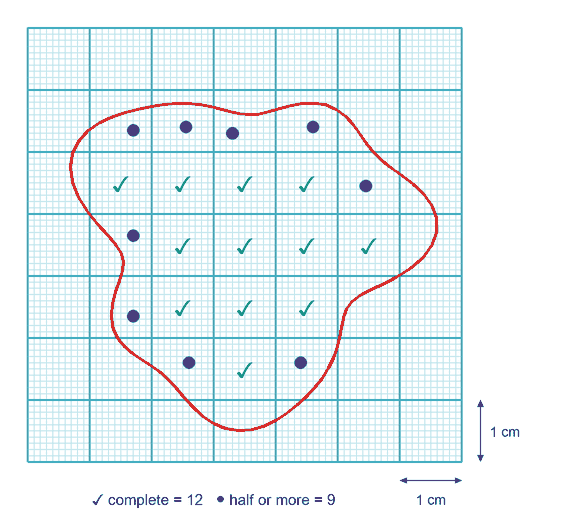
In the figure there are 12 complete squares and 9 squares that are half or more inside.
So the area of this lamina is about 21 cm.
Watch out: The answer is approximate, because counting a half-filled square as a whole one and leaving out a less-than-half square only balance out roughly; using 1 mm squares gives a closer value.
Therefore, the area of an irregular lamina is found by drawing its outline on a graph paper and counting the complete squares plus the squares half or more inside, each square being 1 cm (21 cm in the example).