
Question 494 marksEasy
Name two devices which are used to measure the volume of an object. Draw their neat diagrams.
Confirming your payment
Sign up now and get 250 free tokens.
Physical Quantities and Measurement · Question 49 of 70
Name two devices which are used to measure the volume of an object. Draw their neat diagrams.
Solution:
Concept: Volume is the space occupied by an object. Its S.I. unit is the cubic metre (m), the volume of a cube whose every side is 1 m long. Smaller units are the cubic centimetre (cm), the litre (L) and the millilitre (mL). One litre is 1000 cm, one millilitre is 1 cm, and one cubic metre is 1000 litres.
Step 1 — Name the devices.
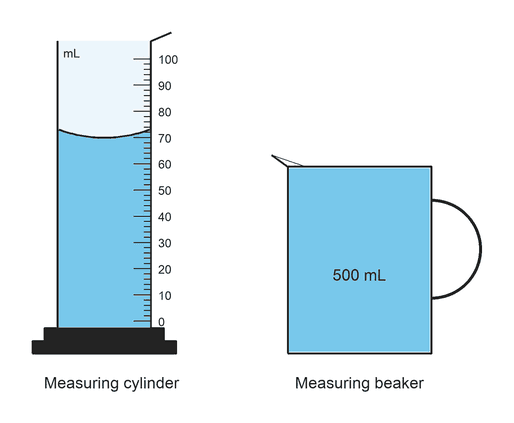
The two devices are the measuring cylinder and the measuring beaker. Both are shown below.
Step 2 — Describe the measuring cylinder.
It is a tall, narrow cylinder of glass or plastic standing on a broad base, with a lip for pouring. It is graduated in mL (cm), with its zero mark at the bottom; the one shown holds 100 mL. It measures the volume of a liquid, and the volume of an irregular solid by the displacement of water. Bigger cylinders of 200 mL and 500 mL are also made.
Step 3 — Read the measuring cylinder correctly.
Place it on a flat surface and wait until the liquid is still. The surface of the liquid (the meniscus) is curved, so keep the eye level with the bottom of the meniscus and read the mark there. In the figure the reading is 70 mL.
Step 4 — Describe the measuring beaker.
It is a vessel with a handle and a spout, made in fixed capacities such as 50 mL, 100 mL, 200 mL, 500 mL and 1000 mL, with the capacity marked on it. When it is filled to the brim, it holds exactly that volume, so it is used to measure out a fixed volume of a liquid such as milk or oil.
Watch out: Reading from above or below the level of the meniscus gives a wrong value.
Therefore, the measuring cylinder and the measuring beaker are two devices used to measure volume.