
Opening your dashboard
Class 7 Physics Chapter 1 Physical Quantities and Measurement: Practice Questions
40 questions on Chapter 1, each worked through on its own page with the AI tutor. Class 7 Physics, ICSE 2026-27.
40 questions
1–5 marks · Mixed difficulty
- 11 mark
Question 1
Bloom's level: Remember
Which pair of a physical quantity and its S.I. unit is correct ?
- 21 mark
Question 2
Bloom's level: Remember
A cube-shaped box has an inner side of 1 dm (that is, 10 cm). When it is filled to the brim with water, the volume of water in it is :
- 31 mark
Question 3
Bloom's level: Understand
A farmer says that his field has an area of one hectare. In ares, the area of his field is :
- 41 mark
Question 4
Bloom's level: Apply
A measuring cylinder contains water up to the 40 mL mark. Five identical glass marbles are gently slipped into it and they sink completely. The water level rises to the 55 mL mark. The volume of one marble is :
- 51 mark
Question 5
Bloom's level: Apply
A cube of side 2 cm has a mass of 21.6 g. Using the table of densities in your book (glass 1.97, aluminium 2.7, iron 7.8, brass 8.4, all in g cm), the cube is most likely made of :
- 61 mark
Question 6
Bloom's level: Apply
Which of the following is the greatest speed ?
- 71 mark
Question 7
Bloom's level: Analyse
To identify a colourless liquid, a student records :
Observation Reading Mass of empty beaker 60 g Volume of liquid poured from the measuring cylinder into the beaker 40 mL Mass of beaker with the liquid 92 g Using the densities in your book (alcohol 0.8, water 1.0, milk 1.03, mercury 13.6, all in g cm), the liquid is most likely :
- 81 mark
Question 8
Bloom's level: Evaluate
Three students read the level of water in the same measuring cylinder kept on a flat table.
Asha looks down at the water surface from above. Bunty bends so that his eye is in line with the lower surface of the curved water surface. Chetan reads the level of the upper edge of the curved surface where the water touches the glass.
Whose reading should be accepted ?
- 91 mark
Question 9
Bloom's level: Understand
While finding the density of a stone, the stone tied to a thread must be immersed completely in the water in the measuring cylinder. This is because :
- 101 mark
Question 10
Bloom's level: Understand
Read the Assertion (A) and the Reason (R) and choose the correct option.
Assertion (A): A small iron nail and a long iron rod have the same density.
Reason (R): The density of a substance does not change with the change in its shape or size.
- 111 mark
Question 11
Bloom's level: Understand
Read the Assertion (A) and the Reason (R) and choose the correct option.
Assertion (A): The area of a leaf found by counting squares on a graph paper is its exact area.
Reason (R): While counting, the squares less than half inside the outline are left out.
- 121 mark
Question 12
Bloom's level: Remember
Read the Assertion (A) and the Reason (R) and choose the correct option.
Assertion (A): The S.I. unit of speed is metre per second.
Reason (R): In the S.I. system, distance is measured in kilometre and time in hour.
- 132 marks
Question 13
Bloom's level: Understand
Rohan measures his school bag strap and says, "Its length is 75 cm." Explain what the number 75 and the unit cm tell us, using the meaning of measurement.
- 142 marks
Question 14
Bloom's level: Apply
(a) The capacity of a water tank on a roof is 1.5 m. Express it in litre.
(b) How many glasses, each of capacity 250 mL, can be completely filled from a 2 litre bottle of juice ?
- 152 marks
Question 15
Bloom's level: Apply
A cylindrical tin of oil has a radius of 7 cm and a height of 10 cm. Find its volume in cm and in litre. (Take .)
- 162 marks
Question 16
Bloom's level: Apply
A rectangular school plot is 250 m long and 80 m broad. Find its area in (a) m, (b) ares, (c) hectares.
- 172 marks
Question 17
Bloom's level: Understand
Two identical boxes are filled to the brim, one with dry sand and the other with sawdust. Which box will be heavier ? What does this tell you about the densities of sand and sawdust ?
- 182 marks
Question 18
Bloom's level: Apply
A rectangular slab of ice measures 10 cm × 5 cm × 4 cm and has a mass of 184 g. Find the density of ice in g cm and in kg m. Is ice denser or less dense than water ?
- 192 marks
Question 19
Bloom's level: Apply
A cheetah runs 300 m in 12 s.
(a) Find its speed in m s and in km h.
(b) At this speed, how long will it take to run 1 km ?
- 202 marks
Question 20
Bloom's level: Evaluate
To find the density of milk, Kabir weighed an empty beaker (54 g), poured 50 mL of milk into it from a measuring cylinder and weighed it again (105.5 g). He wrote : density of milk g cm. Is his answer correct ? Justify and give the correct value.
- 212 marks
Question 21
Bloom's level: Analyse
Sana wants to find the volume of an irregular lump of rock salt by the displacement method, using water in a measuring cylinder. Explain why her result will be wrong, and suggest how she can still use the displacement method.
- 222 marks
Question 22
Bloom's level: Remember
Name the physical quantity that is expressed in each of the following units :
(a) hectare (b) kg m (c) km h (d) millilitre
- 234 marks
Question 23
Bloom's level: Apply
A piece of stone has a mass of 75 g. When it is tied to a thread and lowered completely into a measuring cylinder, the water level rises from the 40 mL mark to the 70 mL mark.
(a) Find the volume of the stone.
(b) Find the density of the stone in g cm and in kg m.
(c) Another piece of the same stone has a volume of 120 cm. Find its mass.
- 243 marks
Question 24
Bloom's level: Analyse
The outline of a leaf-shaped piece of cardboard (a lamina) has been drawn on a sheet ruled in squares of side 1 cm.
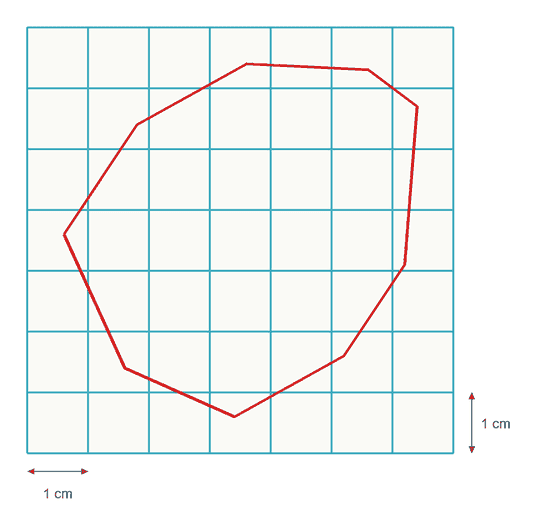
(a) Count the complete squares and the squares that are half or more than half inside the outline.
(b) Find the approximate area of the lamina.
(c) Why is this area only approximate ? How could it be found more accurately using the same graph paper ?
- 254 marks
Question 25
Bloom's level: Analyse
Case study: A milk co-operative tests three samples P, Q and R that are said to be pure milk. For each sample, exactly 50 mL is poured into a weighed beaker and the mass of the milk alone is found.
Sample P Q R Mass of 50 mL of milk (in g) 51.5 51.0 50.25 (a) Find the density of each sample in g cm.
(b) The density of pure milk is 1.03 g cm and that of water is 1.0 g cm. Which samples are probably mixed with water ?
(c) Which sample has the most water mixed in it ? Explain why adding water changes the density of milk in this way.
- 264 marks
Question 26
Bloom's level: Understand
Case study: Neha's father is driving her to school. The speedometer of the car shows 40 km h. Near the school gate there is a board: SCHOOL ZONE - SPEED LIMIT 20 km h. A cyclist outside the gate is going at 6 m s, and a bullock-cart is moving slowly on the same road.
(a) What does the speedometer reading of 40 km h tell Neha ?
(b) Is the cyclist within the speed limit of the school zone ? Show your working.
(c) The car and the bullock-cart both move for one minute. Explain, using the meaning of speed, how we can tell which of them is faster.
- 274 marks
Question 27
Bloom's level: Analyse
A glass aquarium is a cuboid 50 cm long, 30 cm broad and 40 cm high. It is filled with water up to a height of 30 cm.

(a) Find the volume of water in the aquarium in cm and in litre.
(b) How many more litres of water are needed to fill it to the top ?
(c) Pebbles with a total volume of 3000 cm are now placed at the bottom, so that they are completely under water. Find the new height of the water.
- 284 marks
Question 28
Bloom's level: Evaluate
A trader sells a small cube-shaped bar of side 2 cm and claims that it is pure silver. You measure the mass of the bar on a beam balance and find it to be 67.2 g.
(a) Find the density of the bar.
(b) Using the table of densities in your book (silver 10.3 g cm, brass 8.4 g cm, iron 7.8 g cm), judge whether the trader's claim is true. Which metal is the bar most likely made of ?
(c) What should be the mass of a pure silver bar of the same size ?
- 295 marks
Question 29
Bloom's level: Create
Your class has cut out a map of India from a thick, uniform cardboard sheet. Plan a method to find the volume of this cardboard map using only a graph paper, a metre ruler and some more identical cardboard sheets of the same kind. Include :
(a) how you will find the area of the map,
(b) how you will find the thickness of the cardboard accurately with a metre ruler,
(c) how you will calculate the volume, with an example using your own sample readings,
(d) one reason why the volume you get is only approximate.
- 304 marks
Question 30
Bloom's level: Create
Plan a fair test to find out which of three friends - Amit, Bina and Charu - runs the fastest on the school ground. Include :
(a) what you will measure and the instruments you will use,
(b) two things you will keep the same to make the test fair,
(c) an observation table with your own sample readings, the speed of each runner in m s and km h, and your conclusion.
- 311 mark
Question 31
A can contains 2.5 litre of cooking oil. The volume of the oil in cm is :
- 321 mark
Question 32
Two solid cubes, one of iron and the other of aluminium, have exactly the same size. The density of iron is 7.8 g cm and that of aluminium is 2.7 g cm. Which of the following statements is correct ?
- 331 mark
Question 33
A cyclist rides at a steady speed of 5 m s. The distance covered by the cyclist in 2 minute is :
- 341 mark
Question 34
Fill in the blank :
A square sheet of side 1 m has an area of .............. cm.
- 351 mark
Question 35
Write true or false :
When a stone is immersed completely in the water contained in a measuring cylinder, the rise in the level of water gives the mass of the stone.
- 362 marks
Question 36
A solid iron ball is heated on a flame. State how each of the following changes, if at all : (a) the mass of the ball, (b) the volume of the ball, (c) the density of iron. Give a reason for your answer to (c).
- 372 marks
Question 37
A student measures a rectangular wooden block with a metre ruler and finds it to be 12 cm long, 5 cm broad and 4 cm high. Its mass, measured with a beam balance, is 168 g. Calculate (a) the volume of the block, (b) the density of the wood.
- 384 marks
Question 38
A stone of mass 65 g is tied to a thread and lowered into the water contained in a measuring cylinder. The figure shows the cylinder (a) before and (b) after the stone is immersed.
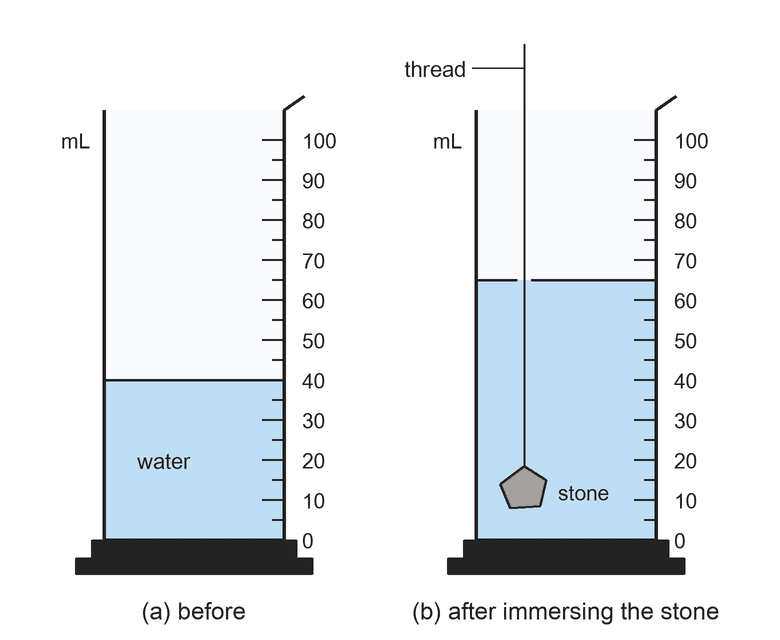
(a) Read the level of water in the cylinder before and after the stone is immersed.
(b) Find the volume of the stone in cm.
(c) Calculate the density of the stone in (i) g cm, (ii) kg m.
- 394 marks
Question 39
You are given a beaker, a measuring cylinder, a common beam balance and some liquid.
(a) Describe, in steps, how you will find the density of the liquid.
(b) In such an experiment the mass of the empty beaker is 45 g. When 60 mL of the liquid is transferred into it, the mass of the beaker with the liquid is 93 g. Calculate the density of the liquid in g cm.
- 405 marks
Question 40
(a) Define the speed of a body and state its S.I. unit.
(b) The table gives the distance travelled and the time taken by three vehicles P, Q and R.
Vehicle Distance travelled Time taken P 450 m 1 minute 30 second Q 27 km 30 minute R 2.4 km 4 minute Calculate the speed of each vehicle in m s. Which vehicle is the fastest ?
(c) How much time will the fastest vehicle take to travel 4.5 km at the same speed ?