
Opening your dashboard
Class 7 Physics Chapter 1 Physical Quantities and Measurement: Competency-Based Questions (CBQ)
40 questions on Chapter 1, each worked through on its own page with the AI tutor. Class 7 Physics, ICSE 2026-27.
40 questions
1–5 marks · Mixed difficulty
- 11 mark
Question 1
Competency: Application
A tap in a school washroom is leaking. To find out how much water is being wasted, Ishaan keeps a measuring cylinder under the tap and finds that 40 mL of water collects in 10 minutes. If the tap keeps dripping at the same rate, how much water will be wasted in one day (24 hours) ?
- 21 mark
Question 2
Competency: Analysis
Kavya wants to find the volume of a cork. A cork floats on water, so she ties it with a thread to an iron bolt, which pulls it completely under water. She uses the same water in the same measuring cylinder and notes the level three times, as shown in X, Y and Z.
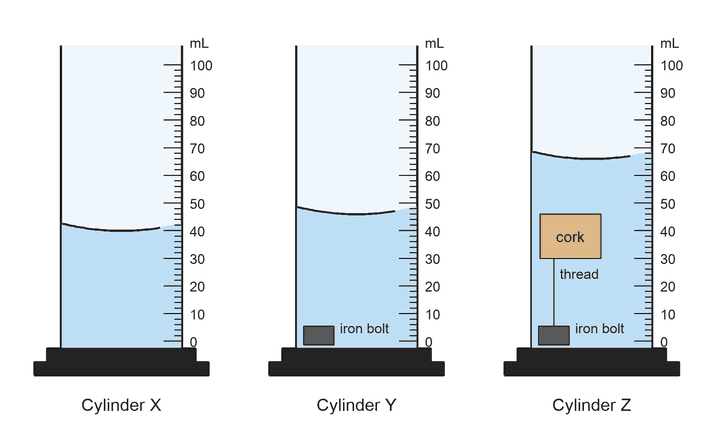
X shows the water alone, Y shows the water with the iron bolt, and Z shows the water with the bolt and the cork tied together. What is the volume of the cork ?
- 31 mark
Question 3
Competency: Analysis
A scrap dealer has four solid blocks P, Q, R and S. He measures the mass and the volume of each block.
Block P Q R S Mass (in g) 54 156 135 156 Volume (in cm) 20 20 50 60 Which two blocks could be made of the same material ?
- 41 mark
Question 4
Competency: Application
At a pedestrian crossing the green "walk" signal stays on for 10 s. The road is 12 m wide. What is the least speed at which Naina must walk to reach the other side before the signal changes ?
- 51 mark
Question 5
Competency: Understanding
Assertion (A): To find the capacity of an empty bottle with a narrow neck, the bottle is filled completely with water and the water is then poured into a measuring cylinder.
Reason (R): A liquid takes the shape of the vessel into which it is poured, but its volume remains the same.
- 61 mark
Question 6
Competency: Understanding & Application
Assertion (A): A notice board of area 1 m can be covered exactly by 100 square stickers, each of side 1 cm.
Reason (R): 1 m = 100 cm.
- 72 marks
Question 7
Competency: Application
For the school garden, a wooden box 2 m long and 1 m broad is to be filled with soil up to a height of 30 cm. The soil is sold in bags, each holding 50 litre of soil.
(a) Find the volume of soil needed, in m.
(b) How many bags must be bought ?
- 82 marks
Question 8
Competency: Application & Evaluation
Rhea finds the density of a cooking oil. She weighs an empty beaker (62 g), measures 50 mL of the oil in a measuring cylinder, pours it into the beaker and weighs the beaker again (106.5 g). Afterwards she notices that a thin layer of oil is still sticking to the inside of the measuring cylinder.
(a) Calculate the density of the oil from her readings.
(b) Is her value greater or less than the true density of the oil ? Give a reason, and suggest one change in her method that removes this error.
- 92 marks
Question 9
Competency: Analysis & Evaluation
A shop sells ghee in two tins at the same price. Tin X is marked "Net quantity 1 litre" and tin Y is marked "Net quantity 1 kg". The density of ghee is 0.9 g cm.
(a) Find the mass of the ghee in tin X.
(b) Which tin is the better buy ? Justify your answer.
- 102 marks
Question 10
Competency: Application & Analysis
Meera can cycle to her school by two routes. Route P goes through the market: it is 3 km long and the crowd lets her ride at 12 km h. Route Q goes round the market: it is 4.5 km long, but the road is clear and she can ride at 15 km h.
(a) Find the time she takes by each route, in minute.
(b) Her brother says, "Take route Q. You ride faster on it, so you will reach earlier." Is he right ? Give a reason.
- 114 marks
Question 11
Competency: Application & Analysis
Case study: A village council wants to know the size of its pond. A surveyor draws the outline of the pond to scale on a sheet ruled in squares, as shown below. Each square stands for a square piece of ground of side 2 m.
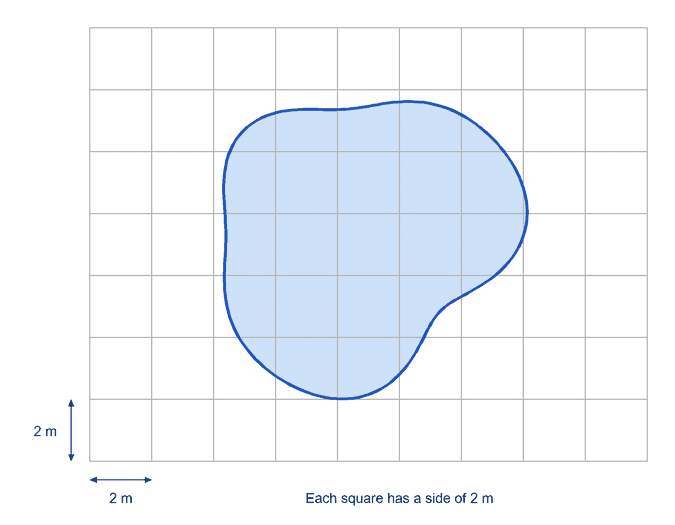
(a) What area of ground does one square stand for ? Count the squares that must be taken while estimating the area of the pond, and state the rule you used.
(b) Estimate the area of the pond in m and in are.
(c) The pond is about 1.5 m deep everywhere. Estimate the volume of water in it in m and in litre. Suggest one change in the ruled sheet that would give a closer estimate of the area, with a reason.
- 124 marks
Question 12
Competency: Analysis & Evaluation
Case study: A scrap dealer wants to sort three irregular lumps of metal, P, Q and R. He finds the mass of each lump with a beam balance. He then lowers each lump by a thread into water in a measuring cylinder and notes the level of the water before and after.
Lump Mass (in g) Water level before (in mL) Water level after (in mL) P 81 40 70 Q 234 40 70 R 126 45 60 Densities of some metals, in g cm : aluminium 2.7, iron 7.8, brass 8.4, silver 10.3.
(a) Find the volume and the density of each lump.
(b) Identify the metal of each lump.
(c) The dealer says, "Q is heavier than R, so Q must be made of the denser metal." Use your results to judge his statement.
- 134 marks
Question 13
Competency: Analysis
Case study: A factory casts solid cubes of aluminium, each of side 5 cm. The density of aluminium is 2.7 g cm. To check the quality, an inspector weighs three cubes taken from the day's lot.
Cube 1 2 3 Mass (in g) 337.5 270 337.5 All three cubes have exactly the same size.
(a) Find the volume of a cube and the mass that a solid aluminium cube of this size should have.
(b) For cube 2, find the mass per unit volume from its mass and its outer size. The inspector is sure that the factory used nothing except aluminium. What must be wrong with cube 2 ? Give a reason.
(c) Find the volume of the aluminium actually present in cube 2 and, from it, the volume of the fault.
- 144 marks
Question 14
Competency: Analysis & Evaluation
Case study: A bus runs along a straight highway from stop A to stop C through stop B. The figure shows the distance of each stop from A and the time at which the bus passed it. The bus kept a steady speed from A to B and another steady speed from B to C. The speed limit on this highway is 60 km h.

(a) From the figure, find the distance and the time taken for each of the two parts, A to B and B to C.
(b) Calculate the speed of the bus in each part in km h. Express the greater of the two speeds in m s.
(c) The driver says, "I covered 78 km in 80 minutes. That works out to less than 60 km h, so I did not cross the speed limit anywhere." Judge his statement. At what time would the bus have reached C if it had travelled from B to C at exactly 60 km h ?
- 154 marks
Question 15
Competency: Creation & Application
Arjun wants to find the density of a stone paperweight of irregular shape. The stone is too wide to go into his 100 mL measuring cylinder. He has a mug wide enough to take the stone, a large dry bowl, water, a piece of thread, the 100 mL measuring cylinder and a beam balance with a weight box.
(a) Plan, in steps, how he can find the volume of the stone with these things.
(b) In a trial, the mass of the stone is 325 g. The water collected fills the measuring cylinder up to the 100 mL mark once, and the water left over then stands at the 25 mL mark. Find the density of the stone in g cm and in kg m.
(c) If a little of the collected water remains sticking to the bowl, will the density found be more or less than the true value ? Give a reason, and state one other precaution he should take.
- 161 mark
Question 16
Competency: Application
A doctor advises Mohan to give his young sister of a syrup three times a day for days. The chemist sells this syrup only in bottles of . What is the least number of bottles Mohan must buy for the full course ?
- 171 mark
Question 17
Competency: Analysis
A rectangular swimming pool is long and broad. On a very hot, dry summer day, the water level in the pool falls by because of evaporation. (Hypothetical data.) How many litres of water does the pool lose ?
- 181 mark
Question 18
Competency: Analysis
A student measures the mass of different volumes of three liquids P, Q and R, and plots the readings in the graph below. Density is the mass of a unit volume of a substance.
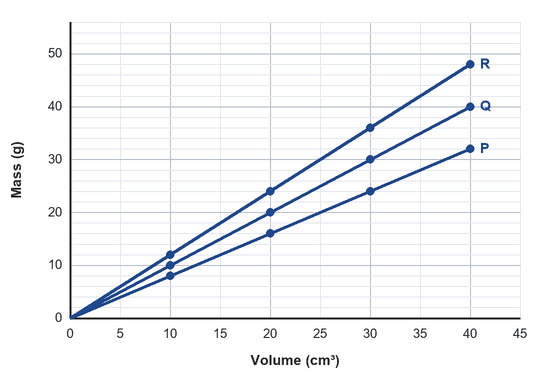
Which of the following statements is correct ?
- 191 mark
Question 19
Competency: Analysis
Anil lowers a rough stone, tied to a thread, into the water in a measuring cylinder to find its density. He does not notice that several tiny air bubbles are sticking to the surface of the stone. He finds the mass of the stone correctly. Compared with the true density of the stone, the density that Anil calculates will be
- 201 mark
Question 20
Competency: Understanding
Assertion (A): A square carpet of side covers four times as much floor area as a square carpet of side .
Reason (R): When the side of a square is doubled, its area is also doubled.
- 211 mark
Question 21
Competency: Understanding
Assertion (A): A car whose speedometer reads at 10:00 a.m. must travel exactly between 10:00 a.m. and 11:00 a.m.
Reason (R): A speedometer shows the speed of the car at that instant.
- 221 mark
Question 22
Competency: Application
The floor of a rectangular classroom is long and broad. It is to be covered completely with square tiles of side . How many tiles are needed ?
- 231 mark
Question 23
Competency: Analysis
Two cars P and Q start together from the same point and move in the same direction along a straight road. Car P moves at a steady speed of and car Q at a steady speed of . (Hypothetical data.) How far apart are the two cars after minutes ?
- 241 mark
Question 24
Competency: Analysis
Meena wants the density of a salt solution, but she has no measuring cylinder. She uses a small bottle with a stopper and a balance. The empty bottle has a mass of . Filled completely with water, it has a mass of . Filled completely with the salt solution, it has a mass of . The density of water is . (Hypothetical data.)
What is the density of the salt solution ?
- 251 mark
Question 25
Competency: Analysis
A solid metal cube of side is cut, without wasting any metal, into identical small cubes. Which statement about each small cube is correct ?
- 262 marks
Question 26
Competency: Understanding
Length, mass and time are fundamental quantities. A quantity whose unit is made by combining the units of the fundamental quantities is a derived quantity. The S.I. unit of speed is and that of density is .
(a) Which fundamental quantities are combined in the unit of speed, and which in the unit of density ?
(b) Why are speed and density called derived quantities ?
- 272 marks
Question 27
Competency: Application
A train long crosses a signal post in at a constant speed. The post is so thin that it may be taken as a point.
(a) How much distance does the train cover while it crosses the post ?
(b) Find the speed of the train in and in .
- 282 marks
Question 28
Competency: Analysis
In a laboratory, of liquid X has a mass of and of liquid Y has a mass of . The two samples are mixed. Assume that the volume of the mixture is the sum of the two volumes.
(a) Find the density of each liquid.
(b) Find the density of the mixture.
- 293 marks
Question 29
Competency: Analysis
Sunita wants to find the density of the metal of a small coin. Her measuring cylinder has a mark for every . She tilts the cylinder and slides identical coins gently into the water, one by one, until all of them lie completely under water. The level rises from to . The coins together have a mass of . (Hypothetical data.)
(a) Find the volume of one coin.
(b) Find the density of the metal of the coins.
(c) Why did Sunita use coins and not just one ?
- 302 marks
Question 30
Competency: Evaluation
Priya has to measure out of water as accurately as possible. She has two measuring cylinders. Cylinder 1 has a capacity of and its scale has a mark for every . Cylinder 2 has a capacity of and its scale has a mark for every .
(a) Which cylinder should she use ?
(b) Give a reason for your choice.
- 312 marks
Question 31
Competency: Application
A mason has to build a wall long, thick and high. Each brick is a cuboid measuring . (Hypothetical data.) Ignore the thickness of the cement joints.
(a) Find the volume of the wall and the volume of one brick, in .
(b) How many bricks are needed ?
- 323 marks
Question 32
Competency: Analysis
Kiran fills a glass bottle to the brim with of water, closes it tightly with a cap and keeps it in the freezer overnight. In the morning all the water has turned into ice and the bottle is cracked. The density of water is and the density of ice is . (Hypothetical data.)
(a) Find the inside volume of the bottle.
(b) What is the mass of the ice ? Give a reason.
(c) Find the volume of the ice, and use it to explain why the bottle cracked.
- 333 marks
Question 33
Competency: Application
During training, Leela runs round a track at a steady speed of for minutes. (Hypothetical data.)
(a) Express her speed in .
(b) How many complete rounds of the track does she finish in the minutes, and how far into the next round is she when she stops ?
(c) How long does she take to finish complete rounds ? Give the answer in minutes and seconds.
- 343 marks
Question 34
Competency: Evaluation
A water tank in a house is a cuboid long, broad and high. A family of uses litre of water per person per day. (Hypothetical data.)
(a) Find the capacity of the full tank in litre.
(b) Find the volume of water used by the family in one day.
(c) A neighbour says that the full tank will last the family for a week. Is the neighbour right ? Give a reason.
- 353 marks
Question 35
Competency: Analysis
A carpenter has three kinds of wood, A, B and C. He cuts a cube of side from one piece and finds that it has a mass of . The densities of the three woods are given in the table. (Hypothetical data.)
Wood A B C Density (in ) (a) Find the density of the wood of the cube.
(b) Which wood is it ?
(c) Find the mass, in kg, of a plank of this wood measuring .
- 363 marks
Question 36
Competency: Analysis
A rectangular park is long and broad. A concrete path wide runs inside the boundary all the way round the park, and the rest of the park is a lawn. (Hypothetical data.)
(a) Find the area of the whole park.
(b) Find the area of the lawn.
(c) Find the area of the path.
- 374 marks
Question 37
Competency: Evaluation
Case study: A delivery rider leaves a shop at 9:00 a.m. and rides to a market and then to a factory. He rests at the market for a few minutes. The table shows his journey. (Hypothetical data.)
Part of the journey Distance (in km) Time (in minutes) Shop to market Rest at market Market to factory (a) Find the speed of the rider in on each of the two parts in which he rides.
(b) At what time does he reach the factory ?
(c) The factory gate opens at 9:50 a.m. The next day he again leaves at 9:00 a.m., rides to the market at the same speed as before and rests there for minutes. His friend says, "To reach the gate exactly at 9:50 a.m., you must ride from the market to the factory twice as fast as you did today." Find the speed he actually needs on that part, and say whether the friend is right.
- 384 marks
Question 38
Competency: Analysis
Case study: In a laboratory, four students measure out different volumes of the same liquid in a measuring cylinder and pour each into an empty beaker of mass . They find the mass of the beaker with the liquid. The readings are shown in the table. (Hypothetical data.)
Student Volume of liquid (in ) Mass of beaker with liquid (in g) 1 2 3 4 (a) Find the mass of the liquid in each reading.
(b) Find the density of the liquid from each reading.
(c) One reading is not in line with the others. Say which, and give the density of the liquid from the other readings in .
- 395 marks
Question 39
Competency: Creativity
Rina has a clear plastic bottle with straight, upright sides and no markings, a small medicine cup with a mark at , water, a marker pen and a potato that sinks in water. The potato is too big for a measuring cylinder but fits easily into the bottle.
(a) Describe, in steps, how she can mark the bottle with a scale of , , , and .
(b) Describe how she can then use the marked bottle to find the volume of the potato.
(c) State one reason why her marked bottle is less accurate than a measuring cylinder, and one way to reduce the error.
- 404 marks
Question 40
Competency: Evaluation
Case study: A company wants to pack litre of juice in a cuboid box. It makes three trial boxes P, Q and R. The inner measurements of the boxes are given in the table. (Hypothetical data.) The juice is to be kept on a shelf in which the gap between two shelves is .
Box Length (in cm) Breadth (in cm) Height (in cm) P Q R (a) Find the volume of each box in .
(b) Which boxes can hold exactly litre of juice ?
(c) Which box should the company choose ? Give a reason.