
Opening your dashboard
Class 6 Physics Chapter 2: Physical Quantities and Measurement Solutions
55 textbook questions with step-by-step answers, free to read, for ICSE 2026-27.
Get talked through Ch 2, not just shown the answer
Reading a finished solution is not the same as being able to do it. The AI tutor takes one question at a time and works it with you, in your own words, until you can.
- Ask it out loud, in your own words
- It gives you the next step, not the answer
- Stuck on part (ii)? Start there
55 questions with solutions
1–4 marks · Mixed difficulty
- 11 mark
Question 1
Choose the correct answer from the multiple choices given below.
The symbol of degree celsius is :
Solve with AIAnswer
- Correct
(A) °C
(B) °F
(C) K
(D) °K
Answer: (A) °C
Concept: Temperature is the degree of hotness or coldness of a body. Its S.I. unit is the kelvin (K); common units are the degree Celsius (°C) and the degree Fahrenheit (°F). Melting ice is at 0 °C and water boils at 100 °C (at normal atmospheric pressure).
Step 1 — Recall the symbol.
The degree Celsius is written as a small raised circle (the degree sign) followed by a capital C, that is, °C.
Step 2 — Check the other symbols.
The symbol °F stands for the degree Fahrenheit, and K stands for the kelvin, the S.I. unit of temperature. So only °C is the symbol of the degree Celsius.
Watch out: In words we write “degree Celsius” with a capital C, because the unit is named after the scientist Anders Celsius; this is the one exception to writing unit names in small letters.
Why the other options are wrong:
- (B) °F: °F is the symbol of the degree Fahrenheit, a different unit of temperature.
- (C) K: K is the symbol of the kelvin, the S.I. unit of temperature.
- (D) °K: °K is an old way of writing the kelvin; since 1968 the kelvin is written K, with no degree sign.
Therefore, the symbol of degree Celsius is °C, option (A).
- 21 mark
Question 2
Choose the correct answer from the multiple choices given below.
10 mm is equal to :
Solve with AIAnswer
- Correct
(A) 1 cm
(B) 1 m
(C) 10 dm
(D) 10 cm
Answer: (A) 1 cm
Concept: The S.I. unit of length is the metre (m). One kilometre is 1000 m, one metre is 100 cm and one centimetre is 10 mm. In the F.P.S. system, one foot is 12 inches, one yard is 3 feet, and one inch is 2.54 cm.
Step 1 — Recall the relation.
Each centimetre on a ruler is divided into 10 equal parts, and each part is one millimetre. So 10 mm make 1 cm.
Step 2 — Convert.
We divide the number of millimetres by 10 to get centimetres.
Watch out: Divide by 10 to change mm into cm, and multiply by 10 to change cm into mm.
Why the other options are wrong:
- (B) 1 m: 1 m is 1000 mm, a hundred times more than 10 mm.
- (C) 10 dm: Ten decimetres make 1 m, and 1 m is 1000 mm, a hundred times more than 10 mm.
- (D) 10 cm: 10 cm is 100 mm, ten times more than 10 mm.
Therefore, 10 mm is equal to 1 cm, option (A).
- 31 mark
Question 3
Choose the correct answer from the multiple choices given below.
The amount of surface occupied by an object is called its :
Solve with AIAnswer
(A) volume
- Correct
(B) area
(C) mass
(D) length
Answer: (B) area
Concept: Area is the amount of surface occupied by an object. Its S.I. unit is the square metre (m²), the area of a square whose each side is 1 m. The area of a regular shape is worked out from its measured sides, and the area of an irregular shape is found by counting squares on a graph paper.
Step 1 — Recall the definition.
The amount of surface occupied by an object, such as the top of a table or a sheet of paper, is called its surface area, or simply its area.
Step 2 — Check the unit.
Area is measured in square units such as m² and cm², which also shows that it is a measure of surface.
Watch out: Area measures a surface (square units); volume measures the space inside (cubic units).
Why the other options are wrong:
- (A) volume: Volume is the space occupied by an object, measured in cubic units, not its surface.
- (C) mass: Mass is the quantity of matter in a body, measured in kilograms.
- (D) length: Length is the distance between two points, measured in metres.
Therefore, the amount of surface occupied by an object is called its area, option (B).
- 41 mark
Question 4
Choose the correct answer from the multiple choices given below.
A metre ruler is graduated in :
Solve with AIAnswer
(A) m
(B) cm
- Correct
(C) mm
(D) km
Answer: (C) mm
Concept: A metre ruler is 1 m long. It is divided into 100 centimetres, and each centimetre into 10 millimetres, so it measures a length correct up to 1 mm. The ruler has some thickness, so the eye must be kept vertically above the mark being read; reading from one side gives a wrong value, the error of parallax.
Step 1 — Look at the markings.
A metre ruler is divided into 100 centimetres, and each centimetre is further divided into 10 small parts.
Step 2 — Find the smallest graduation.
Each small part is 1 mm, so the finest graduations of the ruler are in millimetres. That is why it can measure a length correct up to 1 mm.
Watch out: The phrase “graduated in” asks for the smallest division marked on the scale, which is the millimetre.
Why the other options are wrong:
- (A) m: The whole ruler is 1 m long, but it is not marked only in metres; it has many finer marks.
- (B) cm: The ruler is numbered in centimetres, so this is partly right, but each centimetre is further divided into millimetres, and the finest graduation is the better answer.
- (D) km: A kilometre is 1000 m, far longer than the ruler itself.
Therefore, a metre ruler is graduated in mm, option (C).
- 51 mark
Question 5
Choose the correct answer from the multiple choices given below.
A thermometer is graduated in :
Solve with AIAnswer
(A) kelvin
- Correct
(B) °C
(C) g
(D) cm
Answer: (B) °C
Concept: Temperature is the degree of hotness or coldness of a body. Its S.I. unit is the kelvin (K); common units are the degree Celsius (°C) and the degree Fahrenheit (°F). Melting ice is at 0 °C and water boils at 100 °C (at normal atmospheric pressure).
Step 1 — Recall the thermometers we use.
A laboratory thermometer is marked from −10 °C to 110 °C, and a clinical thermometer from 35 °C to 42 °C.
Step 2 — Name the unit of the marks.
Both are marked in degrees Celsius, so a thermometer is graduated in °C.
Watch out: The kelvin is the S.I. unit of temperature, yet everyday thermometers are marked in °C.
Why the other options are wrong:
- (A) kelvin: The kelvin is the S.I. unit of temperature, but the thermometers used at school and at home are marked in °C (some also in °F), not in kelvin.
- (C) g: The gram (g) is a unit of mass, not of temperature.
- (D) cm: The centimetre (cm) is a unit of length, not of temperature.
Therefore, a thermometer is graduated in °C, option (B).
- 61 mark
Question 6
Choose the correct answer from the multiple choices given below.
Out of the following which one unit does not belong to S.I.
Solve with AIAnswer
(A) Metre
- Correct
(B) Pound
(C) Second
(D) Kilogram
Answer: (B) Pound
Concept: The S.I. units (the International System of Units) are used by scientists all over the world. The S.I. unit of length is the metre (m), of mass the kilogram (kg), of time the second (s) and of temperature the kelvin (K).
Step 1 — List the S.I. units in the options.
The metre (length), the kilogram (mass) and the second (time) are all S.I. units.
Step 2 — Find the odd one out.
The pound (lb) is the unit of mass in the F.P.S. (foot-pound-second) system, so it does not belong to the S.I.
Why the other options are wrong:
- (A) Metre: The metre is the S.I. unit of length.
- (C) Second: The second is the S.I. unit of time.
- (D) Kilogram: The kilogram is the S.I. unit of mass.
Therefore, the pound does not belong to S.I., option (B).
- 71 mark
Question 7
Choose the correct answer from the multiple choices given below.
1 square yard is equal to :
Solve with AIAnswer
- Correct
(A) 1 yard × 1 yard
(B) 1 yard × 1 square ft
(C) 1 yard × 1 acre
(D) none of these
Answer: (A) 1 yard × 1 yard
Concept: Area is the amount of surface occupied by an object. Its S.I. unit is the square metre (m²), the area of a square whose each side is 1 m. The area of a regular shape is worked out from its measured sides, and the area of an irregular shape is found by counting squares on a graph paper.
Step 1 — Recall what a square unit means.
One square yard is the area of a square whose each side is 1 yard.
Step 2 — Write it as a product.
The area of a square is side × side, so one square yard is 1 yard × 1 yard.
Watch out: An area is always a length × a length; length × area gives a volume.
Why the other options are wrong:
- (B) 1 yard × 1 square ft: A yard times a square foot is a length times an area, which gives a volume, not an area.
- (C) 1 yard × 1 acre: An acre is itself an area, so a yard times an acre is a volume, not an area.
- (D) none of these: Option (A) is correct, so “none of these” cannot be the answer.
Therefore, 1 square yard is equal to 1 yard × 1 yard, option (A).
- 81 mark
Question 8
Choose the correct answer from the multiple choices given below.
1 acre is equal to :
Solve with AIAnswer
(A) 0.09290 m²
(B) 0.836 m²
- Correct
(C) 4046.856 m²
(D) none of these
Answer: (C) 4046.856 m²
Concept: Area is the amount of surface occupied by an object. Its S.I. unit is the square metre (m²), the area of a square whose each side is 1 m. The area of a regular shape is worked out from its measured sides, and the area of an irregular shape is found by counting squares on a graph paper.
Step 1 — Recall what an acre is.
The acre is an old unit used for large pieces of land. One acre is 4840 square yards.
Step 2 — Change it into square metres.
One square yard is about 0.836127 m², so we multiply.
Step 3 — Check the size.
A piece of land must be thousands of square metres, so the answer must be a large number. Only 4046.856 m² fits.
Watch out: The acre measures land, so it is far bigger than a square foot or a square yard.
Why the other options are wrong:
- (A) 0.09290 m²: 0.09290 m² is one square foot (0.3048 m × 0.3048 m), not one acre.
- (B) 0.836 m²: 0.836 m² is one square yard, not one acre.
- (D) none of these: Option (C) is correct, so “none of these” cannot be the answer.
Therefore, 1 acre is equal to 4046.856 m², option (C).
- 91 mark
Question 9
The following questions are Assertion-Reason based questions. Choose the answer based on the codes given below.
(1) Both A and R are true and R is the correct explanation of A
(2) Both A and R are true and R is not the correct explanation of A
(3) A is true but R is false
(4) A is false but R is true
Assertion (A) : Stopwatch can measure intervals shorter than one second.
Reason (R) : Stopwatch counts seconds using the standard unit of time.
Solve with AIAnswer
(A) (1) Both A and R are true and R is the correct explanation of A
- Correct
(B) (2) Both A and R are true and R is not the correct explanation of A
(C) (3) A is true but R is false
(D) (4) A is false but R is true
Answer: (B) (2) Both A and R are true and R is not the correct explanation of A
Concept: The S.I. unit of time is the second (s). One minute is 60 s, one hour is 60 minutes (3600 s), and one day is 24 hours (86,400 s). Short time intervals are measured with a stop clock or a stop watch.
Step 1 — Judge the Assertion.
A stop watch is used for short time intervals. A mechanical stop watch can read a fraction of a second (often 0.1 s), and a digital one reads to 0.01 s. So the Assertion is true.
Step 2 — Judge the Reason.
A stop watch counts time in seconds, and the second is the standard (S.I.) unit of time. So the Reason is true.
Step 3 — Decide whether R explains A.
Every clock and watch counts in seconds, yet an ordinary clock cannot time a part of a second. A stop watch can do so because its dial or display is divided into fractions of a second and it can be started and stopped at once. R does not give this reason, so R does not explain A.
Why the other options are wrong:
- (A): R does not explain A: counting in seconds does not let a watch measure less than a second.
- (C): R is a true statement: a stop watch counts in seconds, the standard unit of time.
- (D): A is a true statement: a stop watch can measure fractions of a second.
Therefore, both A and R are true and R is not the correct explanation of A, option (B).
- 101 mark
Question 10
The following questions are Assertion-Reason based questions. Choose the answer based on the codes given below.
(1) Both A and R are true and R is the correct explanation of A
(2) Both A and R are true and R is not the correct explanation of A
(3) A is true but R is false
(4) A is false but R is true
Assertion (A) : A beam balance is used to measure mass.
Reason (R) : It compares the unknown mass with a known standard mass.
Solve with AIAnswer
- Correct
(A) (1) Both A and R are true and R is the correct explanation of A
(B) (2) Both A and R are true and R is not the correct explanation of A
(C) (3) A is true but R is false
(D) (4) A is false but R is true
Answer: (A) (1) Both A and R are true and R is the correct explanation of A
Concept: Mass is the quantity of matter contained in a body. Its S.I. unit is the kilogram (kg). One kg is 1000 g, one quintal is 100 kg, one metric tonne is 1000 kg, and one pound (lb) is about 453.59 g. Mass is measured with a beam balance.
Step 1 — Judge the Assertion.
The beam balance is the instrument commonly used to measure the mass of a body, so the Assertion is true.
Step 2 — Judge the Reason.
The body is put on the left pan and known standard weights on the right pan, until the beam is horizontal. So the balance compares the unknown mass with known standard masses, and the Reason is true.
Step 3 — Decide whether R explains A.
Balancing the unknown mass against known masses is exactly how the beam balance finds the mass. So R correctly explains A.
Why the other options are wrong:
- (B): R does explain A: the comparison with standard masses is how the balance measures mass.
- (C): R is a true statement: the balance compares the unknown mass with standard masses.
- (D): A is a true statement: a beam balance is used to measure mass.
Therefore, both A and R are true and R is the correct explanation of A, option (A).
- 111 mark
Question 11
Fill in the blanks :
The S.I. unit of length is ........, of time is ........, of mass is ........
Solve with AIWritten solution
Solution:
Concept: The S.I. units (the International System of Units) are used by scientists all over the world. The S.I. unit of length is the metre (m), of mass the kilogram (kg), of time the second (s) and of temperature the kelvin (K).
Step 1 — Recall the S.I. units.
Scientists all over the world agreed on the S.I. units in 1960. The units of length, time and mass are the metre, the second and the kilogram.
Step 2 — Fill the blanks in order.
The blanks ask for length, then time, then mass. Their symbols are m, s and kg.
Therefore, the S.I. unit of length is metre, of time is second, of mass is kilogram.
- 121 mark
Question 12
Fill in the blanks :
°C is the unit of ........
Solve with AIWritten solution
Solution:
Concept: Temperature is the degree of hotness or coldness of a body. Its S.I. unit is the kelvin (K); common units are the degree Celsius (°C) and the degree Fahrenheit (°F). Melting ice is at 0 °C and water boils at 100 °C (at normal atmospheric pressure).
Step 1 — Read the symbol.
The symbol °C stands for the degree Celsius.
Step 2 — Name the quantity.
The degree Celsius is used to state how hot or cold a body is, which is its temperature.
Therefore, °C is the unit of temperature.
- 131 mark
Question 13
Fill in the blanks :
1 metric tonne = ........ kg.
Solve with AIWritten solution
Solution:
Concept: Mass is the quantity of matter contained in a body. Its S.I. unit is the kilogram (kg). One kg is 1000 g, one quintal is 100 kg, one metric tonne is 1000 kg, and one pound (lb) is about 453.59 g. Mass is measured with a beam balance.
Step 1 — Recall the relations.
One metric tonne is 10 quintals, and one quintal is 100 kg.
Step 2 — Multiply.
We multiply the number of quintals by the kilograms in each quintal.
Therefore, 1 metric tonne = 1000 kg.
- 141 mark
Question 14
Fill in the blanks :
The zero mark in Celsius thermometer is the melting point of ........
Solve with AIWritten solution
Solution:
Concept: Temperature is the degree of hotness or coldness of a body. Its S.I. unit is the kelvin (K); common units are the degree Celsius (°C) and the degree Fahrenheit (°F). Melting ice is at 0 °C and water boils at 100 °C (at normal atmospheric pressure).
Step 1 — Recall the fixed points.
The Celsius scale has two fixed points: the melting point of pure ice, marked 0 °C, and the boiling point of pure water at normal atmospheric pressure, marked 100 °C.
Step 2 — Fill the blank.
The zero mark is where the mercury stands when the bulb is kept in melting ice.
Therefore, the zero mark in Celsius thermometer is the melting point of ice.
- 151 mark
Question 15
Fill in the blanks :
The thermometer used to measure the human body temperature is called the ........ thermometer.
Solve with AIWritten solution
Solution:
Concept: A clinical thermometer measures the temperature of the human body. It is marked only from 35 °C to 42 °C, with each degree divided into 10 parts, and a constriction (a narrow part of the bore) just above the bulb stops the mercury from falling back by itself.
Step 1 — Recall the special thermometer.
Doctors use a thermometer marked only from 35 °C to 42 °C, the range of temperatures of the human body.
Step 2 — Name it.
This thermometer is called the clinical thermometer.
Therefore, the thermometer used to measure the human body temperature is called the clinical thermometer.
- 161 mark
Question 16
Fill in the blanks :
The normal temperature of human body is ........ °C or ........ °F.
Solve with AIWritten solution
Solution:
Concept: Temperature is the degree of hotness or coldness of a body. Its S.I. unit is the kelvin (K); common units are the degree Celsius (°C) and the degree Fahrenheit (°F). Melting ice is at 0 °C and water boils at 100 °C (at normal atmospheric pressure).
Step 1 — Recall the normal value.
The normal temperature of a healthy human body is taken as 37 °C. It is marked by a red arrow on a clinical thermometer.
Step 2 — Change it into °F.
To change °C into °F, we multiply by and add 32. Here F stands for the temperature in °F.
Note: 37 °C is the standard textbook value. A healthy person's temperature varies a little during the day, roughly between 36.5 °C and 37.5 °C. Doctors today usually call it a fever when the temperature reaches about 38 °C (100.4 °F).
Therefore, the normal temperature of human body is 37 °C or 98.6 °F.
- 171 mark
Question 17
Fill in the blanks :
The ........ of an object is measured with the help of a beam balance.
Solve with AIWritten solution
Solution:
Concept: Mass is the quantity of matter contained in a body. Its S.I. unit is the kilogram (kg). One kg is 1000 g, one quintal is 100 kg, one metric tonne is 1000 kg, and one pound (lb) is about 453.59 g. Mass is measured with a beam balance.
Step 1 — Recall what a beam balance does.
A beam balance compares the unknown mass of a body with known standard weights placed on its other pan.
Step 2 — Fill the blank.
So the quantity it measures is the mass of the body.
Therefore, the mass of an object is measured with the help of a beam balance.
- 181 mark
Question 18
Write true or false for each statement :
S.I. unit of temperature is fahrenheit.
Solve with AIWritten solution
Solution:
Concept: Temperature is the degree of hotness or coldness of a body. Its S.I. unit is the kelvin (K); common units are the degree Celsius (°C) and the degree Fahrenheit (°F). Melting ice is at 0 °C and water boils at 100 °C (at normal atmospheric pressure).
Step 1 — Recall the S.I. unit.
The S.I. unit of temperature is the kelvin (K), named after Lord Kelvin.
Step 2 — Judge the statement.
The degree Fahrenheit is only a common unit of temperature, so the statement is false.
Therefore, the statement is false. Correct statement: the S.I. unit of temperature is kelvin.
- 191 mark
Question 19
Write true or false for each statement :
Every measurement involves two things – a number and a unit.
Solve with AIWritten solution
Solution:
Concept: Measurement is the comparison of an unknown quantity with a known fixed quantity of the same kind, called the unit. Every measurement is written as a number and a unit, for example 5 m.
Step 1 — Recall how a measurement is written.
To measure a quantity we choose a unit and find how many times the unit is contained in the quantity.
Step 2 — Check with an example.
In “the length of a room is 5 m”, 5 is the number and metre is the unit. Without the unit, “5” would mean nothing. So the statement is true.
Therefore, the statement is true: every measurement involves a number and a unit.
- 201 mark
Question 20
Write true or false for each statement :
Mass is the measure of quantity of matter.
Solve with AIWritten solution
Solution:
Concept: Mass is the quantity of matter contained in a body. Its S.I. unit is the kilogram (kg). One kg is 1000 g, one quintal is 100 kg, one metric tonne is 1000 kg, and one pound (lb) is about 453.59 g. Mass is measured with a beam balance.
Step 1 — Recall the definition.
The mass of a body is the quantity of matter contained in it.
Step 2 — Judge the statement.
This is exactly what the statement says, so it is true. Its S.I. unit is the kilogram.
Therefore, the statement is true: mass is the measure of the quantity of matter.
- 211 mark
Question 21
Write true or false for each statement :
The S.I. unit of time is hour.
Solve with AIWritten solution
Solution:
Concept: The S.I. unit of time is the second (s). One minute is 60 s, one hour is 60 minutes (3600 s), and one day is 24 hours (86,400 s). Short time intervals are measured with a stop clock or a stop watch.
Step 1 — Recall the S.I. unit.
The S.I. unit of time is the second (s).
Step 2 — Place the hour.
The hour is a bigger unit used in daily life; one hour is 3600 seconds. So the statement is false.
Therefore, the statement is false. Correct statement: the S.I. unit of time is second.
- 221 mark
Question 22
Write true or false for each statement :
Area can be expressed as the product of lengths of two sides.
Solve with AIWritten solution
Solution:
Concept: Area is the amount of surface occupied by an object. Its S.I. unit is the square metre (m²), the area of a square whose each side is 1 m. The area of a regular shape is worked out from its measured sides, and the area of an irregular shape is found by counting squares on a graph paper.
Step 1 — Recall the area of a rectangle.
The area of a rectangle (or a square) is its length multiplied by its breadth, which is the product of the lengths of two of its sides.
Step 2 — Check with an example.
The base of a box 20 cm long and 7 cm broad has the area below.
Step 3 — Judge the statement.
So area can be expressed as the product of the lengths of two sides, and the statement is true.
Watch out: The product rule is for rectangles and squares; the area of an irregular shape such as a leaf is found by counting squares on a graph paper.
Therefore, the statement is true: area can be expressed as the product of the lengths of two sides.
- 231 mark
Question 23
Match the following columns :
Column A : (a) Length of a housing plot
Choose from Column B :
Column B (i) Clock (ii) Beam balance (iii) Thermometer (iv) Measuring tape (v) Graph paper (vi) Metre ruler Solve with AIWritten solution
Solution:
Concept: The S.I. unit of length is the metre (m). One kilometre is 1000 m, one metre is 100 cm and one centimetre is 10 mm. In the F.P.S. system, one foot is 12 inches, one yard is 3 feet, and one inch is 2.54 cm.
Step 1 — See what is being measured.
The sides of a housing plot are many metres long, too long for a metre ruler.
Step 2 — Pick the device from Column B.
A measuring tape, 50 m or 100 m long and flexible, is used for such long lengths.
Therefore, length of a housing plot matches (iv) measuring tape.
- 241 mark
Question 24
Match the following columns :
Column A : (b) Breadth of a book
Choose from Column B :
Column B (i) Clock (ii) Beam balance (iii) Thermometer (iv) Measuring tape (v) Graph paper (vi) Metre ruler Solve with AIWritten solution
Solution:
Concept: A metre ruler is 1 m long. It is divided into 100 centimetres, and each centimetre into 10 millimetres, so it measures a length correct up to 1 mm. The ruler has some thickness, so the eye must be kept vertically above the mark being read; reading from one side gives a wrong value, the error of parallax.
Step 1 — See what is being measured.
The breadth of a book is a short, straight length of a few centimetres.
Step 2 — Pick the device from Column B.
A metre ruler measures such a length correct up to 1 mm.
Therefore, breadth of a book matches (vi) metre ruler.
- 251 mark
Question 25
Match the following columns :
Column A : (c) Mass of an apple
Choose from Column B :
Column B (i) Clock (ii) Beam balance (iii) Thermometer (iv) Measuring tape (v) Graph paper (vi) Metre ruler Solve with AIWritten solution
Solution:
Concept: Mass is the quantity of matter contained in a body. Its S.I. unit is the kilogram (kg). One kg is 1000 g, one quintal is 100 kg, one metric tonne is 1000 kg, and one pound (lb) is about 453.59 g. Mass is measured with a beam balance.
Step 1 — See what is being measured.
The mass of an apple is the quantity of matter in it.
Step 2 — Pick the device from Column B.
Mass is measured by balancing the apple against standard weights on a beam balance.
Therefore, mass of an apple matches (ii) beam balance.
- 261 mark
Question 26
Match the following columns :
Column A : (d) Period of time for study
Choose from Column B :
Column B (i) Clock (ii) Beam balance (iii) Thermometer (iv) Measuring tape (v) Graph paper (vi) Metre ruler Solve with AIWritten solution
Solution:
Concept: The S.I. unit of time is the second (s). One minute is 60 s, one hour is 60 minutes (3600 s), and one day is 24 hours (86,400 s). Short time intervals are measured with a stop clock or a stop watch.
Step 1 — See what is being measured.
A period of time for study is a time interval of minutes or hours.
Step 2 — Pick the device from Column B.
Such everyday time intervals are measured with a clock.
Therefore, period of time for study matches (i) clock.
- 271 mark
Question 27
Match the following columns :
Column A : (e) Temperature of a body
Choose from Column B :
Column B (i) Clock (ii) Beam balance (iii) Thermometer (iv) Measuring tape (v) Graph paper (vi) Metre ruler Solve with AIWritten solution
Solution:
Concept: Temperature is the degree of hotness or coldness of a body. Its S.I. unit is the kelvin (K); common units are the degree Celsius (°C) and the degree Fahrenheit (°F). Melting ice is at 0 °C and water boils at 100 °C (at normal atmospheric pressure).
Step 1 — See what is being measured.
The temperature of a body tells how hot or cold it is.
Step 2 — Pick the device from Column B.
Temperature is measured with a thermometer.
Therefore, temperature of a body matches (iii) thermometer.
- 281 mark
Question 28
Match the following columns :
Column A : (f) Surface area of a leaf
Choose from Column B :
Column B (i) Clock (ii) Beam balance (iii) Thermometer (iv) Measuring tape (v) Graph paper (vi) Metre ruler Solve with AIWritten solution
Solution:
Concept: Area is the amount of surface occupied by an object. Its S.I. unit is the square metre (m²), the area of a square whose each side is 1 m. The area of a regular shape is worked out from its measured sides, and the area of an irregular shape is found by counting squares on a graph paper.
Step 1 — See what kind of shape it is.
A leaf has an irregular shape, so no formula gives its area.
Step 2 — Pick the item from Column B.
Its outline is drawn on a graph paper, and the squares inside it are counted.
Therefore, surface area of a leaf matches (v) graph paper.
- 292 marks
Question 29
What is measurement ? How is a measurement expressed ?
Solve with AIWritten solution
Solution:
Concept: Measurement is the comparison of an unknown quantity with a known fixed quantity of the same kind, called the unit. Every measurement is written as a number and a unit, for example 5 m.
Step 1 — Define measurement.
Measurement is the comparison of an unknown quantity with a known fixed quantity of the same kind. The known fixed quantity is called the unit.
Step 2 — Say how it is expressed.
A measurement needs two things: the unit u, and a number n that tells how many times the unit is contained in the quantity. So a measurement is written as the number times the unit.
Step 3 — Give an example.
If a room is 5 times as long as one metre, its length is written as 5 m. Here 5 is the number and the metre is the unit.
Therefore, measurement is the comparison of an unknown quantity with a known fixed quantity (the unit) of the same kind, and it is expressed as a number times the unit, such as 5 m.
- 302 marks
Question 30
State two characteristics of a unit.
Solve with AIWritten solution
Solution:
Concept: Measurement is the comparison of an unknown quantity with a known fixed quantity of the same kind, called the unit. Every measurement is written as a number and a unit, for example 5 m.
Step 1 — First characteristic.
A unit should be of convenient size, neither too big nor too small for the quantity being measured. For example, the kilometre suits the distance between two cities, and the millimetre suits the thickness of a coin.
Step 2 — Second characteristic.
A unit must be well defined and universally accepted: its value must be the same at all places and at all times, so that a measurement means the same to everybody.
Therefore, a unit should be of convenient size, and it should be universally accepted, not changing with place or time.
- 312 marks
Question 31
Name four basic measurements in our daily life.
Solve with AIWritten solution
Solution:
Concept: The S.I. units (the International System of Units) are used by scientists all over the world. The S.I. unit of length is the metre (m), of mass the kilogram (kg), of time the second (s) and of temperature the kelvin (K).
Step 1 — Name the four basic measurements.
In daily life we most often measure four basic quantities.
- Length: a tailor measures the length of cloth with a measuring tape.
- Mass: a shopkeeper measures the mass of vegetables with a balance.
- Time: a clock measures the time of each school period.
- Temperature: a doctor measures our body temperature with a thermometer.
Therefore, the four basic measurements in our daily life are length, mass, time and temperature.
- 323 marks
Question 32
What are the S.I. units of (i) mass (ii) length (iii) time and (iv) temperature ? Write their names and symbols.
Solve with AIWritten solution
Solution:
Concept: The S.I. units (the International System of Units) are used by scientists all over the world. The S.I. unit of length is the metre (m), of mass the kilogram (kg), of time the second (s) and of temperature the kelvin (K).
Step 1 — List the units and symbols.
The table gives the S.I. unit of each quantity with its symbol.
Quantity S.I. unit Symbol (i) Mass kilogram kg (ii) Length metre m (iii) Time second s (iv) Temperature kelvin K Step 2 — Note how the symbols are written.
The symbols kg, m and s are small letters. The symbol K is a capital letter because the kelvin is named after a scientist, Lord Kelvin, although the name of the unit is written in small letters.
Therefore, the S.I. units are (i) kilogram (kg), (ii) metre (m), (iii) second (s) and (iv) kelvin (K).
- 333 marks
Question 33
Define one metre, the S.I. unit of length. State its one multiple and one sub multiple.
Solve with AIWritten solution
Solution:
Concept: The S.I. unit of length is the metre (m). One kilometre is 1000 m, one metre is 100 cm and one centimetre is 10 mm. In the F.P.S. system, one foot is 12 inches, one yard is 3 feet, and one inch is 2.54 cm.
Step 1 — Define one metre.
One metre is the distance travelled by light in vacuum in of a second. This is very nearly of a second, because light travels about m every second.
Step 2 — Know the older definition.
Earlier, one metre was the distance between two marks on a rod of platinum-iridium alloy kept at 0 °C at the International Bureau of Weights and Measures at Sèvres, near Paris. The light-based definition, used since 1983, can be reproduced in any laboratory.
Step 3 — Give one multiple.
The kilometre (km) is a multiple of the metre, used for long distances such as that between two cities.
Step 4 — Give one sub-multiple.
The centimetre (cm) is a sub-multiple, used for short lengths such as the length of a pen.
Watch out: The definition uses light in vacuum; light is very slightly slower in air.
Therefore, one metre is the distance travelled by light in vacuum in 1/299,792,458 of a second; one multiple is the kilometre (1000 m) and one sub-multiple is the centimetre (1/100 m).
- 343 marks
Question 34
The diagram below shows a stick placed along a metre ruler. The length of the stick is measured keeping the eye at positions A, B and C.
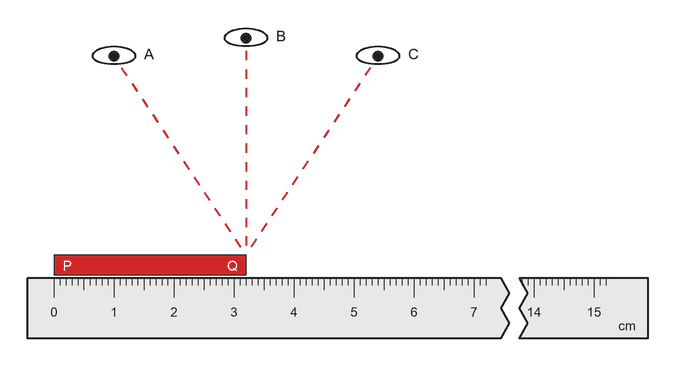
(a) Write the length of stick PQ as observed, for each position of the eye. Are they all same?
(b) Which is the correct position of the eye ? Write the correct length of the stick.
Solve with AIWritten solution
Solution:
Concept: A metre ruler is 1 m long. It is divided into 100 centimetres, and each centimetre into 10 millimetres, so it measures a length correct up to 1 mm. The ruler has some thickness, so the eye must be kept vertically above the mark being read; reading from one side gives a wrong value, the error of parallax.
Step 1 — Read the true length.
The end P of the stick is at the 0 mark. Looking straight down at the end Q, it is 2 small divisions past the 3 cm mark, that is, at 3.2 cm.
Step 2 — See what a slanting view does.
The marks lie on the top surface of the ruler, a little above the stick's end. A slanting line of sight to Q therefore crosses the marked surface beside Q instead of directly above it.
Step 3 — (a) Write the reading for each eye position.
The table gives the reading for each position of the eye.
Eye position Where the line of sight meets the scale Reading A (to the left) a little before Q about 3.1 cm (too small) B (vertically above Q) exactly at Q 3.2 cm C (to the right) a little beyond Q about 3.3 cm (too large) The three readings are not the same. The difference is caused by the error of parallax.
Step 4 — (b) Choose the correct eye position.
The eye at B is vertically above the end Q, in front of and in line with the mark to be read, so it gives the correct reading.
Watch out: The readings from A and C only show the direction of the error; how far they are off depends on how far to the side the eye is and how thick the ruler is.
Therefore, (a) the readings are about 3.1 cm from A, 3.2 cm from B and about 3.3 cm from C, so they are not the same; (b) B is the correct position of the eye, and the correct length of the stick is 3.2 cm.
- 353 marks
Question 35
Define mass. State its (i) S.I. (ii) C.G.S and (iii) F.P.S units. How are they related ?
Solve with AIWritten solution
Solution:
Concept: Mass is the quantity of matter contained in a body. Its S.I. unit is the kilogram (kg). One kg is 1000 g, one quintal is 100 kg, one metric tonne is 1000 kg, and one pound (lb) is about 453.59 g. Mass is measured with a beam balance.
Step 1 — Define mass.
The mass of a body is the quantity of matter contained in it.
Step 2 — State the units.
The table gives the unit of mass in each system.
System Unit Symbol (i) S.I. kilogram kg (ii) C.G.S. gram g (iii) F.P.S. pound lb Step 3 — Relate the kilogram and the gram.
One kilogram is a thousand grams.
Step 4 — Relate the pound.
One pound is a little less than half a kilogram.
Watch out: One kilogram is about 2.2 pounds, so a mass in pounds is a bigger number than the same mass in kilograms.
Therefore, mass is the quantity of matter in a body; its units are (i) kilogram (S.I.), (ii) gram (C.G.S.) and (iii) pound (F.P.S.), with 1 kg = 1000 g and 1 lb = 453.59 g.
- 363 marks
Question 36
Name the instrument which is commonly used to measure the mass of a body. State how it is used.
Solve with AIWritten solution
Solution:
Concept: Mass is the quantity of matter contained in a body. Its S.I. unit is the kilogram (kg). One kg is 1000 g, one quintal is 100 kg, one metric tonne is 1000 kg, and one pound (lb) is about 453.59 g. Mass is measured with a beam balance.
Step 1 — Name the instrument.
The beam balance is the instrument commonly used to measure the mass of a body.
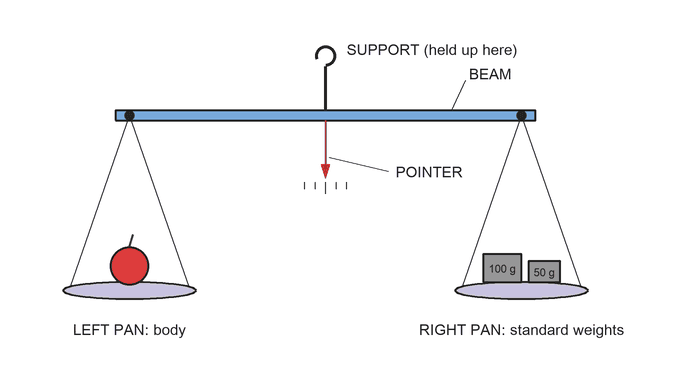
Step 2 — Describe it.
It has a straight beam held up at its middle, with a pointer in front of a small scale. Two identical pans hang from the ends of the beam by strings of equal length.
Step 3 — Check the balance first.
With both pans empty, the beam should rest horizontal and the pointer should be at the middle mark of the scale.
Step 4 — Weigh the body.
Place the body on the left pan. Put standard weights (such as 100 g, 50 g, 10 g) on the right pan, one by one, until the beam is horizontal again and the pointer is at the middle mark.
Step 5 — Read the mass.
Add up the standard weights on the right pan. Their total is the mass of the body. In the figure, 100 g + 50 g balance the apple, so its mass is 150 g.
Therefore, the beam balance measures mass: the body is placed on the left pan and standard weights on the right pan until the beam is horizontal, and the total of the weights gives the mass.
- 373 marks
Question 37
Define one kilogram, the S.I. unit of mass. How is it related to (i) quintal (ii) metric tonne and (iii) gram?
Solve with AIWritten solution
Solution:
Concept: Mass is the quantity of matter contained in a body. Its S.I. unit is the kilogram (kg). One kg is 1000 g, one quintal is 100 kg, one metric tonne is 1000 kg, and one pound (lb) is about 453.59 g. Mass is measured with a beam balance.
Step 1 — Define one kilogram.
One kilogram is, very nearly, the mass of 1 litre (1000 mL) of pure water at 4 °C. This is the everyday way to picture the S.I. unit of mass.
Step 2 — Know how it is fixed today.
From 1889 to 2019 the kilogram was the mass of a cylinder of platinum-iridium alloy kept at the International Bureau of Weights and Measures at Sèvres, near Paris. Since 2019 it has been fixed by a constant of nature, the Planck constant, so it can never change.
Step 3 — (i) Relate it to the quintal.
One quintal is 100 kg.
Step 4 — (ii) Relate it to the metric tonne.
One metric tonne is 1000 kg.
Step 5 — (iii) Relate it to the gram.
One kilogram is 1000 grams.
Therefore, one kilogram is (very nearly) the mass of 1 litre of water at 4 °C; it is 1/100 of a quintal, 1/1000 of a metric tonne and 1000 grams.
- 383 marks
Question 38
Name and define the S.I. unit of time. How is it related to (i) minute (ii) hour, (iii) day and (iv) year ?
Solve with AIWritten solution
Solution:
Concept: The S.I. unit of time is the second (s). One minute is 60 s, one hour is 60 minutes (3600 s), and one day is 24 hours (86,400 s). Short time intervals are measured with a stop clock or a stop watch.
Step 1 — Name the unit.
The S.I. unit of time is the second (symbol s).
Step 2 — Define it.
One second is part of a mean solar day. A solar day is the time from one noon to the next; its length changes a little through the year, so the average over the year, the mean solar day, is used.
Step 3 — Know how it is fixed today.
Since 1967 the second has been defined by atomic clocks, using the vibrations of caesium atoms, which are far steadier than the turning of the earth. The two definitions agree very closely.
Step 4 — (i) Relate it to the minute.
One minute is 60 seconds.
Step 5 — (ii) Relate it to the hour.
One hour is 60 minutes, so we multiply by 60.
Step 6 — (iii) Relate it to the day.
One day is 24 hours.
Step 7 — (iv) Relate it to the year.
One year is 365 days (a leap year has 366).
Therefore, the S.I. unit of time is the second, 1/86,400 of a mean solar day; 1 min = 60 s, 1 h = 3600 s, 1 day = 86,400 s and 1 year = 31,536,000 s.
- 392 marks
Question 39
Name two devices used to measure the short time interval of an event.
Solve with AIWritten solution
Solution:
Concept: The S.I. unit of time is the second (s). One minute is 60 s, one hour is 60 minutes (3600 s), and one day is 24 hours (86,400 s). Short time intervals are measured with a stop clock or a stop watch.
Step 1 — See what is needed.
A short time interval, such as a 100 m race, needs a device that can be started and stopped at once and set back to zero.
Step 2 — Name the two devices.
These are the stop clock and the stop watch. A digital stop watch can measure time correct to 0.01 s.
Therefore, two devices used to measure a short time interval are the stop clock and the stop watch.
- 402 marks
Question 40
What does the temperature measure ?
Solve with AIWritten solution
Solution:
Concept: Temperature is the degree of hotness or coldness of a body. Its S.I. unit is the kelvin (K); common units are the degree Celsius (°C) and the degree Fahrenheit (°F). Melting ice is at 0 °C and water boils at 100 °C (at normal atmospheric pressure).
Step 1 — State what temperature measures.
Temperature is the measure of the degree of hotness or coldness of a body.
Step 2 — See how it decides the flow of heat.
Heat always flows from a body at a higher temperature to a body at a lower temperature. A hot cup feels hot because heat passes from it into our hand.
Therefore, temperature measures the degree of hotness or coldness of a body.
- 412 marks
Question 41
Name the (i) S.I. unit and (ii) one common unit of temperature. Write their symbols also.
Solve with AIWritten solution
Solution:
Concept: Temperature is the degree of hotness or coldness of a body. Its S.I. unit is the kelvin (K); common units are the degree Celsius (°C) and the degree Fahrenheit (°F). Melting ice is at 0 °C and water boils at 100 °C (at normal atmospheric pressure).
Step 1 — (i) Name the S.I. unit.
The S.I. unit of temperature is the kelvin, with the symbol K.
Step 2 — (ii) Name a common unit.
A common unit is the degree Celsius, with the symbol °C. The degree Fahrenheit (°F) is another common unit.
Therefore, (i) the S.I. unit of temperature is the kelvin (K), and (ii) one common unit is the degree Celsius (°C).
- 422 marks
Question 42
Write the temperature of (i) melting ice (ii) boiling water.
Solve with AIWritten solution
Solution:
Concept: Temperature is the degree of hotness or coldness of a body. Its S.I. unit is the kelvin (K); common units are the degree Celsius (°C) and the degree Fahrenheit (°F). Melting ice is at 0 °C and water boils at 100 °C (at normal atmospheric pressure).
Step 1 — (i) Melting ice.
Pure ice melts at 0 °C. This is the lower fixed point of the Celsius scale; it is about 273 K, or 32 °F.
Step 2 — (ii) Boiling water.
Pure water boils at 100 °C at normal atmospheric pressure. This is the upper fixed point; it is about 373 K, or 212 °F.
Watch out: Water boils at 100 °C only at normal atmospheric pressure; high up on a mountain it boils at a lower temperature.
Therefore, (i) melting ice is at 0 °C, and (ii) boiling water is at 100 °C.
- 432 marks
Question 43
What is the normal temperature of the human body? How is it indicated in a clinical thermometer ?
Solve with AIWritten solution
Solution:
Concept: A clinical thermometer measures the temperature of the human body. It is marked only from 35 °C to 42 °C, with each degree divided into 10 parts, and a constriction (a narrow part of the bore) just above the bulb stops the mercury from falling back by itself.
Step 1 — State the normal temperature.
The normal temperature of a healthy human body is taken as 37 °C, which is 98.6 °F.
Step 2 — Say how it is shown.
On a clinical thermometer this temperature is marked by a red arrow on the scale (at 37 °C, or at 98.6 °F on a Fahrenheit thermometer), so it can be seen at a glance.
Note: a healthy person's temperature varies a little during the day, roughly between 36.5 °C and 37.5 °C. Doctors today usually call it a fever when the temperature reaches about 38 °C (100.4 °F).
Therefore, the normal temperature of the human body is 37 °C (98.6 °F), and it is indicated by a red arrow on a clinical thermometer.
- 442 marks
Question 44
Can a clinical thermometer be used to measure the temperature of boiling water ? Give reason for your answer.
Solve with AIWritten solution
Solution:
Concept: A clinical thermometer measures the temperature of the human body. It is marked only from 35 °C to 42 °C, with each degree divided into 10 parts, and a constriction (a narrow part of the bore) just above the bulb stops the mercury from falling back by itself.
Step 1 — Give the answer.
No, a clinical thermometer cannot be used to measure the temperature of boiling water.
Step 2 — Give the reason.
A clinical thermometer is marked only from 35 °C to 42 °C, so it can measure temperatures only up to 42 °C. Boiling water is at about 100 °C, far above this range.
Step 3 — See what would happen.
The mercury would expand far beyond the end of the narrow bore, and the thermometer could burst.
Therefore, no, because a clinical thermometer reads only up to 42 °C, while boiling water is at about 100 °C.
- 452 marks
Question 45
Explain the term 'area of a surface'.
Solve with AIWritten solution
Solution:
Concept: Area is the amount of surface occupied by an object. Its S.I. unit is the square metre (m²), the area of a square whose each side is 1 m. The area of a regular shape is worked out from its measured sides, and the area of an irregular shape is found by counting squares on a graph paper.
Step 1 — Explain the term.
The total surface occupied by an object is called its surface area, or simply its area. A brick has six faces, and the sum of their areas is its surface area.
Step 2 — Say how it is expressed.
For a rectangle, area is the product of two measured lengths.
Its S.I. unit is the square metre (m²).
Therefore, the area of a surface is the total surface occupied by an object, measured in square units such as m².
- 462 marks
Question 46
Name the S.I. unit of area and define it.
Solve with AIWritten solution
Solution:
Concept: Area is the amount of surface occupied by an object. Its S.I. unit is the square metre (m²), the area of a square whose each side is 1 m. The area of a regular shape is worked out from its measured sides, and the area of an irregular shape is found by counting squares on a graph paper.
Step 1 — Name the unit.
The S.I. unit of area is the square metre (symbol m²).
Step 2 — Define it.
One square metre is the area of a square whose each side is 1 metre.
Therefore, the S.I. unit of area is the square metre (m²), the area of a square of each side 1 m.
- 473 marks
Question 47
How are the units (i) square yard (ii) hectare (iii) km,² (iv) cm² (v) mm² related to the S.I. unit of area ?
Solve with AIWritten solution
Solution:
Concept: Area is the amount of surface occupied by an object. Its S.I. unit is the square metre (m²), the area of a square whose each side is 1 m. The area of a regular shape is worked out from its measured sides, and the area of an irregular shape is found by counting squares on a graph paper.
Step 1 — (i) Square yard.
One yard is 0.9144 m, so a square of side 1 yard has the area below.
Step 2 — (ii) Hectare.
One hectare is the area of a square of side 100 m.
Step 3 — (iii) Square kilometre.
One kilometre is 1000 m, so a square of side 1 km has the area below.
Step 4 — (iv) Square centimetre.
One centimetre is m.
Step 5 — (v) Square millimetre.
One millimetre is m.
Step 6 — Collect the results.
The table puts the five relations together.
Unit Value in m² 1 square yard about 0.836 m² 1 hectare m² 1 km² m² 1 cm² m² 1 mm² m² Watch out: Square the length relation: 1 cm is 1/100 m, but 1 cm² is 1/10,000 m².
Therefore, 1 square yard ≈ 0.836 m², 1 hectare = 10⁴ m², 1 km² = 10⁶ m², 1 cm² = 10⁻⁴ m² and 1 mm² = 10⁻⁶ m².
- 484 marks
Question 48
(a) Describe in steps how would you measure the length of a pencil using a metre ruler. Draw a diagram if necessary.
(b) Explain with an example how you will use the metre ruler in part (a) if the ends of the ruler are broken.
Solve with AIWritten solution
Solution:
Concept: A metre ruler is 1 m long. It is divided into 100 centimetres, and each centimetre into 10 millimetres, so it measures a length correct up to 1 mm. The ruler has some thickness, so the eye must be kept vertically above the mark being read; reading from one side gives a wrong value, the error of parallax.
Step 1 — (a) Place the ruler.
Place the pencil along the metre ruler so that the marked edge of the ruler touches the pencil.
Step 2 — (a) Set the zero mark.
Make the zero mark of the ruler coincide with one end A of the pencil.
Step 3 — (a) Read the other end.
Keep the eye vertically above the other end B, in line with the mark to be read, and note the mark. A slanting view would give a wrong reading because of the thickness of the ruler (the error of parallax).

Step 4 — (a) Write the length.
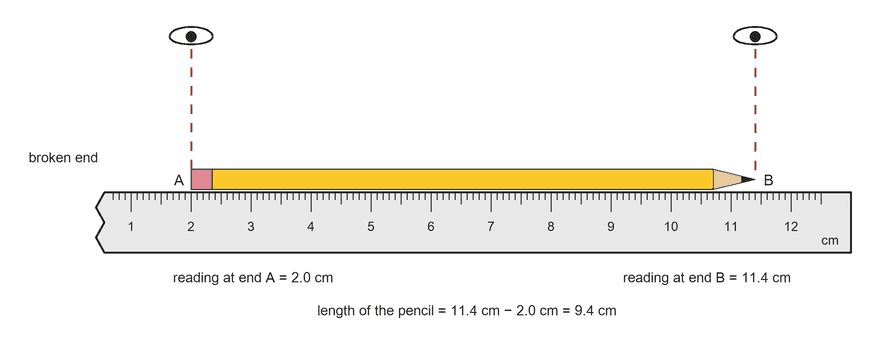
The reading at end B is the length of the pencil. In the example in the figure, end B is at 9.4 cm, so the pencil is 9.4 cm long, measured correct up to 1 mm.
Step 5 — (b) Avoid the broken end.
If the ends of the ruler are broken, its zero mark cannot be used. Place one end A of the pencil exactly at a clear full mark away from the broken end, for example the 2.0 cm mark.
Step 6 — (b) Read both ends.
With the eye vertically above each end in turn, read the marks at both ends.
Step 7 — (b) Subtract.
The length is the difference of the two readings. In the example, end A is at 2.0 cm and end B is at 11.4 cm.
Watch out: Never start from a broken or worn end of a ruler; the distance from it to the first mark may not be correct.
Therefore, (a) with end A at the zero mark and the eye vertically above end B, the reading at B gives the length (9.4 cm in the example); (b) with a broken ruler, read both ends and subtract: 11.4 cm − 2.0 cm = 9.4 cm.
- 493 marks
Question 49
Name the instrument used for measuring the temperature of a person. Draw its neat labelled diagram.
Solve with AIWritten solution
Solution:
Concept: A clinical thermometer measures the temperature of the human body. It is marked only from 35 °C to 42 °C, with each degree divided into 10 parts, and a constriction (a narrow part of the bore) just above the bulb stops the mercury from falling back by itself.
Step 1 — Name the instrument.
The temperature of a person is measured with a clinical thermometer.
Step 2 — Draw the labelled diagram.
The diagram shows its parts.
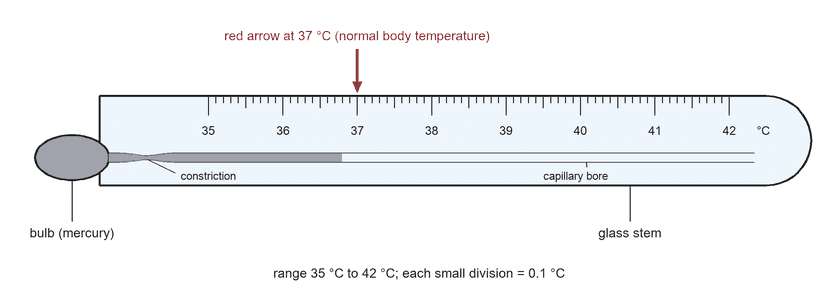
Step 3 — Describe the parts.
Each labelled part has its own job.
- Bulb: it holds the mercury and is kept under the tongue or in the armpit.
- Constriction: a very narrow part of the bore just above the bulb; it stops the mercury from falling back by itself.
- Capillary bore and glass stem: the mercury rises in the fine bore inside the glass stem, which is marked from 35 °C to 42 °C.
- Red arrow: it marks 37 °C, the normal temperature of a healthy person.
Note: digital clinical thermometers are now common, and mercury thermometers are being phased out in many countries because mercury is poisonous.
Therefore, the instrument is the clinical thermometer; its diagram shows the bulb, the constriction, the capillary bore in the glass stem marked 35 °C to 42 °C, and the red arrow at 37 °C.
- 504 marks
Question 50
What is a clinical thermometer ? State its special features. Draw a neat labelled diagram of a clinical thermometer showing the range of temperature marked on it.
Solve with AIWritten solution
Solution:
Concept: A clinical thermometer measures the temperature of the human body. It is marked only from 35 °C to 42 °C, with each degree divided into 10 parts, and a constriction (a narrow part of the bore) just above the bulb stops the mercury from falling back by itself.
Step 1 — Define it.
A clinical thermometer is a special thermometer used to measure the temperature of the human body.
Step 2 — Feature 1: a short range.
It is marked only from 35 °C to 42 °C, because the temperature of a living person normally stays within this range. (A Fahrenheit clinical thermometer is marked from about 94 °F to 108 °F.)
Step 3 — Feature 2: fine divisions.
Each degree is divided into 10 parts, so it reads correct up to 0.1 °C.
Step 4 — Feature 3: a constriction.
Just above the bulb the bore has a very narrow part, the constriction. When the thermometer is taken out of the mouth, the mercury thread breaks at the constriction and cannot fall back by itself, so the reading can be noted calmly. Before the next use, the thermometer is given a few jerks to send the mercury back below 35 °C.
Step 5 — Feature 4: a red arrow.
The normal temperature of a healthy person, 37 °C (98.6 °F), is marked by a red arrow.
Step 6 — Draw the labelled diagram.
The diagram shows the range of temperature marked on it.
Note: digital clinical thermometers are now common, and mercury thermometers are being phased out in many countries because mercury is poisonous.
Therefore, a clinical thermometer measures human body temperature; it has a short range of 35 °C to 42 °C, divisions of 0.1 °C, a constriction above the bulb and a red arrow at 37 °C.
- 514 marks
Question 51
Explain how you will measure the area of (i) a square (b) a leaf ?
Solve with AIWritten solution
Solution:
Concept: Area is the amount of surface occupied by an object. Its S.I. unit is the square metre (m²), the area of a square whose each side is 1 m. The area of a regular shape is worked out from its measured sides, and the area of an irregular shape is found by counting squares on a graph paper.
Step 1 — (i) Measure the side of the square.
A square is a regular shape, so its area is worked out from its side. Measure the length of one side with a metre ruler; all four sides of a square are equal.
Step 2 — (i) Calculate the area.
The area of a square is side × side. For example, a square of side 3 cm has the area below.
Step 3 — (b) Trace the leaf.
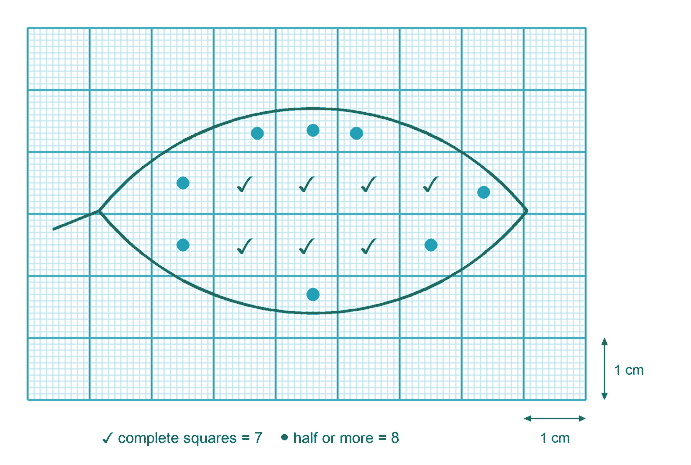
A leaf has an irregular shape, so a graph paper is used. Place the leaf on a graph paper, draw its outline with a sharp pencil and remove the leaf.
Step 4 — (b) Count the squares.
Count the complete squares (each 1 cm × 1 cm) inside the outline, and mark them ✓. Then count the squares that are half or more than half inside the outline, and mark them ●. Leave out the squares that are less than half inside.
Step 5 — (b) Calculate the area.
Add the two counts and multiply by the area of one square. In the figure there are 7 complete squares and 8 squares that are half or more inside.
Watch out: The leaf's area is only approximate; a graph paper with smaller squares gives a closer value.
Therefore, (i) the area of a square is side × side (9 cm² for a side of 3 cm); (b) the area of a leaf is found by counting squares on a graph paper, about 15 cm² for the leaf in the figure.
- 523 marks
Question 52
Name the device which you will use to measure the perimeter of your play ground. Describe in steps how you will use it.
Solve with AIWritten solution
Solution:
Concept: The S.I. unit of length is the metre (m). One kilometre is 1000 m, one metre is 100 cm and one centimetre is 10 mm. In the F.P.S. system, one foot is 12 inches, one yard is 3 feet, and one inch is 2.54 cm.
Step 1 — Name the device.
A measuring tape is used. It is a long, flexible strip of cloth, plastic, fibre glass or steel, marked in metres and centimetres, usually 50 m or 100 m long. It can also follow a curved boundary.
Step 2 — Start at a corner.
Ask a friend to hold the zero end of the tape firmly at one corner of the playground.
Step 3 — Measure the first side.
Stretch the tape straight and tight along the boundary up to the next corner, and read the mark there with the eye vertically above it.
Step 4 — Measure every side.
Repeat for each side until you come back to the starting corner. If a side is longer than the tape, mark where the tape ends, move the zero end to that mark and continue.
Step 5 — Add the lengths.
The perimeter is the sum of the lengths of all the sides. For example, a rectangular playground with sides 50 m and 30 m has the perimeter below.
Therefore, a measuring tape is used: measure each side along the boundary with the eye vertically above the reading, and add the lengths of all the sides to get the perimeter.
- 534 marks
Question 53
Convert the following quantities as indicated :
(a) 12 inch = ........ ft (b) 1 ft = ........ cm
(c) 20 cm = ........ m (d) 4.2 m = ........ cm
(e) 0.2 km = ........ m (f) 0.2 cm = ........ mm
(g) 1 yard = ........ m
Solve with AIWritten solution
Solution:
Concept: The S.I. unit of length is the metre (m). One kilometre is 1000 m, one metre is 100 cm and one centimetre is 10 mm. In the F.P.S. system, one foot is 12 inches, one yard is 3 feet, and one inch is 2.54 cm.
Step 1 — (a) 12 inch into ft.
One foot is 12 inches, so we divide by 12.
Step 2 — (b) 1 ft into cm.
One foot is 12 inches and one inch is 2.54 cm, so we multiply.
Step 3 — (c) 20 cm into m.
One metre is 100 cm, so we divide by 100.
Step 4 — (d) 4.2 m into cm.
One metre is 100 cm, so we multiply by 100.
Step 5 — (e) 0.2 km into m.
One kilometre is 1000 m, so we multiply by 1000.
Step 6 — (f) 0.2 cm into mm.
One centimetre is 10 mm, so we multiply by 10.
Step 7 — (g) 1 yard into m.
One yard is 36 inches, and each inch is 2.54 cm.
Watch out: Multiply when changing into a smaller unit (m into cm) and divide when changing into a bigger unit (cm into m).
Therefore, (a) 1 ft, (b) 30.48 cm, (c) 0.2 m, (d) 420 cm, (e) 200 m, (f) 2 mm, (g) about 0.91 m.
- 544 marks
Question 54
Express in second (i) 3 minute 15 second, and (ii) 5 hour 2 minute 5 second.
Solve with AIWritten solution
Solution:
Concept: The S.I. unit of time is the second (s). One minute is 60 s, one hour is 60 minutes (3600 s), and one day is 24 hours (86,400 s). Short time intervals are measured with a stop clock or a stop watch.
Step 1 — (i) Change the minutes into seconds.
One minute is 60 s.
Step 2 — (i) Add the seconds.
Now we add the 15 s that are left over.
Step 3 — (ii) Change the hours into seconds.
One hour is 3600 s.
Step 4 — (ii) Change the minutes into seconds.
One minute is 60 s.
Step 5 — (ii) Add all the parts.
Now we add the hours, the minutes and the 5 s, all in seconds.
Watch out: One hour is 3600 s, not 60 s; change every part into seconds before adding.
Therefore, (i) 3 minute 15 second = 195 s, and (ii) 5 hour 2 minute 5 second = 18,125 s.
- 554 marks
Question 55
Convert the following quantities as indicated :
(a) 2500 kg = ........ metric tonne
(b) 150 kg = ........ quintal
(c) 10 lb = ........ kg (d) 2500 g = ........ kg
(e) 0.01 kg = ........ g (f) 5 mg = ........ kg
Solve with AIWritten solution
Solution:
Concept: Mass is the quantity of matter contained in a body. Its S.I. unit is the kilogram (kg). One kg is 1000 g, one quintal is 100 kg, one metric tonne is 1000 kg, and one pound (lb) is about 453.59 g. Mass is measured with a beam balance.
Step 1 — (a) 2500 kg into metric tonne.
One metric tonne is 1000 kg, so we divide by 1000.
Step 2 — (b) 150 kg into quintal.
One quintal is 100 kg, so we divide by 100.
Step 3 — (c) 10 lb into kg.
One pound is 453.59 g, so we multiply, then change grams into kilograms.
Step 4 — (d) 2500 g into kg.
One kilogram is 1000 g, so we divide by 1000.
Step 5 — (e) 0.01 kg into g.
One kilogram is 1000 g, so we multiply by 1000.
Step 6 — (f) 5 mg into kg.
One milligram is g, and one gram is kg, so one milligram is kg.
Watch out: 1 mg is a thousandth of a gram, so it is a millionth of a kilogram ( kg), not kg.
Therefore, (a) 2.5 metric tonne, (b) 1.5 quintal, (c) 4.5359 kg, (d) 2.5 kg, (e) 10 g, (f) 5 × 10⁻⁶ kg.
What Class 6 Physics Ch 2 covers
The sections of the chapter, in the order the book takes them. Every question above comes from one of these.
- 01Measurement – Its Importance
- 02Choice of Unit
- 03Basic Physical Quantities
- 04Measurement of Length
- 05Measurement of Mass
- 06Measurement of Time
More ways to study this chapter
The same chapter asked three other ways. Practise it, revise it, and see what the board has set on Ch 2 before.
Class 6 Physics Ch 2 questions students ask
How many questions are there in Class 6 Physics Ch 2?
55 questions. Every one is solved step by step on this page.
Are these Class 6 Physics solutions free?
Yes. Every question and its full working is free to read, with no account needed.
Can I download the Class 6 Physics Ch 2 solutions as a PDF?
There is no PDF to download. Every solution is on this page instead, which means it is searchable, always the current syllabus, and readable on a phone. Use your browser's print option if you want it on paper.