Solution:
Concept: A metre ruler is 1 m long. It is divided into 100 centimetres, and each centimetre into 10 millimetres, so it measures a length correct up to 1 mm. The ruler has some thickness, so the eye must be kept vertically above the mark being read; reading from one side gives a wrong value, the error of parallax.
Step 1 — Read the true length.
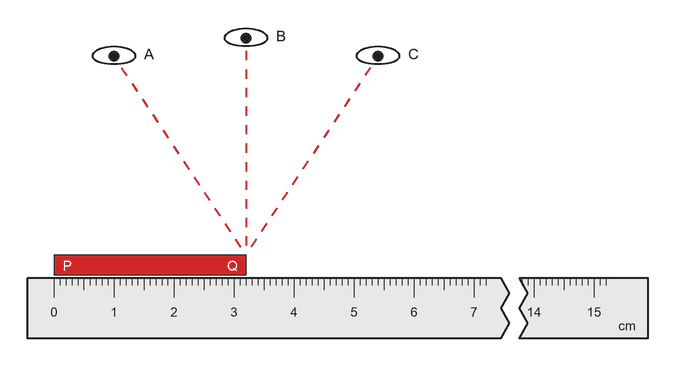
The end P of the stick is at the 0 mark. Looking straight down at the end Q, it is 2 small divisions past the 3 cm mark, that is, at 3.2 cm.
Step 2 — See what a slanting view does.
The marks lie on the top surface of the ruler, a little above the stick's end. A slanting line of sight to Q therefore crosses the marked surface beside Q instead of directly above it.
Step 3 — (a) Write the reading for each eye position.
The table gives the reading for each position of the eye.
| Eye position | Where the line of sight meets the scale | Reading |
|---|
| A (to the left) | a little before Q | about 3.1 cm (too small) |
| B (vertically above Q) | exactly at Q | 3.2 cm |
| C (to the right) | a little beyond Q | about 3.3 cm (too large) |
The three readings are not the same. The difference is caused by the error of parallax.
Step 4 — (b) Choose the correct eye position.
The eye at B is vertically above the end Q, in front of and in line with the mark to be read, so it gives the correct reading.
Watch out: The readings from A and C only show the direction of the error; how far they are off depends on how far to the side the eye is and how thick the ruler is.
Therefore, (a) the readings are about 3.1 cm from A, 3.2 cm from B and about 3.3 cm from C, so they are not the same; (b) B is the correct position of the eye, and the correct length of the stick is 3.2 cm.