
Question 484 marksEasy
(a) Describe in steps how would you measure the length of a pencil using a metre ruler. Draw a diagram if necessary.
(b) Explain with an example how you will use the metre ruler in part (a) if the ends of the ruler are broken.
Confirming your payment
Sign up now and get 250 free tokens.
Physical Quantities and Measurement · Question 48 of 55
(a) Describe in steps how would you measure the length of a pencil using a metre ruler. Draw a diagram if necessary.
(b) Explain with an example how you will use the metre ruler in part (a) if the ends of the ruler are broken.
Solution:
Concept: A metre ruler is 1 m long. It is divided into 100 centimetres, and each centimetre into 10 millimetres, so it measures a length correct up to 1 mm. The ruler has some thickness, so the eye must be kept vertically above the mark being read; reading from one side gives a wrong value, the error of parallax.
Step 1 — (a) Place the ruler.
Place the pencil along the metre ruler so that the marked edge of the ruler touches the pencil.
Step 2 — (a) Set the zero mark.
Make the zero mark of the ruler coincide with one end A of the pencil.
Step 3 — (a) Read the other end.
Keep the eye vertically above the other end B, in line with the mark to be read, and note the mark. A slanting view would give a wrong reading because of the thickness of the ruler (the error of parallax).

Step 4 — (a) Write the length.
The reading at end B is the length of the pencil. In the example in the figure, end B is at 9.4 cm, so the pencil is 9.4 cm long, measured correct up to 1 mm.
Step 5 — (b) Avoid the broken end.
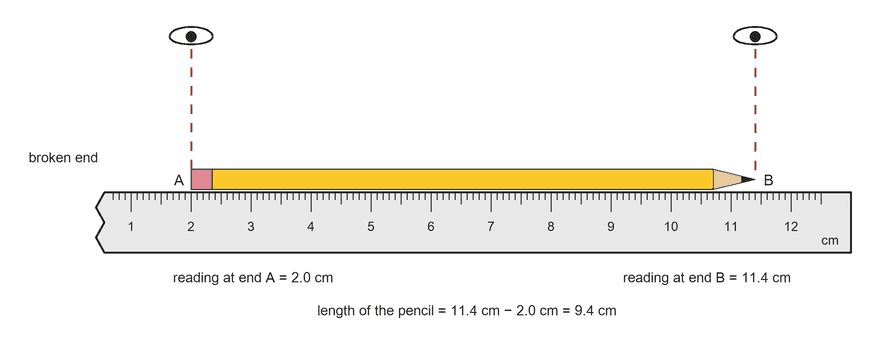
If the ends of the ruler are broken, its zero mark cannot be used. Place one end A of the pencil exactly at a clear full mark away from the broken end, for example the 2.0 cm mark.
Step 6 — (b) Read both ends.
With the eye vertically above each end in turn, read the marks at both ends.
Step 7 — (b) Subtract.
The length is the difference of the two readings. In the example, end A is at 2.0 cm and end B is at 11.4 cm.
Watch out: Never start from a broken or worn end of a ruler; the distance from it to the first mark may not be correct.
Therefore, (a) with end A at the zero mark and the eye vertically above end B, the reading at B gives the length (9.4 cm in the example); (b) with a broken ruler, read both ends and subtract: 11.4 cm − 2.0 cm = 9.4 cm.