
Question 504 marksEasy
What is a clinical thermometer ? State its special features. Draw a neat labelled diagram of a clinical thermometer showing the range of temperature marked on it.
Confirming your payment
Sign up now and get 250 free tokens.
Physical Quantities and Measurement · Question 50 of 55
What is a clinical thermometer ? State its special features. Draw a neat labelled diagram of a clinical thermometer showing the range of temperature marked on it.
Solution:
Concept: A clinical thermometer measures the temperature of the human body. It is marked only from 35 °C to 42 °C, with each degree divided into 10 parts, and a constriction (a narrow part of the bore) just above the bulb stops the mercury from falling back by itself.
Step 1 — Define it.
A clinical thermometer is a special thermometer used to measure the temperature of the human body.
Step 2 — Feature 1: a short range.
It is marked only from 35 °C to 42 °C, because the temperature of a living person normally stays within this range. (A Fahrenheit clinical thermometer is marked from about 94 °F to 108 °F.)
Step 3 — Feature 2: fine divisions.
Each degree is divided into 10 parts, so it reads correct up to 0.1 °C.
Step 4 — Feature 3: a constriction.
Just above the bulb the bore has a very narrow part, the constriction. When the thermometer is taken out of the mouth, the mercury thread breaks at the constriction and cannot fall back by itself, so the reading can be noted calmly. Before the next use, the thermometer is given a few jerks to send the mercury back below 35 °C.
Step 5 — Feature 4: a red arrow.
The normal temperature of a healthy person, 37 °C (98.6 °F), is marked by a red arrow.
Step 6 — Draw the labelled diagram.
The diagram shows the range of temperature marked on it.
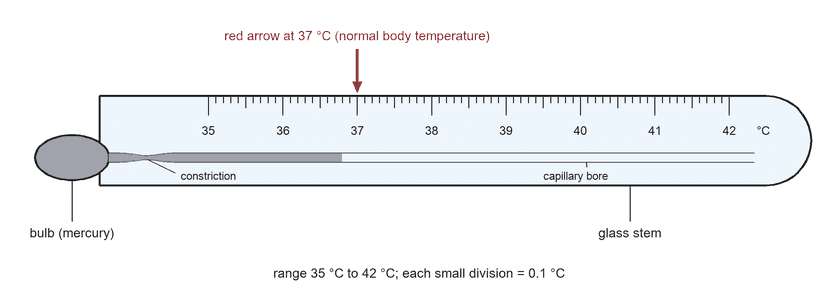
Note: digital clinical thermometers are now common, and mercury thermometers are being phased out in many countries because mercury is poisonous.
Therefore, a clinical thermometer measures human body temperature; it has a short range of 35 °C to 42 °C, divisions of 0.1 °C, a constriction above the bulb and a red arrow at 37 °C.