
Question 514 marksEasy
Explain how you will measure the area of (i) a square (b) a leaf ?
Confirming your payment
Sign up now and get 250 free tokens.
Physical Quantities and Measurement · Question 51 of 55
Explain how you will measure the area of (i) a square (b) a leaf ?
Solution:
Concept: Area is the amount of surface occupied by an object. Its S.I. unit is the square metre (m²), the area of a square whose each side is 1 m. The area of a regular shape is worked out from its measured sides, and the area of an irregular shape is found by counting squares on a graph paper.
Step 1 — (i) Measure the side of the square.
A square is a regular shape, so its area is worked out from its side. Measure the length of one side with a metre ruler; all four sides of a square are equal.
Step 2 — (i) Calculate the area.
The area of a square is side × side. For example, a square of side 3 cm has the area below.
Step 3 — (b) Trace the leaf.
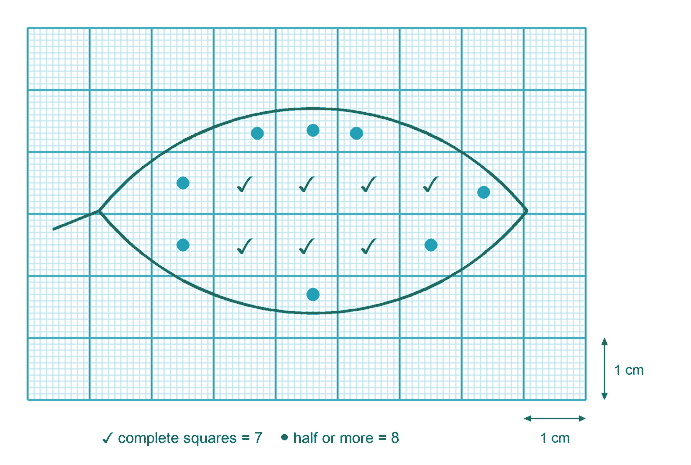
A leaf has an irregular shape, so a graph paper is used. Place the leaf on a graph paper, draw its outline with a sharp pencil and remove the leaf.
Step 4 — (b) Count the squares.
Count the complete squares (each 1 cm × 1 cm) inside the outline, and mark them ✓. Then count the squares that are half or more than half inside the outline, and mark them ●. Leave out the squares that are less than half inside.
Step 5 — (b) Calculate the area.
Add the two counts and multiply by the area of one square. In the figure there are 7 complete squares and 8 squares that are half or more inside.
Watch out: The leaf's area is only approximate; a graph paper with smaller squares gives a closer value.
Therefore, (i) the area of a square is side × side (9 cm² for a side of 3 cm); (b) the area of a leaf is found by counting squares on a graph paper, about 15 cm² for the leaf in the figure.