
Opening your dashboard
Class 6 Physics Chapter 2 Physical Quantities and Measurement: Competency-Based Questions (CBQ)
40 questions on Chapter 2, each worked through on its own page with the AI tutor. Class 6 Physics, ICSE 2026-27.
40 questions
1–5 marks · Mixed difficulty
- 11 mark
Question 1
Competency: Application & Analysis
Riya and her elder brother Kabir measure the length of the same school corridor by counting their footsteps. Riya counts 48 steps and Kabir counts 40 steps. They then measure it with a measuring tape, and both get 24 m.
Which conclusion is correct?
- 21 mark
Question 2
Competency: Application & Analysis
A carpenter needs one wooden board that is at least 1.2 m long to make a shelf. A shop has four boards with these lengths marked on them: 95 cm, 1150 mm, 4 ft and 45 inch.
Which board is long enough? (1 ft = 30.48 cm, 1 inch = 2.54 cm)
- 31 mark
Question 3
Competency: Application
A small truck is allowed to carry a load of at most 2 metric tonne. It has already been loaded with 15 sacks of wheat of mass 1 quintal each and 40 crates of fruit of mass 12 kg each.
How much more load can the truck carry?
- 41 mark
Question 4
Competency: Application
The pendulum of a wall clock takes 2 second to complete one to-and-fro oscillation. Tara has no watch. She counts that the pendulum completes 90 oscillations while a kettle of water comes to the boil.
How long did the water take to boil?
- 51 mark
Question 5
Competency: Understanding
Assertion (A): The reading of a clinical thermometer can be noted correctly even after it has been taken out of the patient's mouth.
Reason (R): A clinical thermometer has a constriction (kink) in its stem just above the bulb, which prevents the mercury from falling back by itself.
- 61 mark
Question 6
Competency: Understanding
Assertion (A): The kilogram is a more convenient unit than the gram for expressing the mass of a gold ring.
Reason (R): The kilogram is the S.I. unit of mass.
- 72 marks
Question 7
Competency: Understanding & Analysis
Rohan looks at the two straight lines PQ and RS shown below and says, "RS is clearly longer than PQ." He then measures both lines with a ruler and finds that each of them is 8.4 cm long.
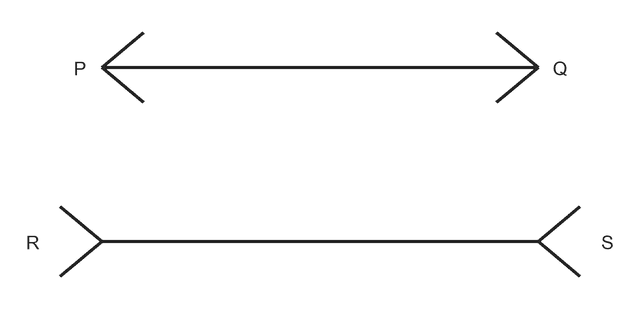
(a) What does this observation show about judging a length by sight alone?
(b) Give one other everyday example in which a sense of our body can give a wrong idea of a quantity, and name the instrument that should be used instead.
- 82 marks
Question 8
Competency: Application & Evaluation
A gardener wants to find the distance around the trunk of a mango tree. He has a wooden metre ruler and a tailor's measuring tape.
(a) Which of the two can he use directly on the trunk? Give a reason.
(b) When the tape is wrapped once around the trunk, its zero mark meets the 135 cm mark. Express the distance around the trunk in metre. His son says, "With a long thread, the metre ruler can also be used to get this distance." Is the son right? Explain briefly.
- 92 marks
Question 9
Competency: Application
Meera puts an empty steel bowl on an electronic balance. The screen shows 240 g. She fills the bowl with rice, and the screen now shows 1.09 kg.
(a) Find the mass of the rice in the bowl, in gram and in kilogram.
(b) She needs 3.4 kg of rice for a family function. How many such bowlfuls of rice must she measure out?
- 102 marks
Question 10
Competency: Application
A farmer has a rectangular field 250 m long and 140 m broad. The seed packet he buys says: "Use 20 kg of seed for each hectare of land."
(a) Find the area of the field in and in hectare. (1 hectare = 10000 )
(b) How much seed does he need for the whole field?
- 113 marks
Question 11
Competency: Application & Analysis
Case study: Arjun is feeling unwell. His mother keeps a clinical thermometer under his tongue for about a minute, takes it out and holds it level with her eyes. The thermometer looks as shown below.

(a) What temperature does one small division of this thermometer stand for? Read Arjun's temperature.
(b) What does the red arrow on the thermometer mark? By how many degrees is Arjun's temperature above it?
(c) Without jerking the thermometer, his mother at once puts it under the tongue of Arjun's sister, whose body temperature is actually 37.2°C. What will the thermometer show? Explain, and state what she should have done first.
- 124 marks
Question 12
Competency: Analysis & Evaluation
Case study: In a games period, the teacher times three students, one at a time, as each runs once around the basketball court. She starts a stop clock from zero when the student starts and stops it when the student finishes. Every run takes less than one minute. The dial of the stop clock at the end of Anu's run is shown below.
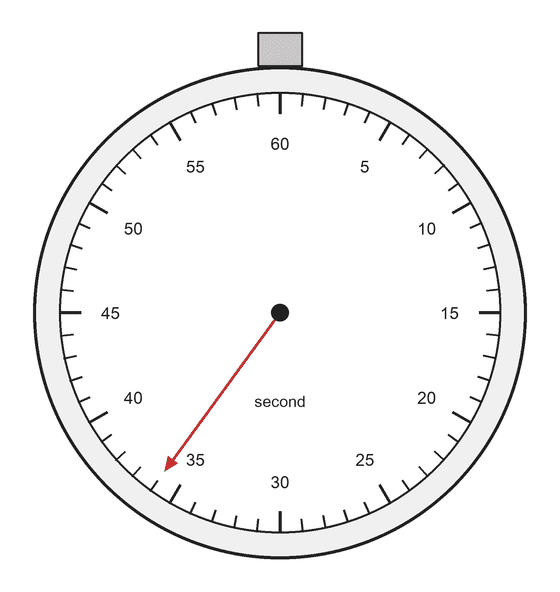
The times of the other two students are given in the table.
Student Anu Bela Charu Time taken as shown on the dial 41 s 33 s (a) What time interval does one small division of this dial stand for? Read the time taken by Anu.
(b) Who is the fastest of the three? How much less time did the fastest student take than the slowest?
(c) In a second round, the stop clock shows 33 s for both Charu and Anu. The teacher says, "So both of them took exactly the same time." Is this conclusion certain? Suggest a better device for deciding such a close result and give a reason.
- 134 marks
Question 13
Competency: Analysis & Evaluation
Case study: For a project on plants, Zoya traces the outlines of three leaves P, Q and R on a graph paper in which each square has a side of 1 cm. For each outline she counts the squares of three kinds and records them in a table.
Leaf Complete squares Squares that are half or more than half inside Squares that are less than half inside P 18 9 7 Q 21 5 10 R 14 10 6 (a) Find the approximate area of each leaf. Which leaf has the largest area?
(b) Why are the squares that are less than half inside the outline left out, while those that are half or more are counted as complete?
(c) Her friend Imran says, "It is simpler to count every square that the leaf touches as one full square." Find the area of each leaf by Imran's method. Is his method acceptable? Does it change the answer to the question 'which leaf is the largest'?
- 144 marks
Question 14
Competency: Creation
You are asked to find the diameter of a cricket ball. You are given a metre ruler and two rectangular wooden blocks, and you may work on a flat table.
(a) Why can the diameter not be measured correctly by simply holding the ruler against the ball? Plan, in steps, a method to measure it with the things given. You may draw a diagram.
(b) State two precautions you will take.
(c) In one trial, the inner faces of the two blocks are at the 12.4 cm mark and the 19.6 cm mark of the ruler. Find the diameter of the ball in cm and in mm. How will you check that this value can be trusted?
- 154 marks
Question 15
Competency: Analysis & Evaluation
Case study: A school keeps a health card for every student. Part of Sara's card is shown below. The entries of the two years were written by different teachers, who did not use the same units.
Quantity Last year This year Height 138 cm 1.45 m Mass 34 kg 38500 g Body temperature 37°C 98.6°F Time for a 50 m run 12.5 s 10 s (a) By how much have Sara's height and mass increased in one year?
(b) A classmate reads the card and says, "Her body temperature has gone up from 37 to 98.6, so she has high fever." Judge this statement.
(c) Speed = distance ÷ time. Find Sara's speed in the 50 m run in each year. Is speed a basic (fundamental) quantity or a derived quantity? Give a reason.
- 161 mark
Question 16
Competency: Application
A tailor has yard of cloth to stitch curtains, but the shop's rate list is given per metre. Taking yard m, about how many metre of cloth does the tailor have ?
- 171 mark
Question 17
Competency: Analysis
Three students measure the same rope without a ruler. Asha uses a unit X, Bilal uses a unit Y and Charu uses a unit Z. Asha finds that the rope is X long, Bilal finds that it is Y long and Charu finds that it is Z long. Which statement is correct ?
- 181 mark
Question 18
Competency: Analysis
Riya dips the bulb of a laboratory thermometer in warm water. She waits until the mercury stops rising and then keeps her eye level with the top of the mercury thread. The thermometer is shown below. Between two neighbouring numbered marks the scale has equal divisions.
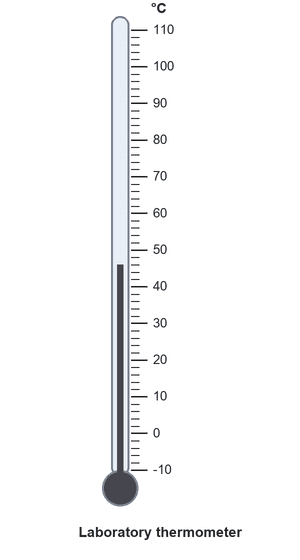
What is the temperature of the water ?
- 191 mark
Question 19
Competency: Analysis
(Hypothetical data.) Naveen wants to find the time taken by a pendulum to make one oscillation. When he starts and stops a stop watch by hand, the time he notes can be wrong by about s. In Method X he times one oscillation. In Method Y he times oscillations, which take s, and divides the time by . Which method gives a more reliable time for one oscillation, and why ?
- 201 mark
Question 20
Competency: Understanding
Assertion (A): One square centimetre is equal to of a square metre.
Reason (R): One centimetre is equal to of a metre.
- 211 mark
Question 21
Competency: Understanding
Assertion (A): A change of in temperature is larger than a change of .
Reason (R): Between the ice point and the steam point there are divisions on the Celsius scale but divisions on the Fahrenheit scale.
- 221 mark
Question 22
Competency: Application
(Hypothetical data.) A doctor advises Kavya to take tablets, times a day, for days. Each tablet has a mass of mg. What is the total mass of the tablets she takes, in gram ?
- 231 mark
Question 23
Competency: Application
A circular playground has a radius of m. Taking , find its area in are. ( are )
- 241 mark
Question 24
Competency: Evaluation
A steel spoon and a wooden spoon have been lying on a table in the same room for a whole day. When Amit touches them, the steel spoon feels colder than the wooden spoon. (Steel takes heat away from the hand faster than wood does.) He then touches the bulb of a laboratory thermometer to each spoon in turn, waits for the mercury to settle, and reads for both. (Hypothetical data.) Which conclusion is best supported by these facts ?
- 251 mark
Question 25
Competency: Application
Water in a beaker is warmed from to . By how much does its temperature rise on the kelvin scale and on the Fahrenheit scale ? (One degree celsius degree fahrenheit.)
- 262 marks
Question 26
Competency: Evaluation
(Hypothetical data.) A shopkeeper's kg standard weight has had a piece broken off its base, and its true mass is now only g. A customer asks for kg of rice, and the shopkeeper balances the rice against this weight three times on a beam balance.
(a) How much rice, in kg, does the customer actually get ?
(b) Which property of a good unit is lost when a standard weight is damaged in this way ? Explain.
- 272 marks
Question 27
Competency: Application
A basketball ring is fixed at a height of ft above the ground. ( ft cm)
(a) Find the height of the ring in cm and in m.
(b) A player m tall stands under the ring. By how many metre is the ring higher than the top of his head ?
- 282 marks
Question 28
Competency: Analysis
(Hypothetical data.) A wall clock loses s every day. It is set right at 12 noon on 1 January.
(a) By how many minute is it behind the correct time at 12 noon on 21 January ?
(b) What time does the clock show at that moment ?
- 292 marks
Question 29
Competency: Evaluation
Priya wants to measure the temperature of hot water in a beaker with a laboratory thermometer. She dips the bulb into the water and, as soon as the mercury starts to rise, she bends over the thermometer and reads the scale from above the top of the mercury thread.
(a) Point out the two mistakes in her method.
(b) State how each mistake should be corrected.
- 302 marks
Question 30
Competency: Application
A triangular signboard has a base of m and a height of m.
(a) Find its area in .
(b) Express the area in .
- 313 marks
Question 31
Competency: Analysis
(Hypothetical data.) Three friends estimate the length of the school corridor by eye. Rani says m, Sam says m and Tina says m. When the corridor is measured with a measuring tape, its length is m.
(a) Find the error in each estimate, in metre.
(b) Whose estimate is closest to the measured length ?
(c) Why cannot such estimates be used to order a carpet for the corridor ?
- 323 marks
Question 32
Competency: Evaluation
(Hypothetical data.) The smallest division on a metre ruler is mm. Three students measure the length of the same eraser with this ruler and write down these reports: Dev writes cm, Esha writes cm and Farid writes mm.
(a) Which two reports give the same length ?
(b) Which report claims more accuracy than the ruler is able to give ? Give a reason.
(c) Express the length of the eraser in metre.
- 333 marks
Question 33
Competency: Application
(Hypothetical data.) Ritu buys vegetables. Her shopping bag can carry at most kg.
Vegetable Mass bought Rate Potatoes 2 kg 500 g ₹24 per kg Onions 750 g ₹40 per kg Tomatoes 1.25 kg ₹32 per kg (a) Find the total mass of the vegetables in kg.
(b) Find the total amount she pays.
(c) She now wants to add g of ginger. Can the bag carry it ? How many gram more can the bag take at most ?
- 343 marks
Question 34
Competency: Application
(Hypothetical data.) Aman sleeps for h every night. Take year days.
(a) Express the time he sleeps in one night in second.
(b) Find the total time he sleeps in a year in hour, and then in days and hours.
(c) What fraction of the whole year does he spend asleep ?
- 353 marks
Question 35
Competency: Analysis
(Hypothetical data.) Maya heats water in a beaker on a gas stove and notes its temperature with a laboratory thermometer every min.
Time (in min) 0 2 4 6 Temperature (in °C) 28 40 52 64 Assume that the temperature keeps rising in the same steady way.
(a) By how many °C does the temperature rise in every min ?
(b) What will the thermometer read at min ?
(c) After how many minute from the start will the water begin to boil ? (Boiling point of water .)
- 363 marks
Question 36
Competency: Analysis
(Hypothetical data.) A rectangular notice board is m long and m broad. Twelve identical sheets of paper, each cm long and cm broad, are pasted on it as shown.
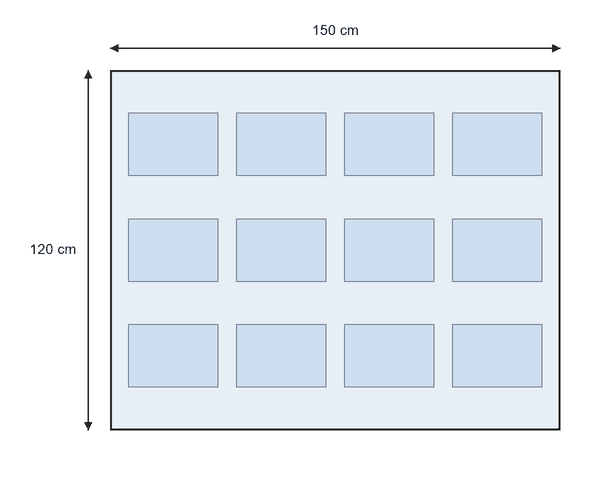
(a) Find the area of the board in .
(b) Find the total area of the sheets in .
(c) Find the area of the board that is not covered by the sheets, in and in .
- 374 marks
Question 37
Competency: Evaluation
Case study: (Hypothetical data.) A school canteen buys rice in bags marked kg. It weighs one bag from each of four suppliers P, Q, R and S on an electronic balance and notes the masses shown. The canteen rejects a supplier whose bag is short of kg by more than g.
Supplier P Q R S Mass shown 5.02 kg 4.95 kg 5100 g 4.9 kg (a) Write the mass of each bag in gram.
(b) Find how many gram each bag differs from kg, and say whether it is extra or short.
(c) Which supplier's rice should the canteen reject ? Give a reason.
- 384 marks
Question 38
Competency: Analysis
Case study: (Hypothetical data.) A park is a rectangle m long and m broad. Every morning Sunil jogs along its boundary.

(a) Find the length of the boundary of the park, in m.
(b) On Monday he jogs rounds. Find the distance he covers, in km.
(c) On Tuesday he wants to jog exactly km. Find how many rounds this is, and tell how he can cover it by starting from one corner and ending at a corner.
- 394 marks
Question 39
Competency: Evaluation
Case study: (Hypothetical data.) Four plots of land, A, B, C and D, are for sale. Their areas are written in different units.
Plot A B C D Area 2 acre 0.9 hectare 85 are 8200 Take acre , hectare and are .
(a) Express the area of every plot in .
(b) Arrange the plots from the smallest to the largest.
(c) A buyer needs a plot of at least and does not want to pay for much more land than that. Which plot should he buy ? Give a reason.
- 405 marks
Question 40
Competency: Creativity
(Hypothetical data.) Sneha has lost her ruler, but she has a stiff card strip cm long, a sharp pencil, and many identical coins. The packet of the coins says that each coin has a diameter of cm. She wants to mark a scale on the card, with its marks numbered in cm.
(a) Describe, in steps, how she can mark the scale using the coins. Why is a coin a better unit than a hand span ?
(b) She places one end of her pencil at the zero end of the scale, and its other end reaches exactly the th mark. Find the length of the pencil in cm, in mm and in m.
(c) Give one source of error in her method and one way to reduce it.