
Competency: Analysis & Evaluation
Case study: In a games period, the teacher times three students, one at a time, as each runs once around the basketball court. She starts a stop clock from zero when the student starts and stops it when the student finishes. Every run takes less than one minute. The dial of the stop clock at the end of Anu's run is shown below.
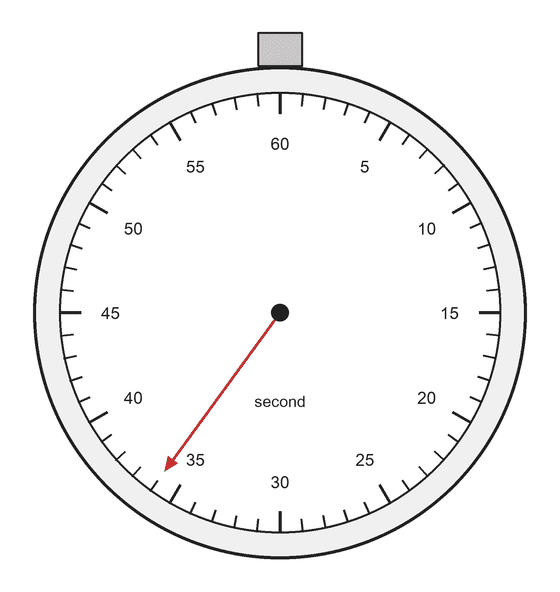
The times of the other two students are given in the table.
| Student | Anu | Bela | Charu |
|---|---|---|---|
| Time taken | as shown on the dial | 41 s | 33 s |
(a) What time interval does one small division of this dial stand for? Read the time taken by Anu.
(b) Who is the fastest of the three? How much less time did the fastest student take than the slowest?
(c) In a second round, the stop clock shows 33 s for both Charu and Anu. The teacher says, "So both of them took exactly the same time." Is this conclusion certain? Suggest a better device for deciding such a close result and give a reason.