
Opening your dashboard
Class 6 Maths Chapter 20: Recognition of Solids Solutions
28 textbook questions with step-by-step answers, free to read, for ICSE 2026-27.
Get talked through Ch 20, not just shown the answer
Reading a finished solution is not the same as being able to do it. The AI tutor takes one question at a time and works it with you, in your own words, until you can.
- Ask it out loud, in your own words
- It gives you the next step, not the answer
- Stuck on part (ii)? Start there
28 questions with solutions
1–3 marks · Mixed difficulty
- 13 marks
Question 1
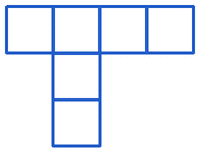
Identify the nets which can be used to form cubes :
(i)
 Solve with AI
Written solution
Solution:
Concept: A net of a solid is a flat shape that folds up into the solid. A cube has 6 equal square faces, so a net of a cube is 6 equal squares joined edge to edge that fold up with every square on a different face: no two squares may land on the same face, and no face may be left open. A row of four squares folds round into the four side walls of a cube. The two remaining squares must then go one on each side of that row (one becomes the top, the other the bottom); if both are on the same side, they cannot both find a free face.
Step 1 — Fold the row of four.
The top row has four squares in a line. Folding them round makes the four side walls of the cube, and the 1st and 3rd squares, and the 2nd and 4th squares, become opposite walls.
Step 2 — Fold the first hanging square.
Two squares hang one below the other under the 2nd square of the row. The first of them folds in under the walls and becomes the bottom face.
Step 3 — Fold the second hanging square.
The second hanging square is joined to the far edge of the bottom face, opposite the 2nd square. So it folds up as a wall on the side opposite the 2nd square, which is where the 4th square already is. Two squares now lie on one face.
Step 4 — Look for an open face.
All six squares have been used, but two of them overlap, so only five faces are covered and the top of the box is left open.
Watch out: A net with six squares is not always a cube net; always check where each square lands.
Therefore, net (i) cannot form a cube.
- 23 marks
Question 2
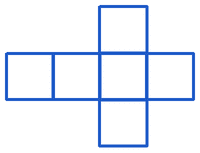
Identify the nets which can be used to form cubes :
(ii)
 Solve with AI
Written solution
Solution:
Concept: A net of a solid is a flat shape that folds up into the solid. A cube has 6 equal square faces, so a net of a cube is 6 equal squares joined edge to edge that fold up with every square on a different face: no two squares may land on the same face, and no face may be left open. A row of four squares folds round into the four side walls of a cube. The two remaining squares must then go one on each side of that row (one becomes the top, the other the bottom); if both are on the same side, they cannot both find a free face.
Step 1 — Fold the row of four.
The middle row of four squares folds round into the four side walls of the cube.
Step 2 — Fold the other two squares.
One square is above the 3rd square of the row and one is below it. They are on opposite sides of the row, so one folds over as the top and the other folds under as the bottom.
Step 3 — Check every face.
The six squares land on six different faces: four walls, a top and a bottom, with no overlap and no gap.
Therefore, net (ii) forms a cube.
- 33 marks
Question 3
Identify the nets which can be used to form cubes :
(iii)
 Solve with AI
Written solution
Solution:
Concept: A net of a solid is a flat shape that folds up into the solid. A cube has 6 equal square faces, so a net of a cube is 6 equal squares joined edge to edge that fold up with every square on a different face: no two squares may land on the same face, and no face may be left open. A row of four squares folds round into the four side walls of a cube. The two remaining squares must then go one on each side of that row (one becomes the top, the other the bottom); if both are on the same side, they cannot both find a free face.
Step 1 — Fold the row of four.
The middle row of four squares folds round into the four side walls of the cube.
Step 2 — Fold the other two squares.
One square is above the row (over the 3rd square) and one is below it (under the 2nd square). They are on opposite sides of the row, so one becomes the top and the other the bottom. It does not matter that they hang from different squares of the row.
Step 3 — Check every face.
The six squares land on six different faces, with no overlap and no gap.
Watch out: The top and bottom squares need not be in line with each other; they only have to be on opposite sides of the row.
Therefore, net (iii) forms a cube.
- 43 marks
Question 4
Identify the nets which can be used to form cubes :
(iv)
 Solve with AI
Written solution
Solution:
Concept: A net of a solid is a flat shape that folds up into the solid. A cube has 6 equal square faces, so a net of a cube is 6 equal squares joined edge to edge that fold up with every square on a different face: no two squares may land on the same face, and no face may be left open. A row of four squares folds round into the four side walls of a cube. The two remaining squares must then go one on each side of that row (one becomes the top, the other the bottom); if both are on the same side, they cannot both find a free face.
Step 1 — Fold the row of four.
The bottom row of four squares folds round into the four side walls of the cube.
Step 2 — Fold the other two squares.
Both remaining squares are above the row, side by side. When we fold them, both swing over the top of the walls, so they land on the same top face and overlap.
Step 3 — Look for an open face.
With two squares on the top, nothing covers the bottom, so the box is open at the bottom.
Watch out: Any net containing a 2 × 2 block of squares can never fold into a cube, because four squares meet at one point of the block, but a corner of a cube has only three faces.
Therefore, net (iv) cannot form a cube.
- 53 marks
Question 5
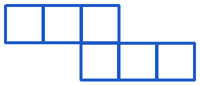
Identify the nets which can be used to form cubes :
(v)
 Solve with AI
Written solution
Solution:
Concept: A net of a solid is a flat shape that folds up into the solid. A cube has 6 equal square faces, so a net of a cube is 6 equal squares joined edge to edge that fold up with every square on a different face: no two squares may land on the same face, and no face may be left open.
Step 1 — Choose a base.
The two rows of three squares share one column: the 3rd square of the top row sits above the 1st square of the bottom row. We take this 3rd square of the top row as the base (bottom face).
Step 2 — Fold the top row.
The 2nd square of the top row folds up as the left wall, and the 1st square, joined to it, folds over to become the top face.
Step 3 — Fold the bottom row.
The 1st square of the bottom row folds up as the front wall. The next square folds round as the right wall, and the last square folds round again as the back wall.
Step 4 — Check every face.
Bottom, top, left, right, front and back are each covered by exactly one square, with no overlap and no gap.
Watch out: A net need not contain a row of four squares; this 'two rows of three' net is also a cube net.
Therefore, net (v) forms a cube; so, of the five nets, (ii), (iii) and (v) form cubes.
- 63 marks
Question 6
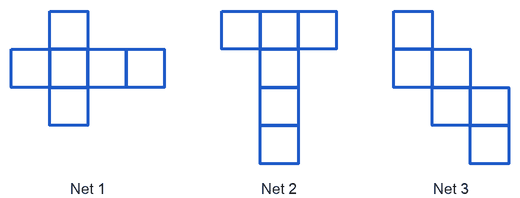
Draw at least three different nets for making a cube.
Solve with AIWritten solution
Solution:
Concept: A net of a solid is a flat shape that folds up into the solid. A cube has 6 equal square faces, so a net of a cube is 6 equal squares joined edge to edge that fold up with every square on a different face: no two squares may land on the same face, and no face may be left open.
Step 1 — Draw Net 1 (the cross).
Draw a row of four equal squares, then one square above and one square below the 2nd square of the row. The row makes the four walls, and the other two squares make the top and the bottom.
Step 2 — Draw Net 2 (the T-shape).
Draw a column of four equal squares, then one square on each side of the top square of the column. The column makes four faces round the cube, and the two side squares make the remaining two faces.
Step 3 — Draw Net 3 (the staircase).
Draw three pairs of squares going down like steps, each pair moved one square to the right of the pair above it. The pairs fold round the cube one after another and cover all six faces.
Step 4 — Check each net.
Fold each net in your mind (or cut it out and fold it): in each one the six squares land on six different faces, so each forms a cube.
Watch out: Do not draw a 2 × 2 block of squares or a row of five squares; neither can fold into a cube.
Therefore, three different nets of a cube are the cross, the T-shape and the staircase shown above (a cube has 11 different nets in all).
- 73 marks
Question 7
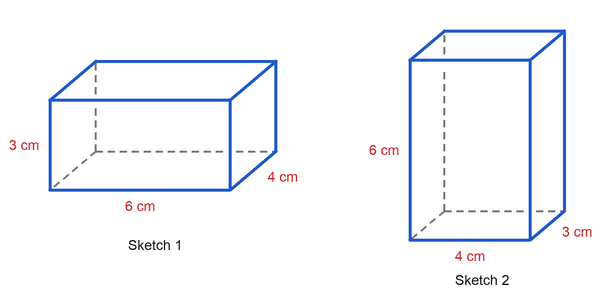
The dimensions of a cuboid are 6 cm, 4 cm and 3 cm. Draw two different types of oblique sketches for this cuboid.
Solve with AIWritten solution
Solution:
Concept: In an oblique sketch the front face is drawn in its true shape and size. The back face is the same shape, drawn a little up and to the right; on squared paper the depth (the edge going 'into' the page) is usually drawn shorter than its true length, often half. Corresponding corners are then joined, and edges that cannot be seen are drawn dotted.
Step 1 — Choose the front face for Sketch 1.
Lay the cuboid down so that the 6 cm × 3 cm face is at the front. Draw this face as a rectangle 6 cm long and 3 cm high.
Step 2 — Draw the back face and join the corners.
The depth of 4 cm goes into the page. Draw the same 6 cm × 3 cm rectangle again, moved up and to the right by about half of 4 cm along a slanting line, and join each corner of the front face to the matching corner of the back face.
Step 3 — Make Sketch 2 standing up.
For a different type of sketch, stand the cuboid up so that the 4 cm × 6 cm face is at the front: draw a rectangle 4 cm wide and 6 cm high, and use the 3 cm edge as the depth, drawn shorter along the slant.
Step 4 — Dot the hidden edges.
In each sketch the three edges that meet at the hidden back-bottom-left corner cannot be seen, so they are drawn dotted. Where a dotted edge passes behind a visible edge, it is broken so that the lines do not cross.
Watch out: Every hidden edge is dotted, but the visible edges are drawn as full lines.
Therefore, Sketch 1 shows the cuboid lying down (front 6 cm × 3 cm, depth 4 cm) and Sketch 2 shows it standing up (front 4 cm × 6 cm, depth 3 cm).
- 83 marks
Question 8
Two cubes, each with 3 cm edge, are placed side by side to form a cuboid. For this cuboid, draw an oblique sketch.
Solve with AIWritten solution
Solution:
Concept: In an oblique sketch the front face is drawn in its true shape and size. The back face is the same shape, drawn a little up and to the right; on squared paper the depth (the edge going 'into' the page) is usually drawn shorter than its true length, often half. Corresponding corners are then joined, and edges that cannot be seen are drawn dotted.
Step 1 — Find the size of the cuboid.
The two cubes are placed side by side, so their lengths add up while the breadth and the height stay 3 cm.
Step 2 — Draw the front face.
The cuboid is 6 cm long, 3 cm broad and 3 cm high. Draw the front face as a rectangle 6 cm long and 3 cm high, with a thin line in the middle where the two cubes meet.
Step 3 — Draw the back face and join the corners.
Draw the same rectangle again, moved up and to the right along a slant for the 3 cm depth (drawn shorter, about half), and join the matching corners.
Step 4 — Dot the hidden edges.
The three edges meeting at the hidden back-bottom-left corner are drawn dotted, broken where they pass behind a visible line.

Watch out: The cuboid is 6 cm long but only 3 cm broad and 3 cm high; the cubes are not stacked.
Therefore, the cuboid formed is 6 cm long, 3 cm broad and 3 cm high, and its oblique sketch is shown above.
- 93 marks
Question 9
The figures, given below, show shadows of some 3D objects when seen under the lamp of an overhead projector :

In each case, name the object
Solve with AIWritten solution
Solution:
Concept: A shadow on the screen of an overhead projector shows only the outline of an object as seen from one direction, so we look for a solid whose outline has the shape shown.
Step 1 — Shadow (i).
The shadow is a square. A cube gives a square outline, because each of its faces is a square.
Step 2 — Shadow (ii).
The shadow is a rectangle that is not a square. A cuboid, such as a box or a brick, gives this outline.
Step 3 — Shadow (iii).
The shadow is a circle. A sphere (a ball) gives a circle from every direction.
Step 4 — Shadow (iv).
The shadow is a triangle. A triangular prism seen from its end gives a triangle.
Watch out: One shadow can come from more than one solid, so look for the simplest solid that fits.
Note: Other objects can cast the same outlines: a cylinder seen from its end also gives a circle, and a cone or a pyramid seen from the side gives a triangle. The answers above are the simplest solid for each shadow.
Therefore, the objects are (i) a cube, (ii) a cuboid, (iii) a sphere and (iv) a (triangular) prism.
- 103 marks
Question 10
Look at the solids, drawn below, and fill the given chart.
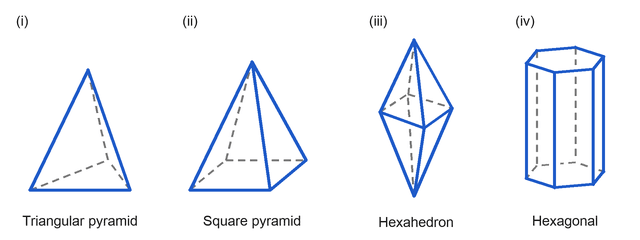
Polyhedon Faces (F) Vertices (V) Edges (E) F – E + V (a) Triangular pyramid (b) Square pyramid (c) Hexahedron (d) Hexagonal prism Solve with AIWritten solution
Solution:
Concept: A face is a flat surface of a solid, an edge is a line where two faces meet, and a vertex (corner) is a point where edges meet. For every solid with flat faces and no hole through it, Euler's formula F − E + V = 2 holds.
Step 1 — Count for (a), the triangular pyramid.
It has a triangular base and 3 triangular side faces, so F = 4. It has 3 corners on the base and 1 at the top, so V = 4. It has 3 base edges and 3 slant edges, so E = 6.
Step 2 — Count for (b), the square pyramid.
It has a square base and 4 triangular faces, so F = 5. It has 4 base corners and 1 top, so V = 5. It has 4 base edges and 4 slant edges, so E = 8.
Step 3 — Count for (c), the solid drawn.
The solid drawn is two square pyramids joined base to base. It has 4 triangles on top and 4 below, so F = 8. It has 4 corners round the middle, 1 at the top and 1 at the bottom, so V = 6. It has 4 edges round the middle, 4 going up and 4 going down, so E = 12.
Step 4 — Count for (d), the hexagonal prism.
It has 2 hexagonal ends and 6 rectangular sides, so F = 8. Each end has 6 corners, so V = 12. Each end has 6 edges and there are 6 side edges joining the ends, so E = 18.
Step 5 — Fill in the chart.
We put the counts in the chart and work out F − E + V for each solid.
Polyhedron Faces (F) Vertices (V) Edges (E) F − E + V (a) Triangular pyramid 4 4 6 2 (b) Square pyramid 5 5 8 2 (c) Hexahedron (as labelled) 8 6 12 2 (d) Hexagonal prism 8 12 18 2 Watch out: Count each edge only once, even though two faces meet along it.
Note: The solid in (c) is labelled 'Hexahedron', but the solid drawn has 8 faces, so it is really an octahedron; the counts above are for the solid as drawn. A true hexahedron (6 faces), such as a cube, would give F = 6, V = 8 and E = 12.
Therefore, the chart reads (a) 4, 4, 6, 2; (b) 5, 5, 8, 2; (c) 8, 6, 12, 2; (d) 8, 12, 18, 2, so F − E + V = 2 for every solid.
- 113 marks
Question 11
Dice are cubes with dot or dots on each face. Opposite faces of a die always have a total of seven on them.
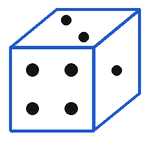
Below are given two nets to make a die (cube), the numbers inserted in each square indicate the number of dots in it.
(i)
(ii)
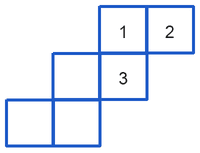
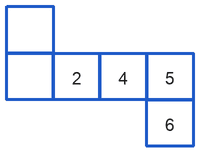
Insert suitable numbers in each blank so that the numbers in the opposite faces of the die have a total of seven dots.
Solve with AIWritten solution
Solution:
Concept: When a net folds into a cube, two squares that become opposite faces are never side by side in the net. In a straight row of three squares, the two end squares are opposite; in a row of four, the 1st and 3rd, and the 2nd and 4th, are opposite.
Step 1 — Find the opposite faces in net (i).
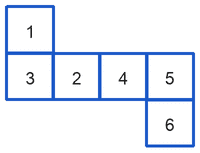
The second row is a row of four squares: blank, 2, 4, 5. So the blank is opposite 4, and 2 is opposite 5 (2 + 5 = 7 already). The square above the row and the square 6 below it are on opposite sides of the row, so they become the top and the bottom, which are opposite.
Step 2 — Fill net (i).
Each blank gets 7 minus the number opposite it.
Step 3 — Find the opposite faces in net (ii).
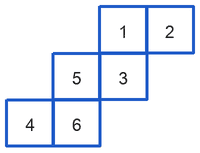
Fold the staircase with 3 as the base. Then 1 (above 3) and the bottom-right blank (below the blank left of 3) become opposite; 2 and the blank left of 3 become opposite; and 3 is opposite the bottom-left blank. You can check this by cutting out the net and folding it.
Step 4 — Fill net (ii).
Again each blank gets 7 minus the number opposite it.
Watch out: Squares that touch in the net are never opposite on the die; never put 7 − n next to n.
Therefore, in net (i) the blanks are 1 (top) and 3 (in the row); in net (ii) the blanks are 5 (left of 3), 4 (bottom left) and 6 (bottom right).
- 123 marks
Question 12
The following figures represent nets of some solids. Name the solids.
(i)
 Solve with AI
Written solution
Solution:
Concept: A net shows every face of a solid laid out flat, so counting the shapes in the net tells us the faces of the solid. A tetrahedron (triangular pyramid) has 4 triangular faces.
Step 1 — Count the faces.
The net is made of four equal triangles and nothing else. A solid with four triangular faces is a triangular pyramid, also called a tetrahedron.
Step 2 — See how it folds.
Take one triangle as the base. The other three fold up from its edges and meet at a single point above it, making the three sloping faces of the pyramid.
Watch out: A triangular prism also has triangles, but it has 2 triangles and 3 rectangles, not 4 triangles.
Note: As printed, four triangles meet at one point of the net, and a corner of a tetrahedron has only three faces, so this exact drawing cannot fold up without overlapping. The intended net has the fourth triangle on the free edge of the middle triangle (a triangle with one triangle on each side), which folds into a tetrahedron.
Therefore, the solid is a tetrahedron (triangular pyramid).
- 133 marks
Question 13
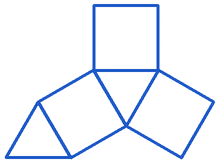
The following figures represent nets of some solids. Name the solids.
(ii)
 Solve with AI
Written solution
Solution:
Concept: A prism has two equal and parallel end faces joined by rectangular side faces. A triangular prism has 2 triangular ends and 3 rectangular sides.
Step 1 — Count the faces.
The net has 2 equal triangles and 3 equal squares (rectangles), five faces in all.
Step 2 — See how it folds.
The three squares are joined to the three sides of one triangle. They fold up as the three side faces, and the second triangle, joined to the outer edge of one square, folds over to close the other end.
Therefore, the solid is a triangular prism.
- 143 marks
Question 14
The following figures represent nets of some solids. Name the solids.
(iii)
 Solve with AI
Written solution
Solution:
Concept: A net of a solid is a flat shape that folds up into the solid. A cube has 6 equal square faces, so a net of a cube is 6 equal squares joined edge to edge that fold up with every square on a different face: no two squares may land on the same face, and no face may be left open.
Step 1 — Count the faces.
The net is made of six equal squares, so the solid can only be a cube.
Step 2 — Check that it folds.
The squares form a staircase of three pairs. Folding pair after pair round the cube puts the six squares on six different faces, with no overlap and no gap.
Therefore, the solid is a cube.
- 153 marks
Question 15
The following figures represent nets of some solids. Name the solids.
(iv)
 Solve with AI
Written solution
Solution:
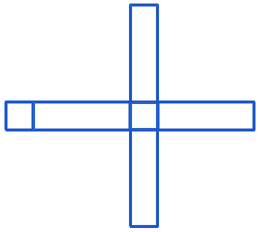
Concept: A cuboid has 6 rectangular faces in 3 pairs of equal, opposite faces. A cuboid whose two ends are squares is still a cuboid.
Step 1 — Count the faces.
The net has two small equal squares and four equal long rectangles, six faces in all.
Step 2 — See how it folds.
The four long rectangles fold up round the middle small square as the four side faces, and the second small square, at the end of one rectangle, folds over to close the top.
Step 3 — Name the solid.
Six rectangular faces with opposite faces equal make a cuboid; here its two ends are squares.
Watch out: The long faces are not squares, so the solid is not a cube.
Therefore, the solid is a cuboid.
- 161 mark
Question 16
A cuboid has :
Solve with AIAnswer
(A) 8 edges
- Correct
(B) 12 edges
(C) 6 edges
(D) 4 edges
Answer: (B) 12 edges
Concept: A face is a flat surface of a solid, an edge is a line where two faces meet, and a vertex (corner) is a point where edges meet. For every solid with flat faces and no hole through it, Euler's formula F − E + V = 2 holds.
Step 1 — Count the edges.
Think of a box: it has 4 edges round the top, 4 round the bottom and 4 upright edges.
Why the other options are wrong:
- (A) 8 edges: 8 is the number of vertices (corners) of a cuboid, not edges.
- (C) 6 edges: 6 is the number of faces of a cuboid.
- (D) 4 edges: 4 counts only the edges round one face.
Therefore, a cuboid has 12 edges, option (B).
- 171 mark
Question 17
A cube has :
Solve with AIAnswer
- Correct
(A) 8 corners
(B) 6 corners
(C) 10 corners
(D) 12 corners
Answer: (A) 8 corners
Concept: A face is a flat surface of a solid, an edge is a line where two faces meet, and a vertex (corner) is a point where edges meet. For every solid with flat faces and no hole through it, Euler's formula F − E + V = 2 holds.
Step 1 — Count the corners.
A cube has 4 corners on its top face and 4 on its bottom face.
Why the other options are wrong:
- (B) 6 corners: 6 is the number of faces of a cube.
- (C) 10 corners: No count of a cube gives 10: it has 6 faces, 8 corners and 12 edges.
- (D) 12 corners: 12 is the number of edges of a cube.
Therefore, a cube has 8 corners, option (A).
- 181 mark
Question 18
A cone has :
Solve with AIAnswer
(A) one vertex, two edges and two surfaces
(B) one vertex, no edge and no surface
(C) one vertex, one edge and one surface
- Correct
(D) one vertex, one edge and two surfaces
Answer: (D) one vertex, one edge and two surfaces
Concept: For solids with curved surfaces, an edge is a line where two surfaces meet and a vertex is a pointed corner.
Step 1 — Count the vertices and surfaces.
A cone has one pointed tip, its vertex. It has two surfaces: the curved surface and the flat circular base.
Step 2 — Count the edges.
The curved surface meets the base along one circle, so a cone has one edge.
Watch out: The flat base is a surface too; do not count only the curved surface.
Why the other options are wrong:
- (A): This counts two edges, but a cone has only one edge, the circle round its base.
- (B): This says the cone has no surface and no edge, but it has a curved surface, a flat base and a circular edge.
- (C): This leaves out the flat circular base; a cone has two surfaces.
Therefore, a cone has one vertex, one edge and two surfaces, option (D).
- 191 mark
Question 19
Which of the following solids has only one surface with no vertex and no edges?
Solve with AIAnswer
(A) cuboid
(B) cone
- Correct
(C) sphere
(D) cylinder
Answer: (C) sphere
Concept: An edge is where two surfaces meet and a vertex is where edges meet, so a solid with only one surface can have neither.
Step 1 — Check each solid.
A sphere is bounded by one curved surface, and nowhere on it do two surfaces meet, so it has no edge and no vertex. Every other solid listed has an edge.
Why the other options are wrong:
- (A) cuboid: A cuboid has 6 flat faces, 12 edges and 8 vertices.
- (B) cone: A cone has 2 surfaces, 1 edge and 1 vertex.
- (D) cylinder: A cylinder has 3 surfaces (a curved one and two flat circles) and 2 circular edges.
Therefore, the sphere has only one surface with no vertex and no edge, option (C).
- 201 mark
Question 20
A prism has :
Solve with AIAnswer
(A) 8 edges
- Correct
(B) 9 edges
(C) 6 edges
(D) 3 edges
Answer: (B) 9 edges
Concept: A face is a flat surface of a solid, an edge is a line where two faces meet, and a vertex (corner) is a point where edges meet. For every solid with flat faces and no hole through it, Euler's formula F − E + V = 2 holds. A prism with triangular ends is a triangular prism.
Step 1 — Count the edges of the prism.
The prism of this chapter is a triangular prism. It has 3 edges round each triangular end and 3 side edges joining the ends.
Watch out: Prisms with other ends have more edges, for example a hexagonal prism has 18.
Note: The question means the triangular prism of this chapter; a prism with a different end shape has a different number of edges (3 times the number of sides of its end).
Why the other options are wrong:
- (A) 8 edges: 8 is not a count of a triangular prism: it has 5 faces, 6 vertices and 9 edges.
- (C) 6 edges: 6 is the number of vertices of a triangular prism.
- (D) 3 edges: 3 counts only the side edges.
Therefore, a (triangular) prism has 9 edges, option (B).
- 211 mark
Question 21
A triangular pyramid has :
Solve with AIAnswer
- Correct
(A) 4 faces
(B) 2 faces
(C) 5 faces
(D) 3 faces
Answer: (A) 4 faces
Concept: A face is a flat surface of a solid, an edge is a line where two faces meet, and a vertex (corner) is a point where edges meet. For every solid with flat faces and no hole through it, Euler's formula F − E + V = 2 holds.
Step 1 — Count the faces.
A triangular pyramid has a triangular base and 3 triangular side faces.
That is why it is also called a tetrahedron ('tetra' means four).
Why the other options are wrong:
- (B) 2 faces: Two faces cannot enclose a solid; a closed solid with flat faces needs at least 4.
- (C) 5 faces: 5 faces belong to a square pyramid or a triangular prism.
- (D) 3 faces: 3 counts only the side faces and leaves out the base.
Therefore, a triangular pyramid has 4 faces, option (A).
- 221 mark
Question 22
A quadrilateral pyramid has :
Solve with AIAnswer
(A) 6 edges
- Correct
(B) 8 edges
(C) 5 edges
(D) 4 edges
Answer: (B) 8 edges
Concept: A face is a flat surface of a solid, an edge is a line where two faces meet, and a vertex (corner) is a point where edges meet. For every solid with flat faces and no hole through it, Euler's formula F − E + V = 2 holds.
Step 1 — Count the edges.
A quadrilateral pyramid has 4 edges round its base and 4 slant edges going up to the top vertex.
Why the other options are wrong:
- (A) 6 edges: 6 edges belong to a triangular pyramid.
- (C) 5 edges: 5 is the number of its faces (and of its vertices), not of its edges.
- (D) 4 edges: 4 counts only the base edges.
Therefore, a quadrilateral pyramid has 8 edges, option (B).
- 231 mark
Question 23
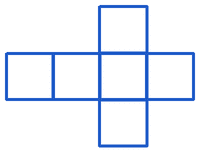
The given figure shows a net of :
 Solve with AI
Answer
- Correct
(A) cube
(B) cuboid
(C) cylinder
(D) rectangle
Answer: (A) cube
Concept: A net of a solid is a flat shape that folds up into the solid. A cube has 6 equal square faces, so a net of a cube is 6 equal squares joined edge to edge that fold up with every square on a different face: no two squares may land on the same face, and no face may be left open.
Step 1 — Look at the shapes.
The net has six equal squares: a row of four with one square above and one below the 3rd square of the row.
Step 2 — Fold it.
The row folds into the four walls and the two other squares become the top and the bottom, so all six faces are covered once.
Why the other options are wrong:
- (B) cuboid: A cuboid's net has rectangles that are not all equal squares (unless the cuboid is a cube).
- (C) cylinder: A cylinder's net has two circles and a rectangle.
- (D) rectangle: A rectangle is a flat figure, not a solid, so it has no net.
Therefore, the figure is a net of a cube, option (A).
- 241 mark
Question 24
The given figure shows a net of :
 Solve with AI
Answer
(A) cube
- Correct
(B) cuboid
(C) cylinder
(D) rectangle
Answer: (B) cuboid
Concept: A net of a solid is a flat shape that folds up into the solid. A cube has 6 equal square faces, so a net of a cube is 6 equal squares joined edge to edge that fold up with every square on a different face: no two squares may land on the same face, and no face may be left open. A cuboid's net has 6 rectangles in 3 pairs of equal ones.
Step 1 — Look at the shapes.
The net has six rectangles in three equal pairs: a row of four (wide, narrow, wide, narrow) and two equal rectangles above and below.
Step 2 — Fold it.
The row folds round as the four side faces, and the two rectangles close the top and the bottom. Six rectangular faces in equal opposite pairs make a cuboid.
Why the other options are wrong:
- (A) cube: A cube's net has six equal squares, but these rectangles are of different sizes.
- (C) cylinder: A cylinder's net has circles, and this net has none.
- (D) rectangle: A rectangle is a flat figure, not a solid, so it has no net.
Therefore, the figure is a net of a cuboid, option (B).
- 251 mark
Question 25
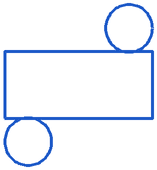
The given figure shows a net of :
 Solve with AI
Answer
(A) cube
(B) cuboid
- Correct
(C) cylinder
(D) rectangle
Answer: (C) cylinder
Concept: A net of a solid is a flat shape that folds up into the solid. A cylinder has a curved surface, which unrolls into a rectangle, and two equal circular ends.
Step 1 — Look at the shapes.
The net has one rectangle and two equal circles touching its opposite sides.
Step 2 — Fold it.
The rectangle rolls up into a tube, the curved surface, and the two circles close its two ends. That is a cylinder.
Why the other options are wrong:
- (A) cube: A cube's net has six equal squares and no circles.
- (B) cuboid: A cuboid's net has six rectangles and no circles.
- (D) rectangle: A rectangle is a flat figure, not a solid, so it has no net.
Therefore, the figure is a net of a cylinder, option (C).
- 261 mark
Question 26
Statement 1 : Prism and quadrilateral pyramid have equal number of faces.
Statement 2 : Number of faces in a prism is 5 and number of faces in a quadrilateral is also 5.
Which of the following options is correct?
Solve with AIAnswer
- Correct
(A) Both the statements are true.
(B) Both the statements are false.
(C) Statement 1 is true, and statement 2 is false.
(D) Statement 1 is false, and statement 2 is true.
Answer: (A) Both the statements are true.
Concept: In a two-statement question we judge each statement on its own as true or false, and then pick the option that matches both verdicts. The prism of this chapter is the triangular prism.
Step 1 — Count the faces.
A (triangular) prism has 2 triangular ends and 3 side faces, so it has 5 faces. A quadrilateral pyramid has 1 base and 4 triangular faces, so it also has 5 faces.
Step 2 — Judge Statement 1.
Both solids have 5 faces, so their numbers of faces are equal. Statement 1 is true.
Step 3 — Judge Statement 2.
Statement 2 says both numbers are 5. Reading 'quadrilateral' as 'quadrilateral pyramid', as Statement 1 does, this is true.
Watch out: Count the base of a pyramid as a face as well.
Note: Read literally, 'a prism' could have any number of faces (a cube is also a prism) and 'a quadrilateral' is a flat figure; the statements are meant for the triangular prism and the quadrilateral pyramid, and on that reading both are true.
Why the other options are wrong:
- (B): This is wrong because both statements are true.
- (C): This is wrong because Statement 2 is also true.
- (D): This is wrong because Statement 1 is also true.
Therefore, both statements are true, option (A).
- 271 mark
Question 27
Choose your answer based on the codes given below :
(1) A is true, R is false. (2) A is false, R is true. (3) Both A and R are true. (4) Both A and R are false.
Assertion (A) : For a cuboid, number of vertices (V) = 8 and number of edges (E) = 12.
Reason (R) : Number of faces (F) = 6.
Solve with AIAnswer
(A) (1) A is true, R is false.
(B) (2) A is false, R is true.
- Correct
(C) (3) Both A and R are true.
(D) (4) Both A and R are false.
Answer: (C) (3) Both A and R are true.
Concept: In an Assertion–Reason question we judge the Assertion (A) and the Reason (R) separately as true or false, and then choose the code that matches both verdicts. A face is a flat surface of a solid, an edge is a line where two faces meet, and a vertex (corner) is a point where edges meet. For every solid with flat faces and no hole through it, Euler's formula F − E + V = 2 holds.
Step 1 — Judge the Assertion.
A cuboid has 4 corners on top and 4 below, so V = 8, and 4 + 4 + 4 = 12 edges, so E = 12. The Assertion is true.
Step 2 — Judge the Reason.
A cuboid has 6 faces (top, bottom and four sides), so F = 6. The Reason is true.
Why the other options are wrong:
- (A): This is wrong because the Reason is also true.
- (B): This is wrong because the Assertion is true.
- (D): This is wrong because both the Assertion and the Reason are true.
Therefore, both A and R are true, option (C).
- 281 mark
Question 28
Choose your answer based on the codes given below :
(1) A is true, R is false. (2) A is false, R is true. (3) Both A and R are true. (4) Both A and R are false.
Assertion (A) : For a cuboid, number of vertices (V) = 8 and number of edges (E) = 12, then number of faces (F) = 6.
Reason (R) : For every three dimensional solid bounded by plane surfaces
F = 2 + E – V.
Solve with AIAnswer
(A) (1) A is true, R is false.
(B) (2) A is false, R is true.
- Correct
(C) (3) Both A and R are true.
(D) (4) Both A and R are false.
Answer: (C) (3) Both A and R are true.
Concept: In an Assertion–Reason question we judge the Assertion (A) and the Reason (R) separately as true or false, and then choose the code that matches both verdicts. A face is a flat surface of a solid, an edge is a line where two faces meet, and a vertex (corner) is a point where edges meet. For every solid with flat faces and no hole through it, Euler's formula F − E + V = 2 holds.
Step 1 — Judge the Reason.
Euler's formula says F − E + V = 2. Adding E and taking away V on both sides gives F = 2 + E − V, so the Reason is Euler's formula written another way, and it is true.
Step 2 — Judge the Assertion.
For a cuboid we put V = 8 and E = 12 into the Reason's formula.
A cuboid does have 6 faces, so the Assertion is true.
Watch out: Keep the signs: F = 2 + E − V, not 2 + V − E.
Note: Euler's formula holds for every solid with flat faces that has no hole through it; a solid with a tunnel, such as a square picture frame, does not obey it. For the solids of this chapter the Reason is true.
Why the other options are wrong:
- (A): This is wrong because the Reason is also true.
- (B): This is wrong because the Assertion is true.
- (D): This is wrong because both the Assertion and the Reason are true.
Therefore, both A and R are true, option (C).
What Class 6 Maths Ch 20 covers
The sections of the chapter, in the order the book takes them. Every question above comes from one of these.
- 01Identification of 3D Shapes
- 02Faces, Edges and Vertices of a Polyhedron
- 03Nets of 3D Figures
- 04Drawing Oblique Sketches of Cube and Cuboid
More ways to study this chapter
The same chapter asked three other ways. Practise it, revise it, and see what the board has set on Ch 20 before.
Class 6 Maths Ch 20 questions students ask
How many questions are there in Class 6 Maths Ch 20?
28 questions. Every one is solved step by step on this page.
Are these Class 6 Maths solutions free?
Yes. Every question and its full working is free to read, with no account needed.
Can I download the Class 6 Maths Ch 20 solutions as a PDF?
There is no PDF to download. Every solution is on this page instead, which means it is searchable, always the current syllabus, and readable on a phone. Use your browser's print option if you want it on paper.