
Opening your dashboard
Class 6 Maths Chapter 20 Recognition of Solids: Practice Questions
40 questions on Chapter 20, each worked through on its own page with the AI tutor. Class 6 Maths, ICSE 2026-27.
40 questions
1–5 marks · Mixed difficulty
- 11 mark
Question 1
Bloom's level: Remember
A rectangle drawn on a sheet of paper has :
- 21 mark
Question 2
Bloom's level: Remember
Each face of a cuboid is in the shape of a :
- 31 mark
Question 3
Bloom's level: Understand
Rahul sorts four solids into polyhedra and others. Which one must he put in the group that is not a polyhedron?
- 41 mark
Question 4
Bloom's level: Apply
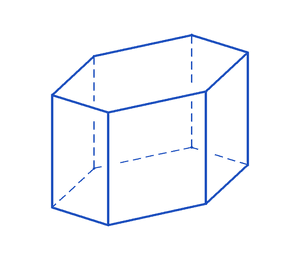
How many edges does a hexagonal prism have?
- 51 mark
Question 5
Bloom's level: Apply
A polyhedron has 7 faces and 10 vertices. Using F E V , the number of its edges is :
- 61 mark
Question 6
Bloom's level: Understand
A net is made of two identical triangles and three rectangles. When folded, it forms a :
- 71 mark
Question 7
Bloom's level: Analyse
Each figure below is made of six equal squares.
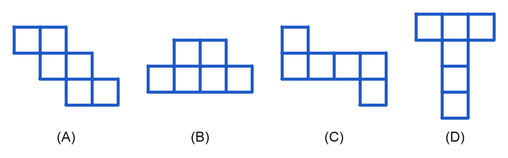
Which of them is not a net of a cube?
- 81 mark
Question 8
Bloom's level: Understand
While drawing an oblique sketch of a cube on squared paper, the front face has been drawn. The next step is to :
- 91 mark
Question 9
Bloom's level: Understand
A solid has a base that is a plane rectilinear figure, and its side-faces are triangles that meet at a common vertex outside the base. The solid is a :
- 101 mark
Question 10
Bloom's level: Understand
Assertion (A) : A cube is a special kind of cuboid.
Reason (R) : A cube is a cuboid whose length, breadth and height are all equal.
- 111 mark
Question 11
Bloom's level: Evaluate
Assertion (A) : A triangular pyramid has 4 faces, 4 vertices and 6 edges.
Reason (R) : In every polyhedron, the number of faces is equal to the number of vertices.
- 121 mark
Question 12
Bloom's level: Analyse
Assertion (A) : Six equal squares joined side by side in a single straight row form a net of a cube.
Reason (R) : A cube has six equal square faces.
- 131 mark
Question 13
Bloom's level: Remember
What is a solid? Give two examples.
- 141 mark
Question 14
Bloom's level: Remember
What is meant by the net of a solid?
- 152 marks
Question 15
Bloom's level: Understand
Explain why a straight line drawn on paper is called one-dimensional, a rectangle drawn on paper two-dimensional, and a brick three-dimensional.
- 162 marks
Question 16
Bloom's level: Apply
A pyramid has a pentagon (5 sides) as its base.
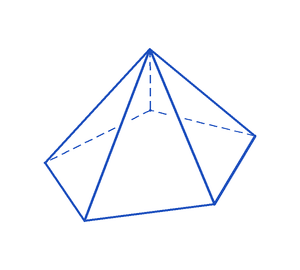
Find the number of its faces (F), vertices (V) and edges (E), and check that F E V .
- 172 marks
Question 17
Bloom's level: Apply
Sana draws an oblique sketch of a cuboid 4 cm long, 3 cm high and 2 cm deep, with the 4 cm 3 cm face in front. How many edges does she draw with full lines and how many with dotted lines? Which face appears in its true shape and size?
- 182 marks
Question 18
Bloom's level: Analyse
The figure shows a net of a cube with its faces marked A to F.
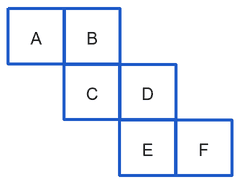
When the net is folded into a cube, which face is opposite to A, which is opposite to B, and which is opposite to C?
- 192 marks
Question 19
Bloom's level: Evaluate
Aman says, "A cylinder has 3 faces, 2 edges and 0 vertices, so F E V . This shows that the rule F E V is wrong." Do you agree? Give a reason.
- 202 marks
Question 20
Bloom's level: Apply
Name the solid shape of each object: (a) a brick, (b) a football, (c) a birthday cap, (d) a gas cylinder, (e) a dice, (f) a chocolate box with two triangular ends and three rectangular sides.
- 212 marks
Question 21
Bloom's level: Understand
Write two differences between a prism and a pyramid.
- 222 marks
Question 22
Bloom's level: Apply
A closed box is 8 cm long, 5 cm wide and 3 cm high.
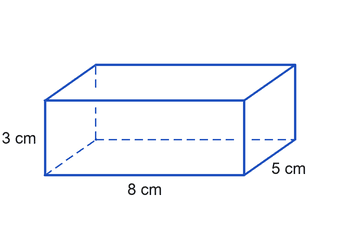
Write the shape and the measurements of its top view, front view and side view.
- 233 marks
Question 23
Bloom's level: Apply
Draw an oblique sketch of a cuboid 5 cm long, 3 cm high and 2 cm deep on squared paper. Write the steps you follow.
- 244 marks
Question 24
Bloom's level: Apply
Case study: Neel wants to make a closed gift box 10 cm long, 6 cm wide and 4 cm high from a sheet of card.
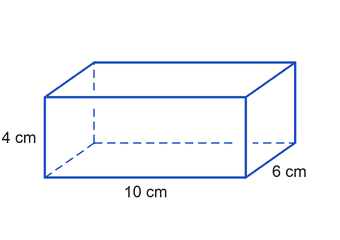
(a) How many rectangular pieces make up the box, and what are their sizes?
(b) Draw a net that he can cut out and fold to make the box.
(c) Find the area of card used for the net (ignore the flaps for gluing).
- 254 marks
Question 25
Bloom's level: Analyse
Case study: A craft model of a hut is made by placing a square pyramid exactly on the top face of a cube, as shown.
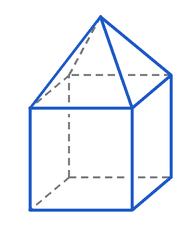
(a) Name the two solids used.
(b) Count the faces (F), vertices (V) and edges (E) of the whole model.
(c) Check whether F E V holds for the model.
- 263 marks
Question 26
Bloom's level: Evaluate
Riya draws the figure below and says it is a net of a cube.

Check whether she is right. If not, explain what goes wrong on folding and move one square to make it a correct net.
- 274 marks
Question 27
Bloom's level: Analyse
(a) Copy and complete the table.
Prism Sides of the base Faces (F) Vertices (V) Edges (E) Triangular prism 3 Cuboid 4 Hexagonal prism 6 (b) Find the pattern connecting F, V and E with the number of sides of the base.
(c) Use your pattern to find F, V and E for a prism whose base has 8 sides.
- 285 marks
Question 28
Bloom's level: Create
On a die, the dots on opposite faces always add up to 7. Design a net for a die in which four squares are in a row, one square is joined above the left end of the row and one square below the right end. Write the numbers 1 to 6 on the net so that opposite faces add up to 7, and explain how you decided which faces are opposite.
- 294 marks
Question 29
Bloom's level: Create
A shopkeeper wants a cuboid-shaped box that holds exactly 12 cubes, each of edge 1 cm, packed in 2 layers with no gaps.
(a) Suggest the length, breadth and height of the box. Explain your choice.
(b) Draw an oblique sketch of your box.
(c) How many faces, edges and vertices does the box have?
- 303 marks
Question 30
Bloom's level: Apply
Name the solid in each case:
(a) Its top view is a circle and its front view is a rectangle.
(b) Its top view is a circle and its front view is a triangle.
(c) Its top, front and side views are equal squares.
(d) It looks like a circle of the same size from every direction.
- 311 mark
Question 31
A solid has two flat circular faces and one curved surface, and it has no vertex. The solid is a :
- 321 mark
Question 32
A prism has 12 vertices. The number of faces of this prism is :
- 331 mark
Question 33
A net is made of a circle and a sector of another circle. When the net is folded and joined, it forms a :
- 342 marks
Question 34
(a) Can a polyhedron have 5 faces, 6 vertices and 10 edges ? Use Euler's formula to decide.
(b) Name a solid which has 5 faces, 5 vertices and 8 edges.
- 352 marks
Question 35
Name the solid described in each case :
(a) All its six faces are squares.
(b) It has two triangular faces and three rectangular faces.
(c) Its base is a square and its other four faces are triangles which meet at one vertex.
(d) It has one flat circular face, one curved surface and one vertex.
- 362 marks
Question 36
The figure shows an oblique sketch of a cuboid with edges 5 cm, 3 cm and 2 cm. The depth is drawn shorter than its true length.
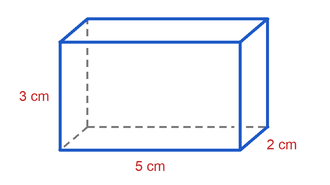
(a) How many edges of the cuboid are drawn with dotted lines, and why ?
(b) Find the sum of the lengths of all the edges of the cuboid.
- 372 marks
Question 37
The net of a pyramid has a regular hexagon in the middle and a triangle joined to each side of the hexagon.
(a) Name the pyramid and write the number of triangles in its net.
(b) Write the number of faces, vertices and edges of the pyramid, and verify Euler's formula.
- 383 marks
Question 38
(a) A pentagonal prism has a pentagon at each end.

Find its numbers of faces, vertices and edges and verify that .
(b) A polyhedron has 9 faces and 14 vertices. Use Euler's formula to find the number of its edges.
(c) The polyhedron in (b) is a prism. How many sides does each of its end faces have ?
- 394 marks
Question 39
The figure shows a net. Each of the three rectangles is 3 cm wide and 5 cm high, and each of the two triangles is equilateral with side 3 cm.
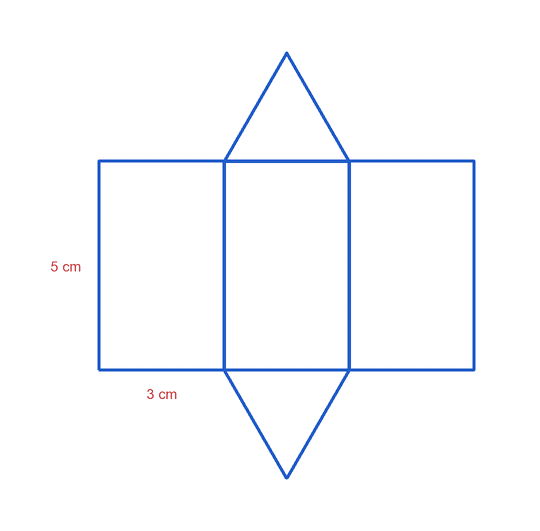
(a) Name the solid which is formed when the net is folded.
(b) How many faces, vertices and edges does the solid have ?
(c) A thin wire is used to make the frame of the solid, with one piece of wire along every edge. Find the length of wire needed.
- 404 marks
Question 40
(a) Name the solid shape of each object : a die, a road roller, a joker's cap, a globe, a cupboard and the great pyramid of Giza (with a square base).
(b) Which of these objects have the shape of a polyhedron ?
(c) Which of them has no flat face at all, and which has exactly one flat face ?