
Question 73 marksEasy
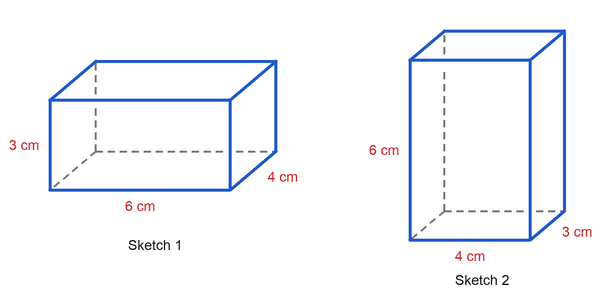
The dimensions of a cuboid are 6 cm, 4 cm and 3 cm. Draw two different types of oblique sketches for this cuboid.
Confirming your payment
Sign up now and get 250 free tokens.
Recognition of Solids · Question 7 of 28
The dimensions of a cuboid are 6 cm, 4 cm and 3 cm. Draw two different types of oblique sketches for this cuboid.
Solution:
Concept: In an oblique sketch the front face is drawn in its true shape and size. The back face is the same shape, drawn a little up and to the right; on squared paper the depth (the edge going 'into' the page) is usually drawn shorter than its true length, often half. Corresponding corners are then joined, and edges that cannot be seen are drawn dotted.
Step 1 — Choose the front face for Sketch 1.
Lay the cuboid down so that the 6 cm × 3 cm face is at the front. Draw this face as a rectangle 6 cm long and 3 cm high.
Step 2 — Draw the back face and join the corners.
The depth of 4 cm goes into the page. Draw the same 6 cm × 3 cm rectangle again, moved up and to the right by about half of 4 cm along a slanting line, and join each corner of the front face to the matching corner of the back face.
Step 3 — Make Sketch 2 standing up.
For a different type of sketch, stand the cuboid up so that the 4 cm × 6 cm face is at the front: draw a rectangle 4 cm wide and 6 cm high, and use the 3 cm edge as the depth, drawn shorter along the slant.
Step 4 — Dot the hidden edges.
In each sketch the three edges that meet at the hidden back-bottom-left corner cannot be seen, so they are drawn dotted. Where a dotted edge passes behind a visible edge, it is broken so that the lines do not cross.
Watch out: Every hidden edge is dotted, but the visible edges are drawn as full lines.
Therefore, Sketch 1 shows the cuboid lying down (front 6 cm × 3 cm, depth 4 cm) and Sketch 2 shows it standing up (front 4 cm × 6 cm, depth 3 cm).