
Opening your dashboard
Class 6 Maths Chapter 20 Recognition of Solids: Competency-Based Questions (CBQ)
40 questions on Chapter 20, each worked through on its own page with the AI tutor. Class 6 Maths, ICSE 2026-27.
40 questions
1–5 marks · Mixed difficulty
- 11 mark
Question 1
Competency: Understanding
A shopkeeper wants tins that can be piled one exactly on top of another on their flat faces. The same tins must also roll along the floor when laid on their side.
Which shape of tin should he choose?
- 21 mark
Question 2
Competency: Application
A bird-cage maker builds the frame of a cuboid-shaped cage. He uses one thin rod for every edge and one ball joint at every corner.
How many rods and how many joints does he need?
- 31 mark
Question 3
Competency: Analysis
A camping tent is in the shape of a pyramid. Counting the top, the tent has 6 corners (vertices) in all.
The floor of the tent is in the shape of a
- 41 mark
Question 4
Competency: Application
The paper label on a cylindrical tin of ghee covers the whole curved surface exactly once. Meera cuts the label straight down and peels it off. She lays it flat on the table.
The shape of the label is a
- 51 mark
Question 5
Competency: Analysis
A carpenter is given two drawings of a wooden box. The top view is a rectangle 12 cm by 8 cm. The front view is a rectangle 12 cm by 5 cm.
The side view of the box is a rectangle
- 61 mark
Question 6
Competency: Evaluation
Assertion (A): Every prism has an even number of vertices.
Reason (R): The two end-faces of a prism are equal polygons, and every vertex of the prism lies on one of these two end-faces.
- 72 marks
Question 7
Competency: Application
For Diwali, Arnav makes the frame of a lantern in the shape of a pentagonal prism. He uses one stick for each edge. Every stick on the two end-faces is 10 cm long. Every stick joining the two end-faces is 25 cm long.
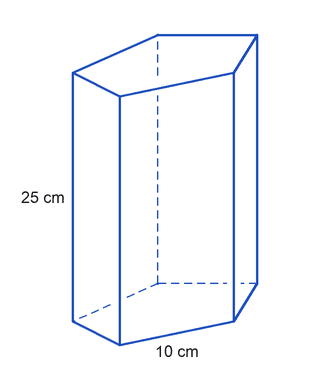
How many sticks does he need? Find the total length of all the sticks.
- 82 marks
Question 8
Competency: Evaluation
Mohan draws an oblique sketch of a cube of edge 4 cm on 1 cm squared paper, as shown.
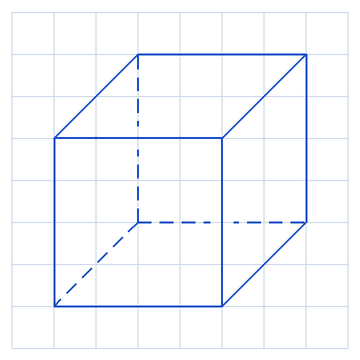
He then measures the slanting edges of his sketch and finds each about 2.8 cm. He says, "My sketch must be wrong, because all the edges of a cube are equal."
Is Mohan's sketch wrong? Which edges of the sketch show the true length of 4 cm?
- 92 marks
Question 9
Competency: Understanding
A paper model of a tent is made by folding a net. The tent is a pyramid with a square floor.
(a) How many pieces does the net have, and what are their shapes?
(b) A real tent of this shape has no cloth on the floor. How many pieces of cloth does it need? Name the solid whose net has exactly four triangles and no other piece.
- 102 marks
Question 10
Competency: Evaluation
A jeweller's helper counts the faces, vertices and edges of two cut stones. Each stone is a polyhedron.
Stone Faces Vertices Edges 1 8 12 18 2 6 8 10 Use to check each count. If a count is wrong, and the faces and vertices are right, how many edges should there be?
- 113 marks
Question 11
Competency: Analysis
Three models of polyhedra are kept in a box. Part of the label of each model has been torn off.
Model Faces (F) Vertices (V) Edges (E) P 5 6 ? Q ? 5 8 R 4 ? 6 (a) Use to find the three missing numbers.
(b) Name each model, choosing from: triangular pyramid, quadrilateral pyramid, triangular prism.
(c) Two of the models have the same number of faces. How do the shapes of their faces differ?
- 123 marks
Question 12
Competency: Creativity
Design a toy model by joining three different solids from this chapter. Follow these rules:
- At least one solid has a curved surface.
- At least one solid is a polyhedron.
(a) Say what your model is, and which solid makes which part.
(b) Make a table of the number of faces, edges and vertices of each of your three solids.
(c) Which of your solids are polyhedra? Check for one of them.
- 133 marks
Question 13
Competency: Application & Analysis
The figure shows the net of a cardboard box. Its six rectangles are marked P, Q, R, S, T and U.
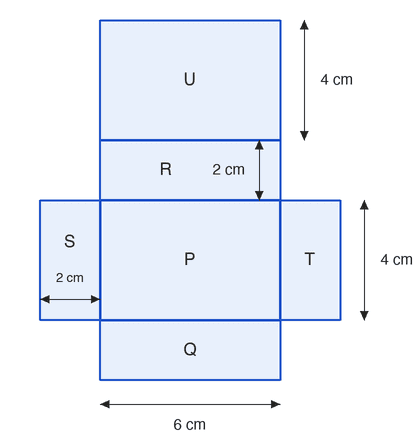
(a) Name the solid formed when the net is folded. Write its length, breadth and height.
(b) When the box rests on face P, which face is on top? Write the three pairs of opposite faces.
(c) Tara paints the box so that opposite faces have the same colour, and faces that touch along an edge have different colours. How many colours does she need? Give a reason.
- 144 marks
Question 14
Competency: Analysis & Evaluation
Case study — The carpenter's drawing
A customer gives a carpenter three views of a closed wooden box she wants.
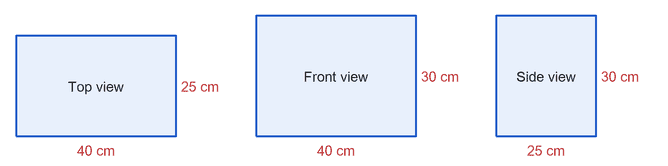
(a) Find the length, breadth and height of the box.
(b) The finished box is turned so that it rests on one of its side faces (25 cm by 30 cm). What is its height now? What are the shape and size of its new top view?
(c) The customer wants to keep a cylindrical tin of diameter 24 cm and height 28 cm inside the box, standing upright, with the box in its first position and the lid closed. Will the tin fit? Justify. Then write the shape and size of the top view and of the front view of the tin.
- 155 marks
Question 15
Competency: Application & Analysis
Case study — The model-making period
Three groups of a class make solids by cutting nets from chart paper. The table shows the pieces in each group's net.
Group Pieces in the net 1 2 equal triangles and 3 rectangles 2 1 square and 4 equal triangles 3 2 equal circles and 1 rectangle (a) Name the solid made by each group.
(b) For the solids of Group 1 and Group 2, write the number of faces, vertices and edges. Check for each.
(c) Write the number of faces, edges and vertices of Group 3's solid. Is it a polyhedron? Give a reason. A fourth group has six equal squares. Which solid can they make? Describe one way of joining the six squares into a net.
- 161 mark
Question 16
Competency: Analysis
A steel tiffin box in the shape of a cylinder stands upright on a table. Its front view is a rectangle 14 cm wide and 20 cm high.
What does its top view look like?
- 171 mark
Question 17
Competency: Analysis
A prism has two end-faces and one rectangular side-face for every side of its base. The base of a prism can be any polygon, so it has at least 3 sides.
Which of these cannot be the number of faces of a prism?
- 181 mark
Question 18
Competency: Application
Rani cuts six rectangular pieces of card to make a closed box in the shape of a cuboid. The sizes of the pieces are given in four different sets.
Which set can be used to make the cuboid?
- 191 mark
Question 19
Competency: Evaluation
Assertion (A): A cone has exactly one vertex and exactly one edge.
Reason (R): The curved surface of a cone and its flat circular base meet along two separate circles.
- 201 mark
Question 20
Competency: Understanding
Dev draws an oblique sketch of a closed cuboid on squared paper. He draws the front face first, then draws the back face a little up and to the right, joins the corresponding corners and makes the hidden edges dotted.
In his finished sketch, how many faces of the cuboid are seen fully, with no dotted edge on them?
- 211 mark
Question 21
Competency: Application
A model-maker has exactly 18 sticks. He makes the frame of a solid, using one stick for every edge, and uses all 18 sticks with none left over.
Which of these frames could he have made?
- 221 mark
Question 22
Competency: Analysis
In a guessing game, Mira says, "My solid has as many faces as it has vertices."
Which of these could be Mira's solid?
- 231 mark
Question 23
Competency: Analysis
A shopkeeper has a block of cheese in the shape of a cuboid. He makes 3 straight cuts, all parallel to the same face of the block, and gets 4 slices.
How many faces of the slices were made by the knife? (These faces were not on the block before it was cut.)
- 241 mark
Question 24
Competency: Evaluation
Assertion (A): A cylinder is not a polyhedron.
Reason (R): A cylinder has exactly two edges.
- 251 mark
Question 25
Competency: Analysis
Neha draws a net of a square pyramid. It is one square with a triangle joined to each of its four sides. She cuts it out and folds the four triangles upwards. Each triangle then has two slanting sides, and neighbouring triangles meet along them. She sticks each meeting place with one strip of tape.
How many strips of tape does she need?
- 262 marks
Question 26
Competency: Evaluation
Anil pours water into a steel bucket. He says, "Water is a solid, because it takes up space just as a brick does."
Is Anil right? Give a reason.
- 272 marks
Question 27
Competency: Application
Isha has a rectangular sheet of chart paper, 40 cm long and 30 cm wide. She cuts the whole sheet into squares of side 10 cm, with no paper left over. She uses six squares, joined with tape, to make one cube of edge 10 cm.
(a) How many squares does she get from the sheet, and how many cubes can she make?
(b) How many more squares does she need to make 3 cubes?
- 282 marks
Question 28
Competency: Analysis
Rohan builds a polyhedron from clay balls and sticks. He counts 12 edges. He also notices that the polyhedron has 2 more vertices than faces.
Find the number of faces and the number of vertices. Name a solid that fits these numbers.
- 292 marks
Question 29
Competency: Analysis
A wooden block is a cuboid 8 cm long, 4 cm wide and 2 cm high. Two students make oblique sketches of it on squared paper.
- Hasan draws the 8 cm by 4 cm face in front.
- Tara draws the 8 cm by 2 cm face in front.
(a) In each sketch, what is the real length shown by the slanting edges? (b) Are both sketches acceptable? Give a reason.
- 302 marks
Question 30
Competency: Application
Four solids are pushed gently along a flat floor, one at a time: a cricket ball, a cylindrical tin lying on its curved side, a cone lying on its curved surface and a wooden brick.
(a) Which two solids roll along a straight path? (b) Which solid moves round in a circle? Give a reason.
- 312 marks
Question 31
Competency: Evaluation
Raju says, "A prism always has more edges than a pyramid, so a prism and a pyramid can never have the same number of edges."
Is Raju right? Give a reason, using a cuboid and a pyramid with a hexagonal base.
- 323 marks
Question 32
Competency: Analysis
A glass paperweight is a polyhedron with 12 faces, and every face is a pentagon (a 5-sided figure). Every edge of the paperweight is shared by exactly two faces.
(a) Find the number of edges. (b) Use to find the number of vertices. (c) Three edges meet at every vertex. Use this to check your answer for (b).
- 333 marks
Question 33
Competency: Evaluation & Analysis
Sana wants to make a triangular prism. Its two ends are right-angled triangles with sides 3 cm, 4 cm and 5 cm, and its length is 6 cm. She draws this net on card. The width of each rectangle is written inside it.
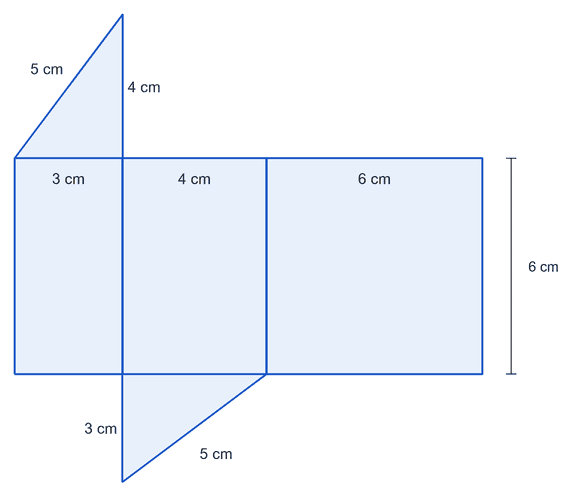
(a) Which rectangle has the wrong width? What should its width be? (b) Why must it have that width? (c) After the net is corrected, how many edges of the prism are 6 cm long?
- 343 marks
Question 34
Competency: Application & Analysis
A toy shop displays a wooden cube of edge 10 cm, placed at the centre of the flat top of a wooden drum. The drum is a cylinder of diameter 20 cm and height 8 cm. The whole base of the cube rests on the top of the drum.
(a) What does the top view of this toy look like? (b) What does the front view look like? Give the measurements. (c) Which view is the same as the front view, and why?
- 353 marks
Question 35
Competency: Analysis
Two models have the same base, a regular octagon (a polygon with 8 sides). Model X is a prism and model Y is a pyramid.
(a) Find the number of faces, vertices and edges of each model. (b) Verify Euler's formula for both models. (c) How many more faces, vertices and edges does the prism have than the pyramid?
- 363 marks
Question 36
Competency: Creativity
Design a net for a closed pyramid whose base is a rectangle 4 cm by 3 cm and whose four slanting edges are all 5 cm long.
(a) List the pieces you need, with their shapes and sizes. (b) Describe how the pieces are joined in your net. (c) When the net is folded, two sides of neighbouring triangles meet along each slanting edge. What must be true about the lengths of these two sides?
- 374 marks
Question 37
Competency: Analysis
Case study — The courier's boxes
A courier office in Pune packs parcels in boxes shaped like cuboids. The loaders look at every box from three sides: the top view (length and breadth), the front view (length and height) and the side view (breadth and height). The storekeeper keeps special shelves for boxes whose side view is a square. The table gives the sizes of four boxes. (Hypothetical data.)
Box Length (cm) Breadth (cm) Height (cm) A 30 20 15 B 25 25 10 C 40 15 15 D 20 20 20 (a) Which box is a cube? Give a reason from the table.
(b) For each box, how many of its three views are exactly the same size as at least one other view of the same box?
(c) Which boxes can be kept on the special shelves? Is each of them a cube? Give a reason.
- 385 marks
Question 38
Competency: Analysis & Evaluation
Case study — Trays from card
A shop makes open trays (boxes with no lid) from rectangular sheets of card 24 cm long and 16 cm wide. From each corner of a sheet, a square of side x cm is cut away. The four flaps left along the sides are then folded up along the dashed lines and taped at the corners. The figure shows one sheet with the corner squares shaded. (Hypothetical data.)
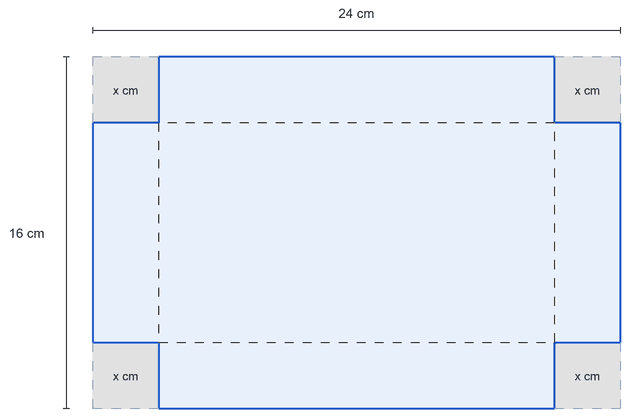
The shop tries corner squares of different sizes:
Side of corner square, x (cm) 2 3 4 5 Length of tray (cm) 20 Breadth of tray (cm) 12 Height of tray (cm) 2 (a) The card left after the four corners are cut away is a net. Of which solid is it a net? Which face of that solid is missing? How many faces does the tray have?
(b) Complete the table.
(c) A customer wants a tray with a square base, made from one of these sheets. Can the shop make it by changing the size of the corner squares? Give a reason. What shape of sheet would always give a tray with a square base?
- 394 marks
Question 39
Competency: Application & Analysis
Case study — The sweet factory
A sweet factory packs its sweets in three kinds of containers: gift packs shaped like a triangular prism, cartons shaped like a cuboid, and tins shaped like a cylinder. For one festival order, the factory uses 5 gift packs, 4 cartons and 3 tins. The packing manager wants to fill a quality-check sheet with the faces, edges and vertices of all the containers. (Hypothetical data.)
(a) Write the number of faces, edges and vertices of one container of each kind.
(b) Find the total number of vertices and the total number of edges of all 12 containers.
(c) For each kind of container, find . For which kind is it not 2?
- 405 marks
Question 40
Competency: Analysis & Application
Case study — The ant on the box
A wooden box in the shape of a cuboid stands on a table. Its length AB is 5 cm, its height BC is 3 cm and its depth BF is 4 cm, as shown in the figure. An ant is at the corner A and wants to reach the opposite corner G. The ant can walk only along the edges of the box, because it cannot cross a face. Some edges are at the back of the box, so they are drawn with dotted lines.
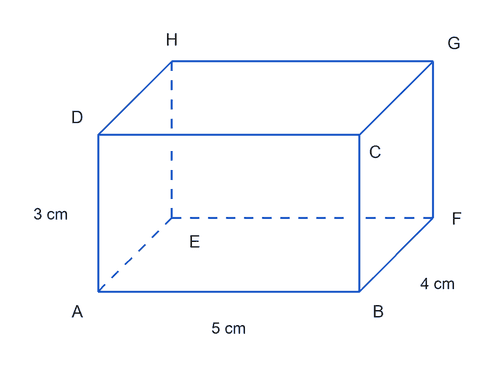
(a) How many edges of the box meet at A? On a shortest route from A to G, how many edges does the ant walk, and how long is the route?
(b) Write down all the shortest routes from A to G.
(c) A second ant walks along A, B, C, D, H and G. How long is its walk, and how much longer is it than a shortest route?