
Competency: Analysis & Evaluation
Case study — Trays from card
A shop makes open trays (boxes with no lid) from rectangular sheets of card 24 cm long and 16 cm wide. From each corner of a sheet, a square of side x cm is cut away. The four flaps left along the sides are then folded up along the dashed lines and taped at the corners. The figure shows one sheet with the corner squares shaded. (Hypothetical data.)
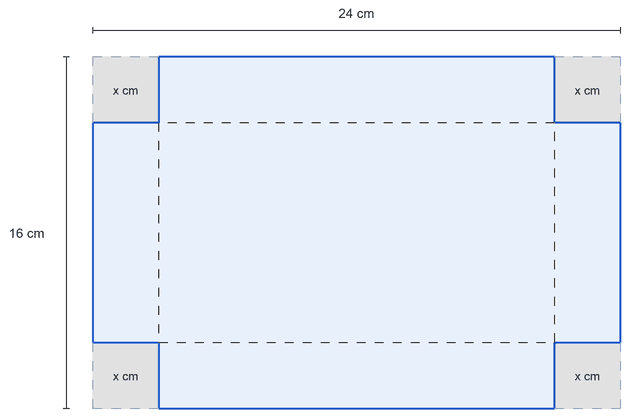
The shop tries corner squares of different sizes:
| Side of corner square, x (cm) | 2 | 3 | 4 | 5 |
|---|---|---|---|---|
| Length of tray (cm) | 20 | |||
| Breadth of tray (cm) | 12 | |||
| Height of tray (cm) | 2 |
(a) The card left after the four corners are cut away is a net. Of which solid is it a net? Which face of that solid is missing? How many faces does the tray have?
(b) Complete the table.
(c) A customer wants a tray with a square base, made from one of these sheets. Can the shop make it by changing the size of the corner squares? Give a reason. What shape of sheet would always give a tray with a square base?