
Question 103 marksMedium
Look at the solids, drawn below, and fill the given chart.
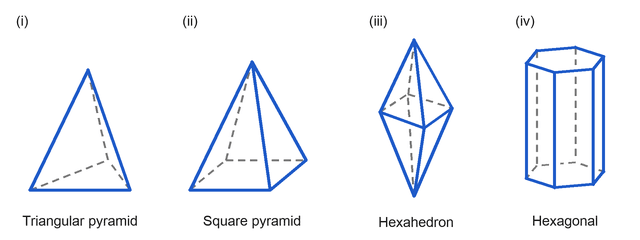
| Polyhedon | Faces (F) | Vertices (V) | Edges (E) | F – E + V |
|---|---|---|---|---|
| (a) Triangular pyramid | ||||
| (b) Square pyramid | ||||
| (c) Hexahedron | ||||
| (d) Hexagonal prism |
Confirming your payment
Sign up now and get 250 free tokens.
Recognition of Solids · Question 10 of 28
Look at the solids, drawn below, and fill the given chart.
| Polyhedon | Faces (F) | Vertices (V) | Edges (E) | F – E + V |
|---|---|---|---|---|
| (a) Triangular pyramid | ||||
| (b) Square pyramid | ||||
| (c) Hexahedron | ||||
| (d) Hexagonal prism |
Solution:
Concept: A face is a flat surface of a solid, an edge is a line where two faces meet, and a vertex (corner) is a point where edges meet. For every solid with flat faces and no hole through it, Euler's formula F − E + V = 2 holds.
Step 1 — Count for (a), the triangular pyramid.
It has a triangular base and 3 triangular side faces, so F = 4. It has 3 corners on the base and 1 at the top, so V = 4. It has 3 base edges and 3 slant edges, so E = 6.
Step 2 — Count for (b), the square pyramid.
It has a square base and 4 triangular faces, so F = 5. It has 4 base corners and 1 top, so V = 5. It has 4 base edges and 4 slant edges, so E = 8.
Step 3 — Count for (c), the solid drawn.
The solid drawn is two square pyramids joined base to base. It has 4 triangles on top and 4 below, so F = 8. It has 4 corners round the middle, 1 at the top and 1 at the bottom, so V = 6. It has 4 edges round the middle, 4 going up and 4 going down, so E = 12.
Step 4 — Count for (d), the hexagonal prism.
It has 2 hexagonal ends and 6 rectangular sides, so F = 8. Each end has 6 corners, so V = 12. Each end has 6 edges and there are 6 side edges joining the ends, so E = 18.
Step 5 — Fill in the chart.
We put the counts in the chart and work out F − E + V for each solid.
| Polyhedron | Faces (F) | Vertices (V) | Edges (E) | F − E + V |
|---|---|---|---|---|
| (a) Triangular pyramid | 4 | 4 | 6 | 2 |
| (b) Square pyramid | 5 | 5 | 8 | 2 |
| (c) Hexahedron (as labelled) | 8 | 6 | 12 | 2 |
| (d) Hexagonal prism | 8 | 12 | 18 | 2 |
Watch out: Count each edge only once, even though two faces meet along it.
Note: The solid in (c) is labelled 'Hexahedron', but the solid drawn has 8 faces, so it is really an octahedron; the counts above are for the solid as drawn. A true hexahedron (6 faces), such as a cube, would give F = 6, V = 8 and E = 12.
Therefore, the chart reads (a) 4, 4, 6, 2; (b) 5, 5, 8, 2; (c) 8, 6, 12, 2; (d) 8, 12, 18, 2, so F − E + V = 2 for every solid.