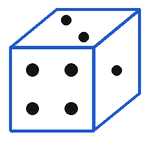
Solution:
Concept: When a net folds into a cube, two squares that become opposite faces are never side by side in the net. In a straight row of three squares, the two end squares are opposite; in a row of four, the 1st and 3rd, and the 2nd and 4th, are opposite.
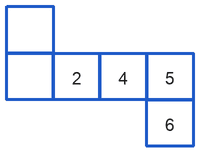
Step 1 — Find the opposite faces in net (i).
The second row is a row of four squares: blank, 2, 4, 5. So the blank is opposite 4, and 2 is opposite 5 (2 + 5 = 7 already). The square above the row and the square 6 below it are on opposite sides of the row, so they become the top and the bottom, which are opposite.
Step 2 — Fill net (i).
Each blank gets 7 minus the number opposite it.
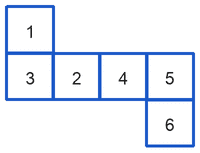
Blank in the row=7−4=3
Top square=7−6=1
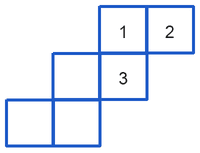
Step 3 — Find the opposite faces in net (ii).
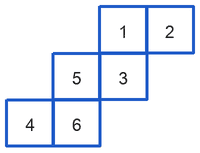
Fold the staircase with 3 as the base. Then 1 (above 3) and the bottom-right blank (below the blank left of 3) become opposite; 2 and the blank left of 3 become opposite; and 3 is opposite the bottom-left blank. You can check this by cutting out the net and folding it.
Step 4 — Fill net (ii).
Again each blank gets 7 minus the number opposite it.
Blank left of 3=7−2=5
Bottom-left square=7−3=4
Bottom-right square=7−1=6
Watch out: Squares that touch in the net are never opposite on the die; never put 7 − n next to n.
Therefore, in net (i) the blanks are 1 (top) and 3 (in the row); in net (ii) the blanks are 5 (left of 3), 4 (bottom left) and 6 (bottom right).