
Opening your dashboard
Class 6 Maths Chapter 19: Constructions Solutions
33 textbook questions with step-by-step answers, free to read, for ICSE 2026-27.
Get talked through Ch 19, not just shown the answer
Reading a finished solution is not the same as being able to do it. The AI tutor takes one question at a time and works it with you, in your own words, until you can.
- Ask it out loud, in your own words
- It gives you the next step, not the answer
- Stuck on part (ii)? Start there
33 questions with solutions
1–3 marks · Mixed difficulty
- 13 marks
Question 1
Draw in your notebook the following angles using a ruler and a compass only.
(i)
 Solve with AI
Written solution
Solution:
Concept: To copy an angle with a ruler and compasses, we draw arcs of the same radius about the vertex of the given angle and about the vertex of the new angle. If the distance between the two cut points (the chord XY) is also the same, the two angles open by exactly the same amount, so they are equal.
Given: The angle ∠AOB shown in the figure; a ruler and a pair of compasses only.
Step 1 — Draw an arc on the given angle.
With O as centre and any convenient radius, draw an arc cutting OB at X and OA at Y. Do not change the compass opening after this step.
Step 2 — Draw the first arm of the copy.
In the notebook, draw a ray O′B′ with the ruler. O′ will be the vertex of the new angle.
Step 3 — Draw the same arc on the new arm.
With O′ as centre and the SAME radius, draw an arc cutting O′B′ at X′. Because the radius is unchanged, O′X′ = OX.
Step 4 — Copy the opening of the angle.
Open the compasses to the distance XY on the given figure. With X′ as centre and radius XY, cut the arc at Y′. Now X′Y′ = XY.
Step 5 — Draw the second arm.
Join O′Y′ and produce it to A′. This ray is the second arm of the new angle.
Step 6 — Look at the finished figure and check it.
The finished construction is shown below, drawn to scale.

The triangles OXY and O′X′Y′ have all three sides equal (OX = O′X′, OY = O′Y′ and XY = X′Y′), so their angles at O and O′ are equal. A protractor gives the same reading on both angles (about 60° for the figure given).
Watch out: Keep one compass opening for the arcs in steps 1 and 3; if the radius changes, the chord XY no longer fits and the copy comes out wrong.
Therefore, ∠A′O′B′ is the required angle; it is equal to the given ∠AOB.
- 23 marks
Question 2
Draw in your notebook the following angles using a ruler and a compass only.
(ii)
 Solve with AI
Written solution
Solution:
Concept: To copy an angle with a ruler and compasses, we draw arcs of the same radius about the vertex of the given angle and about the vertex of the new angle. If the distance between the two cut points (the chord XY) is also the same, the two angles open by exactly the same amount, so they are equal.
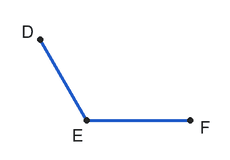
Given: The angle ∠DEF shown in the figure; a ruler and a pair of compasses only.
Step 1 — Draw an arc on the given angle.
With E as centre and any convenient radius, draw an arc cutting EF at X and ED at Y. Do not change the compass opening after this step.
Step 2 — Draw the first arm of the copy.
In the notebook, draw a ray E′F′ with the ruler. E′ will be the vertex of the new angle.
Step 3 — Draw the same arc on the new arm.
With E′ as centre and the SAME radius, draw an arc cutting E′F′ at X′. Because the radius is unchanged, E′X′ = EX.
Step 4 — Copy the opening of the angle.
Open the compasses to the distance XY on the given figure. With X′ as centre and radius XY, cut the arc at Y′. Now X′Y′ = XY.
Step 5 — Draw the second arm.
Join E′Y′ and produce it to D′. This ray is the second arm of the new angle.
Step 6 — Look at the finished figure and check it.
The finished construction is shown below, drawn to scale.
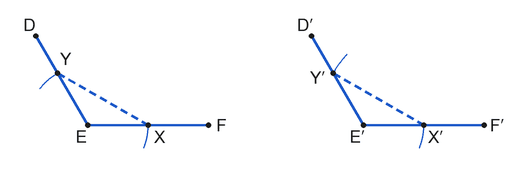
The triangles EXY and E′X′Y′ have all three sides equal (EX = E′X′, EY = E′Y′ and XY = X′Y′), so their angles at E and E′ are equal. A protractor gives the same reading on both angles (about 120° for the figure given).
Watch out: Keep one compass opening for the arcs in steps 1 and 3; if the radius changes, the chord XY no longer fits and the copy comes out wrong.
Therefore, ∠D′E′F′ is the required angle; it is equal to the given ∠DEF.
- 33 marks
Question 3
Draw in your notebook the following angles using a ruler and a compass only.
(iii)
 Solve with AI
Written solution
Solution:
Concept: To copy an angle with a ruler and compasses, we draw arcs of the same radius about the vertex of the given angle and about the vertex of the new angle. If the distance between the two cut points (the chord XY) is also the same, the two angles open by exactly the same amount, so they are equal.
Given: The angle ∠PQR shown in the figure; a ruler and a pair of compasses only.
Step 1 — Draw an arc on the given angle.
With Q as centre and any convenient radius, draw an arc cutting QP at X and QR at Y. Do not change the compass opening after this step.
Step 2 — Draw the first arm of the copy.
In the notebook, draw a ray Q′P′ with the ruler. Q′ will be the vertex of the new angle.
Step 3 — Draw the same arc on the new arm.
With Q′ as centre and the SAME radius, draw an arc cutting Q′P′ at X′. Because the radius is unchanged, Q′X′ = QX.
Step 4 — Copy the opening of the angle.
Open the compasses to the distance XY on the given figure. With X′ as centre and radius XY, cut the arc at Y′. Now X′Y′ = XY.
Step 5 — Draw the second arm.
Join Q′Y′ and produce it to R′. This ray is the second arm of the new angle.
Step 6 — Look at the finished figure and check it.
The finished construction is shown below, drawn to scale.
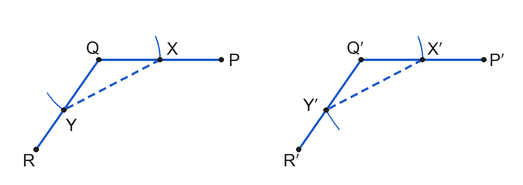
The triangles QXY and Q′X′Y′ have all three sides equal (QX = Q′X′, QY = Q′Y′ and XY = X′Y′), so their angles at Q and Q′ are equal. A protractor gives the same reading on both angles (about 125° for the figure given).
Watch out: Keep one compass opening for the arcs in steps 1 and 3; if the radius changes, the chord XY no longer fits and the copy comes out wrong.
Therefore, ∠R′Q′P′ is the required angle; it is equal to the given ∠PQR.
- 43 marks
Question 4
Construct the following angles, using a ruler and a compass only.
(i) 60°
Solve with AIWritten solution
Solution:
Concept: Angles are built with compasses from 60°. If the compasses keep one opening, the vertex and two cut points on an arc form an equilateral triangle, so the angle at the vertex is 60°. Bisecting an angle (arcs of equal radius from two points equally far from the vertex) halves it, and two angles side by side add up.
Given: The angle to be constructed; a ruler and a pair of compasses only.
Step 1 — Draw the arm.
Draw a ray OA with the ruler. O will be the vertex of the angle.
Step 2 — Draw the first arc.
With O as centre and any convenient radius, draw a large arc cutting OA at C.
Step 3 — Mark the 60° point.
With C as centre and the SAME radius, cut the arc at D. Now OC, OD and CD are all equal to the radius, so triangle OCD is equilateral and ∠DOA = 60°.
Step 4 — Draw the second arm.
Join OD and produce it to B. The ray OB makes 60° with OA.
Step 5 — Look at the finished figure and check it.
The finished construction is shown below, drawn to scale.

A protractor placed on OA reads 60° along OB.
Watch out: Keep the compasses at the SAME radius while stepping off arcs along the first arc; changing it spoils the angle.
Therefore, ∠AOB = 60° is the required angle.
- 53 marks
Question 5
Construct the following angles, using a ruler and a compass only.
(ii) 90°
Solve with AIWritten solution
Solution:
Concept: Angles are built with compasses from 60°. If the compasses keep one opening, the vertex and two cut points on an arc form an equilateral triangle, so the angle at the vertex is 60°. Bisecting an angle (arcs of equal radius from two points equally far from the vertex) halves it, and two angles side by side add up. Here 90° lies half-way between 60° and 120°, so we mark both and bisect the angle between them.
Given: The angle to be constructed; a ruler and a pair of compasses only.
Step 1 — Draw the arm.
Draw a ray OA with the ruler.
Step 2 — Draw the first arc.
With O as centre and any convenient radius, draw a large arc cutting OA at C.
Step 3 — Mark the 60° point.
With C as centre and the SAME radius, cut the arc at D. Now OC, OD and CD are all equal to the radius, so triangle OCD is equilateral and ∠DOA = 60°.
Step 4 — Mark the 120° point.
With D as centre and the same radius, cut the arc again at E. This is a second step of 60°, so ∠EOA is 120°.
Step 5 — Bisect the angle between D and E.
With D and E as centres and the same radius (more than half of DE), draw arcs meeting at F. Join OF and produce it to B. Since F is equally far from D and E, and OD = OE, the line OF divides ∠DOE into two equal parts.
Step 6 — Work out the angle.
The angle DOE, between the 60° mark and the 120° mark, is 60°. OB takes half of it, on top of the 60° already below D.
Step 7 — Look at the finished figure and check it.
The finished construction is shown below, drawn to scale.
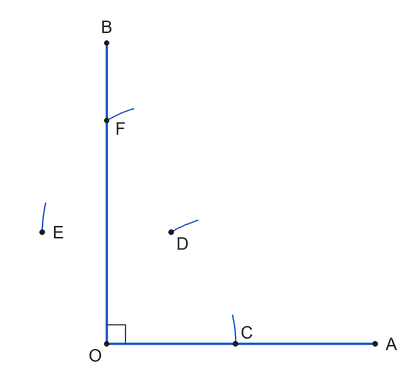
The arm OB stands upright on OA; a set-square placed at O fits it exactly.
Watch out: When bisecting, use the SAME radius from both cut points; unequal arcs meet at a point that is not on the bisector.
Therefore, ∠AOB = 90° is the required angle.
- 63 marks
Question 6
Construct the following angles, using a ruler and a compass only.
(iii) 45°
Solve with AIWritten solution
Solution:
Concept: Angles are built with compasses from 60°. If the compasses keep one opening, the vertex and two cut points on an arc form an equilateral triangle, so the angle at the vertex is 60°. Bisecting an angle (arcs of equal radius from two points equally far from the vertex) halves it, and two angles side by side add up. Here 45° is half of 90°, so we construct 90° and bisect it.
Given: The angle to be constructed; a ruler and a pair of compasses only.
Step 1 — Draw the arm.
Draw a ray OA with the ruler.
Step 2 — Draw the first arc.
With O as centre and any convenient radius, draw a large arc cutting OA at C.
Step 3 — Mark the 60° and 120° points.
With C as centre and the SAME radius, cut the arc at D. Now OC, OD and CD are all equal to the radius, so triangle OCD is equilateral and ∠DOA = 60°. With D as centre and the same radius, cut the arc again at E. This is a second step of 60°, so ∠EOA is 120°.
Step 4 — Construct 90°.
With D and E as centres and the same radius (more than half of DE), draw arcs meeting at F. Join OF. Since F is equally far from D and E, and OD = OE, the line OF divides ∠DOE into two equal parts. So ∠FOA = 90°. Draw OF lightly and let it cut the first arc at G.
Step 5 — Bisect the right angle.
With C and G as centres and the same radius (more than half of CG), draw arcs meeting at H. Join OH and produce it to B. Since H is equally far from C and G, and OC = OG, the line OH divides ∠COG into two equal parts.
Step 6 — Work out the angle.
OB divides the right angle COG into two equal parts.
Step 7 — Look at the finished figure and check it.
The finished construction is shown below, drawn to scale.
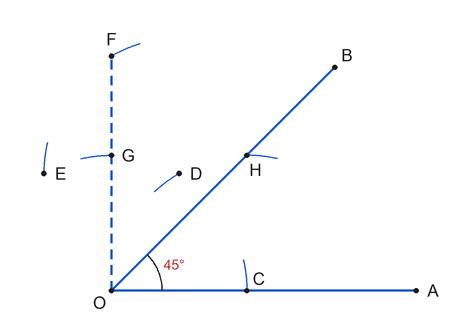
A protractor placed on OA reads 45° along OB.
Watch out: When bisecting, use the SAME radius from both cut points; unequal arcs meet at a point that is not on the bisector.
Therefore, ∠AOB = 45° is the required angle.
- 73 marks
Question 7
Construct the following angles, using a ruler and a compass only.
(iv) 30°
Solve with AIWritten solution
Solution:
Concept: Angles are built with compasses from 60°. If the compasses keep one opening, the vertex and two cut points on an arc form an equilateral triangle, so the angle at the vertex is 60°. Bisecting an angle (arcs of equal radius from two points equally far from the vertex) halves it, and two angles side by side add up. Here 30° is half of 60°, so we construct 60° and bisect it.
Given: The angle to be constructed; a ruler and a pair of compasses only.
Step 1 — Draw the arm.
Draw a ray OA with the ruler.
Step 2 — Draw the first arc.
With O as centre and any convenient radius, draw a large arc cutting OA at C.
Step 3 — Mark the 60° point.
With C as centre and the SAME radius, cut the arc at D. Now OC, OD and CD are all equal to the radius, so triangle OCD is equilateral and ∠DOA = 60°.
Step 4 — Bisect the 60° angle.
With C and D as centres and the same radius (more than half of CD), draw arcs meeting at H. Join OH and produce it to B. Since H is equally far from C and D, and OC = OD, the line OH divides ∠COD into two equal parts.
Step 5 — Work out the angle.
OB divides the 60° angle COD into two equal parts.
Step 6 — Look at the finished figure and check it.
The finished construction is shown below, drawn to scale.

A protractor placed on OA reads 30° along OB.
Watch out: When bisecting, use the SAME radius from both cut points; unequal arcs meet at a point that is not on the bisector.
Therefore, ∠AOB = 30° is the required angle.
- 83 marks
Question 8
Construct the following angles, using a ruler and a compass only.
(v) 120°
Solve with AIWritten solution
Solution:
Concept: Angles are built with compasses from 60°. If the compasses keep one opening, the vertex and two cut points on an arc form an equilateral triangle, so the angle at the vertex is 60°. Bisecting an angle (arcs of equal radius from two points equally far from the vertex) halves it, and two angles side by side add up. Here 120° = 60° + 60°, so we step off two equal arcs.
Given: The angle to be constructed; a ruler and a pair of compasses only.
Step 1 — Draw the arm.
Draw a ray OA with the ruler.
Step 2 — Draw the first arc.
With O as centre and any convenient radius, draw a large arc cutting OA at C.
Step 3 — Mark the 60° point.
With C as centre and the SAME radius, cut the arc at D. Now OC, OD and CD are all equal to the radius, so triangle OCD is equilateral and ∠DOA = 60°.
Step 4 — Mark the 120° point.
With D as centre and the same radius, cut the arc again at E. This is a second step of 60°, so ∠EOA is 120°.
Step 5 — Draw the second arm.
Join OE and produce it to B. The two 60° steps add up.
Step 6 — Look at the finished figure and check it.
The finished construction is shown below, drawn to scale.
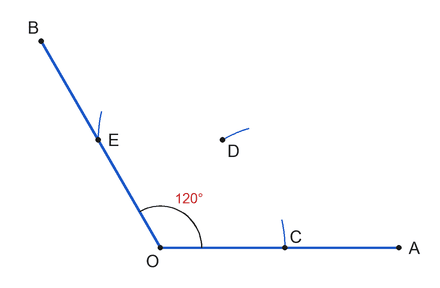
A protractor placed on OA reads 120° along OB, an obtuse angle.
Watch out: Keep the compasses at the SAME radius while stepping off arcs along the first arc; changing it spoils the angle.
Therefore, ∠AOB = 120° is the required angle.
- 93 marks
Question 9
Construct the following angles, using a ruler and a compass only.
(vi) 135°
Solve with AIWritten solution
Solution:
Concept: Angles are built with compasses from 60°. If the compasses keep one opening, the vertex and two cut points on an arc form an equilateral triangle, so the angle at the vertex is 60°. Bisecting an angle (arcs of equal radius from two points equally far from the vertex) halves it, and two angles side by side add up. Here 135° = 90° + 45°, so on a straight line we construct 90° and then bisect the right angle on the far side of the perpendicular.
Given: The angle to be constructed; a ruler and a pair of compasses only.
Step 1 — Draw a straight line.
Draw a straight line AK and mark a point O on it. O will be the vertex.
Step 2 — Draw the first arc.
With O as centre and any convenient radius, draw a large arc cutting OA at C and OK at L.
Step 3 — Mark the 60° and 120° points.
With C as centre and the SAME radius, cut the arc at D. Now OC, OD and CD are all equal to the radius, so triangle OCD is equilateral and ∠DOA = 60°. With D as centre and the same radius, cut the arc again at E. This is a second step of 60°, so ∠EOA is 120°.
Step 4 — Construct 90°.
With D and E as centres and the same radius (more than half of DE), draw arcs meeting at F. Join OF. Since F is equally far from D and E, and OD = OE, the line OF divides ∠DOE into two equal parts. So ∠FOA = 90°, and also ∠FOK = 90°. Let OF cut the first arc at G.
Step 5 — Bisect the right angle on the far side.
With G and L as centres and the same radius (more than half of GL), draw arcs meeting at H. Join OH and produce it to B. Since H is equally far from G and L, and OG = OL, the line OH divides ∠GOL into two equal parts.
Step 6 — Work out the angle.
The angle AOB is the right angle AOF together with half of the right angle FOK.
Step 7 — Look at the finished figure and check it.
The finished construction is shown below, drawn to scale.
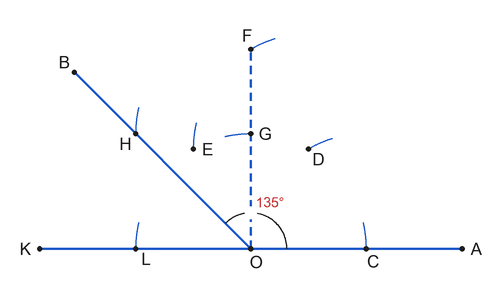
A protractor placed on OA reads 135° along OB.
Watch out: When bisecting, use the SAME radius from both cut points; unequal arcs meet at a point that is not on the bisector.
Therefore, ∠AOB = 135° is the required angle.
- 103 marks
Question 10
Draw line AB = 6 cm. Construct angle ABC = 60°. Then draw the bisector of angle ABC.
Solve with AIWritten solution
Solution:
Concept: To bisect an angle, we draw an arc about its vertex cutting both arms, then draw arcs of equal radius from the two cut points. The meeting point is equally far from both cut points, so the line from the vertex through it divides the angle into two equal parts.
Given: AB = 6 cm and ∠ABC = 60°; a ruler and a pair of compasses only.
Step 1 — Draw AB.
Draw a line segment AB, 6 cm long, with the ruler.
Step 2 — Draw the first arc at B.
With B as centre and a convenient radius, draw an arc cutting BA at X.
Step 3 — Construct 60° at B.
With X as centre and the SAME radius, cut the arc at Y. Join BY and produce it to C. Triangle BXY is equilateral, so ∠ABC = 60°.
Step 4 — Bisect ∠ABC.
With X and Y as centres and the same radius (more than half of XY), draw arcs meeting at Z. Join BZ and produce it to D. Since Z is equally far from X and Y, and BX = BY, the line BZ divides ∠XBY into two equal parts.
Step 5 — Work out the two angles.
BD halves the 60° angle, so each part is 30°.
Step 6 — Look at the finished figure and check it.
The finished construction is shown below, drawn to scale.

A protractor gives ∠ABD = 30° and ∠DBC = 30°.
Watch out: When bisecting, use the SAME radius from both cut points; unequal arcs meet at a point that is not on the bisector.
Therefore, BD is the bisector of ∠ABC, and ∠ABD and ∠DBC are each 30°.
- 113 marks
Question 11
Draw a line segment PQ = 8 cm. Construct the perpendicular bisector of the line segment PQ. Let the perpendicular bisector drawn meets PQ at point R. Measure the lengths of PR and QR. Is PR = QR ?
Solve with AIWritten solution
Solution:
Concept: Every point on the perpendicular bisector of a segment is equally far from its two ends. Arcs of the same radius drawn from both ends meet at such points, so the line through them is the perpendicular bisector, and it cuts the segment at its mid-point.
Given: PQ = 8 cm; a ruler and a pair of compasses only.
Step 1 — Draw PQ.
Draw a line segment PQ, 8 cm long.
Step 2 — Draw arcs from P and Q.
With P as centre and a radius of more than half of PQ (say 5 cm), draw arcs above and below PQ. With Q as centre and the SAME radius, draw arcs cutting them at X (above) and Y (below).
Step 3 — Draw the perpendicular bisector.
Join XY. It meets PQ at R at right angles.
Step 4 — Measure PR and QR.
With the ruler, PR = 4 cm and QR = 4 cm. This agrees with half of PQ:
Step 5 — Look at the finished figure and check it.
The finished construction is shown below, drawn to scale.
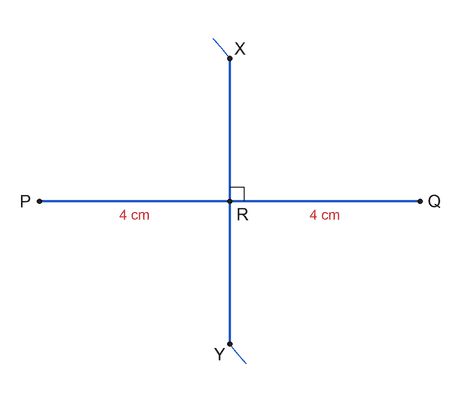
R is the mid-point of PQ, and XY makes a right angle with PQ at R.
Watch out: The radius must be MORE than half of PQ (more than 4 cm here), or the arcs from P and Q do not meet.
Therefore, PR = 4 cm and QR = 4 cm, so yes, PR = QR.
- 123 marks
Question 12
Draw a line segment AB = 7 cm. Mark a point P on AB such that AP = 3 cm. Draw perpendicular on to AB at point P.
Solve with AIWritten solution
Solution:
Concept: To draw a perpendicular at a point P on a line, we mark two points on the line equally far from P. Arcs of equal radius from these two points meet at a point equally far from both, and the line from P through it is the perpendicular bisector of the two points, so it makes a right angle with the line.
Given: AB = 7 cm and AP = 3 cm; a ruler and a pair of compasses only.
Step 1 — Draw AB and mark P.
Draw a line segment AB, 7 cm long. With A as centre and radius 3 cm, cut AB at P, so AP = 3 cm. The rest of the segment, PB, is 4 cm long.
Step 2 — Mark two points equally far from P.
With P as centre and a small radius, draw arcs cutting AB at C and D, one on each side of P. Now PC = PD.
Step 3 — Draw equal arcs from C and D.
With C and D as centres and a larger radius (the same for both), draw arcs meeting at E above AB.
Step 4 — Draw the perpendicular.
Join PE and produce it to Q. E is equally far from C and D, and so is P, so PQ is the perpendicular bisector of CD.
Step 5 — Look at the finished figure and check it.
The finished construction is shown below, drawn to scale.
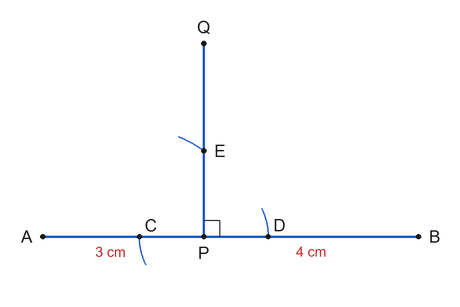
A set-square placed at P with one edge along AB fits along PQ, so ∠QPB = 90°.
Watch out: The two arcs from C and D must have the SAME radius, and it must be larger than PC; otherwise they do not meet above P.
Therefore, PQ is the required perpendicular to AB at P, with ∠QPB = 90°.
- 133 marks
Question 13
Draw a line segment AB = 6·5 cm. Locate a point P that is 5 cm from A and 4·6 cm from B. Through the point P, draw a perpendicular on to the line segment AB.
Solve with AIWritten solution
Solution:
Concept: A point at given distances from two fixed points lies where two arcs with those radii meet. To draw a perpendicular from a point P to a line, we cut the line at two points C and D with one arc about P; the point E where equal arcs from C and D meet on the other side is, like P, equally far from C and D, so PE is perpendicular to CD.
Given: AB = 6·5 cm, PA = 5 cm and PB = 4·6 cm; a ruler and a pair of compasses only.
Step 1 — Draw AB.
Draw a line segment AB, 6·5 cm long.
Step 2 — Locate P.
With A as centre and radius 5 cm, draw an arc above AB. With B as centre and radius 4·6 cm, draw another arc cutting the first at P. Then PA = 5 cm and PB = 4·6 cm.
Step 3 — Cut AB with an arc about P.
With P as centre and a radius larger than the distance of P from AB, draw an arc cutting AB at C and D. Now PC = PD.
Step 4 — Draw equal arcs below AB.
With C and D as centres and the same radius, draw arcs meeting at E on the other side of AB.
Step 5 — Draw the perpendicular.
Join PE. It meets AB at N. Both P and E are equally far from C and D, so PE is the perpendicular bisector of CD, and PN is perpendicular to AB.
Step 6 — Look at the finished figure and check it.
The finished construction is shown below, drawn to scale.
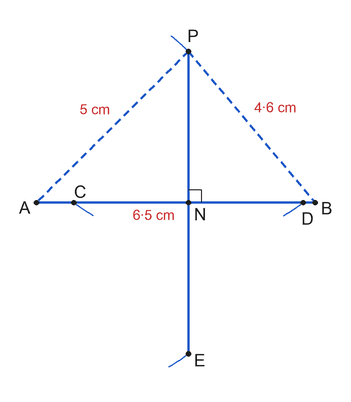
A set-square placed at N with one edge along AB fits along NP, so ∠PNB = 90°.
Watch out: The arc about P must be large enough to cut AB in two points; a small arc does not reach the line.
Therefore, PN is the required perpendicular from P on to AB, with ∠PNB = 90°.
- 143 marks
Question 14
Draw a line segment OA = 5 cm. Use set-squares to construct angle AOB = 60° such that OB = 3 cm. Join A and B; then measure the length of AB.
Solve with AIWritten solution
Solution:
Concept: A set of set-squares has two triangles: one with angles 45°, 45° and 90°, and one with angles 30°, 60° and 90°. Placing a corner of a set-square at a point, with one edge along a line, lets us draw a line at that corner's angle; two set-squares placed side by side add their angles.
Given: OA = 5 cm, ∠AOB = 60° and OB = 3 cm; set-squares.
Step 1 — Draw OA.
Draw a line segment OA, 5 cm long.
Step 2 — Draw the 60° arm.
Place the 30°–60°–90° set-square with its 60° corner at O and the edge next to that corner along OA. Draw a line from O along the other edge of that corner; it makes 60° with OA.
Step 3 — Mark B.
With O as centre and radius 3 cm, cut this line at B. Now ∠AOB = 60° and OB = 3 cm.
Step 4 — Join AB and measure it.
Join AB with the ruler and measure it. AB is about 4·4 cm.
Step 5 — Look at the finished figure and check it.
The finished construction is shown below, drawn to scale.

The figure is drawn to scale; AB is shorter than OA, as it should be, because it is opposite the 60° angle, which is not the largest angle of the triangle.
Watch out: Use the 60° corner, not the 30° corner, of the set-square, and keep its edge exactly along OA.
Note: A value of 5·8 cm, sometimes given for this question, is the length of AB when the angle at O is a right angle. With the 60° angle that the question asks for, AB measures about 4·4 cm.
Therefore, AB = 4·4 cm (approximately).
- 153 marks
Question 15
Draw a line segment OP = 8 cm. Use set-squares to construct ∠ POQ = 90° such that OQ = 6 cm. Join P and Q; then measure the length of PQ.
Solve with AIWritten solution
Solution:
Concept: A set of set-squares has two triangles: one with angles 45°, 45° and 90°, and one with angles 30°, 60° and 90°. Placing a corner of a set-square at a point, with one edge along a line, lets us draw a line at that corner's angle; two set-squares placed side by side add their angles.
Given: OP = 8 cm, ∠POQ = 90° and OQ = 6 cm; set-squares.
Step 1 — Draw OP.
Draw a line segment OP, 8 cm long.
Step 2 — Draw the 90° arm.
Place a set-square with its right-angled corner at O and one edge along OP. Draw a line from O along the other edge; it is perpendicular to OP.
Step 3 — Mark Q.
With O as centre and radius 6 cm, cut this line at Q, so OQ = 6 cm and ∠POQ = 90°.
Step 4 — Join PQ and measure it.
Join PQ with the ruler and measure it. PQ is 10 cm.
Step 5 — Look at the finished figure and check it.
The finished construction is shown below, drawn to scale.
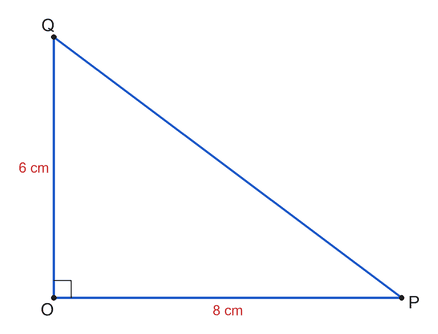
PQ is the longest side, because it is opposite the right angle.
Watch out: Measure OQ along the drawn perpendicular from O itself, not from the edge of the set-square.
Therefore, PQ = 10 cm.
- 163 marks
Question 16
Draw ∠ ABC = 120°. Bisect the angle using ruler and compass. Measure each angle so obtained and check whether or not the new angles obtained on bisecting ∠ ABC are equal.
Solve with AIWritten solution
Solution:
Concept: To bisect an angle, we draw an arc about its vertex cutting both arms, then draw arcs of equal radius from the two cut points. The meeting point is equally far from both cut points, so the line from the vertex through it divides the angle into two equal parts. A 120° angle is made by stepping two equal arcs of 60° along one arc.
Given: ∠ABC = 120°; a ruler and a pair of compasses only.
Step 1 — Construct ∠ABC = 120°.
Draw a ray BC. With B as centre, draw a large arc cutting BC at X. With X as centre and the same radius, cut the arc at Y; with Y as centre and the same radius, cut it again at Z. Join BZ and produce it to A. Each step is 60°, so ∠ABC = 120°.
Step 2 — Bisect ∠ABC.
With X and Z as centres and the same radius (more than half of XZ), draw arcs meeting at W. Join BW and produce it to D. Since W is equally far from X and Z, and BX = BZ, the line BW divides ∠XBZ into two equal parts. Notice that BD also passes through Y, the 60° mark, as it should.
Step 3 — Measure the two angles.
With a protractor, ∠ABD = 60° and ∠DBC = 60°. This agrees with half of 120°:
Step 4 — Look at the finished figure and check it.
The finished construction is shown below, drawn to scale.

Both parts measure 60°, so the bisector has divided ∠ABC into two equal angles.
Watch out: When bisecting, use the SAME radius from both cut points; unequal arcs meet at a point that is not on the bisector.
Therefore, ∠ABD = 60° and ∠DBC = 60°; yes, the two angles obtained on bisecting ∠ABC are equal.
- 173 marks
Question 17
Draw ∠ PQR = 75° by using set-squares. On PQ mark a point M such that MQ = 3 cm. On QR mark a point N such that QN = 4 cm. Join M and N. Measure the length of MN.
Solve with AIWritten solution
Solution:
Concept: A set of set-squares has two triangles: one with angles 45°, 45° and 90°, and one with angles 30°, 60° and 90°. Placing a corner of a set-square at a point, with one edge along a line, lets us draw a line at that corner's angle; two set-squares placed side by side add their angles. Here 75° = 45° + 30°.
Given: ∠PQR = 75°, MQ = 3 cm and QN = 4 cm; set-squares.
Step 1 — Draw 45° at Q.
Draw a ray QR. Place the 45° set-square with a 45° corner at Q and one edge along QR, and draw a light (dashed) line along the other edge. It makes 45° with QR.
Step 2 — Add 30° on top.
Place the 30°–60°–90° set-square with its 30° corner at Q and one edge along the dashed line, on the side away from QR. Draw QP along the other edge. The two angles add up.
Step 3 — Mark M and N.
With Q as centre and radius 3 cm, cut QP at M. With Q as centre and radius 4 cm, cut QR at N.
Step 4 — Join MN and measure it.
Join MN with the ruler and measure it. MN is about 4·3 cm.
Step 5 — Look at the finished figure and check it.
The finished construction is shown below, drawn to scale.

A protractor placed on QR reads 75° along QP.
Watch out: Put the second set-square on the far side of the dashed line; placed on the near side it gives 45° − 30° = 15°.
Therefore, MN = 4·3 cm (approximately).
- 183 marks
Question 18
Construct a triangle ABC with :
AB = 6 cm, BC = 8 cm and AC = 4 cm.
Solve with AIWritten solution
Solution:
Concept: When all three sides of a triangle are given, we draw one side as the base. The third vertex must be at the first given distance from one end of the base and at the second given distance from the other end, so it is the point where two arcs with these radii meet.
Given: AB = 6 cm, BC = 8 cm and AC = 4 cm.
Step 1 — Check that the triangle exists.
The two shorter sides add up to more than the longest side (6 cm + 4 cm = 10 cm, which is more than 8 cm), so the two arcs will meet.
Step 2 — Draw the base.
Draw BC, 8 cm long (the longest side makes a good base).
Step 3 — Draw the arc from B.
With B as centre and radius 6 cm (= AB), draw an arc above BC.
Step 4 — Draw the arc from C.
With C as centre and radius 4 cm (= AC), draw an arc cutting the first arc at A.
Step 5 — Complete the triangle.
Join AB and AC.
Step 6 — Look at the finished figure and check it.
The finished construction is shown below, drawn to scale.
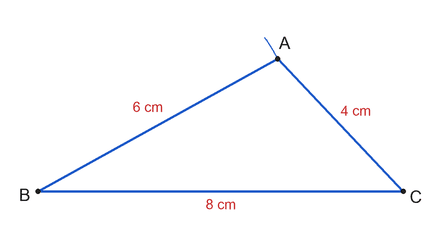
Measuring the sides gives AB = 6 cm, BC = 8 cm and AC = 4 cm, as required.
Watch out: Each arc must be drawn from the correct end of the base with the correct radius; swapping the two radii gives a mirror-image triangle with the sides in the wrong places.
Therefore, ABC is the required triangle.
- 193 marks
Question 19
Construct a triangle ABC with :
AB = 3·5 cm, AC = 4·8 cm and BC = 5·2 cm.
Solve with AIWritten solution
Solution:
Concept: When all three sides of a triangle are given, we draw one side as the base. The third vertex must be at the first given distance from one end of the base and at the second given distance from the other end, so it is the point where two arcs with these radii meet.
Given: AB = 3·5 cm, AC = 4·8 cm and BC = 5·2 cm.
Step 1 — Check that the triangle exists.
The two shorter sides add up to more than the longest side (3·5 cm + 4·8 cm = 8·3 cm, which is more than 5·2 cm), so the two arcs will meet.
Step 2 — Draw the base.
Draw BC, 5·2 cm long.
Step 3 — Draw the arc from B.
With B as centre and radius 3·5 cm (= AB), draw an arc above BC.
Step 4 — Draw the arc from C.
With C as centre and radius 4·8 cm (= AC), draw an arc cutting the first arc at A.
Step 5 — Complete the triangle.
Join AB and AC.
Step 6 — Look at the finished figure and check it.
The finished construction is shown below, drawn to scale.
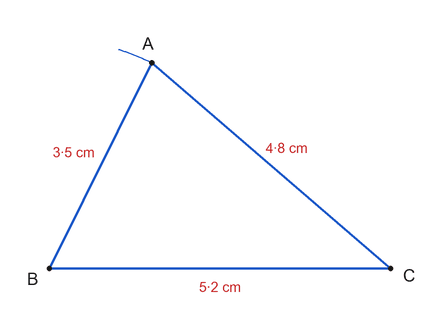
Measuring the sides gives AB = 3·5 cm, AC = 4·8 cm and BC = 5·2 cm, as required.
Watch out: Each arc must be drawn from the correct end of the base with the correct radius; swapping the two radii gives a mirror-image triangle with the sides in the wrong places.
Therefore, ABC is the required triangle.
- 203 marks
Question 20
Construct a triangle ABC with :
AB = BC = 5 cm and AC = 3 cm. Measure angles A and C. Is ∠ A = ∠ C ?
Solve with AIWritten solution
Solution:
Concept: When all three sides of a triangle are given, we draw one side as the base. The third vertex must be at the first given distance from one end of the base and at the second given distance from the other end, so it is the point where two arcs with these radii meet. In a triangle, the angles opposite equal sides are equal.
Given: AB and BC are each 5 cm, and AC = 3 cm.
Step 1 — Draw the base.
Draw AC, 3 cm long.
Step 2 — Draw the arc from A.
With A as centre and radius 5 cm (= AB), draw an arc above AC.
Step 3 — Draw the arc from C.
With C as centre and radius 5 cm (= BC), draw an arc cutting the first arc at B.
Step 4 — Complete the triangle.
Join AB and BC.
Step 5 — Measure ∠A and ∠C.
With a protractor, ∠A is about 72·5° and ∠C is about 72·5°. As a check, the third angle then makes the sum 180°:
Step 6 — Look at the finished figure and check it.
The finished construction is shown below, drawn to scale.
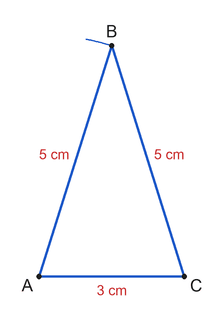
∠A and ∠C are opposite the equal sides BC and AB, so they come out equal.
Watch out: Measure each angle from the base line AC, placing the protractor's centre exactly on the vertex.
Therefore, ∠A and ∠C each measure about 72·5°; yes, ∠A = ∠C.
- 213 marks
Question 21
Construct a triangle ABC with :
AB = BC = CA = 4·5 cm. Measure all the angles of the triangle. Are they equal ?
Solve with AIWritten solution
Solution:
Concept: When all three sides of a triangle are given, we draw one side as the base. The third vertex must be at the first given distance from one end of the base and at the second given distance from the other end, so it is the point where two arcs with these radii meet.
Given: Each of the sides AB, BC and CA is 4·5 cm.
Step 1 — Draw the base.
Draw AB, 4·5 cm long.
Step 2 — Draw the two arcs.
With A as centre and radius 4·5 cm, draw an arc above AB. With B as centre and the same radius, draw an arc cutting it at C.
Step 3 — Complete the triangle.
Join AC and BC.
Step 4 — Measure the angles.
With a protractor, each angle measures 60°. They add up to 180°, as the angles of every triangle do:
Step 5 — Look at the finished figure and check it.
The finished construction is shown below, drawn to scale.

All three sides are equal, so the triangle is equilateral, and its three angles are equal.
Watch out: Keep the compass opening at exactly 4·5 cm for both arcs.
Therefore, each of ∠A, ∠B and ∠C is 60°; yes, all the angles are equal.
- 223 marks
Question 22
Construct a triangle ABC with :
AB = 3 cm, BC = 7 cm and ∠ B = 90°.
Solve with AIWritten solution
Solution:
Concept: When two sides and the angle between them (the included angle) are given, we draw one side, construct the angle at one of its ends, and cut off the other side along the new arm. Joining the free ends completes the triangle.
Given: AB = 3 cm, BC = 7 cm and ∠B = 90°; a ruler and a pair of compasses only.
Step 1 — Draw the base.
Draw BC, 7 cm long.
Step 2 — Construct 90° at B.
With B as centre, draw an arc cutting BC. Keeping the same radius, step off two equal arcs along it to mark the 60° point and the 120° point. With these two points as centres and equal radii, draw arcs meeting outside the first arc, and draw a ray from B through the meeting point. It bisects the angle between 60° and 120°, so it makes 90° with BC.
Step 3 — Cut off AB.
With B as centre and radius 3 cm, cut the 90° ray at A, so BA = 3 cm.
Step 4 — Complete the triangle.
Join AC.
Step 5 — Look at the finished figure and check it.
The finished construction is shown below, drawn to scale.
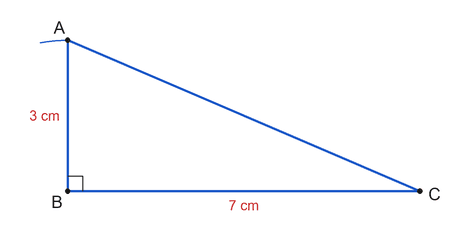
The square at B shows the right angle; BA = 3 cm and BC = 7 cm.
Watch out: The 3 cm side goes on the new arm at B, because ∠B is the angle between AB and BC.
Therefore, ABC is the required right-angled triangle.
- 233 marks
Question 23
Construct a triangle ABC with :
AC = 4·5 cm, BC = 6 cm and ∠ C = 60°.
Solve with AIWritten solution
Solution:
Concept: When two sides and the angle between them (the included angle) are given, we draw one side, construct the angle at one of its ends, and cut off the other side along the new arm. Joining the free ends completes the triangle.
Given: AC = 4·5 cm, BC = 6 cm and ∠C = 60°; a ruler and a pair of compasses only.
Step 1 — Draw the base.
Draw CB, 6 cm long.
Step 2 — Construct 60° at C.
With C as centre and any convenient radius, draw an arc cutting CB. With that cut point as centre and the same radius, cut the arc again, and draw a ray from C through this second point. C and the two cut points form an equilateral triangle, so the ray makes 60° with CB.
Step 3 — Cut off CA.
With C as centre and radius 4·5 cm, cut the 60° ray at A, so CA = 4·5 cm.
Step 4 — Complete the triangle.
Join AB.
Step 5 — Look at the finished figure and check it.
The finished construction is shown below, drawn to scale.
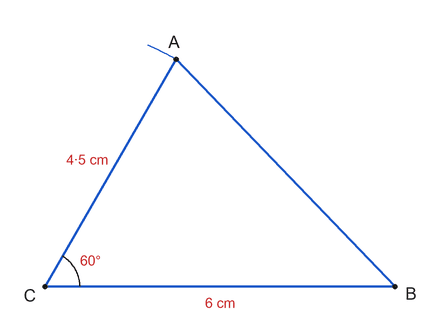
The angle at C measures 60°, and CA = 4·5 cm, CB = 6 cm.
Watch out: ∠C lies between the sides CA and CB, so the angle must be made at C, not at B.
Therefore, ABC is the required triangle.
- 243 marks
Question 24
Construct a triangle ABC with :
AC = 6 cm, ∠ A = 60° and ∠ C = 45°. Measure AB and BC.
Solve with AIWritten solution
Solution:
Concept: When two angles and the side between them are given, we draw that side and construct the two angles at its ends, on the same side of it. The two new arms meet at the third vertex.
Given: AC = 6 cm, ∠A = 60° and ∠C = 45°; a ruler and a pair of compasses only.
Step 1 — Draw the base.
Draw AC, 6 cm long.
Step 2 — Construct 60° at A.
With A as centre and any convenient radius, draw an arc cutting AC. With that cut point as centre and the same radius, cut the arc again, and draw a ray from A through this second point. A and the two cut points form an equilateral triangle, so the ray makes 60° with AC.
Step 3 — Construct 45° at C.
With C as centre, draw an arc cutting CA. Keeping the same radius, step off two equal arcs along it to mark the 60° point and the 120° point. With these two points as centres and equal radii, draw arcs meeting outside the first arc, and draw a ray from C through the meeting point. It bisects the angle between 60° and 120°, so it makes 90° with CA. Now bisect this right angle, using the points where the first arc cuts CA and the 90° ray. The bisector makes 90° ÷ 2 = 45° with CA. Make it on the same side of AC as the 60° ray.
Step 4 — Mark B.
The two rays meet at B. Triangle ABC is complete.
Step 5 — Measure AB and BC.
With the ruler, AB is about 4·4 cm and BC is about 5·4 cm.
Step 6 — Look at the finished figure and check it.
The finished construction is shown below, drawn to scale.
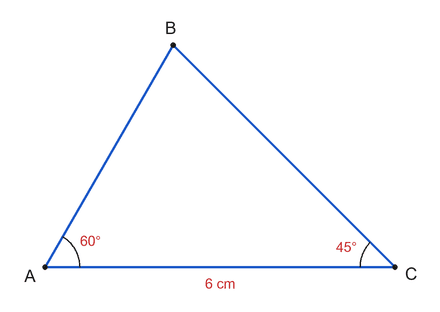
The third angle should measure:
A protractor at B confirms 75°.
Watch out: Make both angles on the SAME side of AC; otherwise the rays never meet.
Therefore, AB = 4·4 cm and BC = 5·4 cm (approximately).
- 253 marks
Question 25
Construct a triangle ABC with :
AB = 5·4 cm, ∠ A = 30° and ∠ B = 90°. Measure ∠ C and side BC.
Solve with AIWritten solution
Solution:
Concept: When two angles and the side between them are given, we draw that side and construct the two angles at its ends, on the same side of it. The two new arms meet at the third vertex.
Given: AB = 5·4 cm, ∠A = 30° and ∠B = 90°; a ruler and a pair of compasses only.
Step 1 — Draw the base.
Draw AB, 5·4 cm long.
Step 2 — Construct 30° at A.
With A as centre and any convenient radius, draw an arc cutting AB. With that cut point as centre and the same radius, cut the arc again, and draw a ray from A through this second point. A and the two cut points form an equilateral triangle, so the ray makes 60° with AB. Now bisect this 60° angle: with the two cut points as centres and equal radii, draw arcs meeting inside the angle, and draw a ray from A through the meeting point. It makes 60° ÷ 2 = 30° with AB.
Step 3 — Construct 90° at B.
With B as centre, draw an arc cutting BA. Keeping the same radius, step off two equal arcs along it to mark the 60° point and the 120° point. With these two points as centres and equal radii, draw arcs meeting outside the first arc, and draw a ray from B through the meeting point. It bisects the angle between 60° and 120°, so it makes 90° with BA. Make it on the same side of AB as the 30° ray.
Step 4 — Mark C.
The two rays meet at C. Triangle ABC is complete.
Step 5 — Measure ∠C and BC.
With a protractor, ∠C measures 60°, and with the ruler BC is about 3·1 cm. The angle sum of the triangle confirms ∠C:
Step 6 — Look at the finished figure and check it.
The finished construction is shown below, drawn to scale.
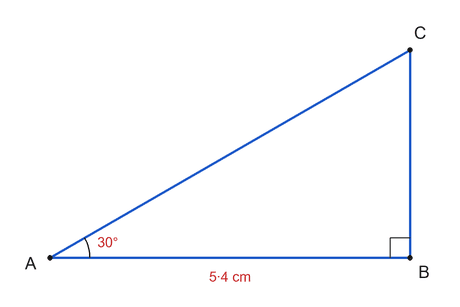
The square at B marks the right angle, and ∠A measures 30°.
Watch out: Make both angles on the SAME side of AB; otherwise the rays never meet.
Therefore, ∠C = 60° and BC = 3·1 cm (approximately).
- 263 marks
Question 26
Construct a triangle ABC with :
AB = 7 cm, ∠ B = 120° and ∠ A = 30°. Measure AC and BC.
Solve with AIWritten solution
Solution:
Concept: When two angles and the side between them are given, we draw that side and construct the two angles at its ends, on the same side of it. The two new arms meet at the third vertex.
Given: AB = 7 cm, ∠B = 120° and ∠A = 30°; a ruler and a pair of compasses only.
Step 1 — Draw the base.
Draw AB, 7 cm long.
Step 2 — Construct 120° at B.
With B as centre, draw an arc cutting BA. Keeping the same radius, step off two equal arcs along it and draw a ray from B through the second mark. Each step is 60°, so the ray makes 120° with BA.
Step 3 — Construct 30° at A.
With A as centre and any convenient radius, draw an arc cutting AB. With that cut point as centre and the same radius, cut the arc again, and draw a ray from A through this second point. A and the two cut points form an equilateral triangle, so the ray makes 60° with AB. Now bisect this 60° angle: with the two cut points as centres and equal radii, draw arcs meeting inside the angle, and draw a ray from A through the meeting point. It makes 60° ÷ 2 = 30° with AB. Make it on the same side of AB as the 120° ray.
Step 4 — Mark C.
The two rays meet at C. Triangle ABC is complete.
Step 5 — Measure AC and BC.
With the ruler, AC is about 12·1 cm (12 cm to the nearest centimetre) and BC is 7 cm.
Step 6 — Look at the finished figure and check it.
The finished construction is shown below, drawn to scale.
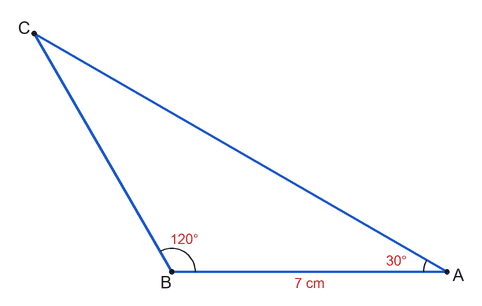
The third angle is:
So ∠C and ∠A are both 30°. The sides opposite these equal angles are equal, so BC is equal to AB (7 cm). This agrees with the measurement.
Watch out: The 120° angle is obtuse; draw it opening away from A, so that it leans back over B.
Therefore, AC = 12·1 cm (about 12 cm) and BC = 7 cm.
- 273 marks
Question 27
Construct a triangle ABC with :
BC = 3 cm, AC = 4 cm and AB = 5 cm. Measure angle ACB. Classify this triangle based on angle ACB.
Solve with AIWritten solution
Solution:
Concept: When all three sides of a triangle are given, we draw one side as the base. The third vertex must be at the first given distance from one end of the base and at the second given distance from the other end, so it is the point where two arcs with these radii meet. A triangle with one angle of 90° is called a right-angled triangle.
Given: BC = 3 cm, AC = 4 cm and AB = 5 cm.
Step 1 — Draw the base.
Draw AB, 5 cm long.
Step 2 — Draw the arc from A.
With A as centre and radius 4 cm (= AC), draw an arc above AB.
Step 3 — Draw the arc from B.
With B as centre and radius 3 cm (= BC), draw an arc cutting the first arc at C.
Step 4 — Complete the triangle.
Join AC and BC.
Step 5 — Measure ∠ACB.
With a protractor, ∠ACB measures 90°.
Step 6 — Look at the finished figure and check it.
The finished construction is shown below, drawn to scale.
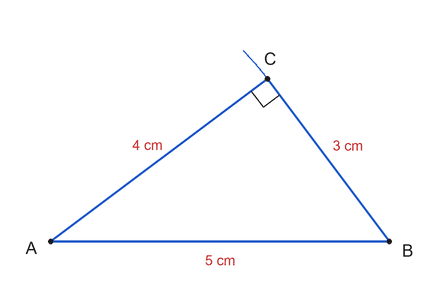
The angle at C is a right angle, so the triangle is classified as right-angled.
Watch out: ∠ACB is the angle at C, between CA and CB; do not measure the angle at A or B instead.
Therefore, ∠ACB = 90°, so triangle ABC is a right-angled triangle.
- 281 mark
Question 28
Two linear adjacent angles are bisected.
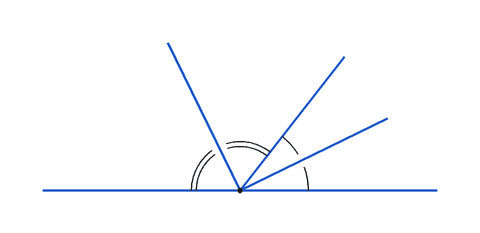
The angle between these two bisectors is :
Solve with AIAnswer
- Correct
(A) 90°
(B) 60°
(C) 120°
(D) 180°
Answer: (A) 90°
Concept: Two linear adjacent angles (a linear pair) lie side by side on a straight line, so they add up to 180°. A bisector divides an angle into two equal halves.
Step 1 — Write what is given.
Let the two linear adjacent angles be x and y. They lie on a straight line, so they add up to 180°: x + y = 180°.
Step 2 — Add the halves.
Each bisector takes half of its own angle, and the angle between the two bisectors is the sum of the two halves.
Watch out: The angle between the bisectors uses the HALVES of the two angles, not the whole angles.
Why the other options are wrong:
- (B) 60°: 60° would need the two angles to add up to 2 × 60° = 120°, but a linear pair adds up to 180°.
- (C) 120°: 120° would need the two angles to add up to 240°, which is more than a straight angle.
- (D) 180°: 180° is the sum of the two whole angles, not of their halves.
Therefore, the angle between the two bisectors is 90°, option (A).
- 291 mark
Question 29
Is it possible to construct a triangle ABC, if BC = 8 cm, ∠ A = 90° and ∠ C = 90° ?
Solve with AIAnswer
(A) yes
- Correct
(B) no
(C) none of these
Answer: (B) no
Concept: The three angles of a triangle add up to exactly 180°, and every angle of a triangle is more than 0°.
Step 1 — Add the two given angles.
The angle sum of a triangle is 180°. Here two angles are already given.
Step 2 — Find what is left for ∠B.
Nothing is left for the third angle, since 180° − 180° = 0°. The two arms drawn at the ends would both be perpendicular to the same line, so they are parallel and never meet.
Watch out: A triangle can have at most one right angle.
Why the other options are wrong:
- (A) yes: yes would need ∠B to be more than 0°, but the two right angles already use up all 180°.
- (C) none of these: none of these does not fit, because the question has a definite answer: no such triangle exists.
Therefore, it is not possible to construct the triangle, option (B).
- 301 mark
Question 30
Is it possible to construct a triangle with vertex angles 70°, 60° and 40° ?
Solve with AIAnswer
(A) yes
- Correct
(B) no
(C) none of these
Answer: (B) no
Concept: The three angles of every triangle add up to exactly 180°.
Step 1 — Add the three angles.
We add the given angles and compare the total with 180°.
Step 2 — Compare with 180°.
The total is 170°, which is not 180°, so these three angles cannot be the angles of one triangle.
Watch out: A triangle needs the sum to be exactly 180°, not just less than 180°.
Why the other options are wrong:
- (A) yes: yes would need the angles to add up to 180°, but they add up to 170°.
- (C) none of these: none of these does not fit, because the question has a definite answer: such a triangle cannot be drawn.
Therefore, it is not possible to construct the triangle, option (B).
- 311 mark
Question 31
An angle of 70° is bisected. Each smaller angle is :
Solve with AIAnswer
(A) 70°
- Correct
(B) 35°
(C) 90°
(D) 180°-70°
Answer: (B) 35°
Concept: To bisect an angle means to divide it into two equal angles.
Step 1 — Halve the angle.
Bisecting divides an angle into two equal parts, so each part is half of 70°.
Why the other options are wrong:
- (A) 70°: 70° is the whole angle before it is bisected.
- (C) 90°: 90° is a right angle; each half of a 70° angle must be smaller than 70°.
- (D) 180°-70°: 180° − 70° = 110° is the supplement of 70°, not half of it.
Therefore, each smaller angle is 35°, option (B).
- 321 mark
Question 32
Choose your answer based on the codes given below :
(1) A is true, R is false. (2) A is false, R is true. (3) Both A and R are true. (4) Both A and R are false.
Assertion (A) : If AB = 7 cm, BC = 4 cm and AC = 3 cm, it is possible to construct the triangle ABC.
Reason (R) : Since, BC + AC = 4 cm + 3 cm = 7 cm = AB, it is not possible to construct the triangle ABC.
Solve with AIAnswer
(A) (1) A is true, R is false.
- Correct
(B) (2) A is false, R is true.
(C) (3) Both A and R are true.
(D) (4) Both A and R are false.
Answer: (B) (2) A is false, R is true.
Concept: In an Assertion–Reason item we judge the Assertion (A) and the Reason (R) separately, true or false, and choose the code that matches both verdicts. A triangle can be drawn only when the sum of any two sides is greater than the third side.
Step 1 — Recall the rule.
Two arcs drawn from the ends of a side meet above it only when the other two sides together are longer than that side. So in a triangle the sum of any two sides is greater than the third side.
Step 2 — Judge the Assertion.
We add the two shorter sides, in cm.
This sum equals AB (7 cm) and is not greater than it. The arcs from A and B meet only on AB itself, so no triangle is formed. The Assertion is false.
Step 3 — Judge the Reason.
The Reason says exactly this: since BC + AC = AB, the triangle cannot be constructed. The Reason is true.
Watch out: The sum must be GREATER than the third side; equal is not enough.
Why the other options are wrong:
- (A): code (1) calls A true and R false, but A is false and R is true.
- (C): code (3) calls A true, but 4 cm + 3 cm is not more than 7 cm, so A is false.
- (D): code (4) calls R false, but R correctly says the triangle cannot be drawn.
Therefore, A is false and R is true, option (B).
- 331 mark
Question 33
Statement 1 : A line PQ meets the line segment AB at point O such that OA = OB and ∠ AOP = 90°. AB is perpendicular bisector of PQ.
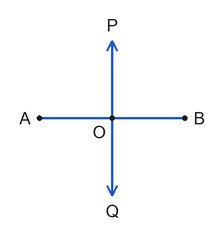
Statement 2 : OA = OB ⇒ PQ bisects AB
∠ AOP = 90° ⇒ PQ is perpendicular to AB
∴ PQ is perpendicular bisector of AB
Which of the following options is correct?
Solve with AIAnswer
(A) Both the statements are true.
(B) Both the statements are false.
(C) Statement 1 is true, and statement 2 is false.
- Correct
(D) Statement 1 is false, and statement 2 is true.
Answer: (D) Statement 1 is false, and statement 2 is true.
Concept: A line is the perpendicular bisector of a segment when it passes through the segment's mid-point at right angles. We judge each statement separately, true or false, and choose the option that matches both verdicts.
Step 1 — Recall the definition.
A line is the perpendicular bisector of a segment when it passes through the mid-point of that segment and makes a right angle with it.
Step 2 — Judge Statement 1.
Statement 1 says AB is the perpendicular bisector of PQ. For that, O would have to be the mid-point of PQ, with OP and OQ equal. We are told only that OA = OB, which makes O the mid-point of AB, not of PQ; in the figure PQ is even drawn as a line, with arrows. Statement 1 is false.
Step 3 — Judge Statement 2.
Statement 2 says: OA = OB, so PQ bisects AB; ∠AOP = 90°, so PQ is perpendicular to AB; hence PQ is the perpendicular bisector of AB. Each step uses the definition correctly. Statement 2 is true.
Watch out: OA = OB tells us about the mid-point of AB only; it says nothing about the lengths OP and OQ.
Note: A key giving Statement 1 true and Statement 2 false cannot be right: Statement 2 applies the definition of the perpendicular bisector exactly, while Statement 1 would need OP = OQ, which is not given.
Why the other options are wrong:
- (A): this calls Statement 1 true, but nothing tells us that O is the mid-point of PQ.
- (B): this calls Statement 2 false, but Statement 2 follows the definition step by step.
- (C): this calls Statement 1 true and Statement 2 false, which is the wrong way round.
Therefore, Statement 1 is false and Statement 2 is true, option (D).
What Class 6 Maths Ch 19 covers
The sections of the chapter, in the order the book takes them. Every question above comes from one of these.
- 01Using a Ruler and a Compass
- 02Construction of Angles
- 03Construction of Perpendiculars
- 04Using Set-Squares
- 05Construction of Triangles
More ways to study this chapter
The same chapter asked three other ways. Practise it, revise it, and see what the board has set on Ch 19 before.
Class 6 Maths Ch 19 questions students ask
How many questions are there in Class 6 Maths Ch 19?
33 questions. Every one is solved step by step on this page.
Are these Class 6 Maths solutions free?
Yes. Every question and its full working is free to read, with no account needed.
Can I download the Class 6 Maths Ch 19 solutions as a PDF?
There is no PDF to download. Every solution is on this page instead, which means it is searchable, always the current syllabus, and readable on a phone. Use your browser's print option if you want it on paper.