
Question 263 marksMedium
Construct a triangle ABC with :
AB = 7 cm, ∠ B = 120° and ∠ A = 30°. Measure AC and BC.
Confirming your payment
Sign up now and get 250 free tokens.
Constructions · Question 26 of 33
Construct a triangle ABC with :
AB = 7 cm, ∠ B = 120° and ∠ A = 30°. Measure AC and BC.
Solution:
Concept: When two angles and the side between them are given, we draw that side and construct the two angles at its ends, on the same side of it. The two new arms meet at the third vertex.
Given: AB = 7 cm, ∠B = 120° and ∠A = 30°; a ruler and a pair of compasses only.
Step 1 — Draw the base.
Draw AB, 7 cm long.
Step 2 — Construct 120° at B.
With B as centre, draw an arc cutting BA. Keeping the same radius, step off two equal arcs along it and draw a ray from B through the second mark. Each step is 60°, so the ray makes 120° with BA.
Step 3 — Construct 30° at A.
With A as centre and any convenient radius, draw an arc cutting AB. With that cut point as centre and the same radius, cut the arc again, and draw a ray from A through this second point. A and the two cut points form an equilateral triangle, so the ray makes 60° with AB. Now bisect this 60° angle: with the two cut points as centres and equal radii, draw arcs meeting inside the angle, and draw a ray from A through the meeting point. It makes 60° ÷ 2 = 30° with AB. Make it on the same side of AB as the 120° ray.
Step 4 — Mark C.
The two rays meet at C. Triangle ABC is complete.
Step 5 — Measure AC and BC.
With the ruler, AC is about 12·1 cm (12 cm to the nearest centimetre) and BC is 7 cm.
Step 6 — Look at the finished figure and check it.
The finished construction is shown below, drawn to scale.
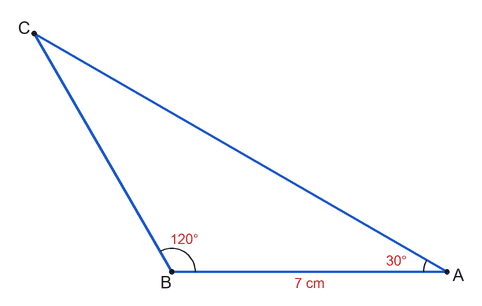
The third angle is:
So ∠C and ∠A are both 30°. The sides opposite these equal angles are equal, so BC is equal to AB (7 cm). This agrees with the measurement.
Watch out: The 120° angle is obtuse; draw it opening away from A, so that it leans back over B.
Therefore, AC = 12·1 cm (about 12 cm) and BC = 7 cm.