Answer: (D) Statement 1 is false, and statement 2 is true.
Concept: A line is the perpendicular bisector of a segment when it passes through the segment's mid-point at right angles. We judge each statement separately, true or false, and choose the option that matches both verdicts.
Step 1 — Recall the definition.
A line is the perpendicular bisector of a segment when it passes through the mid-point of that segment and makes a right angle with it.
Step 2 — Judge Statement 1.
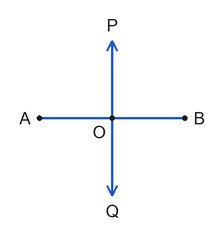
Statement 1 says AB is the perpendicular bisector of PQ. For that, O would have to be the mid-point of PQ, with OP and OQ equal. We are told only that OA = OB, which makes O the mid-point of AB, not of PQ; in the figure PQ is even drawn as a line, with arrows. Statement 1 is false.
Step 3 — Judge Statement 2.
Statement 2 says: OA = OB, so PQ bisects AB; ∠AOP = 90°, so PQ is perpendicular to AB; hence PQ is the perpendicular bisector of AB. Each step uses the definition correctly. Statement 2 is true.
Watch out: OA = OB tells us about the mid-point of AB only; it says nothing about the lengths OP and OQ.
Note: A key giving Statement 1 true and Statement 2 false cannot be right: Statement 2 applies the definition of the perpendicular bisector exactly, while Statement 1 would need OP = OQ, which is not given.
Why the other options are wrong:
- (A): this calls Statement 1 true, but nothing tells us that O is the mid-point of PQ.
- (B): this calls Statement 2 false, but Statement 2 follows the definition step by step.
- (C): this calls Statement 1 true and Statement 2 false, which is the wrong way round.
Therefore, Statement 1 is false and Statement 2 is true, option (D).